Showing posts with label show business. Show all posts

Sunday, May 24, 2020

Showgirls: A Non-Perverted Re-Examination

Showgirls was a bomb in theatrical release. When it was
released on home video it made a $100 million profit. I
suppose the audience was more, um, "comfortable"
watching it the the privacy of their own homes.
It may be some form of social-distancing madness setting in, but when Showgirls (1995) appeared on cable last night in lurid HD I watched it all the way through. I realized it was only the second time I have watched this film (excepting the bits and pieces I would run across while channel-surfing). Showgirls was first released when I was in Los Angeles, if I recall at a decent venue, like the Chinese Theater: I was unable to persuade anybody to go see it with me.

Anyway, as this loud, garish anti-bildungsroman played out, I realized I may have a few things to say about it. I’m not actually recommending you to see Showgirls (I did that for you) but if you run across it and decide to take the challenge, I’m offering tools for a fresh re-evaluation.

This re-evaluation starts with an overview of Paul Verhoeven, a very successful director in the 1980s and 1990s, possessed of a very unusual auteur vision. The concepts and values he explores are so strange and unique they energize his films to this day. His major themes:

• 

Commodification - Paul Verhoeven’s films often explore the idea that human relationships are purely transactional, and human life can be converted into various forms of marketable property. RoboCop (1987) is about a person who is transformed into the property of Omni Consumer Products. Total Recall (1990) is about a company that creates pre-packaged memories— the core of human experience— and offer them up for a price, with optional add-ons.


• Corruption - Good government and sound corporate management are not things that exist in Verhoeven films. His films are populated with cutthroat and immoral executives, weak mayors, sociopathic governors and degenerate police detectives. America is shown as a country in deep moral decline. Democratic norms have been replaced by corporate rule and transactional graft.

The only time he shows a functioning governmental organization is in Starship Troopers (1997), which depicts the Mobile Infantry as a force capable of sound leadership, correcting it’s mistakes and achieving victory— however, this depiction is clearly marked as completely unreliable.

• Sexual Fear - I don’t know what happened to Paul Verhoeven when he was a kid (maybe it was some trauma from his childhood in occupied Holland living near a German V-2 rocket base) but something messed him up a little. Sexuality—especially female sexuality— is often depicted as destructive and menacing (Basic Instinct, Fourth Man) or, in the case of Showgirls, omnipotent. Attraction is always balanced with fear and, as mentioned above, weighed as a transaction.

On to Showgirls, which channels every aspect of Verhoeven’s auteur vision in an open, lurid, unsubtle way.

Nomi as we first meet her.
• A Brief Synopsis:  Nomi Malone (Elizabeth Berkeley), a beautiful young woman with a mysterious past, hitchhikes into Las Vegas. She manages to get a roommate and a job at Cheetahs, a nude club, where she gets the attention of a casino entertainment manager (Kyle MacLachlan) and the star of the casino’s topless show (Gina Gershon). They pull strings to get her a place in the show’s chorus, which begins a story of intense backstage rivalry as Nomi begins her ascent to star status.

And yes, Showgirls is NC-17 and all about titillation, filled end-to-end with nudity and sex acts. But take my word for it: after about 15 minutes or so, the visual spectacle becomes numbing. Women show up nude because that’s their job, nothing more.

Verhoeven protagonists are often new-born characters— ones that really didn’t exist before the start of the film. Nomi Malone enters the film from places unknown, with an unknown past, under an assumed name (“No Me, Alone”), no money, possessions stolen. RoboCop was a synthetic creation that in Act I only existed as an OCP boardroom proposal. Douglas Quade, the nice guy played by Arnold Schwarzenegger in Total Recall, may be an artificial personality implant. Verhoeven is not afraid to question the bedrock reality of his protagonists— and it’s always a neat way to kick off a movie.

• Las Vegas World - Showgirls is mostly about Las Vegas and what a deeply insane place it is. Founded as a city where any and all vices are accommodated, it is in Verhoeven’s vision the  capital of America, the final embodiment of the values of a corrupted, amoral country.

The system of Las Vegas— money is all-important, ends always justify means— is contrasted against, of all things, culture. Dance, theater, and music are all represented in Showgirls in one form or another— all crushed flat under the weight of the Vegas version of show business. Dance is stripping. Theater is a hugely overproduced topless show. Music is represented by a pop star who is nothing less than a sadistic rapist.

And Nomi fits right in: she is the trash princess of a trash city. She has no values outside of purely transactional ones. The value-free system that rules Vegas rewards her, over and over. Nomi Malone is a rags-to-riches success story, a Horatio Alger story with G-strings.

• Nomi the Verhoeven Protagonist - Nomi Malone is extremely unlikeable. She shares this unlikely protagonist quality with Michael Douglas in Basic Instinct (1992) and Kevin Bacon in Hollow Man (2000).

Nomi is selfish, vain, deeply ignorant (“I love Ver-sayse”) and has a hair-trigger temper. About half the one-on-one scenes Nomi has in the film end with an angry physical outburst. Part of the fun of Showgirls is how it reproduces the queasy feeling of being around someone with mental issues: you don’t know moment to moment what will trigger them, which keeps you on your toes.

Reviewer Mick LaSalle described Showgirls as a film that,
like most of the characters, puts on lipstick well past
the natural borders of the lips.
• The Narrative Synthesis. Here’s the part that makes this a truly weird, very telling Verhoeven film: Every other character loves Nomi Malone. Her roommate adores her, James the dancer is in love with her, and she manages to charm the entire staff of the Stardust Hotel and Casino. The star of the topless casino review she is in and the casino’s entertainment director compete for her affections.

This is the insane, coked-up, glitter-coated heart of Showgirls: one messy scene after another, all mismatched emotions and screaming and throwing things and storming out of rooms. The other characters watch her go, eyes wide in love and lust, eternally forgiving.

This isn’t some example of bad writing—though overall, it's not very good. Joe Eszterhas got $2 million for the script, and it ended his superstar career. It is not poor direction either. Paul Verhoeven is… hanging a lantern on it. For all his quirks he is a very capable director, and he would not have crafted such jarring interactions without a purpose. He WANTS you to notice how weird and off-putting it is to have every character in Showgirls sucking up to a horrible, vindictive person like Nomi Malone, who would just as soon spit in your face than thank you for a lovely dinner.* Why?


Why do people put up with Nomi’s shit? Because Nomi is America. She is the embodiment of Late Capitalist American values. Everyone else is simply trying to appeal to her to get ahead, much as Americans have to buy into the system, deal with corrupt corporations and no unions and no health coverage, to get ahead. We are all prepared to be screamed at, spat on, be thrown down the stairs.

Nomi succeeds because in Las Vegas sexuality is a commodity. She proves to everyone she is the most skilled at leveraging her sexuality to ascend the ladder of success. Everyone is constantly trying to figure out how to attach themselves to her success so they can succeed as well. It may look like love or lust but it's pure, heartless transaction.

Nail polish is another major thematic detail; it serves
as a metaphorical battleground between Nomi and
Cristal (Gina Gershon). Weird but effective.
One of the most telling details I noticed in this screening is one that only a director could add: Nomi’s eating habits. Burgers and fries, burgers and fries, burgers and fries. When confronted with a menu at a respectable restaurant (respectable for Vegas: it’s still laminated) she confesses “I don’t know what all this is,” and admits to, in the past, have been content eating dog food. This is a huge character tell. Nomi is Verhoeven’s perfect American: uncultured, selfish, amoral and ignorant— but also self-possessed, confident, and recklessly aggressive.

That’s the realization. Showgirls wasn’t just 131 minutes of tits and screaming in a hideous neon Las Vegas hell-scape: There’s a message in the middle of it, a sharp indictment, and in recent years it has only become more apparent it was a prescient message. In the 25 years since the premiere of Showgirls all the emotionally unstable trash people, the ones that swim in the muck of vice as if it was the River Jordan, moved out of the trash capitals and into our real one.

*There was as similar complaint voiced about the dramaturgy of Starship Troopers, that it was filled with incompetent, flat acting and childish relationship dynamics. It was called “Archie, Betty and Veronica in Outer Space.” Again, this style was chosen very much on purpose. We are supposed to notice how silly and clichéd the narrative elements were, because it’s a propaganda film from the future. The movie we’re seeing is not a movie: it’s a government-engineered work of fiction, designed to increase enlistments and validate a fascist military government. None of it was supposed to be “real.”

Tuesday, April 21, 2020

Nobody Knows Anything, For Real This Time

William Goldman’s famous Hollywood aphorism “Nobody Knows Anything” has never applied with as much profound depth it does now.

Hollywood as a collective definition is composed of several large interlocking systems, all designed to create, produce and distribute entertainment content. Most are being crushed by the coronavirus lockdown. Going through the process beginning to end:


• Pre-production is still going strong. TV writer’s rooms are staffed via video conference, and scripts are still being optioned. Projects are still being greenlit, and everyone is positioning for the days that will follow COVID-19.


• Productions are dark. Thousands of film and TV show production companies are shut down, crews on furlough, sound stages empty, equipment unrented. Film and TV Production are collective endeavors, ones that require a lot of close contact (for example: during shooting, an average cinema camera rig has three sets of hands on it) so it won’t be safe for a long time. News and some forms of reality TV have the edge here: “American Idol” is experimenting with a remote contestant format, which is better than nothing.


• Live theater is utterly dark. Hamilton is playing at precisely zero venues worldwide.


• Streaming services and cable are doing incredible business right now. Industry leaders are worried about the medium-term health of this sector: If the astounding level of unemployment continues, subscriptions to streaming services and full-service cable will start to dwindle as people find them increasingly unaffordable.

• The big hit to Hollywood: Film Exhibition. Movie theaters are closed, and the prospects of movie-going returning to prior levels any time soon is increasingly uncertain. In fact the very survival of movie theaters is in doubt: AMC may be looking at bankruptcy protection (something they do once a decade or so, but still).

Movie-going has been derided constantly in the age of streaming as a dinosaur, a relic of the pre-television industry. This is what most of this post is going to concentrate on, because I do not think people really grasp how absolutely vital the movie theater ecosystem is, and how losing them will profoundly affect almost every other aspect of the entertainment industry.

Studios operate on a “tentpole” model: big, well-publicized films released to thousands of theaters worldwide and provide revenue through box office sales for other productions. To turn a profit for these films, which are generally budgeted over $100 million, huge theater capacity is required, hundreds of thousands of butts in seats. Marvel, the newest large studio, operated on the tentpole model 100%. Others operate downmarket, packaging independent films made on modest budgets.

But all this machinery has stopped.

I’m offering two prognostications for the future of the motion picture exhibition industry, both on the extremes.


FULL RECOVERY SCENARIO


A seating diagram programmed to create a safe space around each sold seat.
A mix of singles, 2s, 3s and 4s shown. Nobody is placed in the middle of a row
so they do not have to pass close to anybody else. Capacity is reduced 75% to 80%.

When the states start slowly opening up theaters again, social distancing guidelines can be put into effect to assure patrons who are going to be VERY VERY NERVOUS about going into a darkened windowless room full of strangers.

The way I came up with (which no doubt the theater chains are implementing) is centered around the fact that most theaters are based on reserved-seat ticket sales. When a block of seats is purchased, the seats around them are condemned for the screening to maintain a 6-foot defensive space. If strict contact rules are allowed— two parties per row to eliminate close passing for the aisle, which is always ass-to-face— theaters can be filled about 25% of capacity. This does not allow for full sellouts, but it is at least equal to a modest weekday crowd.


During these first few weeks or months people will likely be treated to low-budget fare. Independent films, genre comedies, horror films: films with modest budget and the possibility of getting a return even in lower-capacity venues. Studios can and will reserve their large-budget tentpole films until they can get enough screening capacity to make releasing them a worthwhile risk. (a lot of big-budget films are frozen in post-production as well: visual effects houses are not operating, and a film the scope of something like Avengers: Endgame can’t be finished off on somebody’s iMac at home.)

Once the curve is safely flattened theaters can go back to full capacity, though it remains to be seen if people will feel confident enough to pack themselves into sellouts for quite a while. Some late-summer big-budget releases— the sequel to Wonder Woman being an example— are sticking to their release dates, betting the huge audiences are just waiting for the all-clear.


Bravely sticking to a mid-August
release date. Notice it's already
been moved down from June.
COLLAPSE SCENARIO

Major chains, empty but still paying huge rents for their their multiplexes, go out of business. Theaters that survive see persistent poor box-office as people, still spooked by COVID-19, stay away.


Without a way to recoup investment for big-budget films, the studios release them streaming at a loss. Streaming and on-demand represent a revenue source, but compared to theatrical release box office it’s tiny, ancillary, in the old days a way to slightly round up the numbers.

If the financial downturn continues and people cancel subscriptions, even this outlet will become even more problematic. Without a path to profit studios will eventually stop green-lighting big-budget films entirely. For movie geeks who hate comic-book movies this sounds heavenly, but remember that big films finance small films. The Lord of the Rings trilogy financed a decade’s worth of modest-budget New Line films.


Without theaters, the theatrical distribution system will collapse. This will create chaos: non-chain theaters that managed to stay open will have nothing to screen. Drive-in theaters, the only healthy subsection of the exhibition industry, will collapse as well when they run out of films to screen.


This bleak scenario ends on your TV: Streaming, on-demand and TV will be the only outlet for scripted entertainment. The big franchises will likely be broken up into series and miniseries. Cable and premium, already increasingly turning to series to attract viewers, will start to shrink: many of the add-on premium channels show endless theatrical films, and with that source of content gone add-ons like Starz Action and Showtime Comedy will start vanishing.


The other problem is the eternal conflict: Hollywood versus The Internet. If the theater industry collapses, the Internet wins— and never forget the old hacker battle cry: “The Internet wants to be free.” People naturally EXPECT films to be cheap or even free when they’re on TV. Additionally, any film put out on streaming is available for torrent download within hours. In my job as a post-production profession I’ve always advised indie filmmakers to only put your films on streaming platforms when all other revenue streams— festivals, optical media— have been exhausted. Once it’s online, you’re done making money off it.

 But with all the eggs in the TV screen basket we’re back to the ability of people to pay for these services. If hard times persist, many of them will end up cancelling, which will drive revenue even lower.

Well, those are the extremes. I think the reality will be somewhere in-between: some chains will close, some big-budget films will be canceled, and it’s going to be tough to make a living in Hollywood for a while.

But really: nobody knows anything.

Thursday, January 30, 2020

2019 Best Picture Nominees: Place Your Bets

For the first time in a long time, I actually saw all nine of the Best Picture nominees this year. Here’s what I found notable about them, and a stab at prognostication

FORD V FERRARI
– It’s been called a “Dad Movie” and it is: A Boomer story about the one thing Boomers really care about: cars. In this film you can see the humble origins of all the obnoxious high-performance supercars currently being driven around by midlife-crisis millionaires and decadent oil-money royal nephews: Ferrari, Shelby, McLaren, etc. Feels like a fill-in nominee, but Christian Bale has a slim chance to score a win.

THE IRISHMAN – A Netflix offering from Martin Scorsese. I’d argue that, like JOKER, it's an imitation of a Scorsese core cinematic offering, despite the fact he directed it. Really more of a Robert De Niro film: he was instrumental in packaging the deal and bugging Joe Pesci 20+ times until he came out of retirement to participate. It’s overly long, which has a lot to do with the production oversight methods of Netflix (more below) then actually having three hours of story to tell. Look at a few acting nods, but not a Best.

JOJO RABBIT – This is the one film that I consistently forget is in the running. Not that it’s forgettable: it’s such a singular, unique film that it doesn’t fit into the mental framework of Oscar movies. It’s a comedy / drama about 10-year-old Hitler Youth member during the last months of World War II. His imaginary friend is Adolph Hitler, and his core beliefs are challenged when he discovers a Jewish girl hiding in the attic of his house. So it’s a strange setting for a comedy, but a very worthy film-- one that I’m afraid will get passed over because stories like this make some people queasy.

JOKER – Perhaps the first superhero movie (or rather a supervillain movie) from either major imprint to get a Best Picture nod. It may well take the big prize: JOKER has a polished look with solid art direction. It’s also a nihilistic story that is centered on explaining away the creation of a murderer as a product of hard times. It does not quite justify him, though, which is where Joaquin Phoenix’s remarkable performance comes in, pushing against the amoral narrative. It may well take the big prize.

LITTLE WOMEN – This is a fine film, filled with great performances and meticulous art direction (it will get Best Costume because, as we all know by now, Best Costume always goes to the movie where actors wear clothes that look like costumes). The story was given the Tarantino script-blender treatment, transformed from a time-linear narrative to a flashback / flash forward style that breathes a considerable amount of surprise and energy into the familiar tale. Great Gerwig did not get a Best Director nod, which usually means it won’t take the big prize.

ONCE UPON A TIME… IN HOLLYWOOD – QT really mended some fences with me with this film, which luxuriated in the sunny universe of Hollywood in 1969. It will appeal to Academy voters ‘cos it is a very flattering look at their own industry, giving it the standard glossy take as a creative, glamorous place where dreams come true. However the gory, historically inaccurate, needless ending will sink this film.

MARRIAGE STORY – Another Netflix joint. The performances by Scarlett Johansen and Adam Driver are electric, riveting and devastating. I get the feeling one or both will be rewarded. The film itself was… fairly good? It felt like a TV movie, and it suffered from the same problem most Netflix features have: it’s sloppy, underbaked, feeling a lot more like a first edit than a final cut. This has a lot to do with how these films are financed: Netflix is not trying to sell movie tickets. These films are made to generate buzz for a streaming service, which is trying to increase subscriptions. Absent the need to compete one-on-one, Netflix does not insist on one more script polish, one more effects pass, one more edit. Look at the downstream offerings on Netflix and you can really see this oversight philosophy in action.

PARASITE – This is, hands down, the best film of 2019. Enormous creative energy in the direction, photography and design, the acting is superb, and the story is both timely and utterly unique. It tells the story of a poor family which figures out a way of gaining the employment of a rich family through deception and clever thinking. Unfortunately it a Korean film in Korean: there are a certain percentage of film viewers who simply do not like reading subtitles. I HOPE it gets best picture, so I’ll just make it my personal pick.

1917 – a visually and technically superior gimmick film that is staged as one long continuous take. It tells the story of two young soldiers on a perilous mission to deliver a message behind enemy lines. The problem with gimmick movies is the gimmick overwhelms everything else, like story or acting performances. So even though it is a visual spectacle, 1917 is an emotionally static affair. I spent most of my time looking for the parts where they hid the cuts— when a tree is in the foreground or when the scene enters darkness. This film already took some significant pre-Oscar industry awards, and Hollywood may well reward it: they do love their bright, shiny objects.

In a few weeks, we’ll see how I did!

Saturday, January 25, 2020

Harley Motherf***ing Quinn

[Warning: adult language and situations. No spoilers, though.]

Harley Quinn, voice supplied by "The Big Bang Theory's"
Kaley Cuoco. So less of the insane Brooklynite attitude from
previous iterations, more of a scary SoCal girl.
I don’t review TV shows that often, animation almost never, and I’m not a comic book fanboy. But I chanced upon a review on io9 that was so intriguing I had to check it out— and I was not disappointed.

“Harley Quinn” is a comedic adult animated web-based show now streaming on DC Universe, behind an $8-a-month paywall. It tells the story of Harley Quinn, the Joker’s lover and sidekick, as she dumps him and tries to invent herself as an independent person and supervillain in her own right. She does this with the help of her best friend / roommate Poison Ivy (Lake Bell, a wonderfully dry voice performance), and her crew of minor villains who I would know if I actually read comic books.

Harley and Poison Ivy, roommates. These two characters
may be the most 'shipped couple on the internet. So far
they are depicted a just close friends, but the season
is not over yet.
The dynamic between Harley Quinn and Joker has been well-documented, and they’re even going to make it big deal out of it in the Margot Robbie-starring live-action film coming out next month. Her character has been described as suffering from dependent personality disorder: in her former life she became so obsessed with Joker while treating him in Arkham Asylum she abandoned everything to become his often-abused sidekick. As a super villain origin stories go it may be the most mundane one ever: Harley was a victim of abusive, manipulating partner, a trauma untold thousands of people are suffering every day in the real world. It has given her character a special resonance with fans: even though Harley is a supervillain, her personal emotional issues have a human scale and her efforts to break free of her abusive partner make her even more relatable. The show does not shy away from this unhealthy dynamic, and in fact it casts most of her personal growth as an anodyne to Joker, her romantic obsession transformed into professional competition. Harley a fun character, given considerable depth: she is "a bad guy, but not a bad person," and her story arc probably has her headed to antihero status.

The creators of “Harley Quinn” made a strange but ultimately transformative decision: As it is not a broadcast show there are no real restrictions to language and content, so they decided to make a show for adults. It's a bit of a shock. To give a feel for the dialog:


Harley (to Joker, in a subconscious confrontation): “You think you created me, but no one did. My fucked-up parents didn’t create me. Neither did Jessica Sarner when she lied to the whole fucking camp and said I lost my virginity to a horse! A HORSE!” (applies baseball bat to Joker’s crotch: he doubles over) “Neither did those cops who questioned me for hours about what happened to Jessica Sarner! And YOU sure as hell didn’t fucking create me, Puddin’!”

And the sexual innuendo is of the single-entendre variety:


Bane (to Joker on phone): “Harley is at Penguin’s nephew’s Bar Mitzvah.”
Joker: “She crashed the stupid thing?”

Bane: “Yeah. Seems like she’s doing pretty well. Brought a tiger. Pretty cool!”
Joker: “What? Anyone can buy a tiger. You know she has HPV, right?”
Bane: “Most sexually active adults do.”
Joker: “Shut up!”


Dr. Psycho, after the second time he called someone a c**t.
Yeah, the filter is off and this makes it for fairly exhilarating viewing. There are some limits: no female nudity (yet*), but lots of pixelated male crotches. The show even has a line, and one character crosses it: Dr. Psycho, one of Wonder Woman’s nemeses, is blackballed out of the Legion of Doom for calling her, in the heat of battle, a c**t. (it’s the only profane utterance bleeped on the entire show.)

I know adult-oriented animated series are not exactly a new phenomenon: “South Park” is 20+ years old, seriously raunchy, and the movie was legendary in that regard. Every episode of the immensely popular Adult Swim series “Rick and Morty” is filled end-to-end with bleeps and blurred-out genitalia.

What makes “Harley Quinn” exceedingly unusual is the fact it is camped dead center in the DC Universe. It is not a sidecar, like the way Deadpool— the foul-mouthed, violent antihero from Marvel— is a sidecar, peripheral to the X-Men universe (several X-Men make an appearance in the sequel) and completely walled off from the big-money Avengers universe. Deadpool will never crack dick jokes with Captain America. (Professor X, maybe.)

In her show Harley regularly interacts with the big hitters, Batman and Superman and the like. The iconic superheroes they spend hundreds of millions of dollars to make movies about. And by “interact,” I mean when Harley meets The Batman in the first episode, she adamantly insists he is called that because he fucks bats.

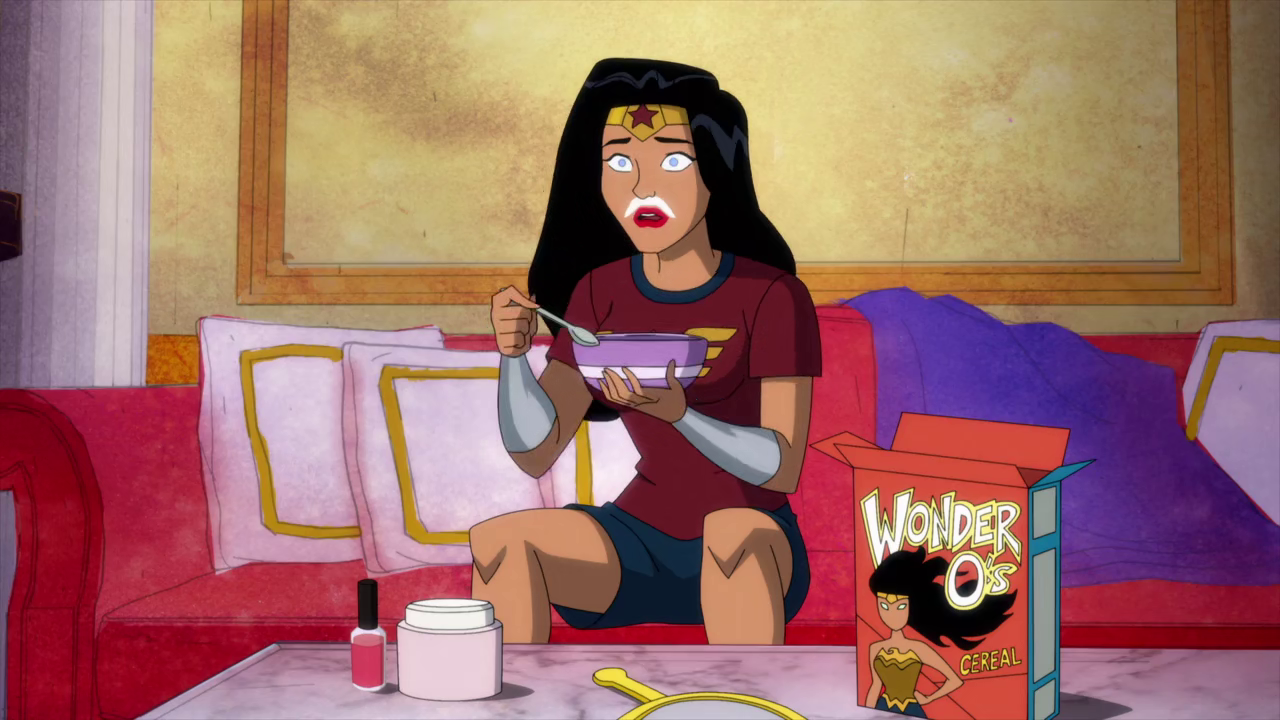
Wonder Woman, eating her own brand of breakfast cereal,
realizing all the ground rules have changed.
This juxtaposition turns an amusing series into a surreal one. What we have is a series which has IP-critical superhero guest cameos— and they basically stand in inhibited silence while a collection of supervillains dance around them, calling them out with ripe curses and sexual innuendo. The decision by DC and Warner Bros. to execute this vision is mystifying.

The other exhilaration that comes from ”Harley Quinn” is how this adult theme remakes every character anew. All the profanity and frank sex talk draws attention to the eroticism that rushes like a deep undercurrent under all superhero stories.The supervillans and superheroes depicted in the blockbuster movies are (mostly) extensions of their juvenile, sexless origins as juvenile, sexless comic-book characters, still hewing to a long-gone 70-year-old Comics Code. Not on “Harley Quinn:” on that show, everyone depicted are People Who Fuck.

People Who Fuck are all around us: it is the normal state of the human race. The great majority of DC and Marvel movies and TV shows still depict their intellectual property as non-existent from the waist down, like Muppets. This is my biggest peeve with the MCU: missing the normalizing dimension as People Who Fuck, for all the significant kisses and long, lingering gazes they’re all just cardboard simulations of real people.

This is the liberating synthesis of “Harley Quinn,” the result of the thesis of comic book characters mixed with the antithesis of real-world People who Fuck. Even though they are set in an unbelievable, unrealistic universe of magic and superpowers, the characters depicted within seem more real than any version of them that came before.

*One of the most confounding things about Adult or R-rated entertainment of late: no problem with profanity and verbally describing sexual situations-- but nudity is increasingly rare. I think, in the case of this show, the influence of the internet is the major deciding factor. If the showrunners ever decided to show Harley Quinn running around with her tits out, every fanboy image server on earth would promptly explode. So that will never happen.

Monday, December 23, 2019

The Rise of Skywalker: The Fall of In Media Res

The Rise of Skywalker is a perfectly fine entry into the canon. It’s tightly scripted and beautifully rendered, full of consequential situations and lots of action. It tells the story of the ragtag Resistance movement— still very reduced in size since the end of The Last Jedi— trying to find a hidden area of the galaxy where the “Final Order”— the successor to the First Order— is amassing a new fleet, lead by none other than Emperor Palpatine himself, back from the dead. It’s a complex goal, and it sets our heroes Finn, Poe and Rey on a literally non-stop quest. Meanwhile, Kylo Ren (Adam Driver, just an amazing actor) is on a singular collision course with Rey, who he wants to come over to the Dark Side. The film is full of neat cameos, some genuine surprises— and if you have been onboard with this franchise you’ll get a little weepy at the end. A fitting end to a truly spectacular franchise.

In broad strokes, Daniel is correct: The Rise of Skywalker is basically The Return of the Jedi after the application of Daniel's Remake Formula. The major story beats are pretty much the same. But without George Lucas mucking the thing up with Ewok kiddie pandering and a static mentor-father-son conflict at the center, it has been improved quite a bit.

Satisfying endings aside, one dissonant element shines through The Rise of Skywalker: the undeniable feeling of compromise, that the owners of this intellectual property are running scared. They’re scared of their own fans. They went out of their way to placate the vocal critics of the last entry, the controversial The Last Jedi, manifested as annoying notes throughout the new film. Rose, Finn’s plucky teammate, is completely sidelined. Kylo’s helmet, smashed to pieces in the previous film (and for good reason) is fixed as good as new. And there is one, huge, ridiculous erasure so egregious it made me say, “What?” out loud in a darkened theater.

The Mandolorian and "The Child." This show was also
influenced by the manga and film series "Lone Wolf and Cub"
Disney’s timid, full fan service approach to the IP is also evident in “The Mandalorian,” currently streaming on Disney+. In the details, the show is as rich as any canon entry, full of robots and aliens and great visual effects. But the story it tells is not nearly as rich. The premise is simple and episodic: The title character enters a situation, gets into a bit of a scrape, then gets out, ready for the next situation. It’s very 1970s-TV-like: It reminded me of the Bixby/Ferrigno “The Incredible Hulk” or (as John pointed out) “Kung Fu.” I’m not caught up and I’ve already seen story lifts from Shane, Seven Samurai and The Unforgiven. “Baby Yoda” is drawing all the attention now as only a beloved character redesigned as a tiny, high-eye-to-face-ratio character can, but it’s now depressingly clear this show is going out of its way not to stray from rote recitations from canon.

Werner Herzog as "The Client," making his own German
Chocolate Existential Ripple ice cream.
This need for fan service is why the most hilarious goof that ever appeared in any Star Wars film had to be ruined. Near the end of The Empire Strikes Back, when Lando Calrissian announces the evacuation of Bespin, we see in a crowd panic scene a guy carrying a plastic ice cream maker. It’s a bucket with a bar on the top to carry the inner container. They were common: I ate a lot of ice cream that came out of those things in the 1970s. It was very obviously thrown in so an extra could have something to do with his hands.

In episode 3 of “The Mandalorian” we see the title character get rewarded for a successful bounty job with stacks of special steel carried in a round bucket with a base on top. It even has a name: a "camtono." In this universe an ice cream maker is actually a safe, apparently. Goof erased.

What happened? As much as I’d like to blame Disney, I think 42 years of fandom has loved this franchise to death.

This isn't the beginning of a movie: it's the middle
of a complex sequence.

Consider the first film-- from a 1977 viewpoint. For kids and grownups who liked genre sci-fi films, Star Wars was an utter shock. The film BEGAN in the middle of a great space battle, and we were quickly introduced to a cast of androids and robots and a masked villain and a princess. As the story unfolded George Lucas refused to explain a single thing. Laser swords? Superluminal travel? A giant monkey dog thing? Nope, we were left as clueless as if we were randomly dropped into an exotic foreign city without a guidebook. The only explanations we were given about anything were plot points, usually one-on-one efforts to convince people to do things: to get Luke to leave his home, Leia to give up the rebel base, to get Han to rescue Leia, etc. But the super-weird stuff? Just a given. Pre-“Episode IV” Star Wars was perfect expression of in media res ("in the middle of things"): An entire self-contained universe we got to run around in for 135 minutes, which was a big part of the thrill. It hooked a lot of people, me included.

Ten years prior “Star Trek” had done something similar in science fiction, but that universe was our universe, just in the future. But know one thing about the humans in the Star Wars universe: they look like us, are similar to us in most ways… but they aren’t us at all. The opening title card “A long time ago in a galaxy far, far away…” has never been explained.

Star Wars was a huge success, and it spawned a dedicated fanbase: a sequel HAD to be made, even though the first episode had a tight ending and only one open end (Darth Vader survived). This sequel— The Empire Strikes Back (1980) was remarkably good. Written by Lawrence Kasdan and Leigh Brackett, It matured the space-opera story of the first movie, introduced romance and mysticism and had a plot with genuine consequences. It also had the best final reveal in any popular film, maybe ever. It was a triumph, not only because it was not the “Star Wars Goes Hawaiian” sequel everyone expected, but it rewarded every fan, deepening their relationship to the franchise AND raising their expectations.

Like I said, Empire was good. Maybe too good: It raised fan expectations so high the franchise had nowhere go but down. This may well have been the place where fandom began to fray, leading to the awful state it is in today.

The ecstasy of fandom is how it creates personal meaning and forges communities. But the tragedy of fandom is this emotional satisfaction comes with a relentless need to identify, classify and explain. Humans are pattern-seeking, storytelling creatures: it's our nature. To draw deeper meaning from a hermetic work like the original Star Wars, we needed all those mysterious little details explained so we could feel more at home there.

When the second set of trilogies came around, George Lucas adamantly refused to bow to fan service. His ideas concerning his own creation had changed and matured between 1983 and 1999, and he had whole host of things to say, some of them quite bizarre. He wanted to explain things, but he did it with complex political discourses and the added existence of a symbiotic organism which “gave” people The Force. He also added more of the feeble kiddie pandering he hinted at in Return of the Jedi, but to his credit he corrected it by Episode II. Lucas clearly didn’t quite understand what the franchise’s fanbase had evolved into-- and, delightfully, he really didn’t have to care.

The throne room from The Rise of Skywalker
But he eventually sold off his franchise, and the new owners— Disney— were aimed like a laser beam at giving fans what they want. The overarching theme of the entire third trilogy of Star Wars films is how their new IP has been guided by the expectations of the fan base. Every fan has a strong opinion about what Star Wars is and should be: some foolish, some nuanced. They started out strong with The Force Awakens and successfully deepened their commitment to original storytelling with Rogue One: a Star Wars Story.

But The Last Jedi was the tearing point. Rian Johnson’s film got a lot done in its exceeding length: it deconstructed George Lucas’s galaxy as a place of irredeemable corruption, where noble causes were not worth much more than the sinister ones. It pulled away from the Holy Skywalker family, establishing that Rey was a Jedi from nowhere, just as Annikin Skywalker came from nowhere. As for Luke Skywalker himself, he was disgusted with the Jedi and saw it as a pointless cult that needed to die.

There were a lot of Star Wars fans who were okay with this redefinition, mostly because it represented a fresh viewpoint, a way to appreciate this universe with added complexity and nuance.

Rian Johnson directing Daisy Ridley on the Throne Room
set in The Last Jedi. Rian's use of red in this film was
incredible. Apparently the curtains on this set were made
from real red velvet.
But there were an equal number of Star Wars fans who HATED what Rian Johnson was doing, and wanted it stopped. For them, they needed the comfort of a black-and-white universe. They needed the saga to be about powerful families: the galaxy far, far away was to be administered by the Kennedys and the Windsors and the Rockefellers. They spoke loud and long, loud enough to spook the IP’s new masters at Disney. Revealing new things is anathema: they wanted stories that explained things. In media res, the style that animated the first film, was extinct by the last one.

When it came time to make Episode IX, guess who Disney listened to?

Still, I am putting in a very strong recommendation to go see The Rise of Skywalker. It is still an immensely entertaining film, especially If you have been a fan of the series. You will leave very satisfied— even if part of you will always wonder what might have been if we hadn’t screwed it up.

In a strange, roundabout way the evolution of Star Wars fandom from awestruck enthusiasm to toxic, second-guessing complaining is a tonic: it makes it easier to say goodbye to the franchise.

Saturday, June 3, 2017

Wonder Woman: Fury Road

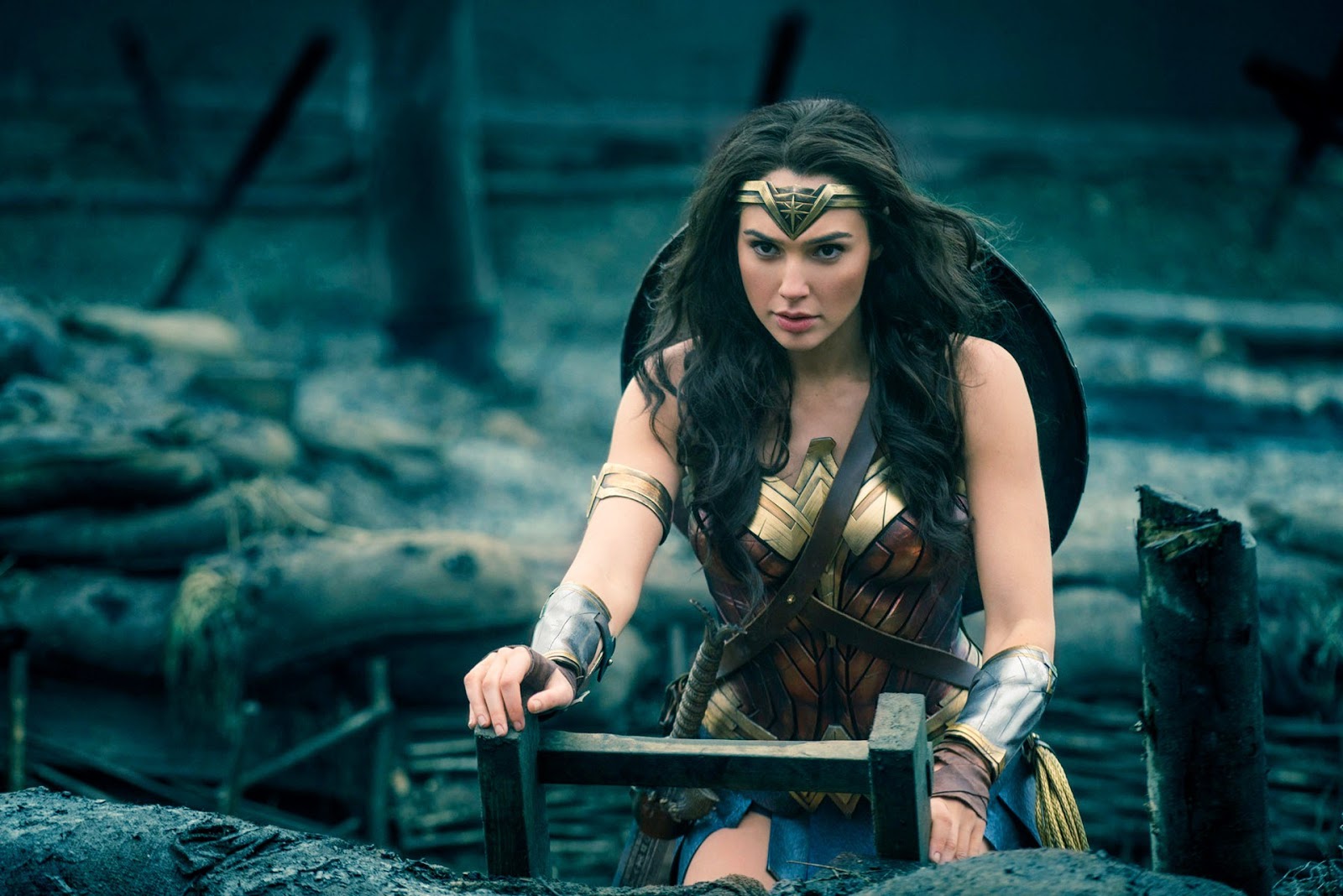
Diana, Princess of Themyscera, getting ready to stab some guy.
The thesis of DC’s Cinematic Universe (and the Marvel Universe, as well) is it’s grinding, dark authoritarian streak. Superman wrestles with his god-like powers: he can do anything, even rule the earth, but he chooses to spend a lot of his time brooding over the loss of his planet and his inherent outsider status. Batman is the nearly omnipotent paladin alter ego of a billionaire who uses his immense wealth to endlessly right the wrong done to his parents and holds himself as a force above the law. They are damaged, self-regarding, nearly schizophrenic men, fighting through childhood trauma, allowing their losses to define everything about them.

What if we had a superhero who has none of these issues? What if she was here because she chose to be here and is here to do good— not to psychologically play out some personal loss, but because it was simply the right thing to do?

Now we have the antithesis to the Dark Knight and the Man of Steel. Finally, after a nine-year development cycle and a dizzying number of deals, we have Wonder Woman, directed by Patty (2003's Monster) Jenkins. The title character is played by Israeli actor Gal Gadot, absolutely majestic in the role of Diana, Princess of Themyscera. (nobody in the film calls her “Wonder Woman.”) Jenkins has rendered a marvelous superhero tale, a breezy, often thoughtful film that is centered on a fascinating hero both capable and naïve, loving and fierce, a warrior for peace. It is not a perfect film— but as an entry into the superhero genre it is way above average.  Go see!

Diana going "over the top" into No Man's Land. This sequence is
incredibly great, indescribably thrilling and unexpected, worth the
price of admission, even.
The basic story: Diana is a princess of a mystical island, made invisible by the intervention of the god Zeus, inhabited by immortal Amazon warriors. Into this idyllic world flies Steve Trevor (Chris Pine) a WWI allied spy on a mission to stop the Germans, lead by General Eric Ludendorff (A real historical figure!) from developing a new and extremely deadly form of mustard gas. When Steve describes the war (via the magic lasso of truth) Diana is so outraged that she sets out with him to end the conflict, which she believes could only be the work of Ares, the God of War, who is influencing men to fight. On the way they visit London and wide-eyed and innocent Diana learns the ways of early 20th century western society. Undeterred, with the help of Trevor and the blessing of a rogue British War Secretary (David Thewlis) they assemble a small cadre of (what can only be described as) helpers and Diane sets off to end the First World War…

A few notes:

• The film’s setting— Europe in 1918, the final months of The Great War— was a marvelous decision on several levels. There is a genuine surprise in the opening act— set on a timeless island magically protected from the outside world— when the lovely azure sky is literally pierced by a German Fokker monoplane. The film then fixes on World War I, the description of that war’s terrible scale and carnage motivates Diana to leave her idyllic home and end the conflict. The setting of the war— the muddy trenches, the damaged Belgian villages, smoky, bustling London— are rendered with incredible detail.

The decision set the film in 1918 follows a smart precedent: Captain America: the First Avenger (2011). That film was set mostly in the Second World War, which—while accurate to comic-book origin— was an unusual choice, not entirely necessary. Same goes with Wonder Woman, the WWI setting of which was an even more of a whole-cloth invention, as the comic book was first published in 1941. Both of these movies could have started in media res, set in our contemporary time, like the majority of comic-book movies are (Spider-Man started in 1962: in the movies he never saved John Kennedy, not even once) but instead chose to introduce our heroes in historical contexts.

Why? Because it effectively de-contextualizes the conflicts that informed their origins. We get to see heroes fight the Hun and Nazis, and the wrecked and ambiguous current state of geo-politics has nothing to do with it. There are no satellite phones or pocket nukes or stealth anything. The battles were more intimate and close those days, and they required guts and battlefield valor, not pinpoint drone missile targeting. It makes our heroes seem all that more pure.

Furiousa takes charge, defending the war rig from the forces of the malignant
patriarch Immortan Joe. Max Rocketanski (Tom Hardy) helps as best he can.
• Guys: I hate to say it, but Wonder Woman proves the jig is up. This film had a singular precedent, and it wasn’t Batman v Superman: Dawn of Justice (2016), even though Diana’s late appearance saved the finale and maybe the battle. No, it’s the purely male action movie paradigm that is showing signs of being played out. That’s been evident since the phenomenal success of Mad Max: Fury Road (2015). George Miller’s action masterpiece proved that audiences are thrilled by strong female leads, and in Fury Road the film series' namesake takes a backseat to Imperator Furiosa (Charleze Theron). It also proved that feminism-- in this film, this means the exposure of the destructive nature of patriarchy-- can be the underlying philosophy of an all-out action spectacle, and this new emphasis just makes the story that much better. (This was followed by the last two Star Wars movies, also notable for having strong female leads, and again: it just seems to improve everything about them.)

It also advances a worldview unheard of in major action films: that maybe patriarchy is a system that causes most of the destruction in the world. Maybe having men run things is a recipe for violence and war and climate destruction. It may even be bad for men in a patriarchy, who tend to define themselves in ways that limit the human potential of everyone in it, including themselves. Violence may be the ultimate catharsis, the red blood that powers action films, but the time may have come when the pleasure of violent catharsis can be questioned and challenged.

Wonder Woman advances this strong feminist theme. Diana comes from an island with no men, and when she leaves it she sees the world in all it’s sexist extremes. Naturally, she is outraged by this, and takes it upon herself to set things right. All her male cohorts can do is follow along as best they can. Steve Trevor, who in any other movie would be the stoic, capable lead character, is quickly reduced to a “feminist ally:” Her agenda becomes his agenda and all he can do is educate Diana on the complexities of modern warfare and social morés. Diana’s motivation is moral outrage against the Great War that men have started and wage without mercy against each other-- and the innocents caught in it’s grasp. The nature of evil itself is held up to question in Wonder Woman— is it an innate thing, part of human nature, or is violence a tragic flaw of the male psyche, or is it caused by something else entirely?

It’s not a perfect feminist manifesto: Wonder Woman definitely tries to have it both ways in places. These are plenty of scenes where Diana is ogled, and her presence as the most beautiful and capable person in the room eases over from admiration to voyeurism. This manifesto suffers especially with the big battle finale (no spoilers) which is more in common with the other titanic, lengthy CGI battles at the end of other DC and Marvel movies than this particular tale. It’s a well-crafted spectacle, a clash of immensely powerful super-powered beings, but after the real-world ethical dilemmas exposed and discussed the film before the finale hits I felt a little disappointed. Punches are being pulled a little, I think. If the film had ended a little earlier, with Diana realizing that war (especially THAT war) was nothing more than a form of nationalistic madness brought on by the belligerence and pride of the interconnected patriarchal royal houses of Europe, I think she would have discovered a deeper truth, and the audience would have left the auditorium wiser and maybe a little outraged, but outraged in a good way.

*Program note: there is NO easter egg tag at the end of Wonder Woman. Feel free to leave when the credits scroll starts.


Sunday, December 25, 2016

La La Land Successfully Updates A Genre

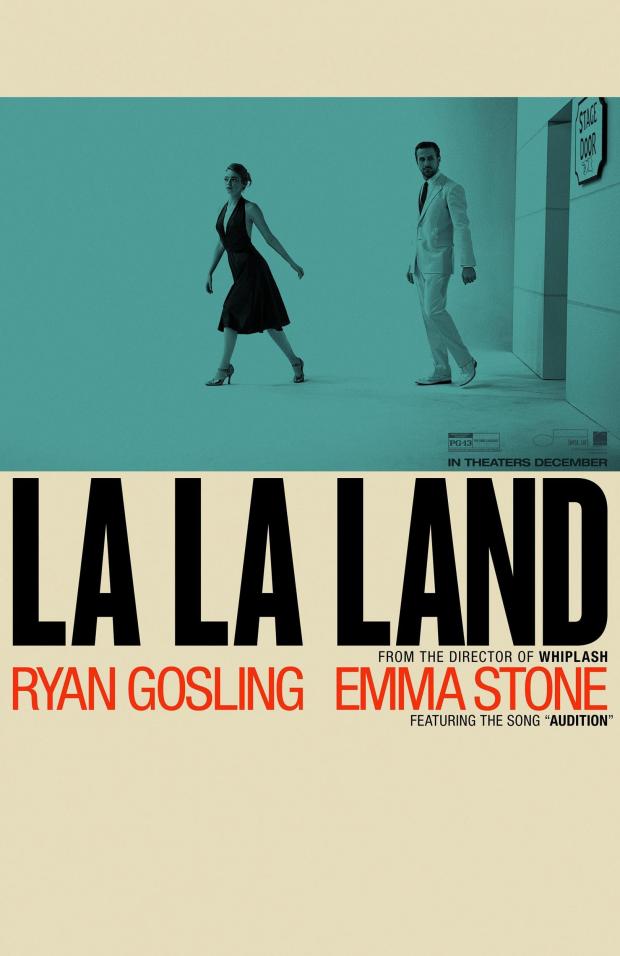
La La Land is a rare bird, a genre musical film— refreshing and uplifting, sincere and happy and melancholy, a much-needed anodyne for the darkness and cynicism of late cinema. It tells the story of the meeting of two young people, Sebastian (Ryan Gosling) the musician and Mia (Emma Stone) the struggling actress. Both are working marginal jobs, waiting for their moment to break into the careers they dream of. When they meet (after a few hilarious missteps) love begins to bloom— and in true musical manner, their emotions soar in the form of song and dance. This is what is wonderful about musicals: in their universe emotions cannot be contained by prosaic reality. They require the characters spontaneously burst into song. Narrative reality breaks loose and people levitate into a magical space where people dance in the middle of traffic jams and fly into the stars of a planetarium.

But it’s not all just a cinematic heaven of singing and lyrical passages of fancy: the eternal rival of romance and career soon takes over.  Mia and Seb inspire each other to take risks, work hard and strive to make their personal dreams come true. The cost of pushing career first soon becomes the central conflict of La La Land, which leads to one of the most soaring and beautiful and melancholy and moving conclusions I have seen in a modern film.

The third character own this film— the namesake— is it’s wonderful, make-believe Los Angeles: Angel’s Flight, Mulholland Drive, Griffith Park, palm trees and stately SoCal architecture under an endless blue sky or deep blue night. It’s a fun, vibrant place full of artist, actors, strivers and dreamers. It’s been too easy in films of late to see LA as some of late-capitalist hellscape (see Training Day): It’s refreshing to remind all of us that LA is a place where people still go to try to make their dreams come true.

Director Damien Chazelle’s last film was Whiplash, a sort of crazy stalker film set in the world of jazz music about an earnest drummer and his insane instructor (J. K. Simmons, who has a lovely cameo in this film).  Jazz plays heavily and strangely in La La Land as well: Sebastian is a young man obsessed with the world of jazz: he has posters of jazz greats in his apartments, Hoagy Carmichael’s piano stool and longs to open a real jazz club in Los Angeles. There are plenty of kids these days who passionately love alls sorts of dead or marginal forms of music: it never becomes clear of Seb is sincere or just really good at affecting his love of the genre.

"A Lovely Night" on location.
The most remarkable number— a real masterpiece of a shot— is “A Lovely Night,” which occurs near the beginning of the film. After a party in the Hollywood Hills where they accident meet up, Seb is helping Mia look for her car. They break into song and dance at a scenic overlook, the wash of lights in the LA basin below. The scene, which goes from real-world to singing to dance to tap-dance (!) is shot at the real location and very specific time: PAST “Magic Hour,” just after sunset, when the warm glow of the sunset underscores a deepening dark blue sky. The set lighting is low as to illuminate the actors and still leave the sunset and sky bright. This scene not only highlights the considerable singing acting talents of of Ryan Gosling and Emma Stone, it shows off cutting-edge film technology: fine-grained, fast film stock (La La Land was mostly shot on 35mm film), fast anamorphic lenses and the latest light, agile camera packages. Were this a Golden Age musical, this shot would have happened on a soundstage. But instead, it is one long, six-minute shot at a very narrow, specific time of day. This makes it breathtaking on several levels.

Another nice PAST-magic hour shot.
La La Land is in many ways an updated classic movie, a pastiche of the conventions, narratives and styles of Hollywood musicals. It is not a breakthrough in and of itself: this isn’t pure storytelling and cinematic innovation like Mad Max: Fury Road was. It takes the best elements of a great genre, updates the sensibilities to contemporary morés and makes it all fresh and unexpected again. There’s a little Vincente Minelli here, some Gene Kelley there, a little Jaques Demy, Even a bit of Ross Hunter/ Doris Day and Paul Thomas Anderson.

Another girl in magical old Los Angeles, dreaming
of acting fame. Naomi Watts in Mulholland Dr.
Given all these obvious movie-history references it was then very, very strange that while La La Land played, the place I kept going to for a visual and stylistic reference was… David Lynch. I COULD NOT STOP thinking: “This is a light-hearted musical version of Mulholland Dr. (2001).” It shares a lot of the same qualities as Lynch’s masterpiece: striking cinematography filled with shots of strong primary colors; an abiding love of Los Angeles locations, show business, actors and the mechanics of filmmaking; flights of surrealism; and intimate close-ups, bursting with emotion. These films are on entirely different missions— light, uplifting musical surrealism versus a surreal dive into the darkest parts of the id— but there is a common thread as well, in look and feel.

I may well be mistaken and La La Land may have been released in the
original CinemaScope aspect ratio of 2.55:1. But that's not how I saw it
in Redwood City: they couldn't even manage to mask the screen right.
And, sorry to say, I have to disagree with both the opening title card and Dana Stevens’ review and report that La La Land is NOT in CinemaScope. That specific film format was proprietary for to 20th Century-Fox and Bausch and Lomb, who standardized the elements of anamorphic cinematography. CinemaScope lenses were not much used past 1960: these early models had distortion problems that caused actors’ faces to widen unnaturally: “CinemaScope Mumps,” they called it. Panavision fixed this problem by re-arranging lens elements to minimize distortion. This film is actually in Panavision: they used Series C lenses to shoot it. But this is a quibble: the widescreen compositions are so lovely and the mise-en-scene is so well developed and rich, it’s worth another viewing just to look for visual clues and symmetries.

If you love Hollywood genres old and new, this is a must-see.

Monday, October 10, 2016

Donald Trump and Hollywood Omertà

Many people have seen, or at least read about, the now-infamous “hot mic” tape of a candid conversation between Donald Trump and Billy Bush in September 2005. News outlets and the internet are currently saturated with analysis of the content of this tape, in which Trump admits that his money and power permits him to commit sexual assault. The astounding crudity of the verbal exchange was seen as revealing the true nature of Donald Trump’s personality and attitude towards women, and the revelation of this tape may well prove to be the tipping point of the 2016 presidential election.

But this article isn’t about the content of the tape: it’s about why it took so long for it to be released. This is the part of this incredible story that seems to be under-discussed— and it relates directly to Hollywood, which is why it’s being discussed here.

The official story is the producer of “Access Hollywood,” Steve Silverstein, remembered this interview about two weeks before the release and dug the footage out of archives. This story is almost certainly false. The reason why it’s not believable is actually embedded in how the tape was recorded.

This political bombshell (more of a nuclear warhead) was taken from a segment of “Access Hollywood” which documented a cameo Donald Trump was making on the soap opera “Days of Our Lives.” It was shot on the backlot of NBC Studios in Burbank. A camera crew was following Trump and “Access” host Billy Bush: both men were fitted with lavalier microphones and transmitter packs which broadcast RF signal to receivers attached to the camera. During the publicly-released segment a cameraman had stepped outside the bus to set up a shot showing Bush and Trump arriving at the studio to be greeted by soap star Arianne Zucker. Thinking they were off-camera, the two men engaged in a crude, degrading conversation about women. Aside from the on-camera personalities there were seven people involved in this taping: two cameramen, the segment producer, a production assistant, Trump’s bodyguard and PR person, and the bus driver.

After this segment was shot, the footage was likely seen and handled by even more people: on-line and offline editors, more show producers, audio technicians and maybe even an archivist.

Charlie Chaplin, during one of his
many, many court appearances.
So about a dozen people— very likely more— heard and saw this footage in 2005. Yet NONE of these people recalled this conversation, one of the most devastating revelations of character any political aspirant has ever uttered? Particularly as this 2005 taping came on the heels of complaints by the cast and crew of Trump’s show “The Apprentice” about his crude on-set behavior? That is an impressive case of collective amnesia.

Hollywood’s code of silence strikes again.

The film industry has been creating and controlling secrets since the days of Charlie Chaplin (and Lita MacMurray) and Fatty Arbuckle (and Virginia Rappe). The studios all had (and still have) well-funded departments which handled public relations and “fixers,” producer-level executives who specialized in keeping indiscretions out of the press. (Hail Caesar was a thinly fictionalized account about a famous studio fixer.)

The culture of secrecy goes very deep in both the film and TV industries. Entertainment is an unusual industry in that the general public is constantly and intently curious about it. Supermarkets do not devote shelf space at the checkout counters with magazines dishing the dirt on astrophysicists and farmers, after all. Scripts and storylines have to be kept secret: details of film shoots are kept from public view as much as possible as well. The need for confidentiality rivals the Pentagon’s.

It’s all for the greater glory of the Industry, of course. That, and jobs. A scandal that would bring down a star would shut down production. A leaked script would kill off box-office potential. Finally, there’s the prestige factor: being on the set gives even the lowest PA or grip access to some of that rare stuff, Hollywood Glamor— stacks of non-disclosure agreements are willingly signed to gain access to that inner circle.

Why did this revelation take so long to emerge into the light of public scrutiny? The culture of Hollywood, a full century of studio secrets kept, reputations protected, indiscretions hidden. And they are so good at it: Did you know that Tom Cruise is only 5’7”? It took a LOT of will to overcome that much inertia and tradition.

Wednesday, October 14, 2015

Jaws as Socio-Economic Parable

Chief Brody (left) deals with pressure from the
Amity Selectmen and their 1974 Cadillac Fleetwood.
Jaws (1975) was a more than Spielberg’s breakthrough thriller hit, a huge box-office hit, and the film that, with Star Wars, invented the idea of the high-concept summer blockbuster. It is also a parable. The most obvious theme is man versus nature— how humanity can band together to defeat relentless forces of death and chaos. But the parable that is touched on but rarely explored is how Jaws is a study of American social structure- How they fight, and how they cooperate.

America in 1975 was somewhat different than it is today. Wall street was still well-regulated, the top marginal tax rates on income were much higher than they are now, and unions were much stronger. The wealthy were very wealthy, but they still had some common ground with a healthy middle class. It was a time when the middle class was still given substantial incentive to prosper: single-income families were still the norm, and even the poor were considered “lower middle class.” It was before Reagan, union-busting and trickle-down economics, and the long and fantastic post-WWII run of prosperity was still going— it was near the end, but it was still working for most people. Looking back, I think most folks didn’t know how good they had it.

Into this prosperous, fairly harmonious but increasingly cynical post-Watergate world enters a shark, who begins eating people off the shore of the small East Coast resort community of Amity. After a few disastrous mistakes by the local powers-that-be that result in even more death, the right decision is made and a fishing expedition to go kill the shark is financed.

And, oddly, a representative of every level of American society is on-board.

Quint: "Let me feel your hands... They're city hands,
soft from counting money."
Hooper: "hey, I don't need this 'working class hero' crap!"
• Matt Hooper (Richard Dreyfuss) is the Woods’ Hole Shark expert. He represents the upper class: He is college-educated, well-traveled and pursues his avocation (oceanographer) with expensive equipment he bought himself. His approach to the challenge of the antagonist is initially aesthetic: He thinks sharks are magnificent, beautiful creatures, the pinnacle of piscine evolution.

• Quint (Robert Shaw) owns the Orca: He is a charter fisherman specializing in shark hunting. He represents the working class: a poorly educated, crude rustic with a strong Down East accent. Quint’s motivations are personal: as a survivor of the sinking of the USS Indianapolis in World War II, he has dedicated his life to vengeance against creatures who killed his shipmates. Considering the condition of his ship and shore facility it seems Quint has turned his obsession into a marginal sort of living.

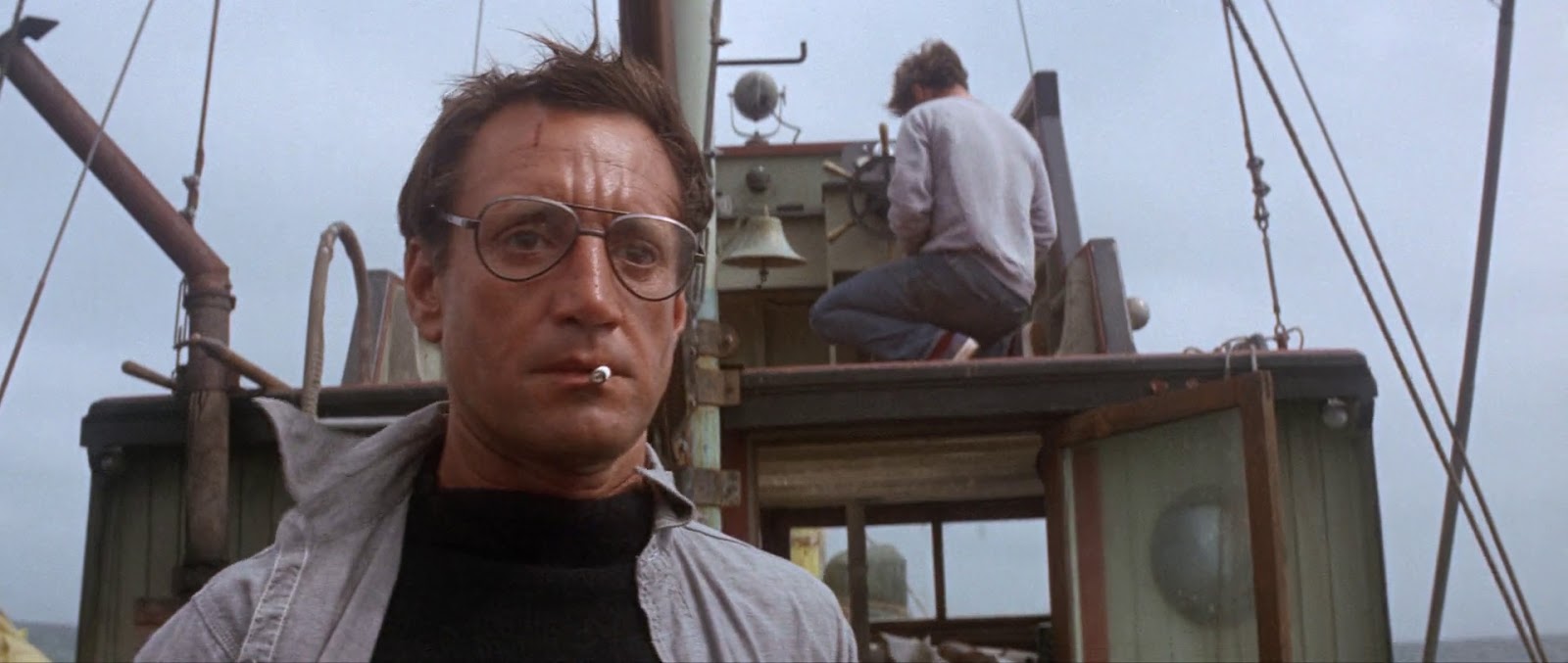
"I think we need a bigger boat." Perfect example of
middle-class pragmatism from Chief Brody.
(This classic line was ad-libbed by Roy Scheider.)
• Chief Martin Brody (Roy Scheider) is on-board as a sponsor: his efforts financed the expedition. He is ostensibly the protagonist of Jaws— and he is solidly middle class. A former New York City policeman turned town police chief, he is pragmatic, methodical and cautious. A civil servant, Brody is fully enmeshed with the pitfalls and complexity of local government, and spends a good part of the film trying to convince Amity’s selectmen to take the shark threat seriously. His viewpoint on the antagonist is a common one: ignorance and fear. He does not like the ocean, does not go into the water, and is frankly terrified of sharks. However, he displays a common-sense willingness to facilitate, learn and help.

With representative of every social class onboard the Orca pursuing the common goal of ridding the fair town of Amity of a rogue Great White it would seem their goals are unified. But there are tensions between each man as much as there are tensions between classes:

The "moment of greatest settled success" of Jaws:
all levels of society literally harmonizing together
before the shark starts taking the boat apart.
Brody and Hooper vs. Quint: As well-integrated members of mainland society, they see Quint as an unhinged, dangerously obsessed yokel.

Hooper and Quint vs. Brody: As experienced seamen and shark enthusiasts, they see Brody as a useless landlubber who has the potential to get into serious trouble onboard.

Quint and Brody vs. Hooper: Hooper has a tendency to be snippy and is constantly suspected of not sharing the primary goal of the expedition: to kill the shark, not study or admire it.

These squabbles are put aside (mostly) when the shark seems to take an interest in them and begins a personal (and scientifically nonsensical) vendetta against the Orca and the three intrepid class representatives onboard. Sharks don’t take vendettas: in fact, most marine biologists believe Great Whites don’t care for people meat, and most fatalities are “test bites” that have bled out.

"How do you work this thing of yours?" Quint setting aside
his working-class resentments for the sake of survival.
This shark vendetta does not makes sense— unless you cast the story as a parable about class. Then the shark becomes a common enemy to all society, high and low, a threat which requires complete socio-economic cooperation.

Hooper, Quint and Brody all work together to battle the shark, who also busy trying to eliminate all of them in no particular order. The final act of the film can even be seen as a microcosm of how chaos and disaster are typically visited upon the American body politic (from here to the end are solid ••• spoilers ••• but shame on you if you haven’t seen this film!)

Quint, being working class, is eaten by the shark, which fits into the demographic of natural disasters affecting the poor proportionally worse than anyone else. Hooper, having access to expensive gear, is able to swim away from his high-tech shark cage, hide on the seafloor, and survive. The job of dispatching the shark falls on the capable middle-class Brody, who uses a tool left by working-class Quint (M1 rifle) and another tool left by wealthy Hooper (compressed-air scuba tank) to blow up the shark. Thus was the burden of the 20th century American middle class.

Peter Benchley, looking sharp in wide lapels.
The original novel was written by Peter Benchley, the grandson of humorist Robert Benchley. In the novel as well as the movie Brody is the protagonist, but Benchley was in life much more of a Hooper (Phillips Exeter prep school, Harvard University). Interestingly, Hooper was a bit of a rich cad in the book: he had an affair with Chief Brody’s wife. Then again, in the book Hooper did not escape the shark cage and was just plain eaten. He comes off much nicer in the movie, which may or may not be social commentary.