Showing posts with label comics. Show all posts

Saturday, January 25, 2020

Harley Motherf***ing Quinn

[Warning: adult language and situations. No spoilers, though.]

Harley Quinn, voice supplied by "The Big Bang Theory's"
Kaley Cuoco. So less of the insane Brooklynite attitude from
previous iterations, more of a scary SoCal girl.
I don’t review TV shows that often, animation almost never, and I’m not a comic book fanboy. But I chanced upon a review on io9 that was so intriguing I had to check it out— and I was not disappointed.

“Harley Quinn” is a comedic adult animated web-based show now streaming on DC Universe, behind an $8-a-month paywall. It tells the story of Harley Quinn, the Joker’s lover and sidekick, as she dumps him and tries to invent herself as an independent person and supervillain in her own right. She does this with the help of her best friend / roommate Poison Ivy (Lake Bell, a wonderfully dry voice performance), and her crew of minor villains who I would know if I actually read comic books.

Harley and Poison Ivy, roommates. These two characters
may be the most 'shipped couple on the internet. So far
they are depicted a just close friends, but the season
is not over yet.
The dynamic between Harley Quinn and Joker has been well-documented, and they’re even going to make it big deal out of it in the Margot Robbie-starring live-action film coming out next month. Her character has been described as suffering from dependent personality disorder: in her former life she became so obsessed with Joker while treating him in Arkham Asylum she abandoned everything to become his often-abused sidekick. As a super villain origin stories go it may be the most mundane one ever: Harley was a victim of abusive, manipulating partner, a trauma untold thousands of people are suffering every day in the real world. It has given her character a special resonance with fans: even though Harley is a supervillain, her personal emotional issues have a human scale and her efforts to break free of her abusive partner make her even more relatable. The show does not shy away from this unhealthy dynamic, and in fact it casts most of her personal growth as an anodyne to Joker, her romantic obsession transformed into professional competition. Harley a fun character, given considerable depth: she is "a bad guy, but not a bad person," and her story arc probably has her headed to antihero status.

The creators of “Harley Quinn” made a strange but ultimately transformative decision: As it is not a broadcast show there are no real restrictions to language and content, so they decided to make a show for adults. It's a bit of a shock. To give a feel for the dialog:


Harley (to Joker, in a subconscious confrontation): “You think you created me, but no one did. My fucked-up parents didn’t create me. Neither did Jessica Sarner when she lied to the whole fucking camp and said I lost my virginity to a horse! A HORSE!” (applies baseball bat to Joker’s crotch: he doubles over) “Neither did those cops who questioned me for hours about what happened to Jessica Sarner! And YOU sure as hell didn’t fucking create me, Puddin’!”

And the sexual innuendo is of the single-entendre variety:


Bane (to Joker on phone): “Harley is at Penguin’s nephew’s Bar Mitzvah.”
Joker: “She crashed the stupid thing?”

Bane: “Yeah. Seems like she’s doing pretty well. Brought a tiger. Pretty cool!”
Joker: “What? Anyone can buy a tiger. You know she has HPV, right?”
Bane: “Most sexually active adults do.”
Joker: “Shut up!”


Dr. Psycho, after the second time he called someone a c**t.
Yeah, the filter is off and this makes it for fairly exhilarating viewing. There are some limits: no female nudity (yet*), but lots of pixelated male crotches. The show even has a line, and one character crosses it: Dr. Psycho, one of Wonder Woman’s nemeses, is blackballed out of the Legion of Doom for calling her, in the heat of battle, a c**t. (it’s the only profane utterance bleeped on the entire show.)

I know adult-oriented animated series are not exactly a new phenomenon: “South Park” is 20+ years old, seriously raunchy, and the movie was legendary in that regard. Every episode of the immensely popular Adult Swim series “Rick and Morty” is filled end-to-end with bleeps and blurred-out genitalia.

What makes “Harley Quinn” exceedingly unusual is the fact it is camped dead center in the DC Universe. It is not a sidecar, like the way Deadpool— the foul-mouthed, violent antihero from Marvel— is a sidecar, peripheral to the X-Men universe (several X-Men make an appearance in the sequel) and completely walled off from the big-money Avengers universe. Deadpool will never crack dick jokes with Captain America. (Professor X, maybe.)

In her show Harley regularly interacts with the big hitters, Batman and Superman and the like. The iconic superheroes they spend hundreds of millions of dollars to make movies about. And by “interact,” I mean when Harley meets The Batman in the first episode, she adamantly insists he is called that because he fucks bats.
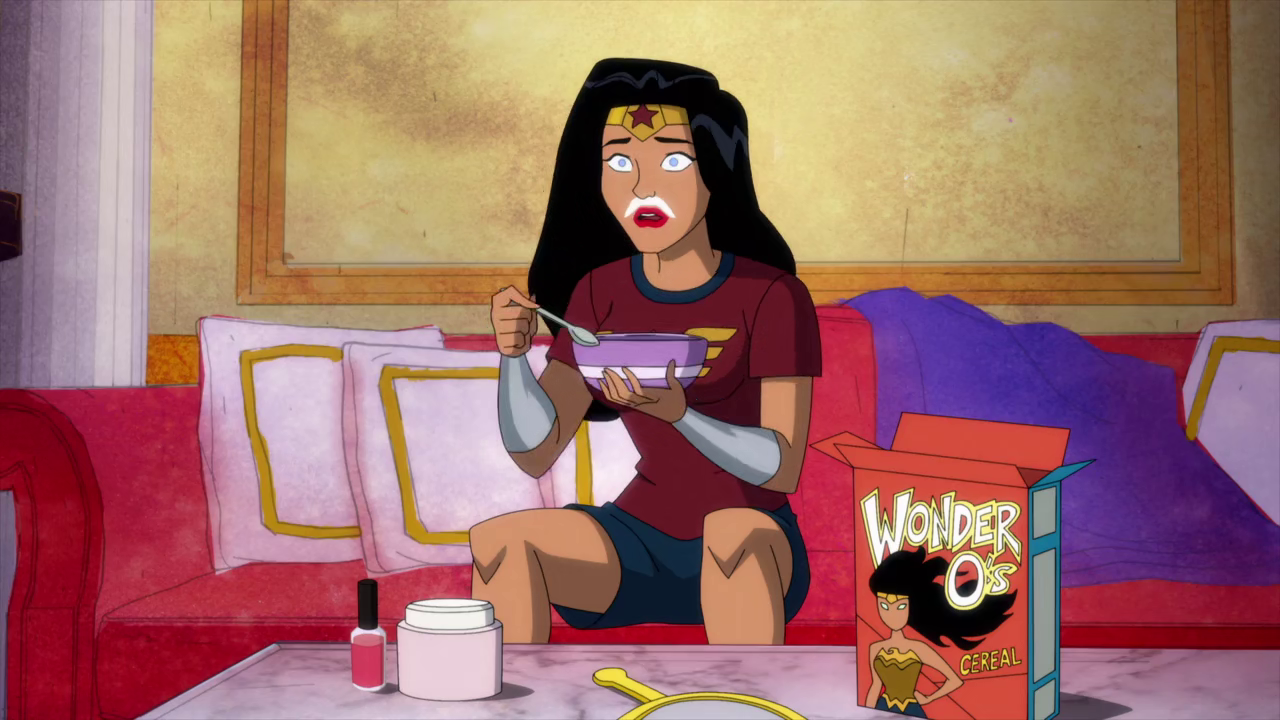
Wonder Woman, eating her own brand of breakfast cereal,
realizing all the ground rules have changed.
This juxtaposition turns an amusing series into a surreal one. What we have is a series which has IP-critical superhero guest cameos— and they basically stand in inhibited silence while a collection of supervillains dance around them, calling them out with ripe curses and sexual innuendo. The decision by DC and Warner Bros. to execute this vision is mystifying.

The other exhilaration that comes from ”Harley Quinn” is how this adult theme remakes every character anew. All the profanity and frank sex talk draws attention to the eroticism that rushes like a deep undercurrent under all superhero stories.The supervillans and superheroes depicted in the blockbuster movies are (mostly) extensions of their juvenile, sexless origins as juvenile, sexless comic-book characters, still hewing to a long-gone 70-year-old Comics Code. Not on “Harley Quinn:” on that show, everyone depicted are People Who Fuck.

People Who Fuck are all around us: it is the normal state of the human race. The great majority of DC and Marvel movies and TV shows still depict their intellectual property as non-existent from the waist down, like Muppets. This is my biggest peeve with the MCU: missing the normalizing dimension as People Who Fuck, for all the significant kisses and long, lingering gazes they’re all just cardboard simulations of real people.

This is the liberating synthesis of “Harley Quinn,” the result of the thesis of comic book characters mixed with the antithesis of real-world People who Fuck. Even though they are set in an unbelievable, unrealistic universe of magic and superpowers, the characters depicted within seem more real than any version of them that came before.

*One of the most confounding things about Adult or R-rated entertainment of late: no problem with profanity and verbally describing sexual situations-- but nudity is increasingly rare. I think, in the case of this show, the influence of the internet is the major deciding factor. If the showrunners ever decided to show Harley Quinn running around with her tits out, every fanboy image server on earth would promptly explode. So that will never happen.

Tuesday, October 8, 2019

JOKER: Nihilism With a Purpose

How fascinating was Todd Phillips' Joker? I didn’t even realize until it was over that the movie was in 1.85:1, traditional spherical widescreen. We’re in an era where almost every theatrical film, tiny indie or major studio release, is in 2.39 ‘scope. It was presented in the period-correct aspect ratio, and the period-correct film washed over me so thoroughly I didn’t even see the frame— and I ALWAYS see the frame.

Controversy swirls around Joker like the cloud of delusions that define Arthur Fleck (Joaquin Phoenix), the movie’s antihero. we’ll get to that later, but first an appreciation of the film’s star. Phoenix was given a lot to work with here and he delivers. In truth, he over-delivers: his character is mentally ill and unknowable and his performance never deviates from this condition. This lends his story and the larger story of Joker a disjointed, alienated feel.

Arthur is a clown-for-hire who aspires to be a stand-up comedian, except his illness leaves him basically without a sense of humor. Inappropriate laughter is his illness’s major symptom: we see him in a comedy club, trying very hard to understand how comedy works, writing notes and laughing at the set-ups, not the punchlines. And his laugh is not a chilling villain’s cackle: it’s a strangled, involuntary reflex he cannot control.

Joker is set in a realistic version of a fictional past: Gotham, the East Coast city from the Batman franchise, in the late 1970s or early 1980s. It has the look and feel of the gritty “New Hollywood” films shot in New York or Philadelphia at the time: trash in the streets, tagged up subway cars, theaters downtown devoted to pornography, and there is not a computer or cellphone in sight. You will think Todd Phillips is emulating Martin Scorsese’s Taxi Driver (1976) to an extreme degree, and you‘d be right. But I’ll argue it’s worth it: the art direction, locations, sets and costumes are worth the price of admission by themselves. The attention to detail is remarkable and thorough. Joker only betrays its 21st-Century origins in the beauty of the images (Shot on an Arri Alexa 65) and the smoothness of camera movement (they have all sorts of magical tech gizmos to facilitate that). Back in the bad old days filmmakers like Scorsese and Melvin Van Peebles and Joseph Sargent and Gordon Parks had to make do with Arriflex IIc cameras loaded with grainy, pushed 35mm film, wooden sticks and Lowell incandescent lights.

Gordon parks, making do with an Arri IIc.
In my opinion Joker could have dispensed entirely with the entire DC Batman mythology. The film did not need it, and it added nothing to the core of what is essentially a psychological thriller. In fact, the baggage of the Joker mythology creates an ethical issue: we know that Joker will become a master criminal and an unrepentant, cold-blooded murderer: this aspect is part and parcel of Joker’s DC persona. But remove Arthur Fleck’s known fate to be a villain, and it becomes the story of one man’s mental disintegration during an era where isolation and alienation were practically the norm.

Martin Scorsese, behind a soundproofed Mitchell NCR.
It’s not a perfect film and it is not that easy to watch: Arthur Fleck is set up as a victim for most of it, and we see him on the ground getting his ass kicked twice. The first half of the film is set-up, and we see things in Arthur’s life, which started out bad, just get worse. The very conditions of urban life in the late 1970s are the antagonist here: Budget cut-backs eliminate Arthur’s weekly visits to a social worker and access to medication to keep his illness in check. He lives in a hideous apartment with his declining mother (Frances Conroy) in a neighborhood overflowing with trash. Adding humiliation to alienation, Arthur’s attempt at stand-up comedy is mocked by a late-night talk-show host (Robert De Niro, playing Jerry Lewis from The King of Comedy). His character is clearly being pushed towards a break with normality, and when it comes the only thing surprising about it is how gory it is.

Joaquin Phoenix, before an Arri Alexa 65.
It also makes Arthur Fleck’s eventual transformation into the Joker problematic. The film explains him away: he is the product of bad genes, a terrible childhood, an even more terrible environment, and horribly complete social isolation. This was the thrust of most of his comic-book origin stories as well: in the famous graphic novel “The Killing Joke,” The Joker is the result of one normal man after one very bad day.

At the point in the story where Arthur Fleck eventually snaps, everything in the film has been placed to make his move to villainy sympathetic. This makes Joker an exercise in pure cinematic nihilism: it’s a director deciding make a murderous villain his movie’s hero. And this is where the film goes from compelling but flawed to brilliant, because Joaquin Phoenix’s performance is the counterbalance to Todd Phillips’ nihilism. He portrays Arthur Fleck as disjointed and mercurial: his moods change from scene to scene, from somewhat sympathetic to completely alien. He leaves the audience with nothing to grab on to, which is the point. As much as the film tries to set up the origins of Joker as pitiable, Joaquin Phoenix pushes back, making sure you don’t feel shit for the guy. It is rare these days to see the an actor-versus-director dynamic play out onscreen, but that’s what we get here.

The “tell” of Joker— the element Todd Phillips and co-writer Steve Silver steered away from DC canon to stake out new narrative territory– is the portrayal of Bruce Wayne’s father, industrialist Thomas Wayne (an almost unrecognizable Brett Cullen). In the comics he is the just, benign father-figure of young Bruce, whose strong ethical sense set Bruce on the path to be a superhero. But in Joker he is a grasping, bloated capitalist who literally sneers at the poor: “Those of us who have accomplished something with our lives will always look down on those who have not as clowns.” Thomas Wayne's statement sparks deep resentment among Gotham’s beaten-down residents, and starts a clown-themed anti-establishment movement— not too far off from the Guy Fawkes thing from V for Vendetta— to topple the rich of the city.

And that is what makes Joker timely. Set in the 1970s, it nonetheless completely understands the cruelty of inequality in our time, and the fact that a society without empathy breeds monsters.

Monday, August 8, 2016

Suicide Squad: Why So Serious?

Maybe reviewers saw the subtitle "Worst. Heroes. Ever."
and took it at face value.
After a week of reading many delicious, angry, mean reviews for Suicide Squad, the latest entry into the DC Extended Universe, I did something somewhat contrary to my usual instincts after feasting so well on such a banquet of snark: I went out and saw it.

I left the screening wondering if the film’s many critical detractors and I saw the same movie. I thought it was pretty enjoyable.

Let me clarify.

We’re living deep in the Comic Book Movie Era. Superhero movies rule box offices worldwide. They are now nothing less than a fully formed cinematic genre, with major and minor characters, multi—year story arcs, and very solid and reliable generic characteristics. So, as an new entry into this well-defined genre, Suicide Squad fulfills most of its expectations: it’s filled with action and cross-franchise references and juvenile humor and even more juvenile depictions of adult relationships. It’s PG-13, so they are holding back quite a bit on the gore on this one, but the body count is also near the normal level for this genre.

I kept getting the feeling that critics were slagging on Suicide Squad as a bad film— compared to the totality of Hollywood movies. Maybe that’s true: it isn’t as good as Chariots of Fire or Michael Clayton or L’Avventura or Dodgeball: a True Underdog Story. But as a comic-book movie, it’s truly right in the middle of the pack. If you approach Suicide Squad as an entry in a superhero universe franchise— but if you are NOT a comic book fan or even that familiar with comic books— than the film works perfectly well. We are introduced to a group of new characters via backstory, given the signposts and guides to these new characters inside the universe, and the plot is set into motion. Sure, it was dumbed-down and expository scene’ed to death, but without exposition most audiences would be totally out to sea because this films stars some decidely minor DC characters.*

Harley Quinn (Margot Robbie) in a rare publicity still
with another character.
I agree with most the of reviews that in Suicide Squad there are things that work and things that don’t work. In the minus column, much has been made in the reviews of what a misfire the villain was: The Enchantress (Cara Delevigne). She was, according to some, a cookie-cutter villain whose ultimate goals were poorly defined. Funny, but to me that sounds a lot like MOST comic-book movie villains of late: Thanos (Guardians of the Galaxy) or Apocalypse (X-Men: Apocalypse) or General Zod (Man of Steel) or Ultron (Avengers: Age of Ultron) are not much more than an interchangeable bunch of power-seeking super beings.

The main story— a group of rag-tag villains is banded together to fight an evil superpower— is another misfire, poorly motivated from conception, really. The main characters are so unwilling to be heroic that at one point they all check out of the story and go get a drink in a bar. From a screenwriting perspective, this is hilariously telling. There is an uncanny and spooky effect in the writing process where characters who are stuck in bad plots will try to get out. They will talk to the writer: “This is stupid: I shouldn’t even be here!” There’s a scene in Avengers: Age of Ultron where Hawkeye (Jeremy Renner) hangs a lantern on this effect: “The city is flying and we're fighting an army of robots. And I have a bow and arrow. Nothing makes sense.” But poorly motivated final battles are a hallmark of comic-book movies, so again: I don’t see what all the fuss is about.

What does work in Suicide Squad are the characters you see in every publicity still: Harley Quinn and The Joker. the sheer amount insane energy Margot Robbie and Jared Leto put into their interpretations is evident on-screen, and both are so vivid they make every other character fade into the background— even Deadshot (Will Smith). People have been looking forward to Harley Quinn’s big-screen debut with as much anticipation as Wonder Woman’s— and she does not disappoint. Funny, sexy, wisecracking and fearless— she’s a character who will go into battle with a super-powered villain armed with a baseball bat-- and think nothing of it. Very much looking forward to her inevitable solo movie.

The Joker, breaking the fourth wall to make you pee a little.
Bad teeth and no eyebrows are menacing enough.
Her relationship with The Joker is as weird and creepy as it is in the comics. He is an abuser who both loves Harley and has zero value for her life and well-being. Some have said Leto’s interpretation of The Joker is too creepy and off-putting. Well, not to sound like a fanboy, but: he’s supposed to be creepy. He’s a villain, a murderer. Even at his charismatic best he should still make you pee a little. I’d take Leto over Heath Ledger, who I thought was a bit too fussy and borderline silly. The Joker should make you uncomfortable. And what he has done to Harley Quinn should make you uncomfortable too.

Strangely, what this film reminded me of most was not another DC or even a Marvel movie: It looked and felt a lot like Mystery Men (1999) a high water mark of the heyday of the Dark Horse Cinematic Universe. It has the same colorful design, outlandish, hand-made-looking costumes and grungy detail. it also featured a rather large roster of fairly unknown comic-book characters, juvenile humor and a somewhat limp main story. Much better villain: tho: I’ll take Casanova Frankenstein over The Enchantress any day.

* Both Marvel and DC superhero movies bury easter eggs in the credits. True fans always advise to stick around for these. But the coda at the end of Suicide Squad— no spoiler— I swear is nothing but Viola Davis and Ben Affleck spewing dense comic-book implications at each other for three minutes. I didn’t understand any of it.

Thursday, May 7, 2015

Age of Ultron and a Genre That's Far From Done

The Avengers (including a few new recruits on the left), against a background
of the hundreds of robots they're about to shred.
Look: if a movie makes nearly $200 million domestic on opening weekend and nearly $400 million worldwide, you kinda have to see what the fuss is about.

Right off the bat, I can tell you that Avengers: Age of Ultron is a worthy and entertaining addition to the Marvel Cinematic Universe. Having absorbed (mostly via osmosis and basic cable) all TEN previous movies in this continuity, I can tell it's a neat new adventure. In terms of sheer spectacle it's worth the cost of a ticket (though I did not pop for 3D glasses: I'm here for the story, baby). The effects are seamless and perfectly designed and so well-integrated that about halfway in I stopped thinking about the sheer hours of VFX design and rendering that went into every damn frame and just let it wash over me.

HAL 9000. Often imitated,
never surpassed, he still has
much to teach us.
The plot: The Avengers, fresh from saving the world from Loki in the last movie, need to locate and dispose of Loki's scepter, a source of mystical power and all other sorts of mayhem. But Tony Stark (Robert Downey Jr.) wants to use it one last time to get his pet project working: a cybernetic creation that will protect all of Earth. But, as the film 2001: a Space Odyssey taught us, it is very difficult to explain the concept of security to a computer without them misconstruing the intent and trying to kill all of us. Which is what the newly animated Ultron (voiced with Tony Stark insouciance by fellow former Brat Pack member James Spader) immediately tries to do. So the threat this time was internally created-- and it's going to take the entire Avengers team to fix it and save the whole planet. Again.

Joss Whedon's style and humor is far more muted here than in his last Avengers movie, but his sense of cinematic action is still there and even improved a bit over his last outing. the opening battle is one long Alejandro González Iñárritu-style tracking shot. In several parts he slows the action down, which allowed some moments of quiet awe. He also gives some great acting turns for the more human members of the Avengers gang. Hawkeye (Modesto's own Jeremy Renner) has some moments of quiet vulnerability. Black Widow (Scarlett Johansson) also gets some nice little moments. A few notes:

• The widespread criticism about Black Widow's character is absolutely true, unfortunately. I feel the giant three-fingered gloved hand of Disney here, holding back Whedon's organic feminism. Natasha is turned from a complex character with a morally questionable past to a sort of kick-ass den mother with a love story (you know, for the chicks). The chilling "red on my ledger" backstory between her and Loki from the last movie is completely absent. Disappointing.

Paul Rudd IS Ant-Man! As far as I could tell from the
trailers this isn't going to be a Romantic Comedy and
Judd Apatow is nowhere to be seen.
• Contrary to some social observers and film critics we have not reached "Peak Comic Book Movie." Not even close. There is a huge stack of Superhero movies waiting in the wings from Marvel and DC: Ant-Man and the Superman-Batman deal and Wonder Woman (I think) and the Fantastic 4 reboot (huh?) and the Guardians of the Galaxy sequel and many, many more. So far these movies still manage to be inventive and fresh, and the dead hand of Mannerism has yet to appear in the genre. Still…

• ...Though Avengers: Age of Ultron is a fun watch and a neat action story, you can see in it how this genre is going to play out: Death by Character Shield. "Character Shield" is one of the screenwriting phrases which explains why lead characters in series and franchise entertainment tend to survive anything you can throw at them: they HAVE to. The appeal of the leads is what makes a series or franchise work, so whatever hairy death-defying situations the writers put them through they HAVE to make it out the other side. They can be emotionally changed, evolve or what have you, but you can't kill 'em.

Superheroes were tailor-made for action franchises: They're tough, very strong, often superhuman beings who can participate in huge violent battles and generally come out with naught but cosmetic scratches. Which is great, because there are usually a string of movies yet to be made featuring them stretching on into the distant future. Furthermore, these superheroes are generally assigned to quests that invariably have them saving the entire world (the Avengers have done this twice now), which is great because it increases your audience base.  But-- quoting another writer on this subject-- if everything is at stake, then nothing is at stake. They're always going to save the world and they're always going to survive. The character shield now encompasses the whole world and everything in it, and the only things you can battle are aliens (the last Avengers) or robots (this one). There is hope for complexity and consequences in the lesser Marvel movies (Captain America: The Winter Solder was a surprisingly complex political thriller) but the forces of monolithic Narrative Stasis are starting to show. With Stasis comes Mannerism, and then audience boredom, and then we move on to the next thing.

The super-secret hangar under Washington where SHIELD has
created a fleet of equally super-secret helicarriers. (scene from
Captain America: The Winter Soldier.) Your unaccounted
off-budget tax dollars at work!
• The product placement for Audi has evolved from ubiquitous to absurd.  Fine new Audis show up everywhere-- in frenetic chase scenes in Seoul, English universities, sitting out in the open in dirt-poor Eastern European countries with the keys in the ignition. At one point in the film Tony Stark activates an offscreen car with a remote. Guess what make of car, driverless, rolls into frame?

• Considering the large number of people in the United States who identify with right-wing causes, I am always surprised how a movie like this is widely liked and accepted despite the blatant presence in it of World Government-- and by that I mean exactly what Tea Party crazies are talking about: shadowy militarized organizations operating internationally with absolute impunity and with overwhelming destructive power. In Age of Ultron The SHIELD agency has collapsed (due to events in The Winter Soldier) but Nick Fury's organization fits the description perfectly: a UN-level secret military that operates stealthily everywhere in the world, has awe-inspiring weapons of mass destruction and respects no borders. The Avengers themselves have the same basic mission as SHIELD-- but as they are just a handful of superheroes they don't seem quite as-- well, quite as obvious-- as a fleet of flying aircraft carriers. Perhaps those of the Fox News persuasion identify more with the direct, um, "problem solving" methods of the Avengers and SHIELD (i.e. awe-inspiring carnage) than ever consider that they are basically seeing UN Black Helicopters: The Movie.

Friday, July 27, 2012

Just Seen: The Dark Knight Rises

Batman (Christian Bale), contemplating
the end of his franchise.

If all comic book movies were as good as The Dark Knight Rises, I would forever swear off making fun of them.

Consider the faintly silly premise: A billionaire who wears a disguise and fights crime with his bare hands and cool gadgets in his spare time. It's a crazy thing, and there are movies who laugh at the whole superhero idea: Kick-Ass (2010) and Super (2010). But there is nobody more serious about comic-book movies than Christopher Nolan. He understands something about how audiences connect to this genre that few other directors in the genre do.

This is the key: There are no superheros in Christopher Nolan's superhero movies.

Bruce Wayne is just a rich guy with great toys who is often in over his head. The Batman may be the titular center of this trilogy, but there is also a cast of perfectly regular people who take up probably as much screen time as he does. Some are rich, some are brilliant, but for the most part most can be summed up in the character of Commissioner Gordon (Gary Oldman) A regular, hard-working person whose only superior aspect is the amount of decency he embodies.

Nolan went through the cast of comic-book characters and remade them as relatable people: Selena Kyle (Anne Hathaway as Catwoman, but is never called that in The Dark Knight Rises) is a thief about to be overwhelmed by her past. Alfred (Michael Caine), is tormented by the reckless choices Bruce Wayne makes in his pursuit of justice-- A performance I guarantee will choke you up. Joseph Gordon-Leavitt plays Blake, a perfectly normal, if exceedingly decent, cop who somehow knows Batman's true identity. Even Bane (Tom Hardy, according to the credits), the villain of the piece, is given a backstory near the end that is more tragic than ominous.

Blake (Joseph Gordon-Leavitt),
a regular guy kneeling over
a regular storm drain.
Nolan's passion for getting the outsized down to a relatable level even extends to how he stages his amazing action sequences. Sure, some are digitally constructed-- you can't blow up a bridge or a football stadium for a movie, though Nolan did blow up a hospital for the last movie-- but only when digital is the only practical solution. His car chases are real, and the amazing mid-air kidnapping that starts the film was real too. I wrote a while ago about It's a Mad, Mad Mad, Mad World (1963) and the impact it still retains through it's stunning number of spectacular, absolutely real stunts. Nolan understands the power of showing what is real: real human-scaled characters, real stunts. Showing what is real resonates with audiences.

Is there a correlation between relying on virtual effects and synthetic heroes, 3D movies and flat characters? Joss Whedon has been dealt a hatful of heroes in Marvel's The Avengers but I defy you to really care about any of them (except for Mark Ruffalo's Bruce Banner/The Hulk, who was quite soulful). The Amazing Spider-Man, that contractual obligation comic-book movie which opened a few weeks ago, drew huge ho-hums (it did quite decently, though it hasn't covered it's $230M budget quite yet).

The Dark Knight Rises
is not just the best comic-book movie this summer: It's a superior motion picture, one that delivers everything it promises, makes you care, and leaves you wanting more at the end.

A few loose notes:

Bane. You'll be seeing a lot more
of him come October 31st.
• As much as I liked everything about this film, I think they way they decided to portray Bane (a Batman graphic-novel villain from the 90s) was a serious misstep. I had no problem with his character: He introduces himself to Gotham as a super-determined revolutionary, the scourge of the One Percent, before he unveils his chilling true mission. But he looks kinda, I dunno, cheap: like a baddie someone slapped together with costume pieces from a Spirit Halloween Superstore. He has a wheezy, hard-to understand voice: like a combination of The Humongous (from The Road Warrior) and Lane Pryce from “Mad Men."

• It's impossible to ignore the horrific events in Aurora, Colorado when watching The Dark Knight Rises. It's an itch of a thought, popping up unexpectedly during the quiet moments and the most violent ones. It's a remarkably bloodless movie (It's PG-13, and Warner Bros. Knows their core audience well) but the nihilism that is the driving force of the villains cannot help but make one reflect on the senselessness of Aurora.

The dark tone of the Christopher Nolan Batman trilogy stands as a reflection of the damage to our collective psyche caused by the 9/11 attack. That catastrophic attack tore a hole in America's sense of self that we're still trying to fill, an awful puzzle we're still trying to solve. It was the ultimate expression of deliberate, compassionless mass murder, done for a purpose we still do not fully understand. This collective dread of inexplicable violence is written into every scene of The Dark Night Rises (and even more so in The Dark Night). This movie, a work of escapist entertainment depicting a world full of nihilistic villains, will now be intimately and forever bound to an actual act of a nihilistic villain.

• Seen at the Century Tanforan in the XD auditorium (bigger screen, cushier seats, still not IMAX), a venue I used to dread because of the high proportion of jerky kids usually in attendance. But there has been a slow but profound change in both kids and public behavior in general over the last few years. I looked around when the lights came up and-- Yup, everyone was staring raptly at the blue glow of their phones, stroking them tenderly bottom-to-top to see all the status updates they missed over the last three hours. It's annoying and a little depressing-- but it sure is quiet.

Wednesday, May 9, 2012

Just Seen: Marvel's The Avengers

Okay, if they're gonna spend $220 million on a film that rakes in $207 million domestic and $390 million worldwide box office the first week, well, such a franchise summary deserves my Costco discount movie pass be added to the pile.

And The Avengers is a definitely a franchise summary, the strange Frankensequel to five other movies (Hulk 1 and 2, Thor, Iron Man 1 and 2 and Captain America: First Avenger.) It 's a hydra movie with five heads and what looks to be a long, long, long tail.

The demi-god Loki (Tom Hiddleston), with his
sword and magic helmet, as he opens a
trans-dimensional portal to our planet (bottom).
(Would you believe I swiped this joke from
the New York Times?)
I'd go so far as to say that the necessity of The Avengers almost ruined Captain America, a delightful superhero film set resolutely in WWII. That movie ended in (spoiler alert, kinda) a no-win situation for the Cap, and he wound up frozen in a block of ice. At the very end of the film he was revived in present day by Nick Fury-- essentially for The Avengers. The bridging between these two films was executed with about as much finesse and subtlety as a street-corner sign twirler.

I can't help but wonder why Marvel was so damn keen on jamming as many superheroes as they could into one film can. Wouldn't it be more profitable in the long run to have a LOT of franchises going? Or is this the result of a sort of a Walmart-ization, a way to streamline profits into one manageable unit?

But this is a quibble: The Avengers is fine escapist entertainment. You get to see stuff blow up. You get to see the inner workings of a giant flying aircraft carrier. You get to hear Tony Stark (Robert Downey Jr.) deliver witty zingers-- he's no Roger Sterling, but it's better than the stilted bantering between Thor (Chris Hemsworth and Loki (Tom Hiddleston)-- what Tony Stark called “Shakespeare in the park.” You get to see Hideous Space Bikers and Giant Trilobite-Snakes from Beyond the Stars battle costumed heroes over Manhattan. Modesto's own Jeremy Renner holds his own as Hawkeye, showing he has the presence to stand out even in a busy comic-book movie.

A few notes:

• Joss Whedon's writing/directing adds two very good elements to the film. He knows the geography of cinema-- how to stage fights and move action among multiple characters so that you never get confused. There is not one shot in The Avengers where you don't know what is happening and how it connects to parallel scenes. Not every action director gets this: Michael Bay lets his transforming robot fights get so out of hand the action becomes a CG blur.

Whedon also infuses the film with a cleverly overwritten and funny tone. It lacks the baffling solemnity most directors add to big-budget flicks like this: almost every non-CG-Fight scene (and some of those as well) ends on a nice upward twist, a cute button that reminded me of some of the better episodes of “Buffy the Vampire Slayer.” Some reviews have praised Whedon for making an intelligent comic-book movie: I wouldn't go that far. (that honor still goes to Jon Favreau and the Iron Man films.) Still, due credit to Joss for pulling The Avengers up to a high-school level of wit, as opposed to the usual middle-school fart-joke level of a Bay film.

• This is the second Joss Whedon film where he has made me try to care about the death of a character I didn't know or care about. I ain't saying who, but it was character that was in several of the parent films and ultimately was about as disposable as a piston rod. Still, all business stops for about ten minutes while a few (I guess hardcore Marvel fan) audience members gasped. He did the exact same thing in Serenity, when he killed off Wash (Alan Tudyk, Steve the Pirate from Dodgeball). All the "Firefly" fans in the theatre freaked out: I never saw a single moment of that series, so I was in the dark as to what the wailing was about. It points up Whedon's fanboyish tendencies, him essentially telling casual moviegoers “If you don't care, you haven't geeked out enough to care.”

• Are superheroes the One Percent? I'll illustrate a scene: In the thick of urban warfare and devastation, Captain America (Chris Evans) lands among a handful of cops and starts barking out orders (“Fall back, set up a perimeter on 39th street,” etc.). One cop, New Yorker to the core, looks at his silly blue tights and says “Why should we be taking orders from you?” Then, by coincidence, Captain America is beset by a half-dozen Hideous Space Bikers. He demolishes them with his shield in the blink of an eye. Beat. The cop then starts urgently repeating Cap's orders to his underlings, ha ha ha. “Why should you be taking orders from me, Mister Ordinary Civil Servant? You should because I am superior to you in every way!”

But this is a subject that's far too big for this article. Bottom line: Go see The Avengers. It's spectacular, engaging and you won't feel all icky afterwards-- like you will when you go see Battleship next week.

Wednesday, March 21, 2012

Springtime For Michael Bay

A pretty daisy. It's spring!
According to the "Heat Vision" (i.e. comic-book movie geek) section of The Hollywood Reporter, devotees of the 80's comic book "Teenage Mutant Ninja Turtles" are quite upset at Michael Bay's plans to re-boot the franchise.

Ahhh. This sort of news is a wonderful gift-- A giant, multicolored prop department daisy. So let's savor it by pulling the pedals off one by one:

• Top Level Reaction: Okay, Michael Bay is going to make another iconic 80s kid-culture franchise. Worked before with those damn folding robots, should work again. (and just so you know it IS indeed working, the next Transformers movie already has a release date: June 27, 2014.)

Michael Bay has sent out a snippy, utterly unconvincing statement to this end, urging calm among his pissed-off and unwilling new fanbase:

Fans need to take a breath, and chill. They have not read the script […] Our team is working closely with one of the original creators of Ninja Turtles to help expand and give a more complex back story. Relax, we are including everything that made you become fans in the first place. We are just building a richer world.

The Turtles: (left to right) Mario, Luigi, Sacco and Vanzetti.
• Geek Point of Outrage #1: Bay wants to make the Turtles aliens, rather than mutants. This has struck fans an a terrible idea, completely inorganic to the whole "TMNT" canon. Alright, let us parse this from a normal person's perspective: human-sized turtles who love pizza and are ninjas who were mutated from normal turtles via toxic ooze-- versus human-sized turtles who love pizza and are ninjas but are actually from another planet. See? World of difference. How could he?

• Geek Point of Outrage #2
: Michael Bay's unique style of filmmaking will "ruin" the "TMNT" franchise. This ruination would occur via the application of Mr. Bay's stylistic ouvre: baseline-dumb scripting; sexy pinup-girl female leads; cooperation with military and/or governmental agencies for added production value; not-so-subtle jingoism; comic-relief racist stereotypes; frenetic, loud and over-rendered CGI sequences. Admittedly, at first glance none of these Bay hallmarks seem to mesh with the "TMNT" universe, but I'm sure he'll find a way.

• The Purist Argument: When you sat down to see the first TMNT movie in 1990, did you feel that a huge disservice had been visited to the spirit of the comic books? Or did you feel, as I did, that the film was pointless, as "TMNT" comics were a thinly conceived, pre-sold-out indie-comic goof on the superhero genre in the first place?

"Dude! Can we, uh... Bring the brewskis?"
-- Frat Boy Leader (Michael Bay), Mystery Men (1999)
• Appeal to Realism: If I were king of Hollywood, I would have given the TMNT reboot to Kevin Spacey. He could have engaged Alexander Payne to direct an Aaron Sorkin script, and created a work which explores the existential and psychological underpinnings of the characters. My version would have been a lot more like "Flowers for Algernon," a quartet of reptiles bought to sentience via genetic alteration-- but briefly, as the toxins which granted them super turtle-ular powers will eventually kill them. It would be a study in heroic, Homeric fatalism, four characters determined to do good before their ooze-given gifts destroy them. Oscar contender! Also a downer-- which is why I'm not king of Hollywood.

• Mike Returns to Form: Most folks (okay, most hard-core movie geeks) may remember Michael Bay from his semi-memorable cameo turn in Mystery Men (1999) as the cool, collected leader of the Frat Boys. Perhaps he looked around the set, saw how much Universal lavished on a star-studded film based on a marginal 1980s comic book-- a spinoff of Bob Burdon's "The Flaming Carrot," a goof on the superhero genre-- and decided to do thou likewise?

(p.s. see what I did with the title up there? 'Cos Megan Fox said Michael Bay was "like Hitler" in the press, it got back to [Transformers producer] Steve Spielberg, and Bay fired her tattooed ass from the franchise.)

Friday, March 18, 2011

March Oddments

••• It's strange to be witness to another entry in the "biggest flop of all time" contest. Of course, we're talking about Mars Needs Moms. Sometimes Hollywood just sneaks 'em out: yet another bouncy, kid-friendly computer-animated 3D flick, with some mild laughs in and cool-looking stuff in the trailer. Then it premieres, and the opening weekend comes and goes, and it racks up a few million in ticket sales. At this point, it shares a surface commonality with the majority of films on Dan's Weekly Box Office Report: It opened wide, a few people saw it, big deal. But then the news breaks wide in the trades (and the New York Times: read it before the whole news site vanishes behind the paywall!) that the damned thing cost the studio $150 million and two years to make.

What? $150 Million? Didn't somebody once say that CG movies would eventually be cheaper than live-action films? Do you mean to tell us that Mars Needs Moms, which is based on a children's picture book by Berkeley "Bloom County" Breathed, cost as much to make as Lord of The Rings: The Return of the King? Really? I once wrote an article praising Dax Shepard that pointed out that his cute little film Employee of the Month (2005) cost $10 million to produce and it eventually collected $30 million in first-release BO: a modest profit, but a profit nonetheless. Did anyone at Disney (who rarely step in the horse exhaust as badly as this, might I add) realize they could have used that motion-capture and compositing money,  made fifteen Employee of the Month movies (covering five seasons worth of employees) and raked in nearly half a billion dollars?

••• I think I have a little crush on a cartoon character (again): Cheryl (or Carol) from "Archer," a TV-MA animated Cold War spy-spoof on FX. Strong recommendation for this show: It's slick-looking, flash-style animation, with handsome, realistic character renderings (it looks a bit like a Saturday Morning version of "Mad Men") and some of the sharpest , funniest writing of any current series, period. It shares a heritage between creator Adam Reed's heady earlier series, particularly "Sealab 2021", and, of all things, "Arrested Development" (Jessica Walter, Jeffrey Tambor and Judy Greer do voices on it).

Anyway, Cheryl (or Carol, voiced by Greer) is the secretary for Malory Archer, the head of ISIS, the spy agency at the center of the story. She is amazingly, mind-bendingly stupid. That's her, drinking rubber cement. She has displayed her near-total lack of intelligence at various times-- to quote her Wikipedia bio-- by "trying to turn on her computer by typing O-N on the keyboard, wondering aloud who brings Jewish people their Christmas presents and thinking that a website can tell her whether she's pregnant." She defies a trio of armed police officers trying to arrest her by yelling "You're not my supervisor!" At the end of an episode that deals with cancer non-stop (it's very funny, I assure you) she leans over to another character and asks "what's cancer?"

It's always a kick to see a character who is set up to be an ignoramus, because if it's written and performed well, you're both amused and a little bit stunned. Cheryl (or Carol) as a character reminds me a bit of Larry, Darryl and Darryl from "Newhart" (1982-1990), who had the ability to throw down absolutely amazing non-sequiteurs. But Cheryl (or Carol) is better because she's smoking hot as well. No Uncanny Valley in "Archer," no sir. Full episodes are available on IMDb.

••• The awful events unfolding in Japan make a mockery of any comparison to fictional disaster or fictional anything, really. Having said that, I should point out that I'm not the first person to draw the most obvious comparison, or at least one that is culturally appropriate: Godzilla. A raging force of nature that destroys indiscriminately and lays waste with a plume of radioactive fire. It's so terribly apt that one could almost see it as science-fiction time loop, a 50s monster inspired by events that occur in devastating cadence half a century later.

But there is another icon from Japanese culture that truly gives me hope for the beleaguered people of Japan: Domo. He's NHK's mascot (and mine too, kinda): a squared-off, stubby-legged monster with beady eyes and a huge, toothy square mouth. Check him out: he's cute enough with the napped fur and outreaching arms, but he's got teeth. Big sharp pointy ones. There's an unlikely mix of winsomeness and determination to him. He always shows his mouthful of shark-like teeth to the world, almost like a challenge. Any culture that can produce a little character that embodies such a dichotomy of cute and tough can internalize these qualities, and they can do anything-- And that is something we at Hang A Lantern On It definitely believe.

Thursday, January 20, 2011

Butch, Barbarella and the Pain Threshhold

Music is so prevalent in motion pictures (and television, video games, public spaces, smartphones, etc.) that for the most part we don't even notice it unless it's trying to flay us (like the stings in Inception-- Yes, I'm sure we have all pushed the button on that link by now. I never get tired of it). For the most part, good movie music seamlessly underscores the tone and rhythm of the film and reinforces it's genre-- the double-beat percussion of a Michael Bay film, the whimsical strings of RomComs, the oldies abuse of Tarantino or Wes Anderson.

But there was a time, quite a while ago, when Hollywood could not figure out what sort of music to put in films-- and I ain't talking about the eighties, when the studios apparently fired all their musicians and hired a keyboard guy. Things have improved as far as major motion pictures go, but television still uses just that one keyboard guy: synthetic music technology has gotten so good that you really can't tell it's just that one guy anymore.

No, I'm talking about the late 1960s, and I have two examples of films, quite good films, that were very nearly sunk by their music. The youth-culture explosion of the era must have left some studio executives completely clueless as to how films should be scored: They may have thought symphonic music would be considered "square." And there were few actually young producers genuinely connected to the times, such as Peter Fonda and the remarkable soundtrack of Easy Rider (1969). So some producers tried to bring in the kids with a "hip" score-- and they didn't always succeed. And nothing, in the historical long view, dates a film as badly as poorly chosen music.

Barbarella (1968) is a big-budget European sci-fi psychedelic freakout of a film, directed by Roger Vadim. It stars Vadim's wife Jane Fonda wearing costumes with transparent sci-fi bits in a role I think was calculated to give Henry Fonda a stroke. It's over-the top, tongue-in-cheek, breezy fare, sure, and it didn't exactly set any box-office records when it came out, but it has an undeniably unique visual style. It's also the very first film adapted from a comic book (Flash Gordon and Buck Rogers were serials).

For reasons I can only imagine were tied to a sincere effort to be groovy, Bob Crewe, a former member of The Four Seasons, was hired to composed the soundtrack. The result is painful. His idea of creating a sci-fi mood is to run a guitar through a super-wet coil (you can hear this on Frankie Valli's "Can't Take My Eyes Off You," which Bob Crewe co-wrote). It's such a overwrought, high-pitched, silly sound that it begins to hammer at you, turning from merely annoying to mild torture by the end. Which is a shame, because what's onscreen is quite lovely to behold.*

On the more Hollywood side of cinema, the producers of Butch Cassidy and the Sundance Kid (1969) must have thought they had a pretty hip property (two guys, one gal, not married!) so they hired a musician who must have seemed pretty far out by studio heads at the time: Burt Bacharach. (I just saw this in sublime HD, which is why I wrote this piece.)

(And I'd like to point out that I am not just making fun of old movies here. I'm sure audiences at the time were as bewildered as I am now that someone would hire a Doo-Wop artist to score a sci-fi love-in, or Dionne Warwick's songwriter to compose a western.)

I'm quite amazed by how, in several sequences, the music sucks you completely out of the film. There's a scene where Butch and his maybe-girl Etta goof around with a bicycle (which was a new invention in the film's setting in the 1890s). "Raindrops Keep Fallin' On My Head" plays. This gets you half-way out of the film. Then, for some reason, the soundtrack starts blaring what can only be described as three minutes of obnoxious circus music. You are then pushed completely out of the film, left watching Paul Newman and Katherine Ross aimlessly improvising bits with a bicycle on a ranch set. This out-of-film experience happens again later in a sequence where Butch and Sundance elude a determined posse to a peppy, mixed-chorus New Christie Minstels sort of scat deal.

But bad music, in this instance, does not kill the movie. It's still a remarkably good watch, much of that credit going to George Roy Hill's interpretation of William Goldman's amazing script. Never a dull moment-- though there are some hard-on-the-ears ones. Katherine Ross was sexy and great, Paul Newman gives an amazing performance and Redford, well… The producers lucked out by getting Robert Redford at the exact moment when he was in full bloom, at his absolute maximum amount of handsome. I'm not generally attracted to men, but in many scenes I found myself unable… to... stop… staring at him.

Jane Fonda, Robert Redford: I guess you can turn the sound off.

*And yeah, they're remaking Barbarella, and the talk is Rose McGowan will be playing her. Maybe they can get Sha-Na-Na to do the soundtrack.

Friday, September 3, 2010

Play Time in 35mm

Just saw it at a revival house in Hollywood - I hate to admit it, but Blu-ray has an edge on it. Unless you got a really bad TV of course.
- Sent from my iPhone

And now it's the next morning! Just to elaborate on that...

I got a tip from Scott K., who has commented on my previous Play Time posts. He loves the film so much that he learned about a screening in Hollywood even though he doesn't live anywhere near here, so he wrote to me recommending that I go. I tried to round up some friends via Facebook but the only person I know who would be interested is an ex with a VERY jealous boyfriend, so I did something I frequently do, go to a movie alone.

This was a splendid opportunity to brush up on the difference between seeing a comedy alone and seeing it in a theatre. And the Silent Movie Theatre (legacy name, obviously) drew a packed house for its double feature of Tati and Chaplin's Modern Times. Kind of a rookie choice for a double feature, but nowadays there are no revival houses so a rookie choice is the ideal one. So lots of people there, favorably disposed toward Tati, knowledgeable about the grammar of film.

On the minus side, the print was dirty (though not scratched) and the projector was dim. If I'm not mistaken the bulb is optimized for the 1:1.33 aspect ratio of silent films, because Modern Times looked great. But blown up and diffused to 1:1.85 the light was a kind of grey pall on everything. Possibly the management wasn't aware, possibly they were just trying to save money, but it was a huge disadvantage to a movie that needs every break it can get.

Anyway, this was my third viewing of Play Time (a different format each time!) so what did I get out of this one? I feel less alienated to the movie now. The first time it seemed not so much a comedy as a depiction of the world as seen through the eyes of an Aspberger's Syndrome sufferer. Now it's charming and sweet. I spotted a couple of new gags (that will happen every time I see it, they tell me). But the one thing I had confirmed by audience reaction is, for the most part, Play Time just isn't very funny. It's brilliant and admirable and it changes the way we look at movies, but it is NOT a laugh riot. And unlike Chaplin, it doesn't pull at the heart strings either.

If there's EVER an opportunity to see it in 70mm though, I'm totally there.

Thursday, September 2, 2010

Jack Benny, Paul Revere, And the Raiders

Jack Benny was a classy enough guy that this appearance on a late sixties variety show was hardly mortifying at all. Believe me, I've seen worse.

Thursday, April 8, 2010

A Sampler of Script Deals

From the archives of a few months of screenplay deals reported on Done Deal Pro, here is a very partial list of films that may be gracing the screens of your local multiplexes over the next few years.

This is just a skim of some of the more groan-worthy or weird ones. Take it as good news or not, but the great majority of recent script deals are for original stories (and aren't reported here). Of course, a lot of these are mind-swap stories and "meet cute" RomComs, so that's original in a conditional sense. (Still, I'm looking forward to the film version of Abraham Lincoln: Vampire Hunter.)

Also, bear in mind that even though all these are studio-ordered script sales, the chances of them being greenlit are slender, but not nearly as slender as original or spec script sales. So here we go, in rough categories:

The 80s Are Back!

The Monster Squad Logline: A group of kids, who worship the classic horror monsters, discover that Dracula is in town and Frankenstein, The Wolf Man, The Gill Man and The Mummy are with him. The kids must stop the creatures' efforts to find an amulet that will give them control of the world. The 1987 original was co-written by Shane Black.

Pet Sematary Logline: A family trades the city life for the country life in Maine, then discovers that they have moved near a pet cemetery that rests on an ancient burial ground. Based on 1983 movie.

Midnight Run 2 Logline: Centers on bounty hunter Jack Walsh and a younger comedic foil. Based on 1988 original, features Robert DeNiro.

The Best Little Whorehouse in Texas Logline: A town sheriff and madame team up to stop a crusading TV personality from shutting down the local whorehouse.

Tron Legacy 2 Logline: No details given. Either gotta give Disney credit for chutzpah here, or they are betting very deep these days. Written by "Lost" showrunners Edward Kitsis and Adam Horowitz.

The Toxic Avenger Logline: A health club mop boy's trusting ways make him easy prey for gym thugs and eventually gets him immersed in a vat of toxic waste. Based on 1984 original, in the remake Toxie is supposed to be a eco-friendly "green" warrior. Sigh.

Let's Revive the Franchise: I'm sure SOMEBODY remembers it...

Godzilla Logline: Centers on a giant monster roused from the ocean depths. Ya think?

Buck Rogers Logline: A present day pilot is awakened in the 25th century after having been flung into space centuries earlier. Director: Paul W. S. Anderson. 3D!

Laverne & Shirley Logline: Centers on two female friends who grew up on the streets during difficult times. Laverne is a very tough girl with a big 'L' tattooed on her arm. The talk is that Jennifer Garner and Jessica Biel will essay the leading roles.

Popeye Logline: Centers on the adventures of Popeye, Olive Oyl, Bluto and Swee'Pea. Animated, 3D!

The Addams Family Logline: An eccentric, wealthy family, who delight in the macabre, are unaware that people find them bizarre or frightening. Animated, 3D!

77 Sunset Strip Logline: Two rugged detectives, both former government secret agents, work out of stylish offices located at 77 Sunset Strip. Honestly, does anyone remember this show?

Speedy Gonzales Logline: Speedy Gonzales, a misunderstood boy who is also the fastest mouse in all of Mexico, comes from a family that works in a very meticulous setting, and he's a little too fast for what they do. He makes a mess of everything, so he has to go out in the world to find what he's good at. Speedy's path in life becomes clearer once he befriends a gun-shy race-car driver. I really, really hope this gets greenlit, because A) Speedy Gonzales is a patently racist cartoon character, and B) the logline makes no sense whatsoever.

Daniel's Remake Formula Specials:

Doc Savage Logline: Trained since birth to be nearly superhuman in every way, Doc Savage, or the Man of Bronze, uses his skills and powers to fight evil all over the world. The 1975 George Pal/Ron Ely version was a bomb.

Daredevil Logline: Living in the Hell's Kitchen neighborhood of New York City, Matt Murdock is blinded by a radioactive substance that falls from an oncoming vehicle. This is a reboot of a 2003 Ben Affleck movie, so it will likely follow The Hulk/The Incredible Hulk meta-sytoryline.

American Pie 4 Logline: Centers on the original characters. It's the Fast and Furious treatment!

And finally, the Inchon-style international epic-- in 3D!

Untitled Battle of Chosin Reservoir Project Logline: During the brutal 17-day battle of Chosin Reservoir, United Nations forces including 12,000 U.S. Marines and soldiers are encircled by a vastly superior Chinese force. 3D!

Wednesday, March 3, 2010

Bruce Willis Hunts Gorillaz


Gorillaz is a great idea. It was hatched by musician Damon Albarn of Blur and artist Jaime Hewlett. The band is comprised of four fictional characters, 2D (Albarn's vocals), Murdoc (bass), Russel (drums) and Noodle (guitar). Because the only consistent musical element is Albarn, the band encompasses a wide variety of styles and features a dizzying number of guest musicians, from Tina Weymouth to Snoop Dogg to Bobby Womack. Their look is provided almost entirely by Hewlett: his visual style is cartoony, awesomely detailed and strangely realistic.

Gorillaz make great music-- they're maybe the only band left, aside from Asleep at the Wheel, I still lay out money for. But it's really all about the music videos: they are arresting, amazing, great. As a virtual band, they were made for that medium. Check out the Gorillaz channel on You Tube and watch: You don't find 2D animation that good anywhere anymore, and it blends with live action seamlessly.

"Stylo," the new video released in advance their new album Plastic Beach, is close to fully live action affair. In a neat cameo, Bruce Willis hops into a vintage red El Camino and tears off across the desert, in all likelihood a bounty hunter or assassin or both, pursuing three members of Gorillaz in a 1968 Camaro SS. They were rendered in 3D computer animation.

So here's the problem: Gorillaz doesn't work as 3D animation. They work, animated or otherwise, as bold line art. Jaime Hewlett's sharp style and exuberant, tight animation (usually done by London's Passion Pictures) overcome the oddities built into the character sheets: empty black or white eyes, green skin, snaggly teeth. In "Stylo," 2D looks sick, Noodle robotic (well, apparently she is a robot now: who knew?) and Murdoc ghastly and undead. In an attempt to better blend the virtual characters into live action, they stumbled and fell deep into the uncanny valley.

There was a term I learned in a class on animation I took in college: "Appeal." It refers to the combination of elements that make animated characters work. Big eyes, simple lines, and slightly stylized features embody the concept of appeal. Mickey Mouse, anime characters and Spongebob have it. But a lot of 2D characters only work that way: render them in 3D, and the appeal vanishes. Think of a Simpsons action figure: not quite right.

It's nice to see fresh Gorillaz content out there, even though their feature-film project seems to have caved in. I just hope "Stylo" is a bump in a long desert road, and the real-life creators steer their virtual creations back to a hand-drawn look.

Monday, August 31, 2009

Iron Mouse

In NY Times cover worthy news, Disney has bought Marvel for $4 billion in stock and cash.

On the face of it, it's an obvious and rather smart move for Disney. They can extend their patented relentless Disney synergy to over 5,000 Marvel characters-- From Aardwolf (A mutant bad guy from Night Thrasher, who sounds like a superhero with restless leg syndrome: Read the breathless fanboy description here) to Zzzax (A high-voltage Hulk nemesis). Marvel comics, at least the directly branded ones, tend to keep to a PG rating: a fairly decent fit for Disney's audience.

I'm not so sure hardcore Marvel Comics fans are going to like the fact the likes of Clarabelle Cow and Goofy are more central to Marvel's new owners than Spider-Man and Thor. They may not be relishing the idea that there is nothing to prevent an Iron Man-"Jonas Brothers" or X-Men-"Wizards of Waverly Place" mashup. Might be interesting the other way: I'd like to see what Marvel could do in the Duckburg universe.

It may not come to that. It was Marvel Entertainment's tendency to shop their properties to a number of different studios: Spider-Man to Columbia/Sony, Iron Man to Paramount, X-Men to Fox, etc. These deals are staying firmly in place. I wonder if Disney is holding something of a pig in a poke, at least in terms of movie rights. With all the easily recognized, big-name franchises tied up elsewhere, they may have to be content with films featuring second-string characters. So look for news of new Disney dev deals for Dead Girl, Collective Man, Flatman, Obnoxio the Clown, and Captain Britain. But hey-- I can suddenly see Howard The Duck actually working!