Showing posts with label magic. Show all posts

Saturday, January 25, 2020

Harley Motherf***ing Quinn

[Warning: adult language and situations. No spoilers, though.]

Harley Quinn, voice supplied by "The Big Bang Theory's"
Kaley Cuoco. So less of the insane Brooklynite attitude from
previous iterations, more of a scary SoCal girl.
I don’t review TV shows that often, animation almost never, and I’m not a comic book fanboy. But I chanced upon a review on io9 that was so intriguing I had to check it out— and I was not disappointed.

“Harley Quinn” is a comedic adult animated web-based show now streaming on DC Universe, behind an $8-a-month paywall. It tells the story of Harley Quinn, the Joker’s lover and sidekick, as she dumps him and tries to invent herself as an independent person and supervillain in her own right. She does this with the help of her best friend / roommate Poison Ivy (Lake Bell, a wonderfully dry voice performance), and her crew of minor villains who I would know if I actually read comic books.

Harley and Poison Ivy, roommates. These two characters
may be the most 'shipped couple on the internet. So far
they are depicted a just close friends, but the season
is not over yet.
The dynamic between Harley Quinn and Joker has been well-documented, and they’re even going to make it big deal out of it in the Margot Robbie-starring live-action film coming out next month. Her character has been described as suffering from dependent personality disorder: in her former life she became so obsessed with Joker while treating him in Arkham Asylum she abandoned everything to become his often-abused sidekick. As a super villain origin stories go it may be the most mundane one ever: Harley was a victim of abusive, manipulating partner, a trauma untold thousands of people are suffering every day in the real world. It has given her character a special resonance with fans: even though Harley is a supervillain, her personal emotional issues have a human scale and her efforts to break free of her abusive partner make her even more relatable. The show does not shy away from this unhealthy dynamic, and in fact it casts most of her personal growth as an anodyne to Joker, her romantic obsession transformed into professional competition. Harley a fun character, given considerable depth: she is "a bad guy, but not a bad person," and her story arc probably has her headed to antihero status.

The creators of “Harley Quinn” made a strange but ultimately transformative decision: As it is not a broadcast show there are no real restrictions to language and content, so they decided to make a show for adults. It's a bit of a shock. To give a feel for the dialog:


Harley (to Joker, in a subconscious confrontation): “You think you created me, but no one did. My fucked-up parents didn’t create me. Neither did Jessica Sarner when she lied to the whole fucking camp and said I lost my virginity to a horse! A HORSE!” (applies baseball bat to Joker’s crotch: he doubles over) “Neither did those cops who questioned me for hours about what happened to Jessica Sarner! And YOU sure as hell didn’t fucking create me, Puddin’!”

And the sexual innuendo is of the single-entendre variety:


Bane (to Joker on phone): “Harley is at Penguin’s nephew’s Bar Mitzvah.”
Joker: “She crashed the stupid thing?”

Bane: “Yeah. Seems like she’s doing pretty well. Brought a tiger. Pretty cool!”
Joker: “What? Anyone can buy a tiger. You know she has HPV, right?”
Bane: “Most sexually active adults do.”
Joker: “Shut up!”


Dr. Psycho, after the second time he called someone a c**t.
Yeah, the filter is off and this makes it for fairly exhilarating viewing. There are some limits: no female nudity (yet*), but lots of pixelated male crotches. The show even has a line, and one character crosses it: Dr. Psycho, one of Wonder Woman’s nemeses, is blackballed out of the Legion of Doom for calling her, in the heat of battle, a c**t. (it’s the only profane utterance bleeped on the entire show.)

I know adult-oriented animated series are not exactly a new phenomenon: “South Park” is 20+ years old, seriously raunchy, and the movie was legendary in that regard. Every episode of the immensely popular Adult Swim series “Rick and Morty” is filled end-to-end with bleeps and blurred-out genitalia.

What makes “Harley Quinn” exceedingly unusual is the fact it is camped dead center in the DC Universe. It is not a sidecar, like the way Deadpool— the foul-mouthed, violent antihero from Marvel— is a sidecar, peripheral to the X-Men universe (several X-Men make an appearance in the sequel) and completely walled off from the big-money Avengers universe. Deadpool will never crack dick jokes with Captain America. (Professor X, maybe.)

In her show Harley regularly interacts with the big hitters, Batman and Superman and the like. The iconic superheroes they spend hundreds of millions of dollars to make movies about. And by “interact,” I mean when Harley meets The Batman in the first episode, she adamantly insists he is called that because he fucks bats.
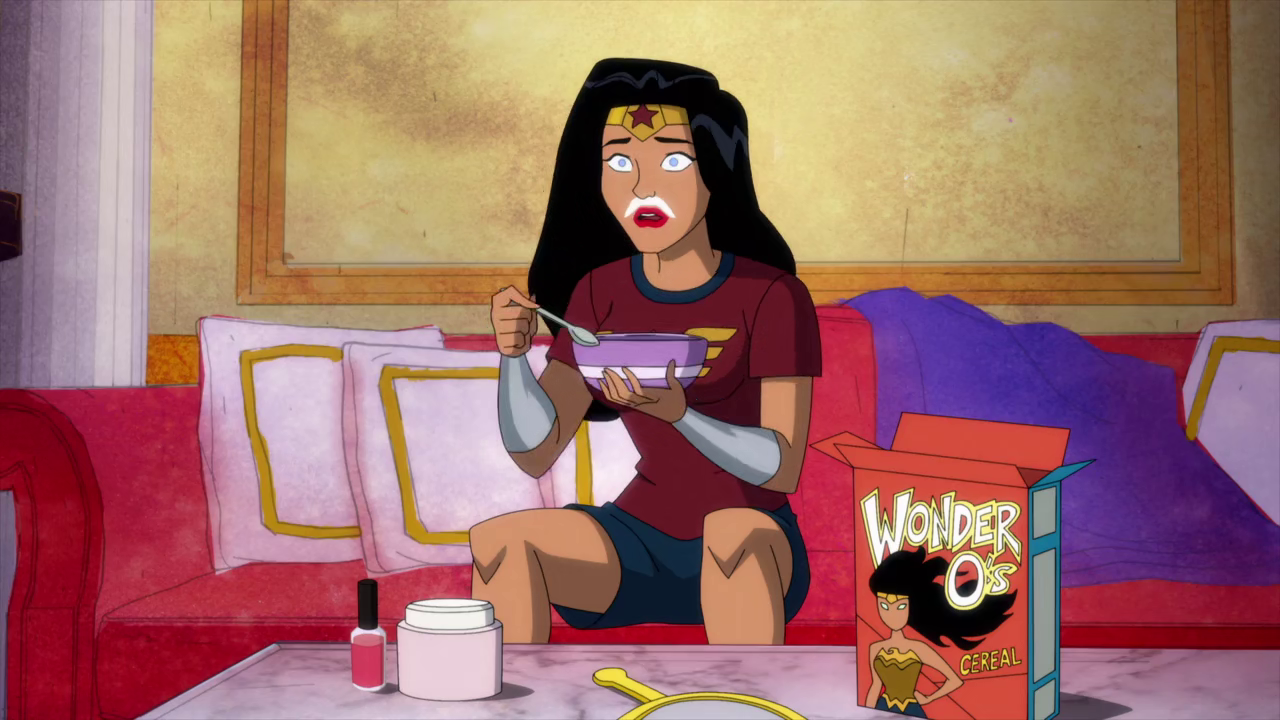
Wonder Woman, eating her own brand of breakfast cereal,
realizing all the ground rules have changed.
This juxtaposition turns an amusing series into a surreal one. What we have is a series which has IP-critical superhero guest cameos— and they basically stand in inhibited silence while a collection of supervillains dance around them, calling them out with ripe curses and sexual innuendo. The decision by DC and Warner Bros. to execute this vision is mystifying.

The other exhilaration that comes from ”Harley Quinn” is how this adult theme remakes every character anew. All the profanity and frank sex talk draws attention to the eroticism that rushes like a deep undercurrent under all superhero stories.The supervillans and superheroes depicted in the blockbuster movies are (mostly) extensions of their juvenile, sexless origins as juvenile, sexless comic-book characters, still hewing to a long-gone 70-year-old Comics Code. Not on “Harley Quinn:” on that show, everyone depicted are People Who Fuck.

People Who Fuck are all around us: it is the normal state of the human race. The great majority of DC and Marvel movies and TV shows still depict their intellectual property as non-existent from the waist down, like Muppets. This is my biggest peeve with the MCU: missing the normalizing dimension as People Who Fuck, for all the significant kisses and long, lingering gazes they’re all just cardboard simulations of real people.

This is the liberating synthesis of “Harley Quinn,” the result of the thesis of comic book characters mixed with the antithesis of real-world People who Fuck. Even though they are set in an unbelievable, unrealistic universe of magic and superpowers, the characters depicted within seem more real than any version of them that came before.

*One of the most confounding things about Adult or R-rated entertainment of late: no problem with profanity and verbally describing sexual situations-- but nudity is increasingly rare. I think, in the case of this show, the influence of the internet is the major deciding factor. If the showrunners ever decided to show Harley Quinn running around with her tits out, every fanboy image server on earth would promptly explode. So that will never happen.

Wednesday, December 31, 2014

Hobbit 3: Peter Jackson's Freestyle Round

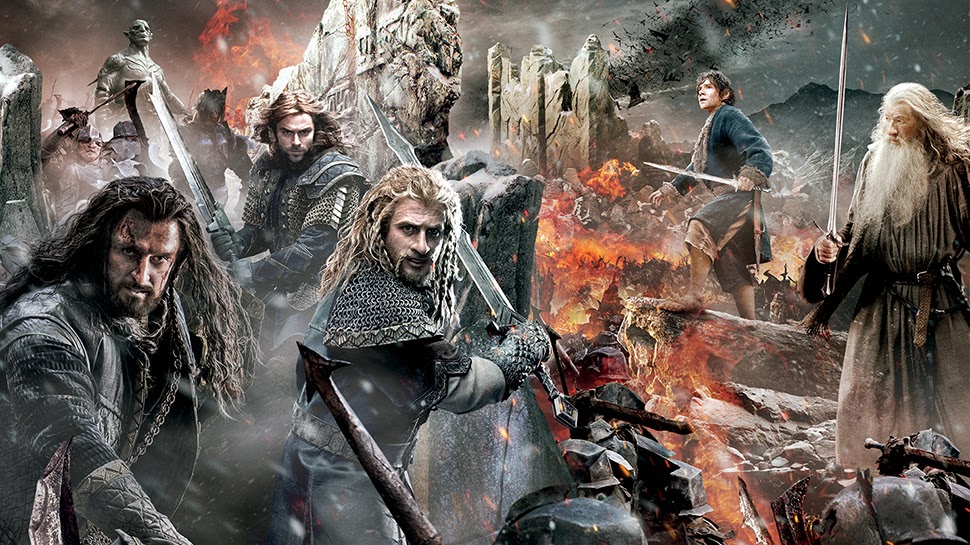
Just a sample of the non-stop, overlapping action that is most
of Battle of the Five Armies.
The Hobbit: Battle of The Five Armies was seen Monday night in crisp 48 HFR 3D.

Peter Jackson is much like a big kid with a huge Middle-Earth action play set. having dispensed for the most part with the events of the original novel in the first two movies, he gets to stretch out on the final battle scenes with greatly extended action sequences. His sense of cinematic place and direction is a good as ever, though, and the thousands of little CG soldiers on the screen never lose a sense of coherent action. And the ending is quite satisfying and presented without having to resort to the 6 endings of the last Lord of the Rings movie-- just one tidy ending, thank you.

Then again, the action on-screen versus the content of the original novel created a strange narrative situation where Bilbo Baggins (Martin Freeman) the titular hero of the film, disappears from the narrative for long stretches of time. I'm reminded of the third Matrix movie, where Neo disappears for most of a movie in which he is the putative savior.

Point-to-point:

• I only counted four armies. My issue probably lies with Tolkien, not Jackson.

Tauriel, cute as an elf.
• Evangeline Lilly as Tauriel was by far my favorite character. Yes, I know she was an entirely whole-cloth, non-canonical character. But her presence is important: added to the movie version to correct Tolkien's paternalism and give us a break from looking at an endless succession of hairy faces.

We also get something sorely needed in big action franchises like this: a love story. Sure, Tauriel the silvan elf may have been invented to prevent it from being the sausage fest of the original book, but it's welcome. She falls for Kili the dwarf, fully two heads shorter than her, but their love-at-first-sight relationship carries resonance-- and this is a welcome break from the general tones of madness, hate and manly stoicism embodied by everybody else in the film.

 A lot of this has to do with Evangeline Lily. She was the best thing about "Lost:" a soulful, loving yet complex and hermetic character in a cast of caricatures and cyphers. Lilly is a remarkably expressive actor and the only shame is she hasn't been in more movies. Tauriel gets to show love and loss and longing in a keener and more immediate way than anyone else in the entire trilogy. It's either a complement to Peter Jackson's skills as storyteller-- or an anodyne, in that he cannot conceive of anyone capable of having softer emotional connections than a-- shudder-- female character.

• You can tell the various races of creatures in this film-- in all the Rings and Hobbit films-- by how they appear after a little wear and tear. Hobbits (Bilbo at least) and Wizards get completely filthy: in fact, the wizard Radegast the Brown has shown up in all three Hobbit movies with a wad of dried bird shit stuck to his head. Humans and Dwarves are sort of grungy all the time, never too clean or too dirty. Elves-- the overachievers of Middle Earth-- never have a hair out of place or a smudge on their clothes. Orcs are similarly neat, all things considered: the lead Orcs wear little bits of armor and show a lot of skin, and would not look out of place in a Pride parade.

• The HFR process: Much improved of the first Hobbit movie. It might be the outdoorsy settings overall, but the scenes seem brighter and more colorful than the dark, washed-out first installment. The 3D was remarkably restrained and natural-looking: There were only a few gimmicky shots of falling stones and billowing flame and whatnot. Whatever Peter Jackson's tech folks needed to do to get the look of 48-frame-per-second to not look like video gloss, they did it.

Peter Jackson, Tolkien: It's been a hell of a ride. The first film series raised the bar for fantasy films forever. The last three, while somewhat under-stuffed and not quite as novel as the first three, are still deserving of all the success they have reaped. If this is Jackson's victory round, he can and should be allowed to freestyle a bit.

Wednesday, June 26, 2013

The Fever Dream That Was Casino Royale

Peter Sellers as Evelyn Tremble/James Bond 007. He was by far the most
charismatic actor in Casino Royale, so it's a shame he didn't shoot his
entire role. In this scene he is playing Baccarat with Le Chiffre
(Orson Welles), despite the fact they were never on the set at the same time.
I do not believe I have ever before seen the 1967 version of Casino Royale all the way through. That is, I thought I did not see this film until I watched it last night in pretty HD. Then I realized I had seen it, probably several times: it was such a mess of a film that my young mind probably couldn't coherently file it away. So this movie somehow fooled me into thinking I never saw it.

And now I know why.

Like I said, Casino Royale (which Daniel adores, for many reasons now very obvious) is a mess of a film-- a glorious tribute to the excesses of producers who believe they have such a hot property that, like a hyperactive dog with a soup bone, they don't know what to do with it. The hot property here was the film rights to "Casino Royale," the first Ian Fleming 007 novel from 1953. These rights eluded Cubby Broccoli and EON Productions, ending up in the hands of Charles K. Feldman and Columbia Pictures.

Woody Allen as Jimmy Bond / Mr. Noah. I'm guessing Charles Feldman
Owed him a solid for writing What's New, Pussycat? and gave him the
juicy Villain role. He was not as funny as you'd expect in this film.
What do you DO with a legally usable character of such as James Bond, Agent 007, in the absolute height of his popularity? Feldman couldn't compete with Cubby Broccoli in terms of making a straight action film. So he made a spoof out of it. And boy, did he lay it on thick. You don't get one James Bond here: you get at least six. Every girl in the film is a Bond Girl (or will eventually be). It's a work of reactionary cinema: almost every scene refers in some way to the main Bond series.

And, like I said, it's a mess. There were six directors and even more screenwriters. Peter Sellers walked off the production, leaving huge holes of missing footage. Orson Welles insisted on doing magic tricks in his scenes. In the end, the filmmakers got so desperate they literally hung the numbers "007" on everything: seals, monkeys and on a plane full of awful Native American stereotypes (who parachute while saying "Geronimo!" Get it?)

Joanna Pettet as Mata Bond. She was a very pleasant surprise: exeedingly
beautiful and quite funny, the best Bond Girl in the film. Yes,
Ursula Andress was also in Casino Royale, but she's a dud:
thanks to HD, It's plain Ursula read her dialog off dummy cards.
All this being said and well-documented (really, this is one of those films where the making of is more interesting than the film itself), I'd have to say it is still a very funny, very unusual film. If you were looking for insight into the mid-1960s, particularly into the slim moment in history when the early 60s James Bond Space Age aesthetic was about to be eclipsed by the psychedelic, Op Art late 60s, this is the touchstone.

The jumpy, scattered storyline is in some ways ahead of its time. Movies of this era were often plodding and linear: it took breakthroughs like Bonnie and Clyde and Easy Rider to move Hollywood cinema to a more punctuated style of narrative. In Casino Royale this evolution happened accidentally: The very effort to salvage this movie -- missing stars, unshot footage, plainly overindulgent style-- into releasable form created a weird dreamlike flow to the story. This interpretation makes quite a bit of sense: If you were dreaming about, say, James Bond, and his appearance shifts from David Niven to Terence Cooper to Peter Sellers, that would seem to the dreamer as a perfectly normal development. Locations shift nonsensically: characters are carefully established, disappear, then re-appear: To the dreamer, none of this seems out of place. So now you know why I didn't remember seeing this film as a kid: can anyone really remember dreams?

It's about as insane as any Terence Malick or David Lynch movie, but much funnier.

Tuesday, May 15, 2012

"Community:" You're Only Dreaming You're Reading This

"Community," a comedy on NBC that notionally chronicles the adventures of seven diverse members of a study group attending a mediocre 2-year college, is a rare beast: a half-hour comedy that serves up laughs while actively de-constructing itself and the entire idea of commercial televised entertainment. There's far, far too much great stuff about this series to encapsulate in one article ("Law and Order" episode; "Elementary Chaos Theory"). I'm more interested in examining the May 10th episode "Curriculum Unavailable," and it's unusual pedigree.

Community's third season is wrapping up on a rather apocalyptic arc: SeƱor Chang (Ken Jeong), former Spanish teacher and now head of security, has engineered a coup, installing himself as the despotic head of Greendale Community College, with an army of junior-high-age minions to do his bidding. He has replaced the spectacularly quirky dean (Jim Rash) with a doppleganger and, to eliminate any challenge to his hegemony, has expelled the study group. "Curriculum Unavailable" begins two months after their expulsion: Abed (Danny Pudi) has been picked up by the police for dumpster-diving (for evidence) at Greendale, and has been compelled to visit a shrink. Being a sitcom, all seven study group members attend the therapy session, with John Hodgman guest-starring as the psychiatrist.

The Study Group, in Greendale Asylum,
imagining themselves as community college students.
By the end of the third act Hodgman makes his stunning-- and strangely convincing-- diagnosis: The entire study group was, at one time and for various reasons, all institutionalized, and Greendale College is entirely imaginary: he contends the group collectively invented a ”fantastical community college where everything that happens is unbelievably ridiculous-- and it all revolves around you.” The study group all freeze in the realization that he just may be right...

This idea-- that the premise of an entire fictitious universe may be the construct of a character in the same universe-- has been trotted out over and over again, especially in movies: Shutter Island, Inception, Total Recall, etc.

Easy to do in a movie-- but not so much in TV: that's because commercial TV series, due to the needs of breaking up story flow for advertising breaks, are dominated by structure and precedent and genre. A sitcom, for example, has a very specific structure: one-camera, three-camera, serial or episodic, every comedy consists of unique elements built upon a solid framework of familiarity. If the "acts" (the spaces between commercials) don't end on satisfying climaxes, the viewer will change the channel: this requires even more structure. It all results in a strange interpretation of reality, where for the sake of storytelling everything revolves around the leads, there are four important revelations per episode, and everything returns to status quo by the tag.

So when an "all this is a dream" idea is put into a TV series, the novelty of it and the structural requirements of serial TV grind against each other, and things get really memorable (and from this point on it's non-stop ••• spoilers••• if you ain't watched too much TV):

Jack, in his final moments.
• ABC's "Lost" (2004-2010) was always tinkering with it's own premise. Characters would die, resurrect, assume different personas, and in the final season the entire cast was duplicated in two separate timelines. In the end, the very very end, the island the show was centered on turned out to be the mental projection of a dying character, a fugue in his final moment of life that lasted and lasted and lasted. BBC's  "Life On Mars" and "Ashes to Ashes" worked the exact same idea.

They even got the bedspread right.
• This dream idea, when first applied to a sitcom, resulted in what was probably the finest show finale ever: "The Last Newhart," the last episode of "Newhart" (1982-1990). Bob Newhart's character, a beleaguered owner of a Vermont inn, is struck in the head by a golf ball: he awakens in bed as his character in "The Bob Newhart Show" (1972-1978) next to Suzanne Pleshette, his wife from that earlier show. The entirety of "Newhart" was apparently a dream brought on by bad sushi.

• Let's not forget the season 8 cliffhanger of "Dallas" in 1986, where Bobby Ewing turns up in a shower and the entire preceding season was revealed to be the dream of another character. But this was not an organic part of the show: rather, a way to paper over some cast changes. The general reaction was either annoyance or amazement at the show's audacity.

Buffy Summers, awake and "lucid" and wanting
nothing more than being able to leave Sunnydale.
• "Curriculum Unavailable" has a direct and unlikely precedent: It refers to "Normal Again," an episode of "Buffy the Vampire Slayer" which aired almost exactly ten years ago.  Protagonist/super-powered Slayer Buffy Summers (Sarah Michelle Gellar) is enmeshed in the typical events in this show's enchanted Sunnydale universe (fighting demons, vampire lovers, using witchcraft, etc.) when she begins to experience hallucinations induced by a demonic toxin. In these hallucinations, she's a mental patient in an asylum in Los Angeles, and has been for six years. Her mother and father, dead and gone in Sunnydale, are there: Buffy's sister Dawn, who magically appeared in season five, never existed. In "reality," Buffy has retreated into an elaborate invented world of magic and monsters and can no longer distinguish her fantasy from reality. But the kicker is: when she describes her situation to her friends in Sunnydale, they exchange nervous looks-- and are unable to refute her assertion that they and the world around them are nothing more than a farfetched illusion. At the end she breaks from "reality," and fully enters her Sunnydale existence: The last shot is Buffy's parents being told by a psychiatrist that she is now hopelessly "gone." It was-- and remains-- one of the most amazing hours of television I have ever seen. It was Joss Whedon acknowledging the intrinsically fantastic premise of his own show: in "Normal Again" he completely shredded it, to let us know how fragile and artificial it-- and any television universe in general-- is. (This idea was so good it was lifted almost note-for note in a 2007 episode of "Smallville.")

The perfectly cast John Hodgman.
But of course "Community" is far too clever for that: Seconds after walking out stunned from the psychologist's office after being told their college is imaginary, study group leader Jeff Winger (Joel McHale) stops and says, "hey, wait! That makes no sense!" Abed, indeed, has hundreds of pictures of campus on his phone and Annie (Alison Brie) has a backpack with the school's logo on it. Hodgman was an impostor, hired by Chang to keep the Study Group from discovering his machinations. In other words, the implausible sitcom premise is correct and the explanation that makes sense in our universe is entirely wrong.

Which is how we like it.

Monday, May 7, 2012

The Uncanny Valley - Live!

I didn't see this guy, but he sure illustrates the point
Spent an hour or two on this weekend at the world-famous Magic Castle in Hollywood, the guest of a magician's dad. We saw 4 magicians and I noticed an interesting phenomenon: normally, by default, magicians are kinda creepy.

I'm saying by default because the guy's son and the closeup magic guy were personable types with senses of humor that you could imagine having a pleasant conversation with. But the other two, who were also brilliant and skilled magicians, were just aliens man. They were impeccably dressed, intense, and inhabited a spot on the creep scale somewhere between John Malkovich and Charles Manson.

So what is it, do you suppose? Are normal guys trained to be that way because they can make their acts more "mysterious" or does magic just attract that kind of person?