Showing posts with label Aspect Ratio. Show all posts

Tuesday, October 8, 2019

JOKER: Nihilism With a Purpose

How fascinating was Todd Phillips' Joker? I didn’t even realize until it was over that the movie was in 1.85:1, traditional spherical widescreen. We’re in an era where almost every theatrical film, tiny indie or major studio release, is in 2.39 ‘scope. It was presented in the period-correct aspect ratio, and the period-correct film washed over me so thoroughly I didn’t even see the frame— and I ALWAYS see the frame.

Controversy swirls around Joker like the cloud of delusions that define Arthur Fleck (Joaquin Phoenix), the movie’s antihero. we’ll get to that later, but first an appreciation of the film’s star. Phoenix was given a lot to work with here and he delivers. In truth, he over-delivers: his character is mentally ill and unknowable and his performance never deviates from this condition. This lends his story and the larger story of Joker a disjointed, alienated feel.

Arthur is a clown-for-hire who aspires to be a stand-up comedian, except his illness leaves him basically without a sense of humor. Inappropriate laughter is his illness’s major symptom: we see him in a comedy club, trying very hard to understand how comedy works, writing notes and laughing at the set-ups, not the punchlines. And his laugh is not a chilling villain’s cackle: it’s a strangled, involuntary reflex he cannot control.

Joker is set in a realistic version of a fictional past: Gotham, the East Coast city from the Batman franchise, in the late 1970s or early 1980s. It has the look and feel of the gritty “New Hollywood” films shot in New York or Philadelphia at the time: trash in the streets, tagged up subway cars, theaters downtown devoted to pornography, and there is not a computer or cellphone in sight. You will think Todd Phillips is emulating Martin Scorsese’s Taxi Driver (1976) to an extreme degree, and you‘d be right. But I’ll argue it’s worth it: the art direction, locations, sets and costumes are worth the price of admission by themselves. The attention to detail is remarkable and thorough. Joker only betrays its 21st-Century origins in the beauty of the images (Shot on an Arri Alexa 65) and the smoothness of camera movement (they have all sorts of magical tech gizmos to facilitate that). Back in the bad old days filmmakers like Scorsese and Melvin Van Peebles and Joseph Sargent and Gordon Parks had to make do with Arriflex IIc cameras loaded with grainy, pushed 35mm film, wooden sticks and Lowell incandescent lights.

Gordon parks, making do with an Arri IIc.
In my opinion Joker could have dispensed entirely with the entire DC Batman mythology. The film did not need it, and it added nothing to the core of what is essentially a psychological thriller. In fact, the baggage of the Joker mythology creates an ethical issue: we know that Joker will become a master criminal and an unrepentant, cold-blooded murderer: this aspect is part and parcel of Joker’s DC persona. But remove Arthur Fleck’s known fate to be a villain, and it becomes the story of one man’s mental disintegration during an era where isolation and alienation were practically the norm.

Martin Scorsese, behind a soundproofed Mitchell NCR.
It’s not a perfect film and it is not that easy to watch: Arthur Fleck is set up as a victim for most of it, and we see him on the ground getting his ass kicked twice. The first half of the film is set-up, and we see things in Arthur’s life, which started out bad, just get worse. The very conditions of urban life in the late 1970s are the antagonist here: Budget cut-backs eliminate Arthur’s weekly visits to a social worker and access to medication to keep his illness in check. He lives in a hideous apartment with his declining mother (Frances Conroy) in a neighborhood overflowing with trash. Adding humiliation to alienation, Arthur’s attempt at stand-up comedy is mocked by a late-night talk-show host (Robert De Niro, playing Jerry Lewis from The King of Comedy). His character is clearly being pushed towards a break with normality, and when it comes the only thing surprising about it is how gory it is.

Joaquin Phoenix, before an Arri Alexa 65.
It also makes Arthur Fleck’s eventual transformation into the Joker problematic. The film explains him away: he is the product of bad genes, a terrible childhood, an even more terrible environment, and horribly complete social isolation. This was the thrust of most of his comic-book origin stories as well: in the famous graphic novel “The Killing Joke,” The Joker is the result of one normal man after one very bad day.

At the point in the story where Arthur Fleck eventually snaps, everything in the film has been placed to make his move to villainy sympathetic. This makes Joker an exercise in pure cinematic nihilism: it’s a director deciding make a murderous villain his movie’s hero. And this is where the film goes from compelling but flawed to brilliant, because Joaquin Phoenix’s performance is the counterbalance to Todd Phillips’ nihilism. He portrays Arthur Fleck as disjointed and mercurial: his moods change from scene to scene, from somewhat sympathetic to completely alien. He leaves the audience with nothing to grab on to, which is the point. As much as the film tries to set up the origins of Joker as pitiable, Joaquin Phoenix pushes back, making sure you don’t feel shit for the guy. It is rare these days to see the an actor-versus-director dynamic play out onscreen, but that’s what we get here.

The “tell” of Joker— the element Todd Phillips and co-writer Steve Silver steered away from DC canon to stake out new narrative territory– is the portrayal of Bruce Wayne’s father, industrialist Thomas Wayne (an almost unrecognizable Brett Cullen). In the comics he is the just, benign father-figure of young Bruce, whose strong ethical sense set Bruce on the path to be a superhero. But in Joker he is a grasping, bloated capitalist who literally sneers at the poor: “Those of us who have accomplished something with our lives will always look down on those who have not as clowns.” Thomas Wayne's statement sparks deep resentment among Gotham’s beaten-down residents, and starts a clown-themed anti-establishment movement— not too far off from the Guy Fawkes thing from V for Vendetta— to topple the rich of the city.

And that is what makes Joker timely. Set in the 1970s, it nonetheless completely understands the cruelty of inequality in our time, and the fact that a society without empathy breeds monsters.

Thursday, March 21, 2019

Apollo 11: Best "Found-Footage" Doc EVER

First of all, I was there for the real thing: July 20th, 1969, when Neil and Buzz of Apollo 11 walked on the moon. A moment in history never to be forgotten or repeated, the day the cold, lifeless universe began to yield to humanity's will. I did not think in such grandiose terms at the time, of course, being seven years old-- but nothing could have pried me away from our Motorola console TV that day, not for all the candy in the world (and the candy was very good in 1969).

We had relatives over and everyone watched with wonder-- except my uncle Jim, who had a big lunch and was passed out in dad's Barcalounger, snoring through the whole thing. I was annoyed with him at the time, but now I realize he had a half-good reason to be zonked out: For such a momentous event in world history it was not a particularly interesting one to watch. Neil's step onto the lunar surface was carried live, but it was a super-contrasty monochrome image. The networks carrying the moon landing used a lot of cheesy animation, simulations and talking heads to pad out the low-res NASA video feed. The astronauts had to return to the earth, with it's plentiful film processing facilities, with magazines of exposed 16mm movie film and 70mm still images to give us the iconic imagery we associate with the era.
Live video of Armstrong on the moon looked like this.

The media status for early manned spaceflight hasn't changed that much: Grainy 16mm and low-res video (some in color), backed up by more 16mm TV coverage. When documentary filmmaker Todd Douglas Miller set out to make a 50th anniversary tribute of the Apollo 11 mission, he started out with the same resources everyone else had since the Nixon era: The familiar stills and grainy news footage, the same warbling audio.

Then two remarkable archives of previously unseen and rarely heard content were discovered.

The Mitchell AP65, very likely one of the cameras used
to document the Apollo missions.
The first discovery was the identification, deep in the vaults of the National Archives, of 165 reels of well-preserved Todd-AO 65mm film negative documenting the Apollo missions, from 8 to 14. These had been stored-- unseen-- since they were shot. Nobody even knew WHY this incredible trove of film existed: There was a tenuous connection to a failed co-production between NASA and MGM pictures, and this precious footage may have been outtakes from this effort. It is more likely that some unknown Public Affairs Officer at NASA wanted a definitive archive document for this extraordinary moment in human history, in the highest fidelity possible. In terms of capturing detailed, realistic imagery, 65mm was about as good as you could get in the late 1960s-- The resolution is the equivalent of 13K digital, a DCP format that does not currently exist because it would melt the image processors.

From the opening sequence: the Crawler delivering the
Saturn v rocket to the launch pad.
The second discovery was the original 30-track audio recordings of  the Apollo missions. At Mission Control in Houston all the various departments (CAPCOM, FIDO, Guidance, etc.) had their own audio circuit loops so the various members of each team could talk to each other. Other departments could punch into these loops as needed: a lot of the cool buttons on the Mission Control consoles are simply audio patch switches. These archive tape reels were digitized, corrected for various imperfections (the “wow and flutter” of the original audio made a lot of the voices on these tracks sound tremulous and nervous: now they just sound normal) and time-coded.

The Saturn V taking off, in 65mm Todd-AO.
These new resources went into Apollo 11— and the results are nothing short of magnificent. You have never seen Apollo-era NASA footage like this before: It's crystal-clear, with vibrant, unfaded color, looking like it was shot yesterday. The vividness is startling, out of context and impossible-feeling, as if someone found super8 home movies taken during the Battle of Gettysburg. The 65mm footage in concentrated in the beginning and end of the film, the launch and all the hubbub around it, and the carrier recovery and processing afterward. There was one Todd-AO camera set up less than a mile from the launch pad (on remote control, if they were smart) and the result is the most insanely detailed look at a Saturn V taking off ever seen. It puts the digital simulations of Apollo 13 (1995) and First Man (2018) to shame.

Johnny Carson, watching the launch from the VIP stands.
He is wearing a give-away paper baseball cap provided
courtesy of RCA. This was 1969: wearing hats went out with
john Kennedy, and only little boys went out in public
wearing baseball caps.
The 65mm camera operators covering the launch did something remarkable: they turned the cameras away from the NASA gear and into the crowds. Some of the best footage is of people milling around that hot morning in Florida, chatting, grabbing snacks, setting up cameras. Warm-weather casual fashion was on display everywhere: and what struck me is 100% of the adult men in attendance at Cape Kennedy or watching nearby wore shirts with buttons and collars. In 1969 T-shirts were underwear, or just for boys.

They let the 65mm camera into the Launch Control Center
at Kennedy, probably because all the windows would provide
enough light to get good shots. Mission Control in Houston
is windowless and all the footage is low-light 16mm.
The middle of the film relies mostly on older 16mm film archives, but the addition of the recovered 30-track audio elements adds something new: when we see Gene Krantz or Charlie Duke talking on those black headsets, the audio is in perfect sync. Before the new audio was available, filmmakers didn't even try to sync the audio.

Overall, it’s a tidy (93 minutes), Cinéma vérité style doc, long on reproducing the sights and sounds of the Apollo 11 mission with a minimum of explanation and no narration. If bringing the past back to life is the goal of any documentary, the startling new video and audio of Apollo 11 sets the highest standard I’ve ever seen.

Neil, Mike and Buzz, about to board the Airstream to the stars!
Any new documentary about American manned spaceflight is an exercise in somewhat wistful nostalgia: they document an era when we used to take on huge, improbable projects like this, apply the best minds on earth to the task, and make human history. There was a recent interview with a retired NASA official where he said that if the funding for space exploration had continued at the same pace as the Apollo program, humans would have landed on Mars by 1985. Alas.

Sunday, November 18, 2018

It's Nice To See ANY Side of the Wind At This Point

You know, I watched a lot of Tonight Show with Johnny Carson in my youth. And it was great comfort food but if you asked me to tell you now about something I remember from all those years of TV, I couldn't. Almost.

I remember one anecdote from the late seventies. Rich Little was on the show, chatting with Johnny about his experience shooting Orson Welles' The Other Side Of The Wind. It was a party scene, and suddenly Orson, behind the camera, bellowed "look down! Between your legs! Midgets are running between your legs!" And later between takes, Little asks Orson "hey, what's with the midgets?" And Orson grunted, "We'll put the midgets in later, when we're in Mexico."

Since then, I've wanted to see that movie.

And by all accounts, Orson wanted me to see it too. Principal photography was done, piecemeal, from 1970 to 1976 whenever people were available and there was enough money; and post production went on for another 5 years until, tragically the footage was seized by the Ayatollah Khomeini during Iran's revolution. (a major portion of the film was owned by the Shah's brother-in-law). From then until his death, Welles devoted his time to getting the footage released and raising money to finish it, but it never happened and Wind became another unfinished Welles movie. There's a lot of 'em.

However, perhaps because it was his last and because the subject matter was clearly so much about Welles himself, people have been trying to until the Gordian knot that secured this thing ever since. And Netflix, a company with resources so great that they could achieve what Showtime failed to do in 2002, has finally done it. Those crazy bastards not only finished The Other Side of The Wind, they also slapped together a documentary about it called They'll Love Me When I'm Dead. It's a documentary about a movie which is, largely, a movie about itself.

Let's just call it TOTSOTW, shall we? TOTSOTW takes place during the last night of film director Jake Hanneford's (John Huston) life. Hanneford is a legend, a firebrand iconoclast genius with enormous appetites, gallons of toxic masculinity and little discipline. His friends (allies, I guess) are throwing a party for his birthday but also to screen his unfinished art film, "The Other Side of the Wind" in hopes of raising the money to finish it. At Hanneford's side is his pal and erstwhile biographer Brooks Otterlake, a character obviously based on Peter Bogdanovich who was originally to be played by Rich Little because Bogdanovich lapses into impressions frequently. However Little dropped out because he only had 3 weeks to shoot, and Welles replaced him with Bogdanovich, So Bogdanovich is playing the Bogdanovich character but Huston plays the Welles character.

Most of the guests are either film students, critics, old Hanneford compatriots, mannequins, or mischievous drunk midgets. I'll be honest, I thought Rich Little had made that part up.

I'm giving you the setup and not the plot here. Frederick Wisemen, the documentarist, was once approached by a film festival. There were writing up a program for the weekend and they wondered if he could summarize his entry into a paragraph for them. Wiseman scowled, "if I could do that I wouldn't need to make the documentary!"  TOTSOTW is pretty similar. It IS the summary. It's kind of those ten years boiled down into 2 hours and 2 minutes. I can tell you it's shot in 3 or four different styles, two aspect ratios, and seemingly whatever film stock Welles could get at a discount. It looks like Oliver Stone's work from a couple decades later. Part of the conceit is that some of the footage is from the film within a film, some is just the movie, and some is documentary footage from film students. Mostly it's a hall of mirrors so you won't notice that there is three years between the close up and the reverse angle.

As infuriating as TOTSOTW can be, I kinda love it. I want to watch it again a few times. Once Welles gave up on trying to sell tickets to the normies he did his best work (and worst simultaneously) and it's fascinating driving around the sharp curves in his brain.

Tuesday, July 25, 2017

Dunkirk in 70mm

Saw Dunkirk last night at the Century 9 in downtown San Francisco in a lovely auditorium. Some theater chains are giving up on seat-filled rooms and are opting for a luxe experience. This place had just that: reclining seats with footrests, low wall between each row so you couldn’t even see the heads of the people ahead of you. If they wanted to re-create the living room experience, they succeeded.

Christopher Nolan lines up a shot on an IMAX camera.
Dunkirk features some of the first hand-held IMAX
footage ever shot. That does not sound like an
easy thing to do.
The Format: Dunkirk was screened in vertical 70mm-- the second-best way to see it: 2.20:1 70mm film threaded through a Cinemeccanica projector. This yields a super-sharp picture, the equivalent of a 13K Digital Cinema image— which is significant because 13K Digital Cinema does not exist. In the few moments when the film slows down— there aren’t many— you can scan the frame and take it in. The 65mm cameras captured it all: Every gold thread on the brim of Kenneth Branagh’s cap. The anguished face of a solder standing on a quay, far in the background. The deep color of Blue Hour over blowing sea foam on the strand.

The Story: Dunkirk follows three main story threads happening at different times during the evacuation of Dunkirk, in different places: on the French shore, on a small boat joining the improvised rescue, and in three Spitfires above the fray. These plots intertwine and cut back and forth, in a way that is unusual for most movies and almost unheard of in war movies, which tend to stick to a linear timeline. But it is a testament to this film that this intercutting is never confusing or abrupt: as the threads come together the tension builds and builds to an almost unbearable level near the end. I would credit this to director Christopher Nolan, of course— but he was abetted by both Lee Smith’s precision editing and Hans Zimmer’s percussive musical score.

Requisite cast of thousands, on a quay.
It’s worth noting that the script for Dunkirk was only 76 pages long. This has everything to do with the dense action sequences and remarkably spare dialog. There are many scenes where soldiers say things to each other which are entirely unintelligible over the noise of war. It doesn’t matter in the least. Nolan, I believe, is making a statement about the smallness of the individual in the face of titanic events (like World War II and the evacuation of 400,000 people from a beach in France) but also about  the sort of everyman quality of the average British soldier. Much has been made of the fact of One Direction’s Harry Styles having a lead role in Dunkirk— but really he just looks like every other British soldier in the film: a skinny, pale extremely young man in a brown wool uniform wearing a permanent expression of terror.

The official format guide for Dunkirk. We saw it in
70mm, the left center format. When I see it again,
it'll be in IMAX 70mm.
The Scope: Christopher Nolan is famous for relying on practical effects over digital effects, and in Dunkirk this is very much in evidence. His extras are running from real explosions on the beach. He had ships rigged to capsize, and strapped cameras onto them so you see and feel the roll over. He put Tom Hardy and Jack Lowden in a two-seat Yak modified to look like a Spitfire and flew them over the English Channel. In fact, his hesitancy to go digital shows on the edges: You can take in stretches of beach other filmmakers would have filled with “tiled-in” digital extras, and ocean vistas that could have been populated by little digitally inserted boats but weren’t.

Lack of Germans: You never see the face of the enemy in Dunkirk. There are fighters and bombers doing damage, and snipers and machine-gunners, but the film doesn’t bother with scenes of the German soldiers or pilots. This makes this an even more unusual war movie. As Jared pointed out after the film was over, you don’t need 'em: The British soldiers stranded on the beach never saw them either.

One of the best elements of Dunkirk is its length, or rather lack of length: 106 minutes. Tell a story, do it well, and tell it with efficiency. And hopefully the relative shortness of the film will give you extra time to travel to a screening in 70mm or 70mm IMAX.

Sunday, December 25, 2016

La La Land Successfully Updates A Genre

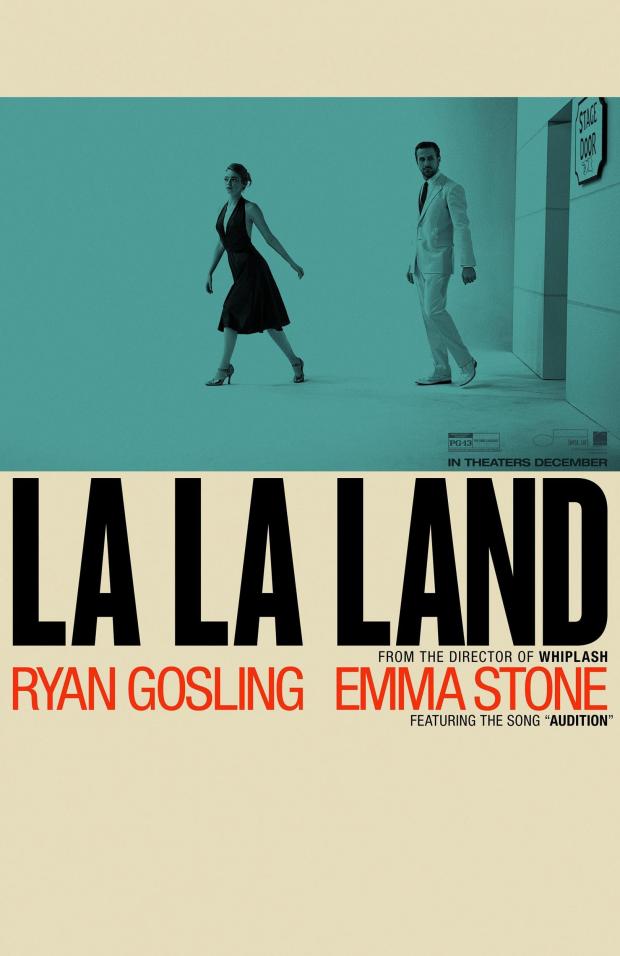
La La Land is a rare bird, a genre musical film— refreshing and uplifting, sincere and happy and melancholy, a much-needed anodyne for the darkness and cynicism of late cinema. It tells the story of the meeting of two young people, Sebastian (Ryan Gosling) the musician and Mia (Emma Stone) the struggling actress. Both are working marginal jobs, waiting for their moment to break into the careers they dream of. When they meet (after a few hilarious missteps) love begins to bloom— and in true musical manner, their emotions soar in the form of song and dance. This is what is wonderful about musicals: in their universe emotions cannot be contained by prosaic reality. They require the characters spontaneously burst into song. Narrative reality breaks loose and people levitate into a magical space where people dance in the middle of traffic jams and fly into the stars of a planetarium.

But it’s not all just a cinematic heaven of singing and lyrical passages of fancy: the eternal rival of romance and career soon takes over.  Mia and Seb inspire each other to take risks, work hard and strive to make their personal dreams come true. The cost of pushing career first soon becomes the central conflict of La La Land, which leads to one of the most soaring and beautiful and melancholy and moving conclusions I have seen in a modern film.

The third character own this film— the namesake— is it’s wonderful, make-believe Los Angeles: Angel’s Flight, Mulholland Drive, Griffith Park, palm trees and stately SoCal architecture under an endless blue sky or deep blue night. It’s a fun, vibrant place full of artist, actors, strivers and dreamers. It’s been too easy in films of late to see LA as some of late-capitalist hellscape (see Training Day): It’s refreshing to remind all of us that LA is a place where people still go to try to make their dreams come true.

Director Damien Chazelle’s last film was Whiplash, a sort of crazy stalker film set in the world of jazz music about an earnest drummer and his insane instructor (J. K. Simmons, who has a lovely cameo in this film).  Jazz plays heavily and strangely in La La Land as well: Sebastian is a young man obsessed with the world of jazz: he has posters of jazz greats in his apartments, Hoagy Carmichael’s piano stool and longs to open a real jazz club in Los Angeles. There are plenty of kids these days who passionately love alls sorts of dead or marginal forms of music: it never becomes clear of Seb is sincere or just really good at affecting his love of the genre.

"A Lovely Night" on location.
The most remarkable number— a real masterpiece of a shot— is “A Lovely Night,” which occurs near the beginning of the film. After a party in the Hollywood Hills where they accident meet up, Seb is helping Mia look for her car. They break into song and dance at a scenic overlook, the wash of lights in the LA basin below. The scene, which goes from real-world to singing to dance to tap-dance (!) is shot at the real location and very specific time: PAST “Magic Hour,” just after sunset, when the warm glow of the sunset underscores a deepening dark blue sky. The set lighting is low as to illuminate the actors and still leave the sunset and sky bright. This scene not only highlights the considerable singing acting talents of of Ryan Gosling and Emma Stone, it shows off cutting-edge film technology: fine-grained, fast film stock (La La Land was mostly shot on 35mm film), fast anamorphic lenses and the latest light, agile camera packages. Were this a Golden Age musical, this shot would have happened on a soundstage. But instead, it is one long, six-minute shot at a very narrow, specific time of day. This makes it breathtaking on several levels.

Another nice PAST-magic hour shot.
La La Land is in many ways an updated classic movie, a pastiche of the conventions, narratives and styles of Hollywood musicals. It is not a breakthrough in and of itself: this isn’t pure storytelling and cinematic innovation like Mad Max: Fury Road was. It takes the best elements of a great genre, updates the sensibilities to contemporary morés and makes it all fresh and unexpected again. There’s a little Vincente Minelli here, some Gene Kelley there, a little Jaques Demy, Even a bit of Ross Hunter/ Doris Day and Paul Thomas Anderson.

Another girl in magical old Los Angeles, dreaming
of acting fame. Naomi Watts in Mulholland Dr.
Given all these obvious movie-history references it was then very, very strange that while La La Land played, the place I kept going to for a visual and stylistic reference was… David Lynch. I COULD NOT STOP thinking: “This is a light-hearted musical version of Mulholland Dr. (2001).” It shares a lot of the same qualities as Lynch’s masterpiece: striking cinematography filled with shots of strong primary colors; an abiding love of Los Angeles locations, show business, actors and the mechanics of filmmaking; flights of surrealism; and intimate close-ups, bursting with emotion. These films are on entirely different missions— light, uplifting musical surrealism versus a surreal dive into the darkest parts of the id— but there is a common thread as well, in look and feel.

I may well be mistaken and La La Land may have been released in the
original CinemaScope aspect ratio of 2.55:1. But that's not how I saw it
in Redwood City: they couldn't even manage to mask the screen right.
And, sorry to say, I have to disagree with both the opening title card and Dana Stevens’ review and report that La La Land is NOT in CinemaScope. That specific film format was proprietary for to 20th Century-Fox and Bausch and Lomb, who standardized the elements of anamorphic cinematography. CinemaScope lenses were not much used past 1960: these early models had distortion problems that caused actors’ faces to widen unnaturally: “CinemaScope Mumps,” they called it. Panavision fixed this problem by re-arranging lens elements to minimize distortion. This film is actually in Panavision: they used Series C lenses to shoot it. But this is a quibble: the widescreen compositions are so lovely and the mise-en-scene is so well developed and rich, it’s worth another viewing just to look for visual clues and symmetries.

If you love Hollywood genres old and new, this is a must-see.

Tuesday, August 23, 2016

The Brilliant Hack Work of "Stranger Things"

The one-sheet by Kyle Lambert.  I would
call this composition form "Drew Struzan
Baroque:" The color fields, grouping
and eye-lines are nearly identical to
any number of his 1980's posters.
Watched all 8 episodes of this Netflix series in short order: it’s slow and convention-bound in the first few episodes, but it soon stretches out into a satisfying-- if strangely derivative-- science fiction/horror series.

In 1983 Indiana, a young boy suddenly vanishes after a game of D and D with his friends. This sparks several searches and investigations by the missing boy’s friends, family and local authorities, which soon start turning up something unsettling, malevolent and supernatural lurking in the woods outside town. At the same time a strange girl appears, an escapee from a secret government site, embodied with telekinetic powers-- who may prove to be the key to finding the missing boy.

Millie Bobby Brown as "Eleven." Apparently
that buzz cut was not all that easy to achieve.
The direction in these eight episodes is remarkable. The visual style is striking, the art direction is thorough and the individual shots are extremely well-composed (in 1.85:1 Spherical Widescreen, the most popular aspect ratio in the 1980s). The central cast are young teenagers, and every one of them offers realistic, emotive performances— in particular Millie Bobby Brown, who plays the mysterious Eleven. Strong performances by children is an indication of a strong director— or, in the cases of some episodes, directors (the show's creators, the Duffer Brothers).

The Duffer Brothers with Winona Rider on the
set of "Stranger Things." Or is this an homage
to Dead Ringers (1988)?

As stated in the title "Stranger Things" is, nonetheless, “hack work of the highest order.*” A little Poltergeist and E.T. here, a little Evil Dead and Firestarter there, litter the sets with vintage movie posters, and it's a solid tribute to the era. If you were able to subtract these period elements, I doubt there would be enough to fill a single hour-long episode. The title sequence is a well-imitated optical-effect-looking shot, complete with negative specks and vintage fonts (Korinna and Avant Garde). As solid and satisfying as the main plot threads are, there are also weak subplots about bullies and ex-husbands and past loss. Still,  "Stranger Things" is very much worth a good binge-- If anything, it’s fun to watch the show and pick up the 80’s references as they come, flashing like bulbs on a string of Christmas lights.

A few notes:

Castroville in da house!
Acknowledgement of a classic era: “Stranger Things” is set in 1983-- and going past the period setting,it just strip-mines the cinema and popular culture of this era. This was a good choice, as it was a remarkably fecund time for original science fiction, horror and fantasy. Bladerunner, E.T., Mad Max 2, Excalibur, Dragonslayer, Heavy Metal, Conan the Barbarian, The Dead Zone, John Carpenter’s The Thing, The Shining, Poltergeist, The Evil Dead and especially Firestarter were all released around this show’s setting. “Stranger Things” is a pastiche of many of these works, perhaps underscored with a narrative form borrowed from Stephen King. So this isn’t an mere exercise in period visual authenticity: it is also a reworking of genres, kept inside the generic rules of the era. It’s less like, say, “The Americans” or “Fargo,” which are set in past eras, and more like The Artist (2011), which reproduced the narrative and social trappings of the silent era in a silent film.

Cinematic New Mexico: this was the name of a TV and movie trope where cell phones are useless. In the days before wireless become omnipresent horror stories were often set in rural areas, so the instant communication afforded by cell technology was eliminated, which increased the isolation of the characters and intensified the drama. ("New Mexico" was, for a time, a mythical movie region where cell phones didn't work.) 1983 was definitely the pre-cellphone era. This allows places like a regular rural house to be completely cut off and vulnerable to attack from inter-dimensional monsters. The filmmakers even hang a lantern on this by having a regular land-line phone fry into uselessness not once, but twice. This was obviously not the entire reason to set “Stranger Things” in the pre-cellphone past, but it sure didn’t hurt.

Local Angle: Dustin (Gaten Matarazzo), a friend of the missing boy,  wears a “Castroville Artichoke Festival” t-shirt for several episodes. It’s totally unmotivated— He lives in Hawkins, Indiana: Castroville is in Central California, south of Santa Cruz. I do appreciate the shout-out.

* h/t to Jared N. Wright, who coined this one-line summary. Once he wrote it, I couldn’t get past it, so I just included it.