Showing posts with label 1970s. Show all posts

Monday, December 23, 2019

The Rise of Skywalker: The Fall of In Media Res

The Rise of Skywalker is a perfectly fine entry into the canon. It’s tightly scripted and beautifully rendered, full of consequential situations and lots of action. It tells the story of the ragtag Resistance movement— still very reduced in size since the end of The Last Jedi— trying to find a hidden area of the galaxy where the “Final Order”— the successor to the First Order— is amassing a new fleet, lead by none other than Emperor Palpatine himself, back from the dead. It’s a complex goal, and it sets our heroes Finn, Poe and Rey on a literally non-stop quest. Meanwhile, Kylo Ren (Adam Driver, just an amazing actor) is on a singular collision course with Rey, who he wants to come over to the Dark Side. The film is full of neat cameos, some genuine surprises— and if you have been onboard with this franchise you’ll get a little weepy at the end. A fitting end to a truly spectacular franchise.

In broad strokes, Daniel is correct: The Rise of Skywalker is basically The Return of the Jedi after the application of Daniel's Remake Formula. The major story beats are pretty much the same. But without George Lucas mucking the thing up with Ewok kiddie pandering and a static mentor-father-son conflict at the center, it has been improved quite a bit.

Satisfying endings aside, one dissonant element shines through The Rise of Skywalker: the undeniable feeling of compromise, that the owners of this intellectual property are running scared. They’re scared of their own fans. They went out of their way to placate the vocal critics of the last entry, the controversial The Last Jedi, manifested as annoying notes throughout the new film. Rose, Finn’s plucky teammate, is completely sidelined. Kylo’s helmet, smashed to pieces in the previous film (and for good reason) is fixed as good as new. And there is one, huge, ridiculous erasure so egregious it made me say, “What?” out loud in a darkened theater.

The Mandolorian and "The Child." This show was also
influenced by the manga and film series "Lone Wolf and Cub"
Disney’s timid, full fan service approach to the IP is also evident in “The Mandalorian,” currently streaming on Disney+. In the details, the show is as rich as any canon entry, full of robots and aliens and great visual effects. But the story it tells is not nearly as rich. The premise is simple and episodic: The title character enters a situation, gets into a bit of a scrape, then gets out, ready for the next situation. It’s very 1970s-TV-like: It reminded me of the Bixby/Ferrigno “The Incredible Hulk” or (as John pointed out) “Kung Fu.” I’m not caught up and I’ve already seen story lifts from Shane, Seven Samurai and The Unforgiven. “Baby Yoda” is drawing all the attention now as only a beloved character redesigned as a tiny, high-eye-to-face-ratio character can, but it’s now depressingly clear this show is going out of its way not to stray from rote recitations from canon.

Werner Herzog as "The Client," making his own German
Chocolate Existential Ripple ice cream.
This need for fan service is why the most hilarious goof that ever appeared in any Star Wars film had to be ruined. Near the end of The Empire Strikes Back, when Lando Calrissian announces the evacuation of Bespin, we see in a crowd panic scene a guy carrying a plastic ice cream maker. It’s a bucket with a bar on the top to carry the inner container. They were common: I ate a lot of ice cream that came out of those things in the 1970s. It was very obviously thrown in so an extra could have something to do with his hands.

In episode 3 of “The Mandalorian” we see the title character get rewarded for a successful bounty job with stacks of special steel carried in a round bucket with a base on top. It even has a name: a "camtono." In this universe an ice cream maker is actually a safe, apparently. Goof erased.

What happened? As much as I’d like to blame Disney, I think 42 years of fandom has loved this franchise to death.

This isn't the beginning of a movie: it's the middle
of a complex sequence.

Consider the first film-- from a 1977 viewpoint. For kids and grownups who liked genre sci-fi films, Star Wars was an utter shock. The film BEGAN in the middle of a great space battle, and we were quickly introduced to a cast of androids and robots and a masked villain and a princess. As the story unfolded George Lucas refused to explain a single thing. Laser swords? Superluminal travel? A giant monkey dog thing? Nope, we were left as clueless as if we were randomly dropped into an exotic foreign city without a guidebook. The only explanations we were given about anything were plot points, usually one-on-one efforts to convince people to do things: to get Luke to leave his home, Leia to give up the rebel base, to get Han to rescue Leia, etc. But the super-weird stuff? Just a given. Pre-“Episode IV” Star Wars was perfect expression of in media res ("in the middle of things"): An entire self-contained universe we got to run around in for 135 minutes, which was a big part of the thrill. It hooked a lot of people, me included.

Ten years prior “Star Trek” had done something similar in science fiction, but that universe was our universe, just in the future. But know one thing about the humans in the Star Wars universe: they look like us, are similar to us in most ways… but they aren’t us at all. The opening title card “A long time ago in a galaxy far, far away…” has never been explained.

Star Wars was a huge success, and it spawned a dedicated fanbase: a sequel HAD to be made, even though the first episode had a tight ending and only one open end (Darth Vader survived). This sequel— The Empire Strikes Back (1980) was remarkably good. Written by Lawrence Kasdan and Leigh Brackett, It matured the space-opera story of the first movie, introduced romance and mysticism and had a plot with genuine consequences. It also had the best final reveal in any popular film, maybe ever. It was a triumph, not only because it was not the “Star Wars Goes Hawaiian” sequel everyone expected, but it rewarded every fan, deepening their relationship to the franchise AND raising their expectations.

Like I said, Empire was good. Maybe too good: It raised fan expectations so high the franchise had nowhere go but down. This may well have been the place where fandom began to fray, leading to the awful state it is in today.

The ecstasy of fandom is how it creates personal meaning and forges communities. But the tragedy of fandom is this emotional satisfaction comes with a relentless need to identify, classify and explain. Humans are pattern-seeking, storytelling creatures: it's our nature. To draw deeper meaning from a hermetic work like the original Star Wars, we needed all those mysterious little details explained so we could feel more at home there.

When the second set of trilogies came around, George Lucas adamantly refused to bow to fan service. His ideas concerning his own creation had changed and matured between 1983 and 1999, and he had whole host of things to say, some of them quite bizarre. He wanted to explain things, but he did it with complex political discourses and the added existence of a symbiotic organism which “gave” people The Force. He also added more of the feeble kiddie pandering he hinted at in Return of the Jedi, but to his credit he corrected it by Episode II. Lucas clearly didn’t quite understand what the franchise’s fanbase had evolved into-- and, delightfully, he really didn’t have to care.

The throne room from The Rise of Skywalker
But he eventually sold off his franchise, and the new owners— Disney— were aimed like a laser beam at giving fans what they want. The overarching theme of the entire third trilogy of Star Wars films is how their new IP has been guided by the expectations of the fan base. Every fan has a strong opinion about what Star Wars is and should be: some foolish, some nuanced. They started out strong with The Force Awakens and successfully deepened their commitment to original storytelling with Rogue One: a Star Wars Story.

But The Last Jedi was the tearing point. Rian Johnson’s film got a lot done in its exceeding length: it deconstructed George Lucas’s galaxy as a place of irredeemable corruption, where noble causes were not worth much more than the sinister ones. It pulled away from the Holy Skywalker family, establishing that Rey was a Jedi from nowhere, just as Annikin Skywalker came from nowhere. As for Luke Skywalker himself, he was disgusted with the Jedi and saw it as a pointless cult that needed to die.

There were a lot of Star Wars fans who were okay with this redefinition, mostly because it represented a fresh viewpoint, a way to appreciate this universe with added complexity and nuance.

Rian Johnson directing Daisy Ridley on the Throne Room
set in The Last Jedi. Rian's use of red in this film was
incredible. Apparently the curtains on this set were made
from real red velvet.
But there were an equal number of Star Wars fans who HATED what Rian Johnson was doing, and wanted it stopped. For them, they needed the comfort of a black-and-white universe. They needed the saga to be about powerful families: the galaxy far, far away was to be administered by the Kennedys and the Windsors and the Rockefellers. They spoke loud and long, loud enough to spook the IP’s new masters at Disney. Revealing new things is anathema: they wanted stories that explained things. In media res, the style that animated the first film, was extinct by the last one.

When it came time to make Episode IX, guess who Disney listened to?

Still, I am putting in a very strong recommendation to go see The Rise of Skywalker. It is still an immensely entertaining film, especially If you have been a fan of the series. You will leave very satisfied— even if part of you will always wonder what might have been if we hadn’t screwed it up.

In a strange, roundabout way the evolution of Star Wars fandom from awestruck enthusiasm to toxic, second-guessing complaining is a tonic: it makes it easier to say goodbye to the franchise.

Tuesday, October 8, 2019

JOKER: Nihilism With a Purpose

How fascinating was Todd Phillips' Joker? I didn’t even realize until it was over that the movie was in 1.85:1, traditional spherical widescreen. We’re in an era where almost every theatrical film, tiny indie or major studio release, is in 2.39 ‘scope. It was presented in the period-correct aspect ratio, and the period-correct film washed over me so thoroughly I didn’t even see the frame— and I ALWAYS see the frame.

Controversy swirls around Joker like the cloud of delusions that define Arthur Fleck (Joaquin Phoenix), the movie’s antihero. we’ll get to that later, but first an appreciation of the film’s star. Phoenix was given a lot to work with here and he delivers. In truth, he over-delivers: his character is mentally ill and unknowable and his performance never deviates from this condition. This lends his story and the larger story of Joker a disjointed, alienated feel.

Arthur is a clown-for-hire who aspires to be a stand-up comedian, except his illness leaves him basically without a sense of humor. Inappropriate laughter is his illness’s major symptom: we see him in a comedy club, trying very hard to understand how comedy works, writing notes and laughing at the set-ups, not the punchlines. And his laugh is not a chilling villain’s cackle: it’s a strangled, involuntary reflex he cannot control.

Joker is set in a realistic version of a fictional past: Gotham, the East Coast city from the Batman franchise, in the late 1970s or early 1980s. It has the look and feel of the gritty “New Hollywood” films shot in New York or Philadelphia at the time: trash in the streets, tagged up subway cars, theaters downtown devoted to pornography, and there is not a computer or cellphone in sight. You will think Todd Phillips is emulating Martin Scorsese’s Taxi Driver (1976) to an extreme degree, and you‘d be right. But I’ll argue it’s worth it: the art direction, locations, sets and costumes are worth the price of admission by themselves. The attention to detail is remarkable and thorough. Joker only betrays its 21st-Century origins in the beauty of the images (Shot on an Arri Alexa 65) and the smoothness of camera movement (they have all sorts of magical tech gizmos to facilitate that). Back in the bad old days filmmakers like Scorsese and Melvin Van Peebles and Joseph Sargent and Gordon Parks had to make do with Arriflex IIc cameras loaded with grainy, pushed 35mm film, wooden sticks and Lowell incandescent lights.

Gordon parks, making do with an Arri IIc.
In my opinion Joker could have dispensed entirely with the entire DC Batman mythology. The film did not need it, and it added nothing to the core of what is essentially a psychological thriller. In fact, the baggage of the Joker mythology creates an ethical issue: we know that Joker will become a master criminal and an unrepentant, cold-blooded murderer: this aspect is part and parcel of Joker’s DC persona. But remove Arthur Fleck’s known fate to be a villain, and it becomes the story of one man’s mental disintegration during an era where isolation and alienation were practically the norm.

Martin Scorsese, behind a soundproofed Mitchell NCR.
It’s not a perfect film and it is not that easy to watch: Arthur Fleck is set up as a victim for most of it, and we see him on the ground getting his ass kicked twice. The first half of the film is set-up, and we see things in Arthur’s life, which started out bad, just get worse. The very conditions of urban life in the late 1970s are the antagonist here: Budget cut-backs eliminate Arthur’s weekly visits to a social worker and access to medication to keep his illness in check. He lives in a hideous apartment with his declining mother (Frances Conroy) in a neighborhood overflowing with trash. Adding humiliation to alienation, Arthur’s attempt at stand-up comedy is mocked by a late-night talk-show host (Robert De Niro, playing Jerry Lewis from The King of Comedy). His character is clearly being pushed towards a break with normality, and when it comes the only thing surprising about it is how gory it is.

Joaquin Phoenix, before an Arri Alexa 65.
It also makes Arthur Fleck’s eventual transformation into the Joker problematic. The film explains him away: he is the product of bad genes, a terrible childhood, an even more terrible environment, and horribly complete social isolation. This was the thrust of most of his comic-book origin stories as well: in the famous graphic novel “The Killing Joke,” The Joker is the result of one normal man after one very bad day.

At the point in the story where Arthur Fleck eventually snaps, everything in the film has been placed to make his move to villainy sympathetic. This makes Joker an exercise in pure cinematic nihilism: it’s a director deciding make a murderous villain his movie’s hero. And this is where the film goes from compelling but flawed to brilliant, because Joaquin Phoenix’s performance is the counterbalance to Todd Phillips’ nihilism. He portrays Arthur Fleck as disjointed and mercurial: his moods change from scene to scene, from somewhat sympathetic to completely alien. He leaves the audience with nothing to grab on to, which is the point. As much as the film tries to set up the origins of Joker as pitiable, Joaquin Phoenix pushes back, making sure you don’t feel shit for the guy. It is rare these days to see the an actor-versus-director dynamic play out onscreen, but that’s what we get here.

The “tell” of Joker— the element Todd Phillips and co-writer Steve Silver steered away from DC canon to stake out new narrative territory– is the portrayal of Bruce Wayne’s father, industrialist Thomas Wayne (an almost unrecognizable Brett Cullen). In the comics he is the just, benign father-figure of young Bruce, whose strong ethical sense set Bruce on the path to be a superhero. But in Joker he is a grasping, bloated capitalist who literally sneers at the poor: “Those of us who have accomplished something with our lives will always look down on those who have not as clowns.” Thomas Wayne's statement sparks deep resentment among Gotham’s beaten-down residents, and starts a clown-themed anti-establishment movement— not too far off from the Guy Fawkes thing from V for Vendetta— to topple the rich of the city.

And that is what makes Joker timely. Set in the 1970s, it nonetheless completely understands the cruelty of inequality in our time, and the fact that a society without empathy breeds monsters.

Sunday, November 18, 2018

It's Nice To See ANY Side of the Wind At This Point

You know, I watched a lot of Tonight Show with Johnny Carson in my youth. And it was great comfort food but if you asked me to tell you now about something I remember from all those years of TV, I couldn't. Almost.

I remember one anecdote from the late seventies. Rich Little was on the show, chatting with Johnny about his experience shooting Orson Welles' The Other Side Of The Wind. It was a party scene, and suddenly Orson, behind the camera, bellowed "look down! Between your legs! Midgets are running between your legs!" And later between takes, Little asks Orson "hey, what's with the midgets?" And Orson grunted, "We'll put the midgets in later, when we're in Mexico."

Since then, I've wanted to see that movie.

And by all accounts, Orson wanted me to see it too. Principal photography was done, piecemeal, from 1970 to 1976 whenever people were available and there was enough money; and post production went on for another 5 years until, tragically the footage was seized by the Ayatollah Khomeini during Iran's revolution. (a major portion of the film was owned by the Shah's brother-in-law). From then until his death, Welles devoted his time to getting the footage released and raising money to finish it, but it never happened and Wind became another unfinished Welles movie. There's a lot of 'em.

However, perhaps because it was his last and because the subject matter was clearly so much about Welles himself, people have been trying to until the Gordian knot that secured this thing ever since. And Netflix, a company with resources so great that they could achieve what Showtime failed to do in 2002, has finally done it. Those crazy bastards not only finished The Other Side of The Wind, they also slapped together a documentary about it called They'll Love Me When I'm Dead. It's a documentary about a movie which is, largely, a movie about itself.

Let's just call it TOTSOTW, shall we? TOTSOTW takes place during the last night of film director Jake Hanneford's (John Huston) life. Hanneford is a legend, a firebrand iconoclast genius with enormous appetites, gallons of toxic masculinity and little discipline. His friends (allies, I guess) are throwing a party for his birthday but also to screen his unfinished art film, "The Other Side of the Wind" in hopes of raising the money to finish it. At Hanneford's side is his pal and erstwhile biographer Brooks Otterlake, a character obviously based on Peter Bogdanovich who was originally to be played by Rich Little because Bogdanovich lapses into impressions frequently. However Little dropped out because he only had 3 weeks to shoot, and Welles replaced him with Bogdanovich, So Bogdanovich is playing the Bogdanovich character but Huston plays the Welles character.

Most of the guests are either film students, critics, old Hanneford compatriots, mannequins, or mischievous drunk midgets. I'll be honest, I thought Rich Little had made that part up.

I'm giving you the setup and not the plot here. Frederick Wisemen, the documentarist, was once approached by a film festival. There were writing up a program for the weekend and they wondered if he could summarize his entry into a paragraph for them. Wiseman scowled, "if I could do that I wouldn't need to make the documentary!"  TOTSOTW is pretty similar. It IS the summary. It's kind of those ten years boiled down into 2 hours and 2 minutes. I can tell you it's shot in 3 or four different styles, two aspect ratios, and seemingly whatever film stock Welles could get at a discount. It looks like Oliver Stone's work from a couple decades later. Part of the conceit is that some of the footage is from the film within a film, some is just the movie, and some is documentary footage from film students. Mostly it's a hall of mirrors so you won't notice that there is three years between the close up and the reverse angle.

As infuriating as TOTSOTW can be, I kinda love it. I want to watch it again a few times. Once Welles gave up on trying to sell tickets to the normies he did his best work (and worst simultaneously) and it's fascinating driving around the sharp curves in his brain.

Saturday, May 27, 2017

Star Wars 40: The Franchise Re-Awakens

I recently posted a link or two on social media to a post I wrote five years ago about the 35th anniversary of the release of the first Star Wars movie. An interesting read, a take in a very specific moment. One that requires an update!

This was the last effort of
George Lucas's Lucasfilm.
Five years ago Lucasfilm was still in the hands of creator George Lucas— and it was looking sad. In some sort of last-ditch effort to keep the whole franchise relevant he re-released Star Wars Episode I: The Phantom Menace in 3D, and it was met by remarkable indifference. Part of it may well be the fact he was trying to push the least popular movie of the series, and the audience was having none of it. part of it was how uninspired an idea it was in the first place: by putting 3D lipstick on the Phantom Menace pig he was signaling that he no longer had any new ideas for his creation.

That 35th post reflected this sense of despair, of the ending of things. It was the slowly dawning realization that we were going to move past Star Wars being a current, active franchise and more an artifact of past film glory. Back to the Future? Great Franchise. So was The Thin Man. Throw Star Wars on that old pile.

But less than five months after I wrote that post, the unthinkable happened: The franchise fired George Lucas. He was the immovable object: as I said in a post on the subject,

It's obvious that the rock in the road in terms of the last three Star Wars films has been George Lucas himself— his feeble kiddie-pandering, his dull political pontificating, and his peculiar and depressing take on morality. His decisions were impediments that prevented the second three films from reaching the heights of the first three.

Kathleen Kennedy shows us where her heart is.
Lucasfilm was sold to Disney without George being any part of it, veteran Lucas and Spielberg producer Kathleen Kennedy took over production for Lucasfilm Ltd., and she immediately started making brilliant decisions. She hired Michael Arndt and Lawrence Kasdan to write the next episode of the main franchise, and attached JJ Abrams to direct it. Soon after Kennedy let ILM head John Knoll develop a standalone story and brought in Tony Gilroy to write it.

This Vanity Fair excerpt tell you everything you need to
know about why Kathleen Kennedy is running
Lucasfilm now. (h/t Tadd Schellenbach)
The aspect that Kennedy brought into the franchise was more than the removal of the dead hand of Lucas’s faded imagination: she showed amazing respect for the both franchise and the audience. She realized something Lucas forgot: Star Wars was partly owned by its fans, and that base stretched back 35 years. Any new effort required fealty to that canon.

The results exceeded all expectation: Star Wars Episode VII: The Force Awakens (2015, right on schedule) was a exciting new installment which introduced new characters while keeping the main protagonists of the franchise— Han, Leia and Luke— front and center as well. Sure, the story was variation of Episodes IV and VI (Death Star, Starkiller Base, same diff) but it was tightly written, full of humor and surprisingly positive dialogue (after a while, you really start noticing how much all the protagonists complement the efforts of the other protagonists: it's kinda weird). The production was both spectacular and felt materially substantial, utilizing as many practical sets and effects as possible. Episode VII was critically acclaimed, very successful and sent out a tremendous message: Star Wars is back, and we went out of our way to respect the franchise and you, our fans.

With the triumph of Episode VII still hanging in the air like a rainbow Rogue One: A Star Wars Story was released one year later. This was a remarkable film in that it featured no Jedis, no lightsabers and (almost) none of the Skywalker clan. It was a completely standalone story, a bold experiment to test the ability of the Star Wars universe to support completely original characters and story forms. Rogue One also celebrated the ordinary people in the Star Wars universe, those struggling under the yoke of the First Galactic Empire-- it shredded David Brin's objection of the franchise, which he saw as anti-democratic and focused on elites. It was nearly as successful as Episode VII, and many critics (me among them) proclaimed it one of the finest entries in the canon.

Teaser one-sheet: a bit of Episodes
IV, V and VI all mooshed together.
Here are how things stand mid-2017: Lucasfilm under Kathleen Kennedy has successfully revived a dying franchise. Disney/ Lucasfilm is 2-0 so far, with two more in production: Star Wars Episode VIII: The Last Jedi opening in December and an as-yet unnamed Han Solo standalone film, due out next year. Of these two, I think we can count on one more solid win with Episode VIII. The “Young Han Solo” movie? Not so sure. It has a solid director team (Phil Lord and Christopher Miller) and Lawrence Kasdan wrote the script-- but there’s such a whiff of “Disney’s Star Wars Babies” to it that it has the possibility— a slight one, but it’s there— of this anthology entry landing with a thud.

I’d say the pessimism I have had over a beloved movie franchise five years ago is pretty much gone, and I’m one happy Star Wars fan. But when you live in golden times (I’m talking about the franchise, not the larger world, which sucks right now) you are constantly searching the horizon for storm clouds. This re-awakening can only last as long as it is led by executives who both love it and know how to make it profitable, and in Hollywood this is always a balancing act.

The other concern is more philosophical: Sure, a huge number of people love the franchise, and some have for 40 years: but being given more quality installments is like going to a huge chain restaurant that always serves everyone their favorite food. You never get tired of it, but after a while you wonder: Are better and newer restaurants being crowded out? How long can they keep serving this great stuff before everyone gets sick of it, even though the quality has never flagged? And how long can this fabulous chain go on before new management decides to cash in-- and steak and Stag’s Leap Malbec 2011 becomes saltines and tap water?

Wednesday, May 24, 2017

Alien: Covenant as a Weyland-Yutani Investment Prospectus

The corporate logo as it appears in the era of
Alien: Covenant, showing the influence of
Ancient Egyptian mythology.
Every Alien movie is another chapter in the long history of the Weyland-Yutani Corporation, a powerful British-Japanese conglomerate specializing in advanced technology, mostly space exploration, extraterrestrial colonization and robotics. In terms of sheer size and scope of operations, W-YC is a formidable, well-funded corporate entity.

The corporate logo as it as it appears later in the Alien
fictional universe, around the time of Aliens.
But with the evidence of all the Alien movies— the four main sequence films, the AVP prequels and the two newer prequels— one would come to the inevitable conclusion that Weyland-Yutani is not that successful at basic core competency. Colonization Division has a number of outstanding failures (Aliens, Covenant). The loss of large, expensive spacecraft (The Nostromo, Auriga and Prometheus) is constant and horrendous. And Robotics Division’s track record of creating helpful, useful, trustworthy cyborgs is not stellar. For every helpful synthetic (Call from Resurrection and Bishop from Aliens) there is a deceitful, untrustworthy model (Ash from Alien and, as it turns out, David from Covenant).

So I need advise all that Weyland-Yutani may not be a good long-term investment.

On to Alien: Covenant, the second Ridley Scott prequel. this latest prequel franchise installment-- occurring after the events of Prometheus but before Alien-- involves the crew of the colony ship Covenant being awoken by an interstellar storm and, during repairs, they catch a faint signal from a nearby planet. Bound by Weyland-Yutani’s rules about such things, they change course and investigate the signal. Yes, this exact same thing happened in Alien, but this world is much prettier, with big redwood trees and shimmering lakes. However, again like the first film that big horse-shoe Alien vessel is there, and the well-armed but non-space-suited crew of the Covenant are in for an unpleasant surprise…

Danny McBride's character is called "Tennessee."
Gee, I wonder why.
As far as the story goes, Covenant hits nearly identical notes as the first Alien film: the crew is picked off one by one by various manifestations of the Alien life-form, sometimes in pairs. The cast is great: Katherine Waterston (Shasta from Inherent Vice) is the Ripley analogue, Billy Crudup is the feckless, fundamentalist captain, and Danny McBride probably turns in the best, least self-aware performance of his career so far. Michael Fassbender is sublime in a dual role as David, the cyborg from Prometheus, and Walter, a slightly updated model.

The thing Ridley Scott is interested in— aside from fascination over David and Walter— is explaining the origin of the Alien life-form. It is indeed compelling, the effort that goes into outlining and detailing this drawn-out exegesis. it's like watching a steel rail being heated and bent into a circle: a lot of effort, serves no real purpose, but it is still interesting to watch the process.

Covenant puts out a strong Aliens vibe in places.
The Alien life-form does not need a backstory. It is, like Ash called it in the 1979 original, a perfect organism. It is pure aggression, unknowable and mysterious and always deadly. We do not need know how it came to be: it represents the danger of the unknown, the fact that if we reach out into the dark universe and look hard and long enough we will eventually discover something that will kill us.

Nonetheless get a more-or less whole Alien creation story out of Alien: Covenant, which is much more than the plot gives us in terms of interest. Like the movie Alien, we start with a good dozen or so humans who manage to blunder or become enticed to planet where they meet their untimely ends in various violent ways. After a while the film devolves into a pastiche of haunted house/ teen slasher film tropes. The Alien is Mike Meyers, the crew are dumb teenagers who are killed off randomly, and we even have a nice Crystal Lake that they get murdered on. Actually, it’s the saving grace of Alien: Covenant and the original Alien that the grisly body count does not respect gender: men and women are killed off randomly. The ending is depressingly predictable, with a dull twist that will fool nobody: unlike Prometheus, which was weird enough to be mysterious, Covenant is too conventional to be all that surprising.

Like I said, it might be time to liquidate those Weyland-Yutani stocks. Yoyodyne Propulsion Systems, however, is still a blue-chip stock— or it would be if they ever went public.

Wednesday, October 14, 2015

Jaws as Socio-Economic Parable

Chief Brody (left) deals with pressure from the
Amity Selectmen and their 1974 Cadillac Fleetwood.
Jaws (1975) was a more than Spielberg’s breakthrough thriller hit, a huge box-office hit, and the film that, with Star Wars, invented the idea of the high-concept summer blockbuster. It is also a parable. The most obvious theme is man versus nature— how humanity can band together to defeat relentless forces of death and chaos. But the parable that is touched on but rarely explored is how Jaws is a study of American social structure- How they fight, and how they cooperate.

America in 1975 was somewhat different than it is today. Wall street was still well-regulated, the top marginal tax rates on income were much higher than they are now, and unions were much stronger. The wealthy were very wealthy, but they still had some common ground with a healthy middle class. It was a time when the middle class was still given substantial incentive to prosper: single-income families were still the norm, and even the poor were considered “lower middle class.” It was before Reagan, union-busting and trickle-down economics, and the long and fantastic post-WWII run of prosperity was still going— it was near the end, but it was still working for most people. Looking back, I think most folks didn’t know how good they had it.

Into this prosperous, fairly harmonious but increasingly cynical post-Watergate world enters a shark, who begins eating people off the shore of the small East Coast resort community of Amity. After a few disastrous mistakes by the local powers-that-be that result in even more death, the right decision is made and a fishing expedition to go kill the shark is financed.

And, oddly, a representative of every level of American society is on-board.

Quint: "Let me feel your hands... They're city hands,
soft from counting money."
Hooper: "hey, I don't need this 'working class hero' crap!"
• Matt Hooper (Richard Dreyfuss) is the Woods’ Hole Shark expert. He represents the upper class: He is college-educated, well-traveled and pursues his avocation (oceanographer) with expensive equipment he bought himself. His approach to the challenge of the antagonist is initially aesthetic: He thinks sharks are magnificent, beautiful creatures, the pinnacle of piscine evolution.

• Quint (Robert Shaw) owns the Orca: He is a charter fisherman specializing in shark hunting. He represents the working class: a poorly educated, crude rustic with a strong Down East accent. Quint’s motivations are personal: as a survivor of the sinking of the USS Indianapolis in World War II, he has dedicated his life to vengeance against creatures who killed his shipmates. Considering the condition of his ship and shore facility it seems Quint has turned his obsession into a marginal sort of living.

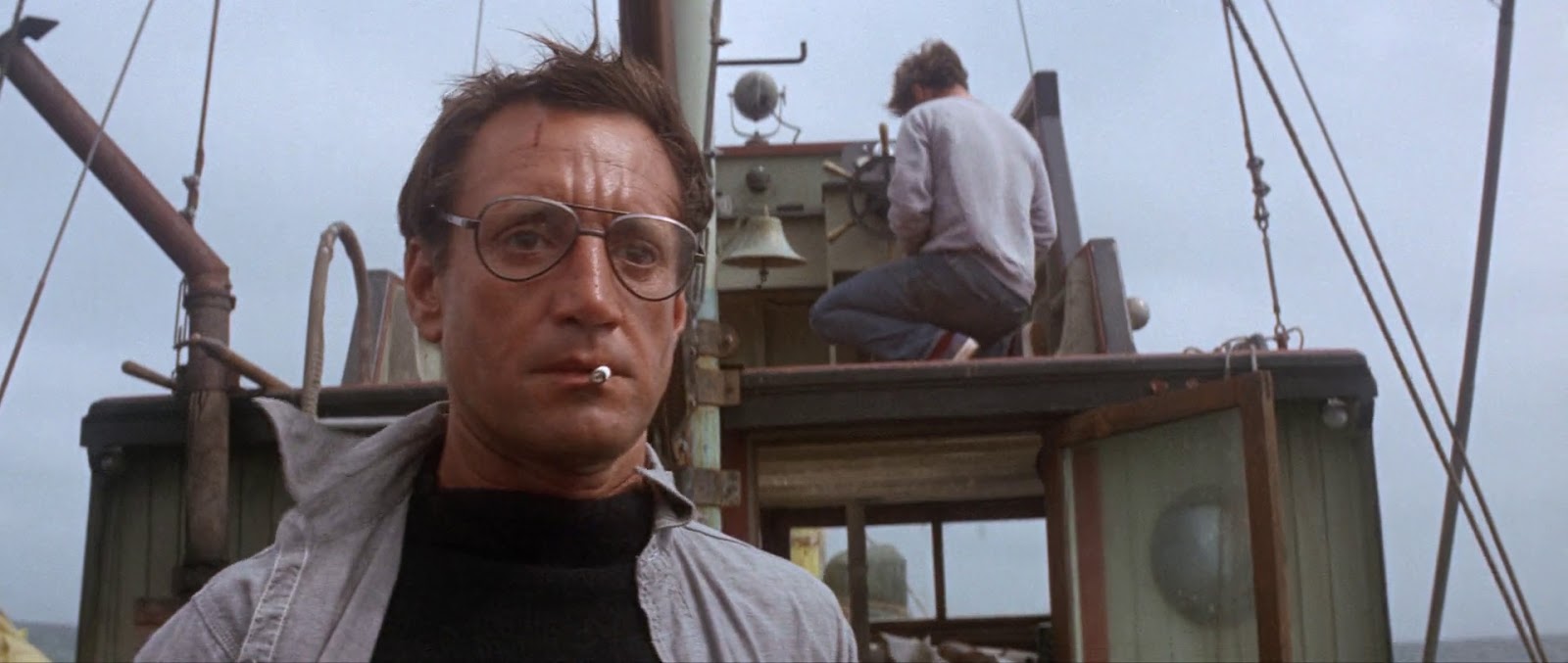
"I think we need a bigger boat." Perfect example of
middle-class pragmatism from Chief Brody.
(This classic line was ad-libbed by Roy Scheider.)
• Chief Martin Brody (Roy Scheider) is on-board as a sponsor: his efforts financed the expedition. He is ostensibly the protagonist of Jaws— and he is solidly middle class. A former New York City policeman turned town police chief, he is pragmatic, methodical and cautious. A civil servant, Brody is fully enmeshed with the pitfalls and complexity of local government, and spends a good part of the film trying to convince Amity’s selectmen to take the shark threat seriously. His viewpoint on the antagonist is a common one: ignorance and fear. He does not like the ocean, does not go into the water, and is frankly terrified of sharks. However, he displays a common-sense willingness to facilitate, learn and help.

With representative of every social class onboard the Orca pursuing the common goal of ridding the fair town of Amity of a rogue Great White it would seem their goals are unified. But there are tensions between each man as much as there are tensions between classes:

The "moment of greatest settled success" of Jaws:
all levels of society literally harmonizing together
before the shark starts taking the boat apart.
Brody and Hooper vs. Quint: As well-integrated members of mainland society, they see Quint as an unhinged, dangerously obsessed yokel.

Hooper and Quint vs. Brody: As experienced seamen and shark enthusiasts, they see Brody as a useless landlubber who has the potential to get into serious trouble onboard.

Quint and Brody vs. Hooper: Hooper has a tendency to be snippy and is constantly suspected of not sharing the primary goal of the expedition: to kill the shark, not study or admire it.

These squabbles are put aside (mostly) when the shark seems to take an interest in them and begins a personal (and scientifically nonsensical) vendetta against the Orca and the three intrepid class representatives onboard. Sharks don’t take vendettas: in fact, most marine biologists believe Great Whites don’t care for people meat, and most fatalities are “test bites” that have bled out.

"How do you work this thing of yours?" Quint setting aside
his working-class resentments for the sake of survival.
This shark vendetta does not makes sense— unless you cast the story as a parable about class. Then the shark becomes a common enemy to all society, high and low, a threat which requires complete socio-economic cooperation.

Hooper, Quint and Brody all work together to battle the shark, who also busy trying to eliminate all of them in no particular order. The final act of the film can even be seen as a microcosm of how chaos and disaster are typically visited upon the American body politic (from here to the end are solid ••• spoilers ••• but shame on you if you haven’t seen this film!)

Quint, being working class, is eaten by the shark, which fits into the demographic of natural disasters affecting the poor proportionally worse than anyone else. Hooper, having access to expensive gear, is able to swim away from his high-tech shark cage, hide on the seafloor, and survive. The job of dispatching the shark falls on the capable middle-class Brody, who uses a tool left by working-class Quint (M1 rifle) and another tool left by wealthy Hooper (compressed-air scuba tank) to blow up the shark. Thus was the burden of the 20th century American middle class.

Peter Benchley, looking sharp in wide lapels.
The original novel was written by Peter Benchley, the grandson of humorist Robert Benchley. In the novel as well as the movie Brody is the protagonist, but Benchley was in life much more of a Hooper (Phillips Exeter prep school, Harvard University). Interestingly, Hooper was a bit of a rich cad in the book: he had an affair with Chief Brody’s wife. Then again, in the book Hooper did not escape the shark cage and was just plain eaten. He comes off much nicer in the movie, which may or may not be social commentary.

Tuesday, October 6, 2015

My New Favorite Martian

Ridley Scott’s The Martian is a nice reversal of the bloat that is becoming epidemic in most big-budget films— especially in Ridley Scott movies. Prometheus was a hyperactive terrier of a movie, bouncing all over the place, rabidly exploring scifi/horror ideas and abandoning them with equal speed. Exodus was The Bible by way of Lord of the Rings— a dark, heavy, over-art-directed movie that had big CG monsters in it. The Martian is simple and exhilarating— it sticks with a handful of characters and confines itself within the realm of believable science and physics. This last part makes this film sublime: for sci-fi geeks, seeing a film that does NOT invoke some magical frammis to get out of the 3rd act is… well, magical in itself.

Not much to say about the plot you haven’t heard: an expedition to Mars gets hit by a storm which forces them to depart to orbit— leaving one of the crew behind, presumed dead. He isn’t, and now Mark Watney (Matt Damon) has to figure out how to survive alone until he is rescued. How he does it is never less than fascinating.

What makes the film work— aside from the clean direction and terrific casting— is the dialog. The screenplay is by Drew Goddard, a veteran of “Buffy the Vampire Slayer,” “Angel” and “Lost.” Those shows, especially “Buffy,” were known for their witty, fast-paced dialog. The dialog in The Martian isn’t fast-paced (you really need at least two people for proper dialog to happen) but Matt Damon’s naturally self-deprecating manner makes the witty asides Watney tells himself work very well. Humor relieves tension, and pacing out moments of wry exasperation and existential terror in turn makes the experience feel richer and more realistic.

A few notes:

A relatively bulky form factor with
mechanical limitations and limited dynamic range.
The Martian Curse is being met head-on with this film— and so far The Martian seems to be beating it! It took $55 million domestic ($100 million worldwide) opening weekend against a $108 million budget. Just a note about budget here: for a film that displays all the sweep and grandeur of a big sci-fi movie, $108 mil is PEANUTS. Just comparing it to recent victims of the Martian Curse: Mars Needs Moms (2011) cost $150 million to make, and John Carter [of Mars] (2013) cost a mind-bending $264 million or more. And do you know why Ridley Scott’s Mars movie was so (relatively) cheap? It was mostly made in Hungary! The Martian exteriors were shot in Jordan— which, while grand and otherworldly, also looked just a bit familiar. Squint really hard you can see Peter O'Toole’s trailer from Lawrence of Arabia half-buried in a sand dune.

That's right-- everything from Rush's self-titled 1974
 premiere album to 2012's Clockwork Angels, all
on this tiny deal. (Nose not shown.)
• The diagetic soundtrack of The Martian features no song newer than 1979. Apparently the only music left behind on Mars belonged to Mission Commander Lewis (Jessica Chastain), a 1970’s Disco enthusiast. Though this makes for many amusing scenes of Watney being musically tormented (“No, I will not turn the beat around!”) frankly I found this rather unbelievable and a bit of a pander. Guardians of the Galaxy (2014) did the same thing (albeit with a more ecumenical selection of 70s pop) and it’s fair to say that if “Awesome Mix Vol. 1” was not part of that movie it would have been far less fun. They are trying for the same light, easy-to-relate-to musical touch with The Martian— but it doesn’t compute for several reasons: 1. The film set in the mid-2030’s: Disco will be 60 years old by then. Disco is music Lewis’ great-grandparents were into. 2. Digital audio files should NOT be this scarce-- even if they were accidentally left behind on Mars. My friend John received for his birthday the complete collected works of Rush. It was on a USB flash drive that was so small he could literally stuff it up his nose.

Although I did not include it in the article on
The Martian Curse. Robinson Crusoe on Mars did
poorly at the box-office as well. I also forgot
to mention the feature version of My Favorite
Martian
(1999), which also bombed (and
featured Jeff Daniels, who is also in
The Martian!).
The Martian is a Robinson Crusoe story, set on Mars— not the 1964 movie, the 1719 novel by Daniel Dafoe. It explores the application of what is called “Robinson Crusoe Economics,” where the protagonist is in a unique economy where he is the only producer and consumer. To survive he needs to maximize both his personal profits and expand his productivity with very limited resources. Dafoe’s novel was written at the dawn of the Age of Enlightenment, when scientific and rational political thought became paramount. Crusoe was the embodiment of Enlightenment thought: To survive (profit), inventories are made, output calculated and problems are solved, mathematically and dispassionately. As this film is an absolute love letter to Science, nothing could be more appropriate.

• Donald Glover has a small role as Rich Purnell, a JPL astrodynamic physicist who figures in a key plot point. He plays it like a slovenly genius savant: minimal eye contact, poor social skills, the whole deal. Still, as he was both Troy Barnes in “Community” and comic rap artist Childish Gambino, when he showed up on-screen I expected comedy that never actually materialized. Strange.

• Seen in 3D at a late show. I was the only one laughing at the punchy dialog. The 3D is very good, feels natural and the image is unusually bright. See it that way.

Tuesday, June 9, 2015

Zardoz was Exactly 42 Years Ahead Of It's Time

The Big Floating Guy himself.
Perhaps taking my friend Chris’s lead I recently re-watched Zardoz, John Boorman’s very singular science fiction film from 1973. It’s a simple story: In a post-apocalyptic 2293, it’s the story about Zed (Sean Connery), an “exterminator” who manages to escape the wasteland into a “Vortex.” Behind the force fields of the vortex live the “Eternals,” who guard and catalog the remnants of civilization, all under the protection of The Tabernacle, an artificial intelligence. The mere presence of Zed creates conflict and eventually leads to the destruction of their unnatural order.

I know most people with a knowledge of film have some easily portable ideas about this film, sort of meta-positions. Yes, Sean Connery runs around wearing a silly red diaper. Yes, “Zardoz” is a take on “The Wizard of Oz.” Yes, it’s a parable about how nature abhors a vacuum— and will find a way re-establish itself whenever denied. But Zardoz, like Zed himself, is a very clever creation, far more clever than such superficial observations. This film was a breakthrough in several areas— and even has a remarkable solution to a problem that plagues the current state of portable computing.

Burned-out Municipal Centre.
1. Zardoz was the first film to portray what is now a common science-fiction trope: a post-apocalyptic wasteland. The world of this film has been destroyed: civilization has fallen, starving survivors wander blasted hillsides and destroyed cities— preyed on by Exterminators, horsemen chosen by the god Zardoz to check the population of these “Brutals.” The last film to portray people living in an ad-hoc post-apocalyptic society was Alexander Korda’s Things to Come (1940). Sure, the Cold War created plenty of films where the End has Come, but it’s usually a tidy place of empty streets— The World, The Flesh and the Devil (1959), On The Beach (also 1959), Five (1951), etc. In Boorman’s 2293 everything outside the Vortex is wrecked and moldy and haunted by The Brutals: grungy, skinny people wearing threadbare clothes. Boorman’s vision no doubt influenced everything in this genre that came after, from A Boy and His Dog (1975) to Mad Max 2 (1983) right up to The Road (2009) and the Terminator series.

Some Eternals enjoying the garden, unconcerned
about the Brutals on the other side of the shield.
2. The immortal inhabitants of the Vortex, the Eternals, live apart from the dying world behind impenetrable periphery shields. The Eternals took it upon themselves to become the custodians of the past— and in doing so completely detached themselves from Humanity itself. It’s a remarkable criticism of Objectivism— Ayn Rand’s philosophy that great people should be left alone to do great things, and compassion and mercy are really a signs of weakness. Avalow, one of the Eternals, explains to Zed how the Vortex came to be— and perfectly defines it as Galt Gulch:

“We took all that was good and made an oasis here. We few— the rich, the powerful, the clever— cut ourselves off to guard the knowledge and treasures of civilization as the world plunged into a dark age. To do this we had to harden our hearts against suffering outside.”

Boorman exposes this sort of exceptional elitism as nothing more than hubris, unnatural folly that can only fail in the end.

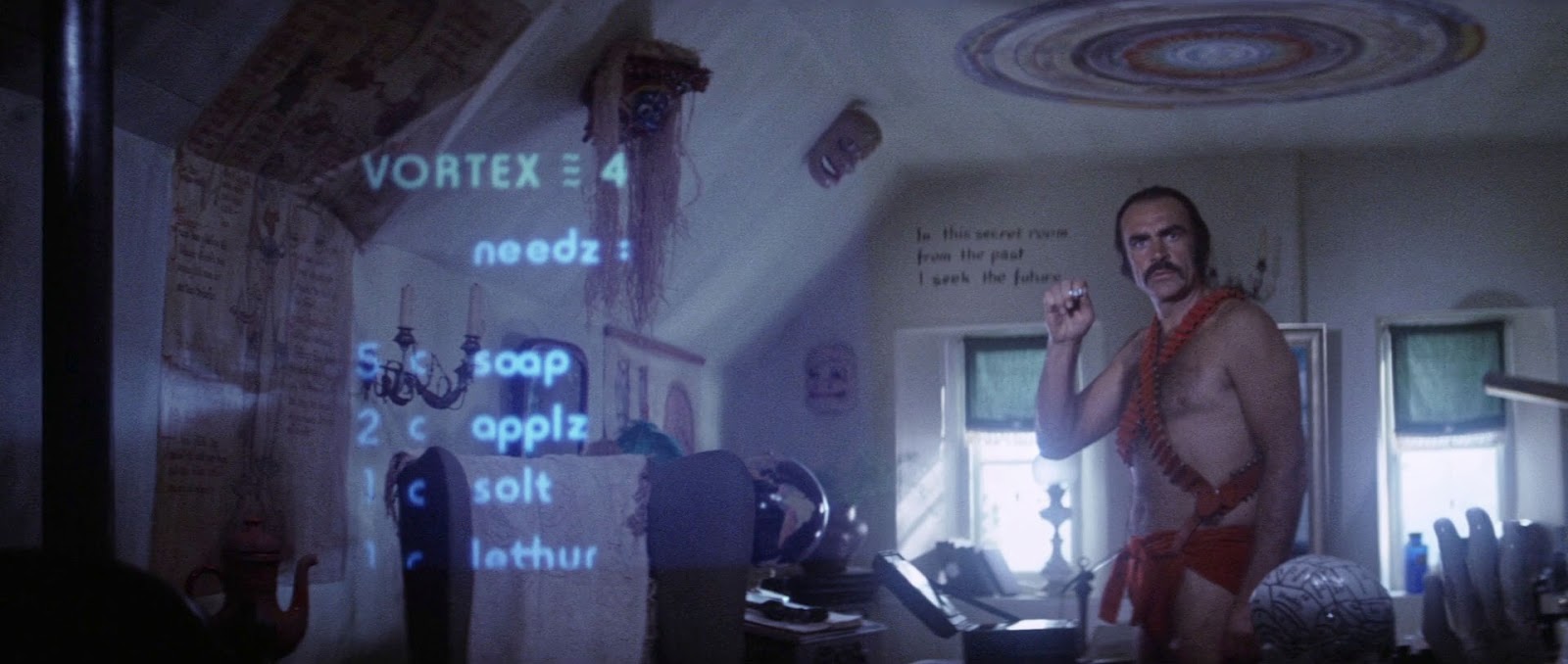
Zed utilizes a Wearable to interface with the Mainframe.
3. The Vortex owes it’s (admittedly doomed) existence to The Tabernacle— an artificial intelligence intimately linked to every Eternal that runs and protects the place. The physical presence of The Tabernacle is revealed in the end of the film as (mild spoiler) a crystal the size of a paperweight. But this is not the part I found intriguing. The interface units the Eternals use to communicate are white metal rings topped with a large square crystal. These rings operate for all intents and purposes like perfected smartphones: They can be used to call people, take notes, scan and diagnose, retrieve and display data, and allow Siri-like verbal communication with Tabernacle.

Consuela (Charlotte Rampling) takes notes.
Damn. The form factor is almost perfect!

Ring displays data. Note that in 2293 the Eternals
have adopted a form of Hip-Hop English.
The long and on-going problem we have with iPhones and Androids in the present day is all in the form factor: to use these devices, you have to walk around with it in your hand and stare at it. Situational awareness suffers for this. Smartphones have managed to make a whole generation of people look detached and unsociable. Even a wearable in the form of a watch is an imperfect solution. Humans were simply not designed to be constantly interacting with a lump of plastic in our hands.

May (Sarah Kestelman) performs a retinal scan with her ring.
A RING, however: stroke of genius! you can talk to it and it answers. it can take pictures and interact with the environment. It can project data and displays. and best of all, you can do all these things without being physically impeded by the device. If we all had tidy little rings rather than clunky phones we’d certainly be in a much better place. Our hands would be free! No more distracted walking or driving-- and we’d see the return of quaint notions such as conversational eye contact. I’m sure a ring that was a portable computer looked like speculative science fiction in 1973, but in 2015 they look like they’re about 5 years away from market reality.

Well-written speculative science fiction is a tricky thing: it does not always reveal itself when first presented, but after a measure of time the world catches up with the creator’s vision.

Tuesday, January 13, 2015

Inherent Vice: Pynchon 101

This poster, aside from tweaking Leonardo DaVinci, gives an idea
of the many wonderful cameos in Inherent Vice. Martin Short
(far right) is particularly funny and strange.
After dinner last Friday, the wife and I stopped by the Redwood City 20 to see what was playing. We spontaneously decided to see Inherent Vice. I love that sort of thing-- we went in unprepared for Paul Thomas Anderson's newest film-- and it ended up being a total delight.

It's the story of "Doc" Sportello (Joaquin Phoenix) a hippie P.I. who is hired to find a missing girl who also happens to be his ex. thus begins Doc's strange journey through 1970 Los Angeles-- both helped and hindered by Detective "Bigfoot" Bjornsen (Josh Brolin), a flat-topped, hippie-hating, brutal/delusional LA cop who also carries a SAG card (we see him as an extra in "Adam-12," in fact). On the long, winding path of investigation Doc encounters all sorts of odd and historically appropriate types: Nazi bikers, cultists, a Laurel Canyon mansion full of hippies, a hidden cabal of dentists and drugs. Lots and lots and lots of drugs. River Phoenix does an amazing job, in fact, of conveying an amazing range of stoned: mellow high, totally baked, buzzed, flying' and everything in-between.

"Doc" Sportello (River Phoenix), doing what he does
dozens of times in the film.
Compared to any other sort of film, I'd say it was not unlike The Big Lebowski- but it's a LOT more like Kiss Me Deadly, a film noir saturated in the light of Los Angeles and the darkness cast by the greedy and evil.

This is the first Thomas Pynchon book ever committed to film, and the script was apparently personally approved by Pynchon as well. Thomas Pynchon and Paul Thomas Anderson were made for each other-- their mutual approach to storytelling is spacey and convoluted yet brimming with insight. Inherent Vice perfectly embodies a lot of Pynchon's favorite motifs: Los Angeles, complex whodunits, subtle mysticism and conspiracies by shadowy, powerful organizations. The 2009 book was considered considered "Pynchon Lite," one of his most accessible novels. If this is so, than the movie version is an even better introduction to his distinctive literary style. Pynchon 101.

Thomas Pynchon, as seen on "The Simpsons." According
to Josh Brolin, the reclusive author has a cameo in
Inherent Vice. Forget it: we'll never figure it out.
Paul Thomas Anderson has developed an elliptical and indirect narrative style, especially in his later films: Inherent Vice could be described as being comprised of a series of close-ups and medium shots of Joaquin Phoenix interacting and reacting. He is an example of a filmmaker whose core relationship with cinematic storytelling has clearly evolved: his beginnings as a teller of Tarantino-like multiple-storyline widescreen films like Boogie Nights and Magnolia to a focus on nuance and dialog, as in The Master and Inherent Vice. This refocusing gives these later films a rambling feel as the plot slowly snakes from one scene to another. It take a little getting used to, but when it all clicks together it's exhilarating.

Inherent Vice is also very funny-- which is sort of unusual. P.T. Anderson doesn't really do funny: There was some situational comedy in Boogie Nights, and Punch Drunk Love was supposed to be funny (it wasn't), but this is the first time he stretches out for some Coen Brothers-style sardonic humor.

Check it out, you'll enjoy it. See it high, and you might enjoy it even more.

Tuesday, June 11, 2013

Kubrick at LACMA

I managed to rush down to Los Angeles to visit the Stanley Kubrick exhibit at the L.A. County Museum of Art before it closed at the end of the month. It was a bit of a pain to get everything to work out on short notice, but the payoff far outweighed the cost.

The Kubrick exhibit takes up the first floor of the Art of The Americas hall, and is arranged like all good museum retrospectives: chronologically, starting with an overview, a short visit to his earlier works, and on chronologically through his highly singular ouvre to Warsaw Diaries, a project he was just in the early stages of researching when he died.

There are a few situational ironies about this exhibit. Stanley Kubrick only shot one film in California: The Killing (1956), his second feature-- and most of that was filmed in the Bay Area, around the former Bay Meadows racetrack in San Mateo. He scrupulously avoided spending time in Hollywood. Los Angeles put on quite a tribute for an outlander-- but then again, it's all one big business. The money that financed his films flowed for the most part out of studio gates. If he was not one of Hollywood's own, then he is widely considered one.

What I found especially pleasing is how hard the curators strove for authenticity in all the sections: there are very few reproductions, aside from amazingly detailed ones, like the model maze from The Shining or the hanging 10-foot model of Discovery One. But Jack Torrance's typewriter and axes, Private Joker's helmet, Barry Lyndon's costume: all the genuine deal. Someone had reproduced the sexy milk-dispensing mannikins from A Clockwork Orange, which struck me as an odd thing to do.

I was very gratified to see that the part of the exhibit concerning 2001: A Space Odyssey was by far the largest in space and number of artifacts. I had read in Piers Bizony's excellent, definitive book 2001: Filming The Future that Kubrick had deliberately destroyed the sets, props, spaceship models and costumes after wrapping 2001 to keep them from being used in cheesy sci-fi films afterward. (This happened to George Pal's Forbidden Planet (1956): those crazy grey jumpsuits showed up on TV shows well into the 1960s, as did Robbie the Robot). I was amazed even a little of it survived.

We visited LACMA on a Friday: there was a comfortable amount of other visitors there, no real crowding. Therefore, I was able to take as much time as I wanted in the Kubrick exhibit. I circled around and took it all in again.

It was an incredible culmuination for me. It was nothing short of awe-inspiring to be in the presence of the artifacts of Kubrick's works. It allowed me to slip through the gossamer veil of the cinema screen: while you're in there, among the hand-written script notes and props and lenses, you're on Kubrick's side of the camera. You stand with Kubrick, see what he saw and wrote and imagined. A powerful, unforgettable experience.

If you missed this retrospective, feel free to kick yourself.
Outside the exhibit space.


A dark room just inside the entrance. It shows side-by-side clips from his films,
one side overlaid with pithy quotes. This goes a long way to show the
breathtaking span of Kubrick's auteur vision.

This is on the wall just past the main entrance. It makes no sense here.
Makes all kinds of sense once you've gone through the exhibit.

Stuart Freeborn's articulated
Australopithicus makeup.
Part of the 2001 exhibit. The Discovery model is a reproduction: the
Space Station 5 chairs are authentic.


Fairchild-Curtis fisheye lens-- This is HAL's eye, the one they used
in close-ups and as a filming lens for HAL's POV.

They displayed the HAL Lens behind glass, but on both sides. All you have to do
is point your camera up to the back and you could shoot right through it.
This is a picture of me as HAL would have seen it, taken straight through
the Fairchild lens. Just amazing.

An actual production Discovery space helmet. This was Dave Bowman's: He wore it on the first EVA to replace the "faulty"
AE-35 unit, and unfortunately forgot it later on. I stared at this for at least ten minutes: I never, ever thought I'd
see something like this in person.


A detail from a surviving spacesuit costume, one of
the silver ones worn on the Moon. This is the
data pad, and there is supposed to be a number
of buttons on it. They must have fallen out.


There was other stuff there too: Here is Private Joker's helmet from
Full Metal Jacket. His gold wire-frame glasses were on display just
below as well.

All work and no going to LA to see a once-in-a-lifetime
museum retrospective make Jack a dull boy. The actual prop
Adler typewriter from The Shining.