Showing posts with label Fantasy. Show all posts

Saturday, January 25, 2020

Harley Motherf***ing Quinn

[Warning: adult language and situations. No spoilers, though.]

Harley Quinn, voice supplied by "The Big Bang Theory's"
Kaley Cuoco. So less of the insane Brooklynite attitude from
previous iterations, more of a scary SoCal girl.
I don’t review TV shows that often, animation almost never, and I’m not a comic book fanboy. But I chanced upon a review on io9 that was so intriguing I had to check it out— and I was not disappointed.

“Harley Quinn” is a comedic adult animated web-based show now streaming on DC Universe, behind an $8-a-month paywall. It tells the story of Harley Quinn, the Joker’s lover and sidekick, as she dumps him and tries to invent herself as an independent person and supervillain in her own right. She does this with the help of her best friend / roommate Poison Ivy (Lake Bell, a wonderfully dry voice performance), and her crew of minor villains who I would know if I actually read comic books.

Harley and Poison Ivy, roommates. These two characters
may be the most 'shipped couple on the internet. So far
they are depicted a just close friends, but the season
is not over yet.
The dynamic between Harley Quinn and Joker has been well-documented, and they’re even going to make it big deal out of it in the Margot Robbie-starring live-action film coming out next month. Her character has been described as suffering from dependent personality disorder: in her former life she became so obsessed with Joker while treating him in Arkham Asylum she abandoned everything to become his often-abused sidekick. As a super villain origin stories go it may be the most mundane one ever: Harley was a victim of abusive, manipulating partner, a trauma untold thousands of people are suffering every day in the real world. It has given her character a special resonance with fans: even though Harley is a supervillain, her personal emotional issues have a human scale and her efforts to break free of her abusive partner make her even more relatable. The show does not shy away from this unhealthy dynamic, and in fact it casts most of her personal growth as an anodyne to Joker, her romantic obsession transformed into professional competition. Harley a fun character, given considerable depth: she is "a bad guy, but not a bad person," and her story arc probably has her headed to antihero status.

The creators of “Harley Quinn” made a strange but ultimately transformative decision: As it is not a broadcast show there are no real restrictions to language and content, so they decided to make a show for adults. It's a bit of a shock. To give a feel for the dialog:


Harley (to Joker, in a subconscious confrontation): “You think you created me, but no one did. My fucked-up parents didn’t create me. Neither did Jessica Sarner when she lied to the whole fucking camp and said I lost my virginity to a horse! A HORSE!” (applies baseball bat to Joker’s crotch: he doubles over) “Neither did those cops who questioned me for hours about what happened to Jessica Sarner! And YOU sure as hell didn’t fucking create me, Puddin’!”

And the sexual innuendo is of the single-entendre variety:


Bane (to Joker on phone): “Harley is at Penguin’s nephew’s Bar Mitzvah.”
Joker: “She crashed the stupid thing?”

Bane: “Yeah. Seems like she’s doing pretty well. Brought a tiger. Pretty cool!”
Joker: “What? Anyone can buy a tiger. You know she has HPV, right?”
Bane: “Most sexually active adults do.”
Joker: “Shut up!”


Dr. Psycho, after the second time he called someone a c**t.
Yeah, the filter is off and this makes it for fairly exhilarating viewing. There are some limits: no female nudity (yet*), but lots of pixelated male crotches. The show even has a line, and one character crosses it: Dr. Psycho, one of Wonder Woman’s nemeses, is blackballed out of the Legion of Doom for calling her, in the heat of battle, a c**t. (it’s the only profane utterance bleeped on the entire show.)

I know adult-oriented animated series are not exactly a new phenomenon: “South Park” is 20+ years old, seriously raunchy, and the movie was legendary in that regard. Every episode of the immensely popular Adult Swim series “Rick and Morty” is filled end-to-end with bleeps and blurred-out genitalia.

What makes “Harley Quinn” exceedingly unusual is the fact it is camped dead center in the DC Universe. It is not a sidecar, like the way Deadpool— the foul-mouthed, violent antihero from Marvel— is a sidecar, peripheral to the X-Men universe (several X-Men make an appearance in the sequel) and completely walled off from the big-money Avengers universe. Deadpool will never crack dick jokes with Captain America. (Professor X, maybe.)

In her show Harley regularly interacts with the big hitters, Batman and Superman and the like. The iconic superheroes they spend hundreds of millions of dollars to make movies about. And by “interact,” I mean when Harley meets The Batman in the first episode, she adamantly insists he is called that because he fucks bats.
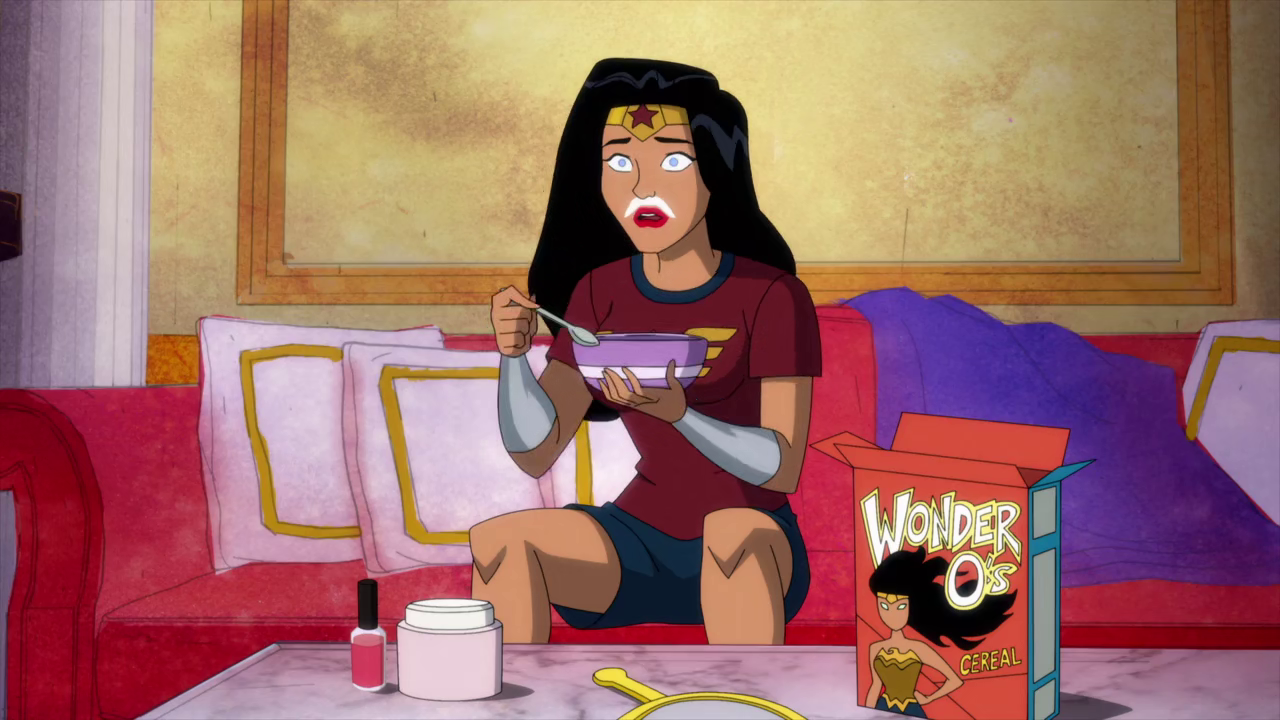
Wonder Woman, eating her own brand of breakfast cereal,
realizing all the ground rules have changed.
This juxtaposition turns an amusing series into a surreal one. What we have is a series which has IP-critical superhero guest cameos— and they basically stand in inhibited silence while a collection of supervillains dance around them, calling them out with ripe curses and sexual innuendo. The decision by DC and Warner Bros. to execute this vision is mystifying.

The other exhilaration that comes from ”Harley Quinn” is how this adult theme remakes every character anew. All the profanity and frank sex talk draws attention to the eroticism that rushes like a deep undercurrent under all superhero stories.The supervillans and superheroes depicted in the blockbuster movies are (mostly) extensions of their juvenile, sexless origins as juvenile, sexless comic-book characters, still hewing to a long-gone 70-year-old Comics Code. Not on “Harley Quinn:” on that show, everyone depicted are People Who Fuck.

People Who Fuck are all around us: it is the normal state of the human race. The great majority of DC and Marvel movies and TV shows still depict their intellectual property as non-existent from the waist down, like Muppets. This is my biggest peeve with the MCU: missing the normalizing dimension as People Who Fuck, for all the significant kisses and long, lingering gazes they’re all just cardboard simulations of real people.

This is the liberating synthesis of “Harley Quinn,” the result of the thesis of comic book characters mixed with the antithesis of real-world People who Fuck. Even though they are set in an unbelievable, unrealistic universe of magic and superpowers, the characters depicted within seem more real than any version of them that came before.

*One of the most confounding things about Adult or R-rated entertainment of late: no problem with profanity and verbally describing sexual situations-- but nudity is increasingly rare. I think, in the case of this show, the influence of the internet is the major deciding factor. If the showrunners ever decided to show Harley Quinn running around with her tits out, every fanboy image server on earth would promptly explode. So that will never happen.

Thursday, May 7, 2015

Age of Ultron and a Genre That's Far From Done

The Avengers (including a few new recruits on the left), against a background
of the hundreds of robots they're about to shred.
Look: if a movie makes nearly $200 million domestic on opening weekend and nearly $400 million worldwide, you kinda have to see what the fuss is about.

Right off the bat, I can tell you that Avengers: Age of Ultron is a worthy and entertaining addition to the Marvel Cinematic Universe. Having absorbed (mostly via osmosis and basic cable) all TEN previous movies in this continuity, I can tell it's a neat new adventure. In terms of sheer spectacle it's worth the cost of a ticket (though I did not pop for 3D glasses: I'm here for the story, baby). The effects are seamless and perfectly designed and so well-integrated that about halfway in I stopped thinking about the sheer hours of VFX design and rendering that went into every damn frame and just let it wash over me.

HAL 9000. Often imitated,
never surpassed, he still has
much to teach us.
The plot: The Avengers, fresh from saving the world from Loki in the last movie, need to locate and dispose of Loki's scepter, a source of mystical power and all other sorts of mayhem. But Tony Stark (Robert Downey Jr.) wants to use it one last time to get his pet project working: a cybernetic creation that will protect all of Earth. But, as the film 2001: a Space Odyssey taught us, it is very difficult to explain the concept of security to a computer without them misconstruing the intent and trying to kill all of us. Which is what the newly animated Ultron (voiced with Tony Stark insouciance by fellow former Brat Pack member James Spader) immediately tries to do. So the threat this time was internally created-- and it's going to take the entire Avengers team to fix it and save the whole planet. Again.

Joss Whedon's style and humor is far more muted here than in his last Avengers movie, but his sense of cinematic action is still there and even improved a bit over his last outing. the opening battle is one long Alejandro González Iñárritu-style tracking shot. In several parts he slows the action down, which allowed some moments of quiet awe. He also gives some great acting turns for the more human members of the Avengers gang. Hawkeye (Modesto's own Jeremy Renner) has some moments of quiet vulnerability. Black Widow (Scarlett Johansson) also gets some nice little moments. A few notes:

• The widespread criticism about Black Widow's character is absolutely true, unfortunately. I feel the giant three-fingered gloved hand of Disney here, holding back Whedon's organic feminism. Natasha is turned from a complex character with a morally questionable past to a sort of kick-ass den mother with a love story (you know, for the chicks). The chilling "red on my ledger" backstory between her and Loki from the last movie is completely absent. Disappointing.

Paul Rudd IS Ant-Man! As far as I could tell from the
trailers this isn't going to be a Romantic Comedy and
Judd Apatow is nowhere to be seen.
• Contrary to some social observers and film critics we have not reached "Peak Comic Book Movie." Not even close. There is a huge stack of Superhero movies waiting in the wings from Marvel and DC: Ant-Man and the Superman-Batman deal and Wonder Woman (I think) and the Fantastic 4 reboot (huh?) and the Guardians of the Galaxy sequel and many, many more. So far these movies still manage to be inventive and fresh, and the dead hand of Mannerism has yet to appear in the genre. Still…

• ...Though Avengers: Age of Ultron is a fun watch and a neat action story, you can see in it how this genre is going to play out: Death by Character Shield. "Character Shield" is one of the screenwriting phrases which explains why lead characters in series and franchise entertainment tend to survive anything you can throw at them: they HAVE to. The appeal of the leads is what makes a series or franchise work, so whatever hairy death-defying situations the writers put them through they HAVE to make it out the other side. They can be emotionally changed, evolve or what have you, but you can't kill 'em.

Superheroes were tailor-made for action franchises: They're tough, very strong, often superhuman beings who can participate in huge violent battles and generally come out with naught but cosmetic scratches. Which is great, because there are usually a string of movies yet to be made featuring them stretching on into the distant future. Furthermore, these superheroes are generally assigned to quests that invariably have them saving the entire world (the Avengers have done this twice now), which is great because it increases your audience base.  But-- quoting another writer on this subject-- if everything is at stake, then nothing is at stake. They're always going to save the world and they're always going to survive. The character shield now encompasses the whole world and everything in it, and the only things you can battle are aliens (the last Avengers) or robots (this one). There is hope for complexity and consequences in the lesser Marvel movies (Captain America: The Winter Solder was a surprisingly complex political thriller) but the forces of monolithic Narrative Stasis are starting to show. With Stasis comes Mannerism, and then audience boredom, and then we move on to the next thing.

The super-secret hangar under Washington where SHIELD has
created a fleet of equally super-secret helicarriers. (scene from
Captain America: The Winter Soldier.) Your unaccounted
off-budget tax dollars at work!
• The product placement for Audi has evolved from ubiquitous to absurd.  Fine new Audis show up everywhere-- in frenetic chase scenes in Seoul, English universities, sitting out in the open in dirt-poor Eastern European countries with the keys in the ignition. At one point in the film Tony Stark activates an offscreen car with a remote. Guess what make of car, driverless, rolls into frame?

• Considering the large number of people in the United States who identify with right-wing causes, I am always surprised how a movie like this is widely liked and accepted despite the blatant presence in it of World Government-- and by that I mean exactly what Tea Party crazies are talking about: shadowy militarized organizations operating internationally with absolute impunity and with overwhelming destructive power. In Age of Ultron The SHIELD agency has collapsed (due to events in The Winter Soldier) but Nick Fury's organization fits the description perfectly: a UN-level secret military that operates stealthily everywhere in the world, has awe-inspiring weapons of mass destruction and respects no borders. The Avengers themselves have the same basic mission as SHIELD-- but as they are just a handful of superheroes they don't seem quite as-- well, quite as obvious-- as a fleet of flying aircraft carriers. Perhaps those of the Fox News persuasion identify more with the direct, um, "problem solving" methods of the Avengers and SHIELD (i.e. awe-inspiring carnage) than ever consider that they are basically seeing UN Black Helicopters: The Movie.

Wednesday, December 31, 2014

Hobbit 3: Peter Jackson's Freestyle Round

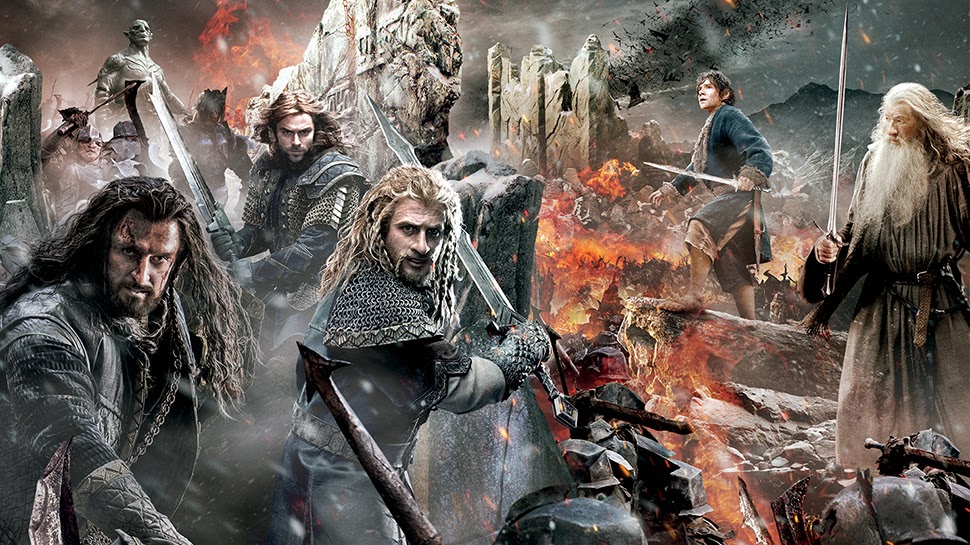
Just a sample of the non-stop, overlapping action that is most
of Battle of the Five Armies.
The Hobbit: Battle of The Five Armies was seen Monday night in crisp 48 HFR 3D.

Peter Jackson is much like a big kid with a huge Middle-Earth action play set. having dispensed for the most part with the events of the original novel in the first two movies, he gets to stretch out on the final battle scenes with greatly extended action sequences. His sense of cinematic place and direction is a good as ever, though, and the thousands of little CG soldiers on the screen never lose a sense of coherent action. And the ending is quite satisfying and presented without having to resort to the 6 endings of the last Lord of the Rings movie-- just one tidy ending, thank you.

Then again, the action on-screen versus the content of the original novel created a strange narrative situation where Bilbo Baggins (Martin Freeman) the titular hero of the film, disappears from the narrative for long stretches of time. I'm reminded of the third Matrix movie, where Neo disappears for most of a movie in which he is the putative savior.

Point-to-point:

• I only counted four armies. My issue probably lies with Tolkien, not Jackson.

Tauriel, cute as an elf.
• Evangeline Lilly as Tauriel was by far my favorite character. Yes, I know she was an entirely whole-cloth, non-canonical character. But her presence is important: added to the movie version to correct Tolkien's paternalism and give us a break from looking at an endless succession of hairy faces.

We also get something sorely needed in big action franchises like this: a love story. Sure, Tauriel the silvan elf may have been invented to prevent it from being the sausage fest of the original book, but it's welcome. She falls for Kili the dwarf, fully two heads shorter than her, but their love-at-first-sight relationship carries resonance-- and this is a welcome break from the general tones of madness, hate and manly stoicism embodied by everybody else in the film.

 A lot of this has to do with Evangeline Lily. She was the best thing about "Lost:" a soulful, loving yet complex and hermetic character in a cast of caricatures and cyphers. Lilly is a remarkably expressive actor and the only shame is she hasn't been in more movies. Tauriel gets to show love and loss and longing in a keener and more immediate way than anyone else in the entire trilogy. It's either a complement to Peter Jackson's skills as storyteller-- or an anodyne, in that he cannot conceive of anyone capable of having softer emotional connections than a-- shudder-- female character.

• You can tell the various races of creatures in this film-- in all the Rings and Hobbit films-- by how they appear after a little wear and tear. Hobbits (Bilbo at least) and Wizards get completely filthy: in fact, the wizard Radegast the Brown has shown up in all three Hobbit movies with a wad of dried bird shit stuck to his head. Humans and Dwarves are sort of grungy all the time, never too clean or too dirty. Elves-- the overachievers of Middle Earth-- never have a hair out of place or a smudge on their clothes. Orcs are similarly neat, all things considered: the lead Orcs wear little bits of armor and show a lot of skin, and would not look out of place in a Pride parade.

• The HFR process: Much improved of the first Hobbit movie. It might be the outdoorsy settings overall, but the scenes seem brighter and more colorful than the dark, washed-out first installment. The 3D was remarkably restrained and natural-looking: There were only a few gimmicky shots of falling stones and billowing flame and whatnot. Whatever Peter Jackson's tech folks needed to do to get the look of 48-frame-per-second to not look like video gloss, they did it.

Peter Jackson, Tolkien: It's been a hell of a ride. The first film series raised the bar for fantasy films forever. The last three, while somewhat under-stuffed and not quite as novel as the first three, are still deserving of all the success they have reaped. If this is Jackson's victory round, he can and should be allowed to freestyle a bit.

Monday, December 17, 2012

The Hobbit: The Law of Diminishing Dwarves


My wife has really, really been looking forward to seeing The Hobbit for weeks, ever since she re-read the novel. And I was very curious about seeing what the new HFR 3D (48 frames per second) process looks like. So tonight we went to go check it out at the Cinemark San Mateo-- where we found out after buying tickets that they don't have HFR. Refund in pocket, we drove to Redwood City, where they did.

Basically, The Hobbit: An Unexpected Journey delivers it's promise: It's a dose of Middle Earth, just as detailed, grand and handsome-looking as any part of the LOTR trilogy. In fact, a lot of the characters from the trilogy show up-- Galathriel, Saruman The White, Frodo Baggins-- even though they aren't in the original book.

There are two basic area to look at with The Hobbit, which despite some harsh reviews had a champion opening weekend ($89 Million)-- the production and the new HFR 3D process:

The Production: I remember when New Line announced they were going to make the Hobbit into a prequel: It was quite exciting news, and a lot of fans were enthused about it. When they announced, not long after the initial news, that it was going to be a two-part epic, people generally shrugged. But when, during pre-production, they said The Hobbit was going to be a trilogy, there was some alarm. The covers of the book it's based on are closer together than any of the other Middle Earth books: that's a small amount of jam to spread on a lot of bread.

Let's look at the arithmetic of screenplay adaptation at work here. The Lord of the Rings trilogy of books totals 1,550 pages. The total running time of all three movies is 558 minutes. The general tally of a standard formatted screenplay is roughly a page a minute, so we can assume the three scripts together total less than 600 pages. This leaves the screenwriters with the standard job of reducing, cutting out characters and plotlines. But The Hobbit is 310 pages long. If they divide it evenly, that's about 103 pages of novel to turn into each movie-- which roughly lines up with where The Unexpected Journey, which is 169 minutes long, ended. There is over an hour of screen time to pad, and it shows.

Peter Jackson has added elements from Tolkien's unpublished memoirs, such as The Quest for Erebor, but you can feel the stretch as the film unwinds. Bilbo Baggins does not leave his hobbit-hole until nearly an hour of screen time has passed. Radagast the Brown Wizard shows up for an extended and fairly pointless sequence. Those LOTR characters ain't just cameos: they have a extended conclave mid-movie as well.

The most interesting, and glaring, change is the addition of an orc villain. Azog, a very minor character in the book, was the Orc king who killed Thror, the father of Thorin Oakenshield, the leader of the dwarf company headed to Erebor. In the movie he's now the nemesis of Thorin. He's also a very tall orc with blue skin, and bears an uncanny-- and even suspicious-- resemblance to one of the huge aliens from James Cameron's Avatar.

Thorin Oakenshield. Dwarf or Klingon? You decide.
There is also another issue, something inherent in the original story, which leaves The Hobbit at a disadvantage compared to the precedent films: the lack of charismatic eye-candy. The LOTR trilogy had, up-front and rock-star handsome, Humans and Elves: Aragorn, Legolas, Eomer, Boromir and even his brother Faramir. I remember the spontaneous applause that broke out during the closing credits at the opening-weekend screening of The Return of the King: throaty, manly yells for Frodo and Sam, schoolgirl screams for Aragorn and Legolas. With The Hobbit the heartthrob is (apparently) Thorin, a hair-covered dwarf set against a mob of a dozen-odd undifferentiated, hair-covered Dwarves. He just doesn't have that ineffable "it."

High Frame Rate 3D: I've read a few reviews for The Hobbit and they all make comment on this new process, where the film was shot at double the frame rate, 48 frames per second, and projected at the same speed. I also remember reading about the hooting and brickbats at the last ComicCon when they screened a sequence for fans in HFR 3D. The general consensus is this: it makes the film look like it was shot on video. It gives the film a cheap-looking patina, like "The Teletubbies" or a soap opera.

You know what? It's not that bad. Sure, there are some scenes that look sort of cheesy, especially handheld ones: they look like they were shot on the set with a video camera. And some of the props and costumes aren't quite as convincing as they might look in 24 frame. But generally it looks very good, and the high frame rate is only mildly distracting. The cinematography is lush and the effects blend seamlessly: this is what you notice first.

Still, I'd venture a suggestion: If anyone was going to make a 48 frame per second feature in the future, I'd use it on a real-life feature, like a comedy or a rom-com, something that does not have a lot of effects or makeup or weird costumes. The impact of a film like The Godfather or Dodgeball or Mulholland Drive would have been greatly enhanced with such an startlingly vivid format.

On the other hand, the high frame rate effect is offset, unfortunately, by the 3D. There was nothing wrong with it as executed in the production: it just suffers from having to put those glasses on and the dark, color-muted, washed-out look all 3-D films have.

Still, it's worth seeing. Remember the awful disappointment you felt when you saw Star Wars Episode I: The Phantom Menace? The Hobbit is nowhere near that bad-- It's just a big-screen example of the Law of Diminishing Returns.

Saturday, May 26, 2012

Star Wars 35: A Cautionary Tale

GL among his pre-digital models. I got a chance to run
my hands over a lot of these things at a Lucasfilm
exhibit at the Marin County Fair. After I left, I saw
the sign saying "Do Not Touch." Oh well.
So it's the 35th anniversary of the opening of Star Wars. That's a lot of Wookies under the bridge.

It's hard to express how exciting and unique a film it was when it came out, how much a part of my life it became-- and, as the years passed, how the franchise (and my admiration for it) stumbled and fell, becoming something emblematic of a primal fear, one that all of us share.

Sure I remember when Star Wars opened up. I was totally primed for it, for three reasons: 1) a totally inaccurate but exciting article about the upcoming "The Star Wars" in Cinefantastique magazine; 2) that amazing, amazing trailer-- They showed it on "Creature Features" in spring '77 and it got such a strong response Bob Wilkins had to show it several more times; 3) I was fourteen.

The Saturday after Star Wars opened (roadshow movies opened on Wednesdays) me and my Soquel High Sci-Fi Club buddies rocketed over the hill to San Jose and took in an afternoon screening at the Century 21 Theatre. Back then, big tentpole movies were platform-released: They would open up in a few dozen major markets in 70mm, then break wide a few weeks later. We waited in the long, long line, took our seats under the apex of the dome, watched the giant gold curtain roll out unveiling the deeply curved screen and the 20th Century Fox fanfare (no trailers whatsoever!)

It totally blew us away. It's difficult to think of a film since that so exceeded my expectations for transcendence. I was the right kind of kid at the right age in the right place in history, and the cultural phenomenon that was Star Wars entered me like an X-Ray. I lived Star Wars. I memorized Star Wars (It's all still in there). I wanted to meet George Lucas*: he was my personal God, and promised to be a font of endless creativity and magic.

I managed to see the it at least two dozen more times that long summer. When Empire came out three years later, we made it to opening day at the Century 21. Same with Jedi-- though, due to a ticketing mixup we saw that one in Pleasant Hill, but it was still in 70mm.

Fast-forward to 1999: Jeffrey Sargent and I are seeing Star Wars Episode I: The Phantom Menace at the AMC in San Francisco at the very first midnight screening. It had been sold out for weeks: Jeff did some major wheeling and dealing to secure us tickets. But the world had changed, cinema had changed and we had changed in the 16 years since Jedi's stirring ending (to the Ewok's "Yub-Yub Song," which George Lucas has since expunged from his improved version). I'm not sure Jeff coined it, but the next day he emailed our basic summary: "George Lucas Pissed In My Eyes."

From that moment on, the Star Wars universe appeared to a rapidly shrinking one, a galaxy under accelerating compromise. It may have started with the regrettable "Star Wars Holiday Special" from 1978, but that was sheer contractual obligation. No, it was the little changes and the little peeks into the Lucasfilm decision process that showed the Ozymandian artifice of the whole thing: the Special Editions, which both blunted the canon and disrespected the core audience. The little, sometimes condescending choices he made in the last three films, Jar Jar Binks and Annie Skywalker, the stilted dialog and the joyless, confusing plots. The final Star Wars film, Revenge of the Sith, was so devoid of surprise it was like watching a movie run backwards, characters and elements being assembled for their bow in a film then 28 years old. By that point, everything that had made me a rabid Star Wars fan back in 1977 had been systematically wrung out of me by George Lucas himself.

But it wasn't all him: I also managed to grow up (a bit) since 1977. I went to college, saw The Hidden Fortress, read Joseph Campbell and E. E. “Doc” Smith's Lensman novels. Seeing where Star Wars came from-- and how closely it was derived-- was inevitable, but instructive. One of the biggest jolts to my Star Wars fandom was reading sci-fi author David Brin's famous and devastating takedown of the ethics of Star Wars. One tiny bit:
George Lucas's version of romanticism is obsessed with nostalgia, feudalism, pyramid-shaped social orders, elitism, a hatred of science and the concept that only genetically advanced demigods matter. He openly avows to never having researched what real heroes do. He also expressed open contempt for this democratic civilization, telling the New York Times that he prefers a 'benign dictatorship.'
And now it's 2012: George Lucas recently re-released Episode I in painstakingly rendered 3D-- and the box-office response was startlingly indifferent. When I read the reviews for it I came to a realization: Star Wars was not the best thing George Lucas ever dreamed up: it was the ONLY thing he ever dreamed up.

God, I wanted to be just like George Lucas when I was a kid. Now he means something else to me. He's a cautionary tale: the embodiment of the frightening notion that we're only entitled to one really good, creative idea per lifetime.

---
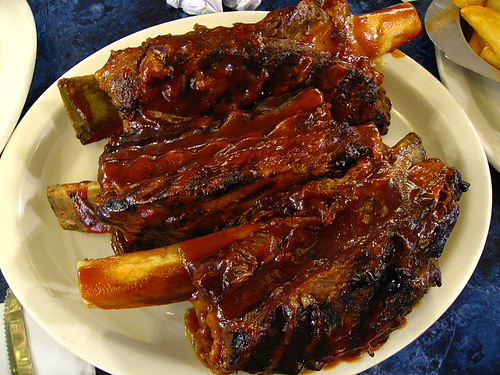
Mmmmm... Ribs.
*In 1992, I got my wish: I met George Lucas. My wife and I were sitting down to dinner at Tony Roma's in Corte Madera (long gone) and he sat down next to us. Alone. It was just a week after the Academy Awards, and he had received the Irving G. Thalberg Award. Yet there he was, all by himself, George Lucas and a good-sized pile of beef ribs. I mentally collected myself enough to squeak out something to say to him (and I DO mean squeak: in my head, I sounded like my 14-year-old self in full conniption mode):

“Mr. Lucas?” (squeak, squeak.)

“Mm-hm?” (I think he was actually had a mouthful of ribs at the time.)

“Uh, Congratulations on getting the Thalberg Award!” Of all the f***king things I could have said to the guy, of all the thousands and thousands of things I fantasized saying to George when I was a kid, it all fled from my consciousness, and that was what I said. Yikes.

“Mmm.. thanks.”

“Alright, I'll leave you be.” Argh.

Wednesday, November 17, 2010

The Maritally Estranged Mr. Limpet

Just seen in super-sharp HD: The 1964 film The Incredible Mr. Limpet. I would not consider this the zenith of the Don Knotts cinematic ouevre – That honor goes to The Ghost and Mr. Chicken, which was ahead of it's time in density of wit and running gags. But I saw Limpet a lot on TV as a kid, and I'll admit to having a soft spot for it.

This new viewing was a bit of a revelation. I assumed it was a kiddie film, but now I can see it wasn't, despite it's animated fantasy elements. The story begins a few months before the bombing of Pearl Harbor: Mr. Limpet is an unassuming bookkeeper who is far more fascinated by fish than his work or his marriage. And we see why: his wife Bessie is overbearing, and his friend George has managed to join the Navy, while he is 4F. Limpet is in such a state of general pessimism about the human condition that early in the film he voices a hope that we will all be eradicated in the upcoming world war, which will allow fish to evolve into our replacements.

Through a bit of unexplained wish-granting, Mr. Limpet falls into the Atlantic and turns into a fish. He quickly adapts and even gains the love of Ladyfish, a comely, naïve female of his new species who talks in a breathy Marilyn Monroe voice. But Mr. Limpet still feels the pull of his old life-- and addresses it's disappointments by helping the U.S. Navy's Atlantic Fleet locate and destroy German U-Boats.

From a 2010 perspective, Mr. Limpet is an unusually bloodthirsty animated protagonist: there are lots of stock-footage shots of submarines imploding and the seas strewn with shattered hulls. Das Boot and Crimson Tide lie between us and this film, and we as an audience now know how horrible it is to die in a submarine. But in 1964, the war was still a fresh memory, and I'm sure every person in the cast and crew were WWII veterans. The enemy was invariably identified as “Nazis” in the film, as in “I'll lead your ship to the Nazi submarines!”

After a lot of German sailors, most of whom were not Nazi Party members, go to their watery graves, the war eventually ends. With the explicit permission of his estranged wife, Mr Limpet and Ladyfish swim off to “the spawning grounds.” The end.

Mr. Limpet, as a fish, often contends with how this unusual dilemma affects his relationships. His former marriage is de facto void, but since Bessie is not technically a widow and they never divorced, his guilt (and then-current social morés) initially prevents him from consummating his relationship with Ladyfish (which should consist of her depositing a clutch of eggs while he sheds gametes into the surrounding water: I'll bet he didn't think that part through when he was wishing to be a fish). His unexplained metamorphosis creates ethical and logical problems no amount of hung lanterns can explain away.

This leads to a completely different reading of The Incredible Mr. Limpet. With one small adjustment, the story can make sense: when Henry Limpet looks out into the sea and says to himself “I wish I were a fish,” what if he meant “I wish I were single?” As a bachelor/fish, Mr. Limpet is able to achieve his full potential: he makes friends, joins the service and receives a commission, and gets to be the hero who eradicates the Axis menace from the Atlantic. None of this would be possible if he had stayed married/human. In the end, after the fighting is over and he retires with honors, Mr. Limpet amicably parts with his first wife and moves on, to live happily ever after with his comely, naïve Ladyfish/second wife.

Just to drive this home, but maybe as just an indication of how serial monogamy worked in the 1960s, I was struck by how much this reminded me of the last season of “Mad Men,” set in 1965. Bessie, in her shrill, domineering way, reminded me of Betty Draper, Don Draper's first wife; Ladyfish had the same youthful, big-eyed, come-hither ways as Megan Calvet, Don's soon-to-be second wife. But Don Draper and Don Knotts: polar opposites, save that first name.

And yes, I'm afraid The Incredible Mr. Limpet is being remade. Warner Bros. has tapped Kevin Lima to direct this effort, which is a good idea: He directed Enchanted, and knows a thing or two about blending reality and fantasy that skews for kids and grownups both. To portray the updated Mr. Limpet, they're looking at Zach Galifianakis. This is an awful idea, for a reason that should be painfully obvious: How can a fish version of Zach be designed to resemble him when fish don't have beards? Duh. I'll even ignore the fact that his style of humor couldn't be a worse fit for the role. Of course, by the time this film is released Zach Galifianakis will have completed his magical transformation into Jack Black and this point will be moot.

Wednesday, February 3, 2010

Nothing Is Irreversible

The final season of "Lost" kicked off last night with another seismic shift to the series' already brain-twisting storytelling style.

In the first few seasons the main story arcs were fortified by extensive flashbacks. Later, they shifted from flashbacks to flash-forwards, which energized the storytelling immensely. This probably led the writers to dispense with narrative temporal shifting entirely and go with something more visceral, like actual time-shifting. The characters proceeded to temporally shift in Kurt Vonnegut Jr. fashion: In fact, they bounced through time so much they got nosebleeds.

So in this final season, as what appears to the ultimate narrative topper, "Lost's " creators split the show into two almost unrelated storylines. One picks up the more-or-less direct narrative thread and keeps our core characters on the island-- in 2007, rather than 1977, but still more or less where they were before all the temporal rambling began. The other is quite intriguing: it picks up at the exact moment in 2005 when Oceanic 815 was supposed to crash-- but doesn't. Jack, Kate, Sawyer, Hugo and company land in LAX, and their stories carry on as if The Island didn't exist (it did, but it was under 1000 feet of water, which apparently neutralizes it's spooky powers). This is the ultimate refutation of the flashback as a narrative device: Just run the characters through both timelines, and let the audience sort it out.

(And I'm going to take a moment to appreciate the charms of Evangeline Lilly, who plays romantically confused woman of action Kate Austin. Her emotional control is amazing, her range is wide and nobody can work in close-ups better. In contrast, Josh Holloway (Sawyer) just has to convey shades of wiseass, and Matthew Fox (Jack) was little more than a constipated refusenik for the entirety of the last season. But most of all, she is one of those rare beauties that looks amazing with tangled hair and covered with dirt and blood. When we see her all cleaned up, Lilly just doesn't pop. Maybe it's the freckles.)

So anyway, we're now seeing two stories unfold: the continuing struggles on The Island, and a glimpse of life if the crash of Oceanic 815 never happened. Because these storylines are apparently either divergent or completely parallel, the death of any character can be completely negated. Shannon, Charley, Locke and Sayid are all alive and kicking on the plane. On The Island, supernatural intervention has apparently reanimated Locke (bear with me) and Sayid (huh?).

It's hard to say where this is all going, which is why "Lost" is one of the best shows on the air: It consistently delivers unfathomable surprises. This is because the producers have created a new form of serial storytelling, one that allows them to kill any character that want, with no consequences.

Damon Lindelof and Carlton Cuse, the current up-front showrunners, are admitted Sci-Fi geeks. (I couldn't help but notice that J. J. Abrams is keeping a low profile in this last season: I think he's trying to dissociate himself from TV in favor of his new feature-film ventures.) They were raised on anthology Sci-Fi shows like "Twilight Zone," "The Outer Limits" and "Night Gallery." Anthologies are great. They have amazing storytelling possibilities: You can blow up the world, kill all the characters, set earwigs into their brains, whatever-- tune in next week, and it's all new. The disadvantage is anthologies lack the intense emotional attachment audiences create for characters in serial programs-- An attachment that can translate into consistent ratings.

So the showrunners simply suspended empirical reality, and voila-- "Lost," the serial anthology. A show with long-running , beloved characters who can die at any time, and still come back. In fact, the characters are also held safely in reserve in an entirely different timeline, just in case.

The only regular I knew was going to die-- die, period, and not come back-- was tipped off by the intrusion of actual reality. Poor Juliet (Elizabeth Mitchell), last seen hammering on a plutonium bomb in last season's finale, didn't make out of this season's two-hour premiere alive. Ms. Mitchell is currently the star of another Sci-Fi series, "V," which ran promos during the show. Unlike "Lost's" universe, Ms. Mitchell can't be in two places at once.

Tuesday, September 22, 2009

A Transparent Cliché

We were trying out some ideas for premium hand-outs for the Austin crowd. The idea that came up was a combination business card and convention badge, a laminate with a slot cut in it for a lanyard. This is a great idea: It's something you can hand out that will get worn and seen. The even better idea that got batted around was to make it transparent.

This idea stalled out when we found out just how much it would cost to get something printed on transparent plastic, especially on two sides, especially with white knock-outs for text and such. Apparently, only American Express Clear can afford it.

So while the plans got scaled back a bit, I thought about exactly why that was so cool. Well, it's because our story is in the Sci-Fi genre, and transparent is... well, Sci-Fi.

Why the hell is that? I'm not sure, but transparent props-- Gizmos featured very prominently in some of the most famous science fiction films ever made-- have been around for 50 years, showing off their futuristic, mysterious see-through power to generations of awe-struck moviegoers.

Forbidden Planet (d. George Pal, 1955). For the most part the incredible technology of the long-dead Krell was grey and opaque and covered with rings, and even hinted to a charming Mid-Century Modern style that would not look out of place at Sterling Cooper Advertising. But clear is here: The Krell music player (“Much like our phonograph,” I remember Dr. Morbius saying) is mostly metal, but it has a band of see-through something right in the middle. How do it work?

2001: A Space Odyssey (d. Stanley Kubrick, 1968). Most of the film was painstakingly designed to show believable, detailed technology. But to make the technological superiority of HAL 9000 stand out over the general art direction, his Logic Core Modules-- The rectangular units Dave Bowman ejects that makes HAL sing funny-- are perfectly transparent.

(Apparently, Kubrick originally wanted the monolith to be transparent, but then-current acrylic casting techniques were not up to the task of making something that big and the idea was scrapped.)

Beneath the Planet of the Apes (D. Ted Post, 1970). The mutant Manhattanites who worship the big polished-brass Doomsday Bomb use a control interface consisting of clear cylinders. TAP plastics was obviously consulted. There are three translucent knobby things on it (which correspond to Ready, Aim, and Fire, no doubt) that make it... Well, blow up.

Zardoz (d. John Boorman, 1974). The computer which runs Vortex Four, a besieged repository of knowledge in a grim post-apocalyptic world, is called The Tabernacle. It is not church-sized, though: It is a lovely piece of faceted lead crystal, easily held in Sean Connery's remarkably hairy hand. Makes a dandy paperweight.

Aliens (d. James Cameron, 1986). Sweaty corporate bad guy Carter Burke (Paul Reiser) wants to go Alien harvesting, but needs someone with on-the-job Alien-wrangling experience to come along. To that end, he gives his calling card to a reluctant Ellen Ripley. It's perfectly transparent-- and rather bulky. Couldn't carry many of those in his wallet, I'm guessing.

The computers of “Star Trek: The Next Generation” ran on "Isolinear Optical Chips," little frammises which were about the same size as modern computer memory, but came in shades of translucent green and blue. They're “optical,” see, so they're see-through, get it?

The Matrix (d. The Wachowski Brothers, 1999). You can pick either the red pill or the blue pill, both are perfectly valid choices. And both are see-through gelatin caps. Not hard to see why Neo took it: He probably thought it was vitamin E or timed-release cold medicine. He did look sort of green in the gills.

Minority Report (d. Steven Spielberg, 2002). Digital effects finally evolved to their current mind-bendingly realistic maturity when this film was made, so they went positively nuts with the see-through. Huge wall displays, computer monitors, tray-like data cards, all as clear as glass. Even Tom Cruise's sad home movies are on little squares of lucite.

(I'm sure there are more good examples. Anyone?)

What's up here? Why is the future always transparent? This visual metaphor has been going on so long, I am officially pronouncing it a cliché. I have several theories as to why see-through has become short-hand for futuristic:

  1. The Inexplicable. To a contemporary movie-goer, a device that has no working parts is not of our time. And a device with no working OR visible parts: well, that's even more impressive.
  2. The Mystical. Sci-Fi giant and satellite buff Sir Arthur C. Clarke's third law of prediction: “Any sufficiently advanced technology is indistinguishable from magic.” crystal-clear machines fit that description to a T.
  3. The Metaphoric. Showing a doo-hickey that obviously does something but appears to be invisible may be the filmmaker's way of saying “Sorry, doesn't exist. Don't look here.” That's right: See-through technology is a way to hang a lantern on it.
  4. The Cinematic. The great thing about clear plastic props is you can shoot lights through them, and they refract and glow in a really dramatic fashion, as if they were somehow filled with amazing energies as yet uninvented. Hate to say it, this is probably how it all got started.
We have repeatedly seen the future, and we can see right through it.

Tuesday, August 25, 2009

Wizards who don't age well


I didn't mean to parallel Daniel's 1970s-film reassessment, honest: I had this entry prepped a few days ago. I see it as proof of positive zeitgeist.

Got home late on Saturday, surfed the premium channels for a semblance of entertainment. Found something that I used to consider very entertaining. Not sure what changed.

The film in question is Wizards, Ralph Bakshi's animated fantasy from 1977, released four months before Star Wars. I thought this film was the absolute apocalypse when it came out, the best animated film ever. So did all my friends. It was a staple at midnight screenings, and I must have seen it (and, as I worked the midnights sometimes, screened it) a dozen times.

So I let Wizards unspool and I settled in. In ten minutes, I was exasperated. By the time a half-hour had gone by, I was aghast. After 80 mercifully short minutes, I was questioning my sanity.

This film, which I loved so much in younger days, was absolutely terrible.

Thirty-two years after it's release, I was seeing Wizards for what it was: A unique sort of failure. Mr. Bakshi had set out to make an animated fantasy-comedy: He objectively failed on all three fronts.

Fantasy: The story concerns the struggle between twin wizard brothers-- one good, one evil-- in a far-off future Earth. The good one (a cross between Gandalf and underground cartoon character Cheech Wizard) lives in a realm full of magic, elves, dwarves, etc., while the evil one rules a land full of technology, orcs, and mutants. The McGuffin is unearthed Nazi propaganda: The bad, Sauron-like wizard uses it to motivate his mutant underlings to take over the world. A quest is then organized by the agents of good to travel to the blah blah blah to defeat the blizblaz of the himham. Alright, it's Lord of the Rings: Details are lifted numerously and wholesale from Tolkien. But it's more of a mash-up: Fantasy vs. Sci-Fi, magic versus technology, fairies versus radioactive Nazi mutants. Bakshi sort of squishes it all together, and it's so ridiculously overdone it's hard to care what happens at the end.

The final stroke of the story-- exactly HOW good Avatar bests his evil brother Blackwolf, is a •••spoiler•••, so I won't reveal it. But I will say it completely negates Bakshi's carefully lifted-- er, carefully built premise.

Comedy: The funny parts are painful. Bakshi's way of lightening the mood in Wizards is to stop the story cold for borscht-belt schtick. Not to geek out, but it's sort of hard to get into the D&D mood when the lead character sounds like Peter Falk and rich New York accents come out of half the character's mouths.

Animation: If you see a cool sequence once in Wizards, you'll see it two more times at least. Bakshi reuses his cels more than Hanna-Barbera ever did. A 12-cel action cycle (for instance, Nekron 99 galumphing along on his two-legged whatever) will be spun out for minutes at a time. The battle royale at the end is thickly padded with rotoscoped (i.e. xeroxed) battle scenes from Zulu, Patton and El Cid.

I know hand-drawn animation is an expensive, labor-intensive endeavor, and Bakshi and Disney were the only ones putting out feature animation in the 1970s. But sheesh.

Seen anew, it is easy to figure out why I liked Wizards so much when it first came out: There was literally nothing else like it out there. It had a hip, cynical sensibility, and it aligned with late-hippie core beliefs: magic good, technology bad. (Apparently, the concept for the film was hatched in late 60s, which explains things a little.)

But between 1977 and 2009-- from Star Wars through the Rings trilogy to Pixar and Harry Potter-- the bottom bar for fantasy films has been raised to the very apex of Hollywood. Wizards is a representative of a time when American animation was dying out, and fantasy films were scrubbing around the margins for studio financing. These may be factors in the film's many shortcomings, but I can't help but feel we all gave it a pass back then because it was the only game in town.

--Skot C.