Showing posts with label wall street. Show all posts

Wednesday, October 14, 2015

Jaws as Socio-Economic Parable

Chief Brody (left) deals with pressure from the
Amity Selectmen and their 1974 Cadillac Fleetwood.
Jaws (1975) was a more than Spielberg’s breakthrough thriller hit, a huge box-office hit, and the film that, with Star Wars, invented the idea of the high-concept summer blockbuster. It is also a parable. The most obvious theme is man versus nature— how humanity can band together to defeat relentless forces of death and chaos. But the parable that is touched on but rarely explored is how Jaws is a study of American social structure- How they fight, and how they cooperate.

America in 1975 was somewhat different than it is today. Wall street was still well-regulated, the top marginal tax rates on income were much higher than they are now, and unions were much stronger. The wealthy were very wealthy, but they still had some common ground with a healthy middle class. It was a time when the middle class was still given substantial incentive to prosper: single-income families were still the norm, and even the poor were considered “lower middle class.” It was before Reagan, union-busting and trickle-down economics, and the long and fantastic post-WWII run of prosperity was still going— it was near the end, but it was still working for most people. Looking back, I think most folks didn’t know how good they had it.

Into this prosperous, fairly harmonious but increasingly cynical post-Watergate world enters a shark, who begins eating people off the shore of the small East Coast resort community of Amity. After a few disastrous mistakes by the local powers-that-be that result in even more death, the right decision is made and a fishing expedition to go kill the shark is financed.

And, oddly, a representative of every level of American society is on-board.

Quint: "Let me feel your hands... They're city hands,
soft from counting money."
Hooper: "hey, I don't need this 'working class hero' crap!"
• Matt Hooper (Richard Dreyfuss) is the Woods’ Hole Shark expert. He represents the upper class: He is college-educated, well-traveled and pursues his avocation (oceanographer) with expensive equipment he bought himself. His approach to the challenge of the antagonist is initially aesthetic: He thinks sharks are magnificent, beautiful creatures, the pinnacle of piscine evolution.

• Quint (Robert Shaw) owns the Orca: He is a charter fisherman specializing in shark hunting. He represents the working class: a poorly educated, crude rustic with a strong Down East accent. Quint’s motivations are personal: as a survivor of the sinking of the USS Indianapolis in World War II, he has dedicated his life to vengeance against creatures who killed his shipmates. Considering the condition of his ship and shore facility it seems Quint has turned his obsession into a marginal sort of living.
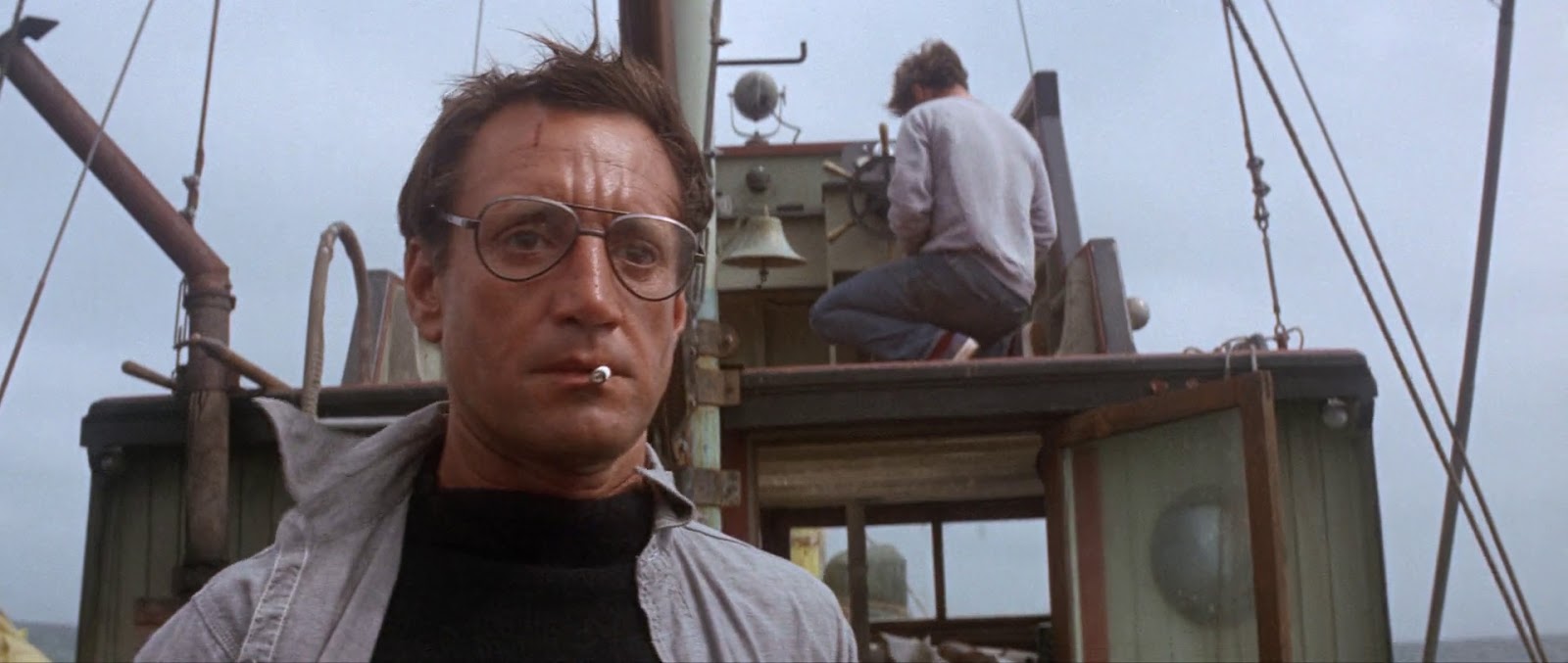
"I think we need a bigger boat." Perfect example of
middle-class pragmatism from Chief Brody.
(This classic line was ad-libbed by Roy Scheider.)
• Chief Martin Brody (Roy Scheider) is on-board as a sponsor: his efforts financed the expedition. He is ostensibly the protagonist of Jaws— and he is solidly middle class. A former New York City policeman turned town police chief, he is pragmatic, methodical and cautious. A civil servant, Brody is fully enmeshed with the pitfalls and complexity of local government, and spends a good part of the film trying to convince Amity’s selectmen to take the shark threat seriously. His viewpoint on the antagonist is a common one: ignorance and fear. He does not like the ocean, does not go into the water, and is frankly terrified of sharks. However, he displays a common-sense willingness to facilitate, learn and help.

With representative of every social class onboard the Orca pursuing the common goal of ridding the fair town of Amity of a rogue Great White it would seem their goals are unified. But there are tensions between each man as much as there are tensions between classes:

The "moment of greatest settled success" of Jaws:
all levels of society literally harmonizing together
before the shark starts taking the boat apart.
Brody and Hooper vs. Quint: As well-integrated members of mainland society, they see Quint as an unhinged, dangerously obsessed yokel.

Hooper and Quint vs. Brody: As experienced seamen and shark enthusiasts, they see Brody as a useless landlubber who has the potential to get into serious trouble onboard.

Quint and Brody vs. Hooper: Hooper has a tendency to be snippy and is constantly suspected of not sharing the primary goal of the expedition: to kill the shark, not study or admire it.

These squabbles are put aside (mostly) when the shark seems to take an interest in them and begins a personal (and scientifically nonsensical) vendetta against the Orca and the three intrepid class representatives onboard. Sharks don’t take vendettas: in fact, most marine biologists believe Great Whites don’t care for people meat, and most fatalities are “test bites” that have bled out.

"How do you work this thing of yours?" Quint setting aside
his working-class resentments for the sake of survival.
This shark vendetta does not makes sense— unless you cast the story as a parable about class. Then the shark becomes a common enemy to all society, high and low, a threat which requires complete socio-economic cooperation.

Hooper, Quint and Brody all work together to battle the shark, who also busy trying to eliminate all of them in no particular order. The final act of the film can even be seen as a microcosm of how chaos and disaster are typically visited upon the American body politic (from here to the end are solid ••• spoilers ••• but shame on you if you haven’t seen this film!)

Quint, being working class, is eaten by the shark, which fits into the demographic of natural disasters affecting the poor proportionally worse than anyone else. Hooper, having access to expensive gear, is able to swim away from his high-tech shark cage, hide on the seafloor, and survive. The job of dispatching the shark falls on the capable middle-class Brody, who uses a tool left by working-class Quint (M1 rifle) and another tool left by wealthy Hooper (compressed-air scuba tank) to blow up the shark. Thus was the burden of the 20th century American middle class.

Peter Benchley, looking sharp in wide lapels.
The original novel was written by Peter Benchley, the grandson of humorist Robert Benchley. In the novel as well as the movie Brody is the protagonist, but Benchley was in life much more of a Hooper (Phillips Exeter prep school, Harvard University). Interestingly, Hooper was a bit of a rich cad in the book: he had an affair with Chief Brody’s wife. Then again, in the book Hooper did not escape the shark cage and was just plain eaten. He comes off much nicer in the movie, which may or may not be social commentary.

Tuesday, February 14, 2012

Downton Abbey: What We're All Missing

Here's the picture in early 2012: The presidential race is heating up, and it has been largely informed by the inequalities in the American social fabric-- and inequality that has been brought to light by the efforts of the Occupy movement. It is such an effective area of discourse that the incumbent President is incorporating it into his platform, promising that the very wealthy will start paying their fair share of taxes. This focus on inequality is so prevalent that even Republican candidates-- long the eager sidekicks of the moneyed class-- cannot avoid bringing it up, slinging mud at Mitt Romney's fifteen-percent tax bracket.

So it is quite incredible that in this charged atmosphere of near-class warfare (call it the undeclared hostilities preceding actual class warfare) that the American viewing public would fall so hard for “Downton Abbey,” an ITV melodramatic series about the trials and tribulations of the House of Grantham in early 20th century Britain. The overarching theme of the series is how absolutely rigid the social classes were in Edwardian England-- There are Earls, Lords, Ladies and gentlemen of bestowed titles enjoying elegant meals prepared by an army of servants toiling in the lower floors of their stately home. Relationships between Upstairs and Downstairs are excessively, ritualistically formal. The middle class is almost invisible in this show: Social mobility has yet to be invented.

In short, the socio-political world of “Downton Abbey” should turn even the most rock-ribbed Republican into a raving anarchist. But it doesn't. It's a hugely popular show on both sides of the Atlantic: It's coming back this fall in a third season, and will be guest-starring Shirley MacLaine as the American mother of the Countess of Grantham. So why has this show captured the public's attention and imagination? A few ideas:

Matthew Crawley and Lady Mary.
Compelling historical detail. We're moving through a moment in entertainment where the past is examined with clinical fascination. Shows like “Mad Men” and “Boardwalk Empire” are more than just dramas set in the past: they delve into the fashions, attitudes and social mores of their settings. We're fascinated by Don Draper's cavalier womanizing, chain smoking and narrow lapels. 1921 Atlantic City is reproduced right down to the wallpaper patterns and brass-trimmed stick phones. Same with “Downton Abbey,” which was definitely the UK answer to these shows. We get to see the elegant trappings of Manor living, the grinding amount of work it took to make Manor living so elegant, and to hear odd archaic sayings like “she was a guinea a minute” and “ship-shape and Bristol fashion.”

It's an insane Douglas Sirk-style melodrama. Servant or Swell, Drudge or Toff, everyone falls violently in love, has wrenching personal disclosures, and carry all sorts of secrets. Dalliances and liaisons coalesce, evolve and dissolve like blobs of wax in a lava lamp. Lady Mary, the eldest daughter of the Crawley family, has had so many suitors die on her she is thought by some “Downton” observers to have Black Widow Powers. Some characters--- such as valet Mr. Bates and head housemaid Anna-- are so soulful and appealing I defy anyone watching to deny they had tears in their eyes when they finally wed. Granny-- The Countess Dowager, played by Maggie Smith-- is a grand Victorian Lady who is constantly horrified by both the excessive snogging and Edwardian modernity in general. She gets the best, funniest lines in the show.

The Earl of Grantham.
• Everyone has a place. Sure, England in 1912-1920 was rigidly stratified, but it was also a smoothly functioning society, where both the high and the low had roles to play-- and, most importantly, each protected the other. The servants conduct themselves with a constant awareness of how their actions will affect the prestige and standing of Downton: In particular Carson, the head butler, understands his duty as a retainer to the dynastic estate, rather than as just a manager of servants.

Conversely, we can see that the Crawley family, Lord Grantham in particular, do not just employ their servants, they defend and protect them as well. The writers of "Downton Abbey" to great lengths to show that he Lord Grantham not just another snobby old aristo. He is the one who brought in his former Boer War aide-de-camp as his personal valet, resolves disputes with the help-- and even allows Sybil, his youngest daughter, to marry the family chauffeur. He even steals a few kisses with a comely (and widowed) new maid, but soon comes to his senses and discharges her--but only after setting her son up for life. Regardless of how you may feel about the legitimacy of peerage, he's the ideal boss.

This, ultimately, is the core of what makes “Downton Abbey” connect with viewers: Noblesse Oblige. The concept that the wealthy have an obligation to respect and care for those below them in class and status. Tune in and you get to see this concept elaborately enacted in every episode. Read the news, watch the presidential race or follow Wall Street and you will see how noticeably absent it is in 21st century life-- and the social decoherence that it's absence is inflicting. Of all the period details on lavish display in the halls of Downton, this abstract concept is likely the only one we wish we could pull forward into our troubled times.

Monday, February 22, 2010

Re-seen: Koyaanisqatsi


There is stuff on besides the Olympics. Tiring of watching the curling round-robin, I tuned into MGM-HD and, like the case of Wizards, caught a film I haven't seen in several decades: Godfrey Reggio's Koyaanisqatsi (1982). I was so blown away by this film when it first came out I saw a matinee screening, then came back a few hours later and saw it again in an evening screening. And unlike Wizards, seeing it afresh after so long didn't expose it as a flawed film. It's every bit as impressive as when it came out: It is history itself that has been unkind.

Koyaanisqatsi a work of the "pure cinema" genre, which I have long been a fan of. Pure cinema dispenses with actors, scripts, dialog, and traditional narrative, building meaning though the arrangement of images and the dialectical language of montage. Dziga Vertov (Man With a Movie Camera, 1929), Leni Reifenstahl (Triumph of the Will, 1934) and Stan Brakhage (Dog Star Man) are notable directors in this genre.

My favorite practitioner is Ron Fricke, who was Godfrey Reggio's cinematographer: He created Baraka (1992), shot all over the world in 65mm Todd-AO. This film has a deep, profoundly honest spiritual resonance that is hard to explain unless you see it, especially if you can see it projected in 70mm. You will not believe a film with no apparent narrative structure can leave you with a lump in your throat when the lights come up. (Baraka is available on Blu-Ray, and is the single best argument I can give you to get a Blu-Ray player.)

Koyaanisquatsi tells a story about humanity's relationship with technology and how it is unmooring us from the natural world, through arresting images (time-lapse footage of people on escalators or freeway traffic; urban blight), stock footage (bombs exploding, rockets launching), montage (cutting together sequences to explore and expand these ideas in a linear way) and Philip Glass' amazing soundtrack, a relentless, percussive work so singular Godfrey Reggio recut his film to match it.

Up to this point, I'm not saying anything that hasn't been written in the last 28 years. But from a contemporary vantage point Koyaanisqatsi has gained some new, unintended insights.

The film is a work of avowed social criticism. It is an 82-minute-long complaint about capitalism and technology, not that much different than the "message" in James Cameron's Avatar (2009). Judging by his age and biography, Godfrey Reggio was no doubt a Vietnam-war-era New Left activist, a hippie-age Boomer, and a bit of a commie.

He shot the film over five years, from 1977 to 1981: the last half of the film is mostly composed of sequences shot in cities, freeways and factories all over the United States. It was a time before computer automation had completely taken over, and people can be seen at work doing things: sorting mail, stuffing Twinkies, stacking ham. It shows factory floors full of Americans doing things they don't do anymore: assembling televisions and Chevy Camaros by hand, streaming out of Lockheed's Burbank facility by the thousands.

Most of this footage was shot undercranked, which speeds everything up to a frenetic pace. Reggio did this to make a point about how technology is making us inhuman. But from our 2010 vantage point, he captured the the pulse of a lively period of American history, with a thriving manufacturing sector and something like full employment. The sped-up stuff just makes the workers of the time seem more purposeful and energetic. In contrast, if he put his undercranked camera in one of Google's vast cubicle farms in Sunnyvale, I don't think it would make compelling viewing.

Reggio saves his best jabs for the end: in the final act, he shows the paper-littered floor of the New York Stock Exchange. He employs the film's only post-production effects here (the under- and over-cranking was done in camera). The footage is double-exposed, rendering the traders as shadowy, invisible capitalists, controlling everything. Okay, I'll admit that part works.

We then get to the famous last scene, an amazingly long piece of stock footage of an Atlas-Centaur rocket blowing up. As the soundtrack goes to organ music and creepy basso profundo chorus, the camera tracks a second-stage engine slowly falling back to earth. Reggio is making a point by showing us what the kids call a "fail" but all I could think about, watching this footage, is the fact that NASA is close to shutting down the Space Shuttle program, and is looking for ways to privatize future space launches. So Godfrey Reggio's metaphor has become yet another example of something America can't do anymore.

You can see Koyaanisqatsi in it's entirety at Hulu: The jarring, every-twelve-minutes commercial breaks add to it's non-narrativeness.

Monday, August 31, 2009

Iron Mouse

In NY Times cover worthy news, Disney has bought Marvel for $4 billion in stock and cash.

On the face of it, it's an obvious and rather smart move for Disney. They can extend their patented relentless Disney synergy to over 5,000 Marvel characters-- From Aardwolf (A mutant bad guy from Night Thrasher, who sounds like a superhero with restless leg syndrome: Read the breathless fanboy description here) to Zzzax (A high-voltage Hulk nemesis). Marvel comics, at least the directly branded ones, tend to keep to a PG rating: a fairly decent fit for Disney's audience.

I'm not so sure hardcore Marvel Comics fans are going to like the fact the likes of Clarabelle Cow and Goofy are more central to Marvel's new owners than Spider-Man and Thor. They may not be relishing the idea that there is nothing to prevent an Iron Man-"Jonas Brothers" or X-Men-"Wizards of Waverly Place" mashup. Might be interesting the other way: I'd like to see what Marvel could do in the Duckburg universe.

It may not come to that. It was Marvel Entertainment's tendency to shop their properties to a number of different studios: Spider-Man to Columbia/Sony, Iron Man to Paramount, X-Men to Fox, etc. These deals are staying firmly in place. I wonder if Disney is holding something of a pig in a poke, at least in terms of movie rights. With all the easily recognized, big-name franchises tied up elsewhere, they may have to be content with films featuring second-string characters. So look for news of new Disney dev deals for Dead Girl, Collective Man, Flatman, Obnoxio the Clown, and Captain Britain. But hey-- I can suddenly see Howard The Duck actually working!