Showing posts with label tv. Show all posts

Thursday, October 8, 2020

The Comey Rule: It Is What It Is

 “It's funny how the colors of the real world only seem really real when you viddy them on the screen.” —Alex Delarge, A Clockwork Orange (1971)

Got through the two-part, 3.5 hour Showtime miniseries The Comey Rule in one sitting, right after watching the Vice Presidential debates, in fact.

The production is top-notch, shot anamorphic in luscious cool tones by veteran DP Elliot Davis and directed by Billy Ray, who wrote the biopics Captain Phillips and Richard Jewell. Despite  its impressive length the miniseries never flags: it moves from one political dilemma to the next (Clinton’s emails, Russian interference and kompromat, etc.) with nervous energy throughout part 1 and into Part 2, where Trump finally shows up. He’s the ultimate non-moveable object, and every character in the film ends up crashing right into him.

Brandon Gleeson as Trump. He is often
shown in the Oval Office with the sun
shining so bright behind him it flares
across the screen. The symbolism at
work here is self-explanatory.


This is the first big-budget narrative biopic about the Trump administration. (there have been dozens of documentaries.) It features Jeff Daniels as James Comey, delivering one of his trademark “Tom Hanks Light” trustworthy and calm performances. The thing is packed with A-list stars like Holly Hunter and Jonathan Banks and Michael Kelly. (The most fun portrayals: William Sadler as Michael Flynn and Joe Lo Truglio as Jeff Sessions.)

Irish actor Brendon Gleeson plays President Donald Trump, and it is a revelation. He inhabits Trump: his Queens-hatched singsong voice, orange skin, sci-fi hairdo, the sack suits. Every third line is punctuated by the wet rasp of his nostrils taking in a breath. In the universe this film sets up in Part One— munificent, hard-working, sort of WASPy people dressed in plain suits, working hard but important jobs— Trump crashes into Part Two like a space alien. I hope he gets all the Emmys.

FBI brass, watching the 2016 election results.
Michael Kelly plays Andrew McCabe.
None of them at this point know
how doomed they are.

The screenplay was adapted from James Comey’s book “A Higher Loyalty,” and as such it tends to hagiography: Comey, in many places, comes off like a solid, patriotic G-man whose only loyalties were to justice and the FBI. But there is also a counter-theme to the portrayal the miniseries does not shy away from. James Comey is shown as a government official with a fatal flaw: he has no political instincts. No gut instincts at all, really. The whole Clinton email debacle— declaring an investigation less than fortnight before the election, and calling it off three days before— was shown as a result of his self-righteousness, his dogged adherence to procedure, without any thought to political fallout.  When someone as primal and cunning as Trump enters his life the miniseries shows in sickening detail he was utterly unprepared for it. He falls back on his honesty and competence, and in the end it makes no difference at all.

One of the wonderful elements of biopics like this is how they can show the color and detail behind events we have recently seen on television or the internet. Biopics somehow make what is real even more real, just like Alex Delarge told us. Great example: the public introduction of Comey into Trump’s administration, the scene he described in his book where when Trump entered, he subconsciously backed up to the opposite side of the room. Trump calls “his” FBI director over: Comey goes frozen-faced. He gives him the trademark tugging handshake and whispers “let’s get a few pictures together.” Meanwhile Comey’s wife and daughter are watching live at home— and the wife says, “that’s his ‘oh shit’ face."

James Comey (left) and Jim Clapper (right)
riding the elevator in Trump Tower.
Contemporary biopics are usually stories filled with dread. We KNOW what is going to happen to the hapless characters introduced in Act One, so all we can do sit helplessly as history and misfortune overtake them. The list is very long: Flight 93, The Perfect Storm, Too Big to Fail (the HBO biopic about the 2008 crash, this film’s closest cousin), and both of Billy Ray’s aforementioned writing credits.

The Comey Rule
is no exception. You get to relive the 2016 election and all the sickening depression that came with it. When Trump starts taking charge, all you can do is watch helplessly as career government employees try to comprehend someone like Trump, who has absolutely no care about the rules and laws and precedents everyone else relies on to keep government running smoothly. The most dread-fulled part of The Comey Rule is this spectacle of slow-motion disaster: The cool, competent bureaucrats and agency employees and lawyers who are are helpless in the face of Trump. They all know something bad is about to happen to the rule of law and the reputation of their agencies, and all they can do is look at each other and shrug.

“It is what it is” is a Trump quote about the Coronavirus, but it shows up in mob movies with regularity. It has a very specific meaning: it says a terrible thing has happened— but it HAD to happen, and there is nothing you or anybody on earth can do about it.

The 2020 election is upon us. Let us hope the outcome is a hopeful one, because The Comey Rule showed us how easy it is to watch everything go to shit and mumble “it is what it is.”

Tuesday, April 21, 2020

Nobody Knows Anything, For Real This Time

William Goldman’s famous Hollywood aphorism “Nobody Knows Anything” has never applied with as much profound depth it does now.

Hollywood as a collective definition is composed of several large interlocking systems, all designed to create, produce and distribute entertainment content. Most are being crushed by the coronavirus lockdown. Going through the process beginning to end:


• Pre-production is still going strong. TV writer’s rooms are staffed via video conference, and scripts are still being optioned. Projects are still being greenlit, and everyone is positioning for the days that will follow COVID-19.


• Productions are dark. Thousands of film and TV show production companies are shut down, crews on furlough, sound stages empty, equipment unrented. Film and TV Production are collective endeavors, ones that require a lot of close contact (for example: during shooting, an average cinema camera rig has three sets of hands on it) so it won’t be safe for a long time. News and some forms of reality TV have the edge here: “American Idol” is experimenting with a remote contestant format, which is better than nothing.


• Live theater is utterly dark. Hamilton is playing at precisely zero venues worldwide.


• Streaming services and cable are doing incredible business right now. Industry leaders are worried about the medium-term health of this sector: If the astounding level of unemployment continues, subscriptions to streaming services and full-service cable will start to dwindle as people find them increasingly unaffordable.

• The big hit to Hollywood: Film Exhibition. Movie theaters are closed, and the prospects of movie-going returning to prior levels any time soon is increasingly uncertain. In fact the very survival of movie theaters is in doubt: AMC may be looking at bankruptcy protection (something they do once a decade or so, but still).

Movie-going has been derided constantly in the age of streaming as a dinosaur, a relic of the pre-television industry. This is what most of this post is going to concentrate on, because I do not think people really grasp how absolutely vital the movie theater ecosystem is, and how losing them will profoundly affect almost every other aspect of the entertainment industry.

Studios operate on a “tentpole” model: big, well-publicized films released to thousands of theaters worldwide and provide revenue through box office sales for other productions. To turn a profit for these films, which are generally budgeted over $100 million, huge theater capacity is required, hundreds of thousands of butts in seats. Marvel, the newest large studio, operated on the tentpole model 100%. Others operate downmarket, packaging independent films made on modest budgets.

But all this machinery has stopped.

I’m offering two prognostications for the future of the motion picture exhibition industry, both on the extremes.


FULL RECOVERY SCENARIO


A seating diagram programmed to create a safe space around each sold seat.
A mix of singles, 2s, 3s and 4s shown. Nobody is placed in the middle of a row
so they do not have to pass close to anybody else. Capacity is reduced 75% to 80%.

When the states start slowly opening up theaters again, social distancing guidelines can be put into effect to assure patrons who are going to be VERY VERY NERVOUS about going into a darkened windowless room full of strangers.

The way I came up with (which no doubt the theater chains are implementing) is centered around the fact that most theaters are based on reserved-seat ticket sales. When a block of seats is purchased, the seats around them are condemned for the screening to maintain a 6-foot defensive space. If strict contact rules are allowed— two parties per row to eliminate close passing for the aisle, which is always ass-to-face— theaters can be filled about 25% of capacity. This does not allow for full sellouts, but it is at least equal to a modest weekday crowd.


During these first few weeks or months people will likely be treated to low-budget fare. Independent films, genre comedies, horror films: films with modest budget and the possibility of getting a return even in lower-capacity venues. Studios can and will reserve their large-budget tentpole films until they can get enough screening capacity to make releasing them a worthwhile risk. (a lot of big-budget films are frozen in post-production as well: visual effects houses are not operating, and a film the scope of something like Avengers: Endgame can’t be finished off on somebody’s iMac at home.)

Once the curve is safely flattened theaters can go back to full capacity, though it remains to be seen if people will feel confident enough to pack themselves into sellouts for quite a while. Some late-summer big-budget releases— the sequel to Wonder Woman being an example— are sticking to their release dates, betting the huge audiences are just waiting for the all-clear.


Bravely sticking to a mid-August
release date. Notice it's already
been moved down from June.
COLLAPSE SCENARIO

Major chains, empty but still paying huge rents for their their multiplexes, go out of business. Theaters that survive see persistent poor box-office as people, still spooked by COVID-19, stay away.


Without a way to recoup investment for big-budget films, the studios release them streaming at a loss. Streaming and on-demand represent a revenue source, but compared to theatrical release box office it’s tiny, ancillary, in the old days a way to slightly round up the numbers.

If the financial downturn continues and people cancel subscriptions, even this outlet will become even more problematic. Without a path to profit studios will eventually stop green-lighting big-budget films entirely. For movie geeks who hate comic-book movies this sounds heavenly, but remember that big films finance small films. The Lord of the Rings trilogy financed a decade’s worth of modest-budget New Line films.


Without theaters, the theatrical distribution system will collapse. This will create chaos: non-chain theaters that managed to stay open will have nothing to screen. Drive-in theaters, the only healthy subsection of the exhibition industry, will collapse as well when they run out of films to screen.


This bleak scenario ends on your TV: Streaming, on-demand and TV will be the only outlet for scripted entertainment. The big franchises will likely be broken up into series and miniseries. Cable and premium, already increasingly turning to series to attract viewers, will start to shrink: many of the add-on premium channels show endless theatrical films, and with that source of content gone add-ons like Starz Action and Showtime Comedy will start vanishing.


The other problem is the eternal conflict: Hollywood versus The Internet. If the theater industry collapses, the Internet wins— and never forget the old hacker battle cry: “The Internet wants to be free.” People naturally EXPECT films to be cheap or even free when they’re on TV. Additionally, any film put out on streaming is available for torrent download within hours. In my job as a post-production profession I’ve always advised indie filmmakers to only put your films on streaming platforms when all other revenue streams— festivals, optical media— have been exhausted. Once it’s online, you’re done making money off it.

 But with all the eggs in the TV screen basket we’re back to the ability of people to pay for these services. If hard times persist, many of them will end up cancelling, which will drive revenue even lower.

Well, those are the extremes. I think the reality will be somewhere in-between: some chains will close, some big-budget films will be canceled, and it’s going to be tough to make a living in Hollywood for a while.

But really: nobody knows anything.

Saturday, January 25, 2020

Harley Motherf***ing Quinn

[Warning: adult language and situations. No spoilers, though.]

Harley Quinn, voice supplied by "The Big Bang Theory's"
Kaley Cuoco. So less of the insane Brooklynite attitude from
previous iterations, more of a scary SoCal girl.
I don’t review TV shows that often, animation almost never, and I’m not a comic book fanboy. But I chanced upon a review on io9 that was so intriguing I had to check it out— and I was not disappointed.

“Harley Quinn” is a comedic adult animated web-based show now streaming on DC Universe, behind an $8-a-month paywall. It tells the story of Harley Quinn, the Joker’s lover and sidekick, as she dumps him and tries to invent herself as an independent person and supervillain in her own right. She does this with the help of her best friend / roommate Poison Ivy (Lake Bell, a wonderfully dry voice performance), and her crew of minor villains who I would know if I actually read comic books.

Harley and Poison Ivy, roommates. These two characters
may be the most 'shipped couple on the internet. So far
they are depicted a just close friends, but the season
is not over yet.
The dynamic between Harley Quinn and Joker has been well-documented, and they’re even going to make it big deal out of it in the Margot Robbie-starring live-action film coming out next month. Her character has been described as suffering from dependent personality disorder: in her former life she became so obsessed with Joker while treating him in Arkham Asylum she abandoned everything to become his often-abused sidekick. As a super villain origin stories go it may be the most mundane one ever: Harley was a victim of abusive, manipulating partner, a trauma untold thousands of people are suffering every day in the real world. It has given her character a special resonance with fans: even though Harley is a supervillain, her personal emotional issues have a human scale and her efforts to break free of her abusive partner make her even more relatable. The show does not shy away from this unhealthy dynamic, and in fact it casts most of her personal growth as an anodyne to Joker, her romantic obsession transformed into professional competition. Harley a fun character, given considerable depth: she is "a bad guy, but not a bad person," and her story arc probably has her headed to antihero status.

The creators of “Harley Quinn” made a strange but ultimately transformative decision: As it is not a broadcast show there are no real restrictions to language and content, so they decided to make a show for adults. It's a bit of a shock. To give a feel for the dialog:


Harley (to Joker, in a subconscious confrontation): “You think you created me, but no one did. My fucked-up parents didn’t create me. Neither did Jessica Sarner when she lied to the whole fucking camp and said I lost my virginity to a horse! A HORSE!” (applies baseball bat to Joker’s crotch: he doubles over) “Neither did those cops who questioned me for hours about what happened to Jessica Sarner! And YOU sure as hell didn’t fucking create me, Puddin’!”

And the sexual innuendo is of the single-entendre variety:


Bane (to Joker on phone): “Harley is at Penguin’s nephew’s Bar Mitzvah.”
Joker: “She crashed the stupid thing?”

Bane: “Yeah. Seems like she’s doing pretty well. Brought a tiger. Pretty cool!”
Joker: “What? Anyone can buy a tiger. You know she has HPV, right?”
Bane: “Most sexually active adults do.”
Joker: “Shut up!”


Dr. Psycho, after the second time he called someone a c**t.
Yeah, the filter is off and this makes it for fairly exhilarating viewing. There are some limits: no female nudity (yet*), but lots of pixelated male crotches. The show even has a line, and one character crosses it: Dr. Psycho, one of Wonder Woman’s nemeses, is blackballed out of the Legion of Doom for calling her, in the heat of battle, a c**t. (it’s the only profane utterance bleeped on the entire show.)

I know adult-oriented animated series are not exactly a new phenomenon: “South Park” is 20+ years old, seriously raunchy, and the movie was legendary in that regard. Every episode of the immensely popular Adult Swim series “Rick and Morty” is filled end-to-end with bleeps and blurred-out genitalia.

What makes “Harley Quinn” exceedingly unusual is the fact it is camped dead center in the DC Universe. It is not a sidecar, like the way Deadpool— the foul-mouthed, violent antihero from Marvel— is a sidecar, peripheral to the X-Men universe (several X-Men make an appearance in the sequel) and completely walled off from the big-money Avengers universe. Deadpool will never crack dick jokes with Captain America. (Professor X, maybe.)

In her show Harley regularly interacts with the big hitters, Batman and Superman and the like. The iconic superheroes they spend hundreds of millions of dollars to make movies about. And by “interact,” I mean when Harley meets The Batman in the first episode, she adamantly insists he is called that because he fucks bats.

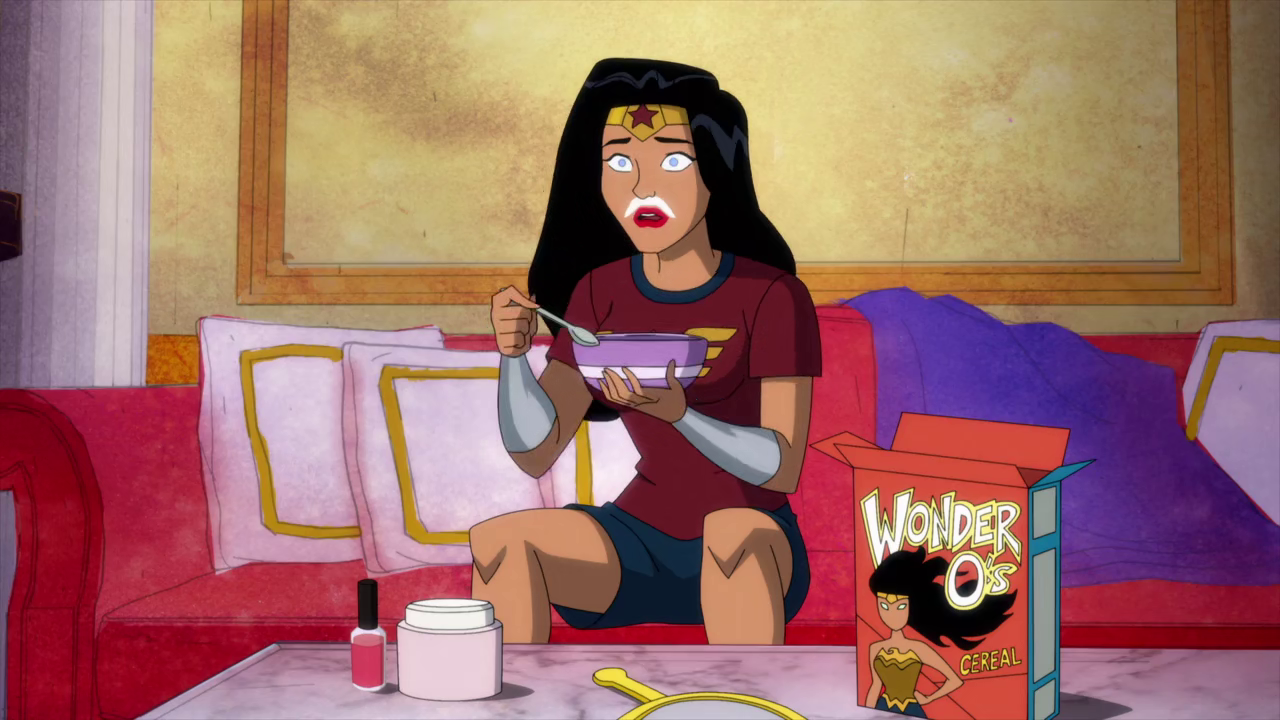
Wonder Woman, eating her own brand of breakfast cereal,
realizing all the ground rules have changed.
This juxtaposition turns an amusing series into a surreal one. What we have is a series which has IP-critical superhero guest cameos— and they basically stand in inhibited silence while a collection of supervillains dance around them, calling them out with ripe curses and sexual innuendo. The decision by DC and Warner Bros. to execute this vision is mystifying.

The other exhilaration that comes from ”Harley Quinn” is how this adult theme remakes every character anew. All the profanity and frank sex talk draws attention to the eroticism that rushes like a deep undercurrent under all superhero stories.The supervillans and superheroes depicted in the blockbuster movies are (mostly) extensions of their juvenile, sexless origins as juvenile, sexless comic-book characters, still hewing to a long-gone 70-year-old Comics Code. Not on “Harley Quinn:” on that show, everyone depicted are People Who Fuck.

People Who Fuck are all around us: it is the normal state of the human race. The great majority of DC and Marvel movies and TV shows still depict their intellectual property as non-existent from the waist down, like Muppets. This is my biggest peeve with the MCU: missing the normalizing dimension as People Who Fuck, for all the significant kisses and long, lingering gazes they’re all just cardboard simulations of real people.

This is the liberating synthesis of “Harley Quinn,” the result of the thesis of comic book characters mixed with the antithesis of real-world People who Fuck. Even though they are set in an unbelievable, unrealistic universe of magic and superpowers, the characters depicted within seem more real than any version of them that came before.

*One of the most confounding things about Adult or R-rated entertainment of late: no problem with profanity and verbally describing sexual situations-- but nudity is increasingly rare. I think, in the case of this show, the influence of the internet is the major deciding factor. If the showrunners ever decided to show Harley Quinn running around with her tits out, every fanboy image server on earth would promptly explode. So that will never happen.

Tuesday, August 23, 2016

The Brilliant Hack Work of "Stranger Things"

The one-sheet by Kyle Lambert.  I would
call this composition form "Drew Struzan
Baroque:" The color fields, grouping
and eye-lines are nearly identical to
any number of his 1980's posters.
Watched all 8 episodes of this Netflix series in short order: it’s slow and convention-bound in the first few episodes, but it soon stretches out into a satisfying-- if strangely derivative-- science fiction/horror series.

In 1983 Indiana, a young boy suddenly vanishes after a game of D and D with his friends. This sparks several searches and investigations by the missing boy’s friends, family and local authorities, which soon start turning up something unsettling, malevolent and supernatural lurking in the woods outside town. At the same time a strange girl appears, an escapee from a secret government site, embodied with telekinetic powers-- who may prove to be the key to finding the missing boy.

Millie Bobby Brown as "Eleven." Apparently
that buzz cut was not all that easy to achieve.
The direction in these eight episodes is remarkable. The visual style is striking, the art direction is thorough and the individual shots are extremely well-composed (in 1.85:1 Spherical Widescreen, the most popular aspect ratio in the 1980s). The central cast are young teenagers, and every one of them offers realistic, emotive performances— in particular Millie Bobby Brown, who plays the mysterious Eleven. Strong performances by children is an indication of a strong director— or, in the cases of some episodes, directors (the show's creators, the Duffer Brothers).

The Duffer Brothers with Winona Rider on the
set of "Stranger Things." Or is this an homage
to Dead Ringers (1988)?

As stated in the title "Stranger Things" is, nonetheless, “hack work of the highest order.*” A little Poltergeist and E.T. here, a little Evil Dead and Firestarter there, litter the sets with vintage movie posters, and it's a solid tribute to the era. If you were able to subtract these period elements, I doubt there would be enough to fill a single hour-long episode. The title sequence is a well-imitated optical-effect-looking shot, complete with negative specks and vintage fonts (Korinna and Avant Garde). As solid and satisfying as the main plot threads are, there are also weak subplots about bullies and ex-husbands and past loss. Still,  "Stranger Things" is very much worth a good binge-- If anything, it’s fun to watch the show and pick up the 80’s references as they come, flashing like bulbs on a string of Christmas lights.

A few notes:

Castroville in da house!
Acknowledgement of a classic era: “Stranger Things” is set in 1983-- and going past the period setting,it just strip-mines the cinema and popular culture of this era. This was a good choice, as it was a remarkably fecund time for original science fiction, horror and fantasy. Bladerunner, E.T., Mad Max 2, Excalibur, Dragonslayer, Heavy Metal, Conan the Barbarian, The Dead Zone, John Carpenter’s The Thing, The Shining, Poltergeist, The Evil Dead and especially Firestarter were all released around this show’s setting. “Stranger Things” is a pastiche of many of these works, perhaps underscored with a narrative form borrowed from Stephen King. So this isn’t an mere exercise in period visual authenticity: it is also a reworking of genres, kept inside the generic rules of the era. It’s less like, say, “The Americans” or “Fargo,” which are set in past eras, and more like The Artist (2011), which reproduced the narrative and social trappings of the silent era in a silent film.

Cinematic New Mexico: this was the name of a TV and movie trope where cell phones are useless. In the days before wireless become omnipresent horror stories were often set in rural areas, so the instant communication afforded by cell technology was eliminated, which increased the isolation of the characters and intensified the drama. ("New Mexico" was, for a time, a mythical movie region where cell phones didn't work.) 1983 was definitely the pre-cellphone era. This allows places like a regular rural house to be completely cut off and vulnerable to attack from inter-dimensional monsters. The filmmakers even hang a lantern on this by having a regular land-line phone fry into uselessness not once, but twice. This was obviously not the entire reason to set “Stranger Things” in the pre-cellphone past, but it sure didn’t hurt.

Local Angle: Dustin (Gaten Matarazzo), a friend of the missing boy,  wears a “Castroville Artichoke Festival” t-shirt for several episodes. It’s totally unmotivated— He lives in Hawkins, Indiana: Castroville is in Central California, south of Santa Cruz. I do appreciate the shout-out.

* h/t to Jared N. Wright, who coined this one-line summary. Once he wrote it, I couldn’t get past it, so I just included it.

Monday, September 14, 2015

Love-- Don't Fear-- The Walking Dead

 “Fear the Walking Dead,” the companion series of AMC’s “The Walking Dead,” premiered a few weeks ago to huge ratings. It is set in East Los Angeles during the very beginning of the same zombie apocalypse as the first series, but if the pace of the first three episodes is any indication a major part of this series is going to be eyewitness to the collapse of civilization. This was skipped in the original series (and the graphic novel): The protagonist wakes up in an abandoned hospital, the gap between normality and post civilization left to the imagination of the viewer.

FTWD has been subject to mixed reviews: some think it is an excellent thriller with some amazing potential, others think the premier episodes was slow and many of the core characters are unlikable. These are both fair observations. I think it is excellent television, and you should definitely check it out! Also, I believe there is a reason why this show was structured this way:

• The core of the cast are Travis (Cliff Curtis) and Maddie (Kim Dickens), both with children from previous marriages. two adults struggling to merge into a new family unit as the story begins. And as much as I like this show so far, I have to admit that all three of their kids are remarkably awful. Maddie’s son Nick (Frank Dillane, a dead ringer for a young Johnny Depp) is a hopeless junkie who sees his first zombie when he comes to in a squat in an abandoned church: so far he has been resolutely concentrating on scoring more opiates, little else. Maddie’s daughter Alicia (Alycia Debnam-Carey) is a high-schooler who was ready to bolt from family and safety to be with her infected, dying boyfriend. Travis’ son Chris (Lorenzo Henrie) is your basic never-respond-to-parents-calls, clueless kid. Much parental energy has been spent in these first three episodes just rounding the kids up in one place, leaving precious little time to cope with the collapse of technological civilization.

Travis, trying to call his dumb kid.
I think there is a reason we are saddled with so many addled kids in this series— and I know the primary reason is likely trying to capture a young viewer demographic. But “The Walking Dead” is the most popular series on television, and so far has disproven the need to cast with the 18-to-25 “ABC Family” audience in mind. This has more to do with showing true, ground-up character construction. These kids are truly clueless (except for flashes from the otherwise drug-addicted Nick, who is the very first character to identify the ”infected” not as sick people but animated dead). We will get to see them develop survival skills from essentially nothing as the show develops. Contemporary young adults are stereotyped as coddled, tech-addicted and incapable of self-support: it should be interesting to see how they harden into zombie killers.

• Added to this core family are Daniel Salazar (Ruben Blades), his wife and daughter. They are from El Salvador, and bring some very interesting developing-nation values into this story. From their first meeting Daniel strikes bargains with Travis and his family: Every favor is matched with obligation. He is not shy about blowing away a zombie with a shotgun. He also sees Travis’s aversion to guns as a sign of weakness— and says (in Spanish) “Good people will be the first to die.” El Salvador was (and well may still be) a messed-up country controlled by autocrats, with a weak government and no rule of law. He is the Greek Chorus of this series, knowing all the upcoming events are going to be bad and are getting worse.

• One of the reasons I think audience are more critical of “Fear the Walking Dead” has something to do with the diminishing returns of any spin-off. The first series introduced the zombie apocalypse, right around Halloween 2010 in fact: it was bleak, thrilling, terrifying and unlike any horror show seen before. Viewers of “Fear the Walking Dead” know this universe well: they are drumming their fingers impatiently, waiting for those hordes of shuffling undead to show up, the expected Grand Guignol of gore, the descent into amoral kill-or-be-killed survival.  But the emphasis on this series is quite different: as I’ve said before here, the collapse of civilization is just as terrifying as animated cannibal corpses. The lights go out; food runs out; basic services are gone. Eventually the emergency services (the California National Guard, apparently) will break down as well, as they are either eaten or abandon their posts and run for the desert. This is going to be playing out in detail, and will be the standout feature of "FTWD."

Look at those lovely anamorphic flares!
• As is the standard for this franchise, a sizable percentage of the cast playing Southern Californians are from the Commonwealth (England, New Zealand and Australia). I’m not gonna get all Donald Trump here, but this casting fetish still strikes me as odd.

• One of the most pleasing things about FTWD is how they’re shooting it. When AMC was financing their first dramatic series it was a big risk, and to keep costs down they shot “Breaking Bad” and “The Walking Dead” in Super16. When “Breaking Bad” started to take off they upgraded the budget and shot in 35mm, but “Walking Dead” stayed with 16mm: It looks gritty, grainy, a little washed out, which perfectly suits the bleak, zombie-infested wastelands of the South. But for "FTWD" they chose to shoot in 2K digital with Hawk Vintage ’74 anamorphic lenses. This gives the show a clean, expansive look, with the same flares, bokeh and shallow focus of a theatrical release in ‘scope. Visually it is as about as far as you can get from the original series. It's still in full-frame 16x9, but I'm hoping the BluRay release will be in 2.35:1.

Wednesday, October 23, 2013

Zombie Night Football

It's incredibly easy to find images of
zombie football players on the web.
Just sayin'.
"The Walking Dead" did something not a lot of scripted television shows have done recently: it outdrew an NFL football game in the key 18-to-35 demographic last Sunday. This was the second episode of the season as well, and so far the fourth season has commanded the best ratings yet for the AMC show. Quite a feat: The NFL rarely allows other shows to take it's viewership. It may be a temporary thing, and the NFL will likely go on and continue to squash all other shows again, especially as the end of the football season approaches. It's still almost unheard of.

It leaves a big question:  Why is this happening? I think it is two factors, opposite and in tandem: How the NFL and "The Walking Dead" are remarkably similar-- and how they are almost exactly opposite.

SIMILARITIES:

• Basic Rules of Action. People, especially people in the key demographic, watch a football game and "The Walking Dead" for the intense action. As I noted elsewhere, a football scrimmage and a zombie attack are remarkably similar things: The offense swarms in from all directions, intent on tackling and gaining possession-- of a brain or a football (about the same size). A wave of undead and a line of fullbacks both possess a undeniably intimidating quality, and both are going to bring the hurt if not stopped. Stop a zombie attack, and seconds later they're lined up again, ready to re-attack. Stakes are higher with zombies, of course, and there is nobody to a call a roughness or unsportsmanlike conduct penalty.

• Unpredictability. Media Critic Neil Postman claimed that sporting events are popular because, unlike scripted television, they offer genuine surprise to the viewer. The most ridiculous mismatched teams can face off, but the final score is far from guaranteed. It's a game of inches, and close one can be nail-bitingly tense.

The extremely clever show runners of "the Walking Dead" know that uncertainty can make for riveting television-- a rule that can be encapsulated by a single principle (one first put forth by, of all people, Joe Bob Briggs): anybody can die at any moment. The show is notorious for killing off key characters: No character shield in effect here, no sir. The way the show's shots are composed and edited is consistently and completely unnerving: long, quiet sequences (to raise viewer tension) with lots of off-center compositions (which make you wonder "what's just off-frame? What's behind that door?" etc.). Finally, there is at least one awful, surprise, pop-up zombie attack per episode. So the visceral thrill for viewers is remarkably similar in both a live football game and scripted zombie drama.

DIFFERENCES: Well, DUH. These two shows could not be any more different. DUH. Okay, but HOW they're different-- and why one is at least temporarily outdrawing the other-- says a lot about American culture and tastes. So yeah, DUH-- but DUH with a pedigree.

• Spectacle vs. Intimacy: To watch an NFL broadcast is to witness nothing less than a massive money bonfire. Millions of dollars of player's salaries clocking up on the field. 50,000 fans who plunked an average of $250 per ticket, wearing $80 replica jerseys. Commercial advertisers paying the most prime ad rates on TV. And the network itself, burning through a billion-dollar broadcast agreement, covering the game with dozens of state-of-the art cameras and the best graphics in the industry. In terms of color, action and sheer spectacle, no other regular broadcast comes even close.

"The Walking Dead," on the other hand, is scripted television playing on a basic cable network. It's produced on location in rural Georgia (the graphic novel was set there-- AND the state offers a sizable tax break for productions) and shot on film-- not even 35mm film: It's shot on economical, if almost antiquated, Super16. This lends the show a grainy, muted look. The episode budgets are surprisingly large ($2.5 million as an average) but it's hard to see it through the resolutely natural feel of it: the money is all in the realistic-looking effects, makeup and props. It's all designed to make the horror intimate-- and real.

• Transience vs. Permanence: The universe of the NFL is based on the temporary nature of everything you see in it. The very game you're watching will be history mere hours after the last play, just a jumble of statistics not even worth a re-run (unless something truly unusual or tragic happened on the field). Every product advertised has several newer versions of it waiting in the wings. Even the player's uniforms are subtly redesigned every year to assure a steady revenue stream. It 's disposable event which reinforces disposable consumerism and disposable consumers.

After the zombie apocalypse, however, the great American machine of consumer goods has completely stopped. The main characters of "The Walking Dead" struggle to survive with whatever worn-out tools and artifacts were left behind. Nothing is disposable. Nothing is wasted. Even bullets to kill zombies are carefully conserved. An interesting detail from last week's show highlights this thrift: Rick's toddler-age daughter contents herself playing with a stack of red plastic party cups, the very icon of disposable culture.

• Self-Image and Freedom: I think people form a positive relationship with a TV based on how it reflects on their self-image. You watch a police procedural to feel smart, a talent show to feel like a part of the talent discovery process, and a show show like "Here Comes honey Boo-Boo" to convince oneself that things could be much, much worse.

The big pull for the NFL is basically the same one for all professional sports: Rooting for the home team. Given the fact that the only local aspects of any given pro team is the stadium and the owner, this can be called a fading asset. So let's look at these through a very narrow filter: how the NFL and "The Walking Dead" define freedom, a tenet still held as near-sacred for the average American. We like to see ourselves as a free people in a free country: how do these shows interpret this for us?

To watch an NFL game is to be in the massive bear hug of free-market capitalism, meshed into the gears of a finely tuned hype machine. Everything is for sale: Every object is branded: every surface has a logo on it. The exception is the gridiron, which is reserved for NFL branding (for the time being: Premier League Soccer teams have had ads on their kits since the 80s). Filtered down as an expression of our freedoms, about the only aspect on display is the freedom of the wallet. We're free to buy everything we see and we're encouraged to express our relationship with our home teams by buying authorized merchandise. It's a relationship we all understand, but it is the hollowest expression of American liberty there is.

In the universe of "The Walking Dead" government, commerce, and the legal structures of society are gone. Freedom is total. The main characters are free of all but the basic responsibilities-- in fact, the only relevant values are those of collective responsibility: everyone helps everyone else survive. It's a scary world, but every living human has a vital place in it and an important job to do.

I can't help but think that there is some appeal to this simplicity. What sounds more exciting to an 18-to-35 year old demographic unit: watching millionaire NFL players give each other concussions, through a high-tech haze of self-serving hype and branding? Or patrolling the ramparts of an abandoned prison with an M4 rifle, the guardian of the last bastion of humanity?

Why did "The Walking Dead" beat the NFL? Maybe because eventually everyone gets a bit tired of being hustled all the time. Zombies may want to eat your brains, but at least they aren't trying to sell you anything.

Tuesday, October 1, 2013

"Breaking Bad:" Petting the Shark

Courtesy of desperation.com.
Sunday morning, the morning before the much-anticipated finale of "Breaking bad" was to air, my subconscious woke me up early. It often does that, if there is some pressing thing I have to do or some problem I need to address in the coming day. but this time it was a little different. My subconscious gave me a simple message: "In a few hours, 'Breaking Bad' will be over-- and we can finally get it out of your head."

I needed to get Walter White out of my head.

"Breaking Bad" was a monumental work of storytelling, 48-hour-long saga of an average man's slide into a universe of violence and destruction. And that is the power of it's gimmick in a nutshell: the "Mr. Chips turns into Scarface" story that Vince Gilligan imagined.

I have written before about how most of the big-hit cable shows are built around a white man who makes life hell for everyone around him. the difference between the other shows and "Breaking Bad" is Walter White is not initially a powerful man. He begins the show as a helpless victim, a very average person with a simple flaws, a bad temper foremost. His greatest asset is his intelligence and scientific know-how.

And slowly, over the course of five seasons, he applies these assets to become a monster.

If movies are dreams, and television is a mirror, then "Breaking Bad" was a unique sort of funhouse mirror, a reflection with a message: This could be you. Walter White is what any average person would become if life dealt him a few bad hands.

Jax Teller (Charlie Hunnam) from "Sons of Anarchy,"
a biker-gang retelling of "Hamlet." One of the reasons I find it
compelling is how much of it is set in Stockton, California, my
familial hometown. Take my word for it: The show gets
the details down a little too authentically.

This is a very different state of affairs than most cable crime dramas. Tony Soprano was introduced as a mob boss from a mob family; Dexter was a psychopath from day one; Jax Teller is the son of a biker club crime lord. We pick up their stories when they are at the height of their powers. Heisenberg, on the the other hand, was constructed right in front of our eyes. And because most of "Breaking Bad's" five seasons covered a span of fictional time less than a year long, we got to witness his transformation in slow motion.

Walter White was not a person I wanted in my head, week after week. His rise and downfall was too understandable, too accessible. It didn't help that he was about my age and we both subscribe to Scientific American. He was a weekly reminder of how fragile civil society is at any time.

Never was there such a plain example of comparative morality as seen in every episode of "Breaking Bad." In it's core, the overarching narrative was about how desperate adversity could potentially drive the best of us to abandon common values and embrace a Medieval, family-and-self-first morality. And it underlined the fact that in the special circumstances Walter White found himself in after he decided to cook meth-- Dealing with violent dealers, killing those who would harm him, etc.-- the primitive moral values he had to adapt to, one that renders the lives of those outside the circle of family as expendable, was not only logical but necessary. Chilling.

Remember the old term "Jumping the shark?" Time to coin a new term: "Petting the Shark." We're offered shows with murderous, psychopathic main characters, and asked to dip a hand in the dark waters week after week. Feel the smooth skin and powerful muscles as it glides by, see the white serrated teeth and dead black eyes. Week after week after week.

"Breaking Bad" was a beautifully written, elegantly shot series, and I loved every episode. Nonetheless, by the time the magnificent finale was over the catharsis was profound. I needed to get Walter White out of my head.

Wednesday, May 29, 2013

HBO: Rich Weird Men Behaving Badly

Michael Douglas IS Liberace. It was the first time
Douglas ever portrayed a non-fictional character
in a movie-- and he nailed it.

I need to share an insight. Mind you, I'm not the first person to have this insight: it builds on an article by Brian Lowery in Variety.

There is something very unusual going in at HBO. The mysterious Powers That Be seem to have a fixation-- one that pokes right through the films and shows they approve, fund and broadcast like broken glass in a paper bag. I'm going to paint the idée fixe these executives seem to be obsessed with a sweeping, and ridiculously simple, comparison of two of their most recent cable films:

• Behind the Candelabra: A Steven Soderbergh HBO film about a wealthy, powerful white man (Liberace) who made life sheer hell for everyone around him.

• Phil Spector: A David Mamet HBO film about a wealthy, powerful white man (Phil Spector) who makes life sheer hell for everyone around him.

Lowry's article expands on this weird parallelism of these films-- wealthy decadent jaded men who channel their desires onto the lesser people in their orbit and force them, again through their power, to suffer for them as well. (BTW: Candelabra was an amazing movie; Phil Spector is talky and dull.) He concludes that HBO execs actually understand and sympathize with the moral universe these men inhabit. Phil Spector may or may not have shot Lana Clarkson; Liberace may or may not have screwed over Scott Thorson in the palimony settlement. It's not much of a stretch to believe cable execs live in the same world as the troubled men portrayed in these movies, a sympathy that may have tweaked the characterizations a bit.

Enoch "Nucky" Thompson
(Steve Buscemi). What he lacks in
brawn he makes up for in menace.

This is a decent read on these films-- but then there's THIS: What I believe is this theme's long, long tail:

• "Game of Thrones:" An HBO series about wealthy, powerful white men (Joffrey Baratheon, Jaime Lannister, Tywin Lannister, etc.) who make life sheer hell for everyone around them.

• "True Blood:" An HBO series about wealthy, powerful white men (Bill Compton, Eric Northman, various vampire royalty) who make life sheer hell for everyone around them.

• "Boardwalk Empire:" An HBO series about a wealthy, powerful white man (Nucky Thompson) who makes life sheer hell for everyone around him.

• "Deadwood:" An HBO series about a wealthy, powerful white man (Al Swearengen) who makes life sheer hell for everyone around him.

• "Curb Your Enthusiasm:" An HBO series about a wealthy, (sort of) powerful white man (Larry David) who makes life sheer hell for everyone around him.

• Game Change: An HBO film about a wealthy, powerful white man (John McCain) who makes life sheer hell for everyone around him--by selecting Sarah Palin as his running mate. I'm not being partisan here: Much of the film focuses on the very real suffering of the staffers charged with getting Palin ready to campaign.

• The Girl: An HBO movie about a wealthy, powerful white man (Alfred Hitchcock) who makes life sheer hell for Tippi Hedren.

All of these shows are the puzzling evidence that points to a simpler explanation of HBO's thing about powerful white guys screwing over their financial and social inferiors. I believe it all started here:

Tony Soprano (James Gandolfini) in his natural
environment: checkered tablecloth, Pellegrini water.
• "The Sopranos:" An HBO series about a wealthy, powerful white man (Anthony Soprano Jr.) who makes life sheer hell for everyone around him.

It is difficult even now to fully illustrate what a profound effect David Chase's epic mob series had on American broadcasting. It redefined HBO from a movie channel to a prestigious destination, appointment television in the days before DVRs and binge-watching. It launched the style of hyper-serial series storytelling that is now the norm on cable and broadcast. "The Sopranos" was also soaked in gore-- bloodletting became an expected dramatic feature, spreading from premium to basic cable and now even to broadcast ("Hannibal" is as bloody a show as I've ever seen, and it's on NBC). It was The Show That Changed Everything.

Most importantly: "The Sopranos" dispensed entirely with a central character viewers could comfortably identify with. Tony Soprano was a cold-blooded mob boss, a man who was defined by his shrink Dr. Melfi as a sociopath. He killed without remorse. He was also affable and he loved those in his circle-- but his actions invariable led to the suffering of those in that circle. It was an absolutely fascinating push-pull with the audience, something David Chase admitted he struggled with: He wanted the audience to love Tony, so he made him charming-- but he made sure this charm was countered by frequent glimpses into his repugnant, immoral soul. Tony Soprano was lovable, chummy, loyal, repellent, unknowable and sick. This push and pull made for irresistible television.
Found this online. Makes my case perfectly.

In short: which executive would NOT want to emulate such success? So as a result we still see David Chase's story and character dynamics all over the airwaves. Tony Soprano's basic character traits can be found in all of the above-outlined shows-- in Dexter Morgan and Walter White and Don Draper as well. Weathy, famous television executives may very well feel sympatico with the wealthy and famous, but their primary concern is attracting eyeballs-- and thus keeping the jobs that made them that way.

Of course HBO does offer a counterbalance to this hegemony of Caucasian Male One Percenters. Most of their miniseries-- from Band of Brothers to John Adams to Mildred Pierce-- do not share these values at all. No, there's not much of a counterbalance to all that privilege, and it may or may not be the right or even fair sort of answer to this trend. It can be embodied thus:

• "Girls:" An HBO series about penniless, struggling white women who make life sheer hell mostly for themselves.

Monday, February 4, 2013

Eximius Scaphium XLVII

A contest for the ages-- the favored XLIX of Civitas Sacti Francisci battled mightily but eventually fell in defeat to the Corvorum of Terram Mariae. The God of the Underworld even blanketed the stadium in darkness, reminding all of the fleetingness of glory. Still, the imperial nature of this event get a little more intense every year: A little more reflexively patriotic, a little more excessive and bombastic, a little more awesomely exclusive, a little less about football.

Heck of a game, so-so broadcast. Still a hugely watched event, 108 million viewers, the third most watched ever.

• Good, weird game. It was a story of competing tempos: The Ravens had it in the first half, and after the blackout the 49ers had it. Unfortunately, that's the wrong time to gain tempo: Super Bowl games can't be won before halftime-- but they can be lost.

• This was a hometown game. When the Giants won the World Series a few months ago, it was double 4th of July in my neighborhood. After the Super Bowl was over, you could have heard a pin drop outside.

• Halftime was professional, none of the coarse goings-on like last year's Madonna jamboree. Beyoncé and the Clones of Doctor Funkenstein did a great job. They probably pulled too many amps with all those video displays and 5K spotlights, which overheated something and lead to a blackout.

Beyoncé and the gang, backstage before the big show.
• Commercials: Blah, for the most part:

• The one that lead in survey as most memorable was a Budweiser ad featuring a horse breeder reunited with a Clydesdale running unbridled through the streets of Chicago, all set to "Landslide" by Fleetwood Mac. Eh. First of all, using "Landslide" to tug heartstrings was done first and better in "You're Getting Old," an episode of South Park from 2011. Second of all, If I know anything about Chicago police, if they saw a huge horse running down the street alone the poor beast would experience a sudden and decisive animal-control action.

• Chrysler featured the highlight and lowlight ads. "God Made a Farmer" was a brilliant two-minute ad, stunning in it's simplicity: a slideshow of hyper-sharp stills of real farmers set to an old Paul Harvey spoken piece. It was the anti-Super Bowl: simple, unglamorous, VFX-free, and told with undeniable sincerity. It was so light on product push the product (Dodge Trucks) was not seen until the last title card. People are already making fun of it, which is a predictable pattern: much like the critical reaction to Les Miserábles, It's sincerity flew under their Ironic Radar Systems.

• Oprah Winfrey narrated an ad for Jeep illustrating the lives of military families and veterans. This pisses me off. I don't care if they stuck a USO logo in the final title card, using members of the military to sell things (like, as someone tweeted, a car that gets 13 MPG) is borderline seditious.

• The rest of the ads were unmemorable, and for the most part most of the Bay Area would just as soon forget the whole thing.

Monday, January 7, 2013

The Downton Abbey Spoiler Challenge

•••NOTE: there are NO Spoilers in this article.•••

Shirley MacLaine, as Fran Kebelik in "The Apartment"
(1960). I just caught this on TCM a few days ago, and
it's still a huge favorite of mine. MacLaine was never
after quite as adorable as she was in this film, short
hair and all. Has anyone ever written a scholarly thesis on
the semiotic meaning of Miss Kubelik's boy-like bob?
The long-awaited Season 3 of "Downton Abbey," ITV's extremely popular 1920s melodrama/ meditation on class harmony/ Edwardian nostalgia fest, aired in the US last night, introduced by an overly excited Laura Linney. Special guest Shirley MacLaine showed up as Cora's mother, American-ing the place up for a spell. The familiar storylines started up again, and a few new ones cranked up as well.

I forgot who pointed this out, but there is an aspect of "Downton Abbey" that should be noted by every aspiring film writer, director and editor-- a trick Julian Fellowes uses throughout the show that sets it apart from most others, something that adds energy to a potentially dull subject. As you watch the show (and you should!) make note of how long an average sequence lasts. They rarely last longer than one minute. There are something like fifty sequences in each hour-long episode-- each one dense with plot. An effective editing trick: the viewer becomes a restless eye, hovering ghost-like throughout the humongous estate, flicking upstairs and down, taking in all events occuring therein. This minute-sequence editing gimmick also pays off in reverse: in scenes where something truly momentous happens, the clock gets turned off. The extra time spent in these big sequences registers at a subconscious level, underscoring their importance.

It's a nifty show, even an important one. And I've seen every single episode of Season Three. Through the incomprehensible scheme of airing the season premiere of "Downton Abbey" in the US a week and half after the conclusion of the same season in the UK, combined with the magic of the Internet, we were able to enjoy the series on the UK schedule. So I have the power and ability to thoroughly ruin it for all of you.

I won't do it, of course.

But this brings up something else, a notion that has been batting around on sites like Slate and Vulture and elsewhere: Spoiler Etiquette.

"It's the story... of a man named Crawley...
who was bringing up three very lovely girls..."
We've all been in a situation at work or a social gathering when someone is about to discuss a recently seen TV show.* "Spoiler Alert!," someone will say. "Shush! I DVR'd it! Don't give anything away!" The potential spoiler, so eager to share a good show, is quashed, and the subject is awkwardly shifted to something else.

The question at hand: who is the villain in this little scene?

 It would seem like the "spoiler," is the social transgressor-- but he or she just wanted to share thoughts on something, to join in what likely is the national water-cooler discussion topic.

The new realization is the villain is actually the "shusher," the one who didn't see it. After all, the "spoiler" made the time for a viewing appointment-- and actually watched the show as it was being broadcast. This is how the creators of the show, the broadcasters of it and even the advertisers who paid for it want you to watch it. Even the "water cooler" discussion the next morning is a strong social positive, playing up the cultural commonality of every participant.

The "shusher," on the other hand is, intentionally or not, selfish. He or she is obviously enthusiastic about the show about to be discussed (or else why bother shushing, right?) but has recorded the show for later viewing at their own convenience. Sometimes, they don't even do that (it is cheaper, after all, to watch "Boardwalk Empire" nine months late on Netflix than subscribe to HBO). Not too long ago it was impossible to "time-shift" viewing: If you missed the last episode of "M*A*S*H" or the "Chuckles Bites The Dust" episode of "The Mary Tyler Moore Show" you just had to patiently wait for summer reruns. Technology has changed all that, of course-- but it has not changed the nature of storytelling, hence the ever-spreading spoiler etiquette crisis. Shushing stifles open discussion, smothers cultural commonality, and drowns the water cooler conversation.

Yet we are a painfully polite sort of people (well, most of us are) so we make a strenuous effort not to spoil anyone's potential enjoyment. We back down from spoiling every time. The problem is, by doing so we spoil our own enjoyment.

 So please, watch every superbly edited minute-long sequence of "Downton Abbey"-- safe in the knowledge I, for one, won't give away any of the absolutely shattering, mind-blowing events that will unfold in the yet-unaired episodes. I'll take one for the home team.

*I'm talking about the phenomenon of TV Show spoilers here, one that has been abetted by new technologies like DVRs and DVDs. Movie-ending spoilers have been around for a hundred years, and I think there is a special level in cinematic hell for those who chronically spoil movies.

Thursday, May 31, 2012

Hatfields & McCoys in Libertarian Paradise

Randall McCoy (Bill Paxton) and Devil Anse Hatfield
(Kevin Costner), the magnificently scruffy-looking
patriarchs of their respective clans.
This 6-hour, 3-part miniseries just finished on the History Channel. It was gol-durned good, and it done good too. According to The Hollywood Reporter,
Even during its premiere on ratings-unfriendly Memorial Day, the first outing of the three-night miniseries Hatfields & McCoys pulled in a record-breaking 13.9 million viewers during its inaugural telecast at 9 p.m. That number marks a new nonsports high for ad-supported cable networks.
For those who need a brush-up on American History, the series chronicles-- with a bit of fictionalized gloss-- a decades-long feud between two extended families in the Kentucky-West Virginia border in the late 1800s. And feuding was done the old-fashioned way back then, with Henry and Winchester rifles, summary executions and a pitched open battle or two.

The whole series was directed by Kevin Reynolds and essentially produced by Kevin Costner, so it seems that Waterworld was not a source of lingering bitterness between the two. A few notes:

• Care was taken not to choose sides in scripting the feud between the Hatfields and McCoys, but at the same time the families were shown to be very different. Randall McCoy (Bill Paxton), the patriarch of his family, is a deeply religious man of difficult means who nonetheless carries seething resentment towards Devil Anse Hatfield (Costner), an Atheist and logging entrepreneur. So, even though the fight began through a series of trivial slights, differences in religion and wealth fueled it. I think everyone who had a casual acquaintance with the history of the feud thought it was a scrap between two undifferentiated clans of inbred hillbillies: the miniseries effectively dispelled that ignorant notion.

Two McCoy girls. Just showing they weren't
all a bunch of scruffy hillbillies.
• The production was quite handsome, shot in sylvan woods seemingly untrammeled by humanity. Still, the overall art direction was seriously uneven. The costumes and weapons were quite authentic-looking-- However, the town set was frankly silly-looking, a collection of Wild West storefronts complete with saloon with swinging doors and flocked red wallpaper. The production suffered from poor typography (“Oh God, another typography discussion!”): newspapers and signage showed the too-clean look of having been printed from Adobe Illustrator, and the “engravings” on the wanted posters were so egregious I could easily figure out what filter effects were used to make 'em.

The credits provided the answer to this uneven look: the whole show was shot in Romania. Unspoiled forests, cheap labor for building log cabins, and equally cheap but inexperienced art department staff.

• There is an important, timely message in Hatfields & McCoys, an abject lesson in the proper role government should take in our lives. The hilly, rural borderlands of Appalachia in the 1870s-1890s were under no real jurisdiction, and the rule of law was unenforced. This is a situation many libertarian and far-right politicians are positively avowed to return us to: one where citizen's rights are untrammeled by any form of government, our property rights and livelihoods entirely the responsibility of the individual. It's Libertarian, Tea Party paradise.

But the lesson of Hatfields & McCoys is showing the bloody anarchy of libertarian realpolitik, a real historical example of how disputes tend to resolve in areas of weak central government where the rule of law is either unavailable or ignored. Accusations concerning a stolen pig or an offhand comment about having sex with a dog (both are shown as catalysts of the feud) quickly escalate to bloodshed. Courts are shown as biased to one side or another, and both families have no respect for them in any case. Most of the young men in both clans are seen as being constantly drunk, armed to the teeth, reflexively belligerent and, abetted by their elders, unafraid of any legal repercussions for their violence.

The tragedy of the Hatfield-McCoy feud is no doubt playing out today between unknown families in countless lawless places in the world: Somalia, rural Pakistan, Congo, probably even Romania. You don't have to be a cynic to have an idea of what awaits us in Libertarian Paradise.

Tuesday, May 15, 2012

"Community:" You're Only Dreaming You're Reading This

"Community," a comedy on NBC that notionally chronicles the adventures of seven diverse members of a study group attending a mediocre 2-year college, is a rare beast: a half-hour comedy that serves up laughs while actively de-constructing itself and the entire idea of commercial televised entertainment. There's far, far too much great stuff about this series to encapsulate in one article ("Law and Order" episode; "Elementary Chaos Theory"). I'm more interested in examining the May 10th episode "Curriculum Unavailable," and it's unusual pedigree.

Community's third season is wrapping up on a rather apocalyptic arc: Señor Chang (Ken Jeong), former Spanish teacher and now head of security, has engineered a coup, installing himself as the despotic head of Greendale Community College, with an army of junior-high-age minions to do his bidding. He has replaced the spectacularly quirky dean (Jim Rash) with a doppleganger and, to eliminate any challenge to his hegemony, has expelled the study group. "Curriculum Unavailable" begins two months after their expulsion: Abed (Danny Pudi) has been picked up by the police for dumpster-diving (for evidence) at Greendale, and has been compelled to visit a shrink. Being a sitcom, all seven study group members attend the therapy session, with John Hodgman guest-starring as the psychiatrist.

The Study Group, in Greendale Asylum,
imagining themselves as community college students.
By the end of the third act Hodgman makes his stunning-- and strangely convincing-- diagnosis: The entire study group was, at one time and for various reasons, all institutionalized, and Greendale College is entirely imaginary: he contends the group collectively invented a ”fantastical community college where everything that happens is unbelievably ridiculous-- and it all revolves around you.” The study group all freeze in the realization that he just may be right...

This idea-- that the premise of an entire fictitious universe may be the construct of a character in the same universe-- has been trotted out over and over again, especially in movies: Shutter Island, Inception, Total Recall, etc.

Easy to do in a movie-- but not so much in TV: that's because commercial TV series, due to the needs of breaking up story flow for advertising breaks, are dominated by structure and precedent and genre. A sitcom, for example, has a very specific structure: one-camera, three-camera, serial or episodic, every comedy consists of unique elements built upon a solid framework of familiarity. If the "acts" (the spaces between commercials) don't end on satisfying climaxes, the viewer will change the channel: this requires even more structure. It all results in a strange interpretation of reality, where for the sake of storytelling everything revolves around the leads, there are four important revelations per episode, and everything returns to status quo by the tag.

So when an "all this is a dream" idea is put into a TV series, the novelty of it and the structural requirements of serial TV grind against each other, and things get really memorable (and from this point on it's non-stop ••• spoilers••• if you ain't watched too much TV):

Jack, in his final moments.
• ABC's "Lost" (2004-2010) was always tinkering with it's own premise. Characters would die, resurrect, assume different personas, and in the final season the entire cast was duplicated in two separate timelines. In the end, the very very end, the island the show was centered on turned out to be the mental projection of a dying character, a fugue in his final moment of life that lasted and lasted and lasted. BBC's  "Life On Mars" and "Ashes to Ashes" worked the exact same idea.

They even got the bedspread right.
• This dream idea, when first applied to a sitcom, resulted in what was probably the finest show finale ever: "The Last Newhart," the last episode of "Newhart" (1982-1990). Bob Newhart's character, a beleaguered owner of a Vermont inn, is struck in the head by a golf ball: he awakens in bed as his character in "The Bob Newhart Show" (1972-1978) next to Suzanne Pleshette, his wife from that earlier show. The entirety of "Newhart" was apparently a dream brought on by bad sushi.

• Let's not forget the season 8 cliffhanger of "Dallas" in 1986, where Bobby Ewing turns up in a shower and the entire preceding season was revealed to be the dream of another character. But this was not an organic part of the show: rather, a way to paper over some cast changes. The general reaction was either annoyance or amazement at the show's audacity.

Buffy Summers, awake and "lucid" and wanting
nothing more than being able to leave Sunnydale.
• "Curriculum Unavailable" has a direct and unlikely precedent: It refers to "Normal Again," an episode of "Buffy the Vampire Slayer" which aired almost exactly ten years ago.  Protagonist/super-powered Slayer Buffy Summers (Sarah Michelle Gellar) is enmeshed in the typical events in this show's enchanted Sunnydale universe (fighting demons, vampire lovers, using witchcraft, etc.) when she begins to experience hallucinations induced by a demonic toxin. In these hallucinations, she's a mental patient in an asylum in Los Angeles, and has been for six years. Her mother and father, dead and gone in Sunnydale, are there: Buffy's sister Dawn, who magically appeared in season five, never existed. In "reality," Buffy has retreated into an elaborate invented world of magic and monsters and can no longer distinguish her fantasy from reality. But the kicker is: when she describes her situation to her friends in Sunnydale, they exchange nervous looks-- and are unable to refute her assertion that they and the world around them are nothing more than a farfetched illusion. At the end she breaks from "reality," and fully enters her Sunnydale existence: The last shot is Buffy's parents being told by a psychiatrist that she is now hopelessly "gone." It was-- and remains-- one of the most amazing hours of television I have ever seen. It was Joss Whedon acknowledging the intrinsically fantastic premise of his own show: in "Normal Again" he completely shredded it, to let us know how fragile and artificial it-- and any television universe in general-- is. (This idea was so good it was lifted almost note-for note in a 2007 episode of "Smallville.")

The perfectly cast John Hodgman.
But of course "Community" is far too clever for that: Seconds after walking out stunned from the psychologist's office after being told their college is imaginary, study group leader Jeff Winger (Joel McHale) stops and says, "hey, wait! That makes no sense!" Abed, indeed, has hundreds of pictures of campus on his phone and Annie (Alison Brie) has a backpack with the school's logo on it. Hodgman was an impostor, hired by Chang to keep the Study Group from discovering his machinations. In other words, the implausible sitcom premise is correct and the explanation that makes sense in our universe is entirely wrong.

Which is how we like it.