For the first time in a long time, I actually saw all nine of the Best Picture nominees this year. Here’s what I found notable about them, and a stab at prognostication
FORD V FERRARI – It’s been called a “Dad Movie” and it is: A Boomer story about the one thing Boomers really care about: cars. In this film you can see the humble origins of all the obnoxious high-performance supercars currently being driven around by midlife-crisis millionaires and decadent oil-money royal nephews: Ferrari, Shelby, McLaren, etc. Feels like a fill-in nominee, but Christian Bale has a slim chance to score a win.
THE IRISHMAN – A Netflix offering from Martin Scorsese. I’d argue that, like JOKER, it's an imitation of a Scorsese core cinematic offering, despite the fact he directed it. Really more of a Robert De Niro film: he was instrumental in packaging the deal and bugging Joe Pesci 20+ times until he came out of retirement to participate. It’s overly long, which has a lot to do with the production oversight methods of Netflix (more below) then actually having three hours of story to tell. Look at a few acting nods, but not a Best.
JOJO RABBIT – This is the one film that I consistently forget is in the running. Not that it’s forgettable: it’s such a singular, unique film that it doesn’t fit into the mental framework of Oscar movies. It’s a comedy / drama about 10-year-old Hitler Youth member during the last months of World War II. His imaginary friend is Adolph Hitler, and his core beliefs are challenged when he discovers a Jewish girl hiding in the attic of his house. So it’s a strange setting for a comedy, but a very worthy film-- one that I’m afraid will get passed over because stories like this make some people queasy.
JOKER – Perhaps the first superhero movie (or rather a supervillain movie) from either major imprint to get a Best Picture nod. It may well take the big prize: JOKER has a polished look with solid art direction. It’s also a nihilistic story that is centered on explaining away the creation of a murderer as a product of hard times. It does not quite justify him, though, which is where Joaquin Phoenix’s remarkable performance comes in, pushing against the amoral narrative. It may well take the big prize.
LITTLE WOMEN – This is a fine film, filled with great performances and meticulous art direction (it will get Best Costume because, as we all know by now, Best Costume always goes to the movie where actors wear clothes that look like costumes). The story was given the Tarantino script-blender treatment, transformed from a time-linear narrative to a flashback / flash forward style that breathes a considerable amount of surprise and energy into the familiar tale. Great Gerwig did not get a Best Director nod, which usually means it won’t take the big prize.
ONCE UPON A TIME… IN HOLLYWOOD – QT really mended some fences with me with this film, which luxuriated in the sunny universe of Hollywood in 1969. It will appeal to Academy voters ‘cos it is a very flattering look at their own industry, giving it the standard glossy take as a creative, glamorous place where dreams come true. However the gory, historically inaccurate, needless ending will sink this film.
MARRIAGE STORY – Another Netflix joint. The performances by Scarlett Johansen and Adam Driver are electric, riveting and devastating. I get the feeling one or both will be rewarded. The film itself was… fairly good? It felt like a TV movie, and it suffered from the same problem most Netflix features have: it’s sloppy, underbaked, feeling a lot more like a first edit than a final cut. This has a lot to do with how these films are financed: Netflix is not trying to sell movie tickets. These films are made to generate buzz for a streaming service, which is trying to increase subscriptions. Absent the need to compete one-on-one, Netflix does not insist on one more script polish, one more effects pass, one more edit. Look at the downstream offerings on Netflix and you can really see this oversight philosophy in action.
PARASITE – This is, hands down, the best film of 2019. Enormous creative energy in the direction, photography and design, the acting is superb, and the story is both timely and utterly unique. It tells the story of a poor family which figures out a way of gaining the employment of a rich family through deception and clever thinking. Unfortunately it a Korean film in Korean: there are a certain percentage of film viewers who simply do not like reading subtitles. I HOPE it gets best picture, so I’ll just make it my personal pick.
1917 – a visually and technically superior gimmick film that is staged as one long continuous take. It tells the story of two young soldiers on a perilous mission to deliver a message behind enemy lines. The problem with gimmick movies is the gimmick overwhelms everything else, like story or acting performances. So even though it is a visual spectacle, 1917 is an emotionally static affair. I spent most of my time looking for the parts where they hid the cuts— when a tree is in the foreground or when the scene enters darkness. This film already took some significant pre-Oscar industry awards, and Hollywood may well reward it: they do love their bright, shiny objects.
In a few weeks, we’ll see how I did!
Showing posts with label Oscars. Show all posts
Showing posts with label Oscars. Show all posts
Thursday, January 30, 2020


Sunday, October 20, 2013
Incubus: Malbenita Kulto Klasika

This 1966 film is set in an imaginary country and past and tells the story of a demonic cult of hot blondes-- a sort of succubus-in-training farm team-- who lure weak, corrupt men to the sea and drown them to hasten their souls to hell. One member, Kai (Allyson Ames, the director's wife at the time), is tired of having to deal with douchebags who are already damned: she wants the thrill of ensnaring a clean, virtuous soul. Marc (William Shatner) embodies this goodness: a heroic soldier returning home to live with his sister Arndis (Ann Atmar).
Kia shows up at their house during an eclipse, tempts Marc away to the sea, intent on doing him in. But his goodness stops her (I guess) and they end up in a church, where she freaks out at all the holiness. Terrible things happen to Arndis: she goes blind and mute, she's kidnapped and raped. Eventually things get so out of hand an Incubus is invoked to help with Kia's goal, which she so miserably failed. The Incubus (played with shirtless greasiness by Milos Milos) eventually gets into a Kirk-versus-Gorn wrestling match with Marc, and by the end everyone is dead or nearly so.
 |
| William Shatner and Allyson Ames. At one point in the film he roughly grabs her by the shoulders and kisses the heck out of her. That was widely identified as a classic Captain Kirk move: this proves it was actually a classic Shatner move. |
It's worth a look for several interesting reasons:
• The movie-- dialog and credits-- is entirely in Esperanto, an international common language invented by a Russian ophthalmologist in the 1890s. It's a bold experiment, aided by the film's rather simplified universe of dichotomies (man/woman, good/evil, dark/light, etc.) If it's a gimmick, it's a good one: Make an instant Foreign Film!
The Esperanto dialog-- aided by huge, hideous, black-blocked subtitles-- is remarkably easy to follow. The language is a sort of mash-up of Romance, Slavic and Germanic language forms, so it sounds startlingly familiar. Apparently, those with a better ear for Esperanto than I say that Shatner gives his line readings a French accent, which may have something to do with his Montreal upbringing.
 |
| Mission San Antonio. It looks just a rough now as it did in 1966, and probably 1771. |
• Apparently a wandering hippie, unhappy with the rude way the Incubus film crew treated him, placed a curse on the production. If you are one to believe in such things as Hippie Curses, it was a quite effective-- if wildly uneven-- hex.
The film was released into the international festival circuit to generally positive acclaim. However, within a year: A) Milos Milos killed his wife, then himself; B) Ann Atmar committed suicide; C) Allyson Ames divorced Leslie Stevens; D) The film lab accidentally destroyed the master negative and most of the prints. Stevens, upset from the tragedies surrounding his film, withdrew it from release.
On the upside of this "curse," within the same year: A) William Shatner would land his iconic role as Captain Kirk on "Star Trek;" B) DP Conrad Hall would be nominated for an Academy Award (Morituri), then two more times in a row (The Professionals in 1966, In Cold Blood in 1967) , lens Harper and Cool Hand Luke, and win the Oscar in 1969 (For Butch Cassidy and the Sundance Kid)
Such is the simple dichotomy of Incubus, a cursed/not cursed cult classic.
Tuesday, January 29, 2013
2013 Best Picture Nominees: Nine Movies You May Have Actually Seen
Just realized two things: 1) I haven't handicapped the Best Picture candidates for the 2013 Oscars yet, and 2) I handicapped the Worst Picture candidates for the 2013 Razzie Awards first. That's backwards. I was probably preoccupied or something, but it's kinda telling. Also, I've only seen three of the nine nominated films-- but the three I saw were quite amazing, so I can tell picking a Best is going to be tough sledding this year. I'll venture a guess that this is going to be the first year in a long time where Best Picture and Best Director are going to be split.
Anyhoo, here are the noteworthy nine:
Amour - Didn't see it. Hardly anybody saw it. However, Michael Haneke got a Best Director nod, so if you believe in the conventional wisdom it has a better chance of netting the big tamale than Argo, Django and Zero Dark Thirty.
Argo - Very enjoyable, hyper-tense and pitch-perfect storytelling. Not sure why Ben Affleck didn't get the director nom. Maybe because he's the star as well, and the Academy voters found it too… I don't know, Afflecky. (A measure of quantity, not quality: he was fine in both roles.)
Beasts of the Southern Wild - Didn't see it. The members of AMPAS have gone for low-budget, little-seen films before (as in last year's The Artist), and they could do it again.
Django Unchained - I get to walk away from objectivity here and say, once again, I hope Tarantino's hitless streak continues. He's still purveying his uniquely unoriginal brand of warmed-over 70s exploitation-film faux junk.
Les Misérables - There was fascinating article in the New York Times about this film, and why so many critics have savaged it AND the audiences who loved it. It has something to do with Tom Hooper's technique of having the actors singing live and in super-close up. It's so intimate that the audience cannot pull away, to get some emotional distance from the subject. this approach makes it absolutely sincere, emotionally raw and true, which makes viewing and evaluating Les Misérables in way-too-typical ironic detachment mode difficult, if not impossible. Irony is the inch-deep sea most critics swim in these days. Hence the brickbats.
Life of Pi - Didn't see it. But Ang Lee got the nod, and I have a strange feeling this one may just take it.
Lincoln - Saw it and loved it. makes you proud to be an American-- in a good way, not a somewhat guilty Zero Dark Thirty way.
Silver Linings Playbook - Did not see it. Close second in best picture race, I think. David O' Russell has been a player for a while, and he may well get his due.
Zero Dark Thirty - Just saw this, and it is amazing, mature and complex. Far from taking sides on things like torture or detainee interrogation it showed the moral complexities involved in it, issues that go deep into the psyche of the intelligence community and post-9/11 America in general. Unfortunately, Kathryn Bigelow took home statues two years ago for The Hurt Locker.
Interesting note: the three Oscar-nominated films I saw - Lincoln, Argo and Zero Dark Thirty-- are of the exact same genre: historical fiction. They're dramatized enactments of important but either obscure or classified moments of American history. In fact, anyone with a reasonable good knowledge of history knows how each film ends. But each of the three was compelling and surprising, telling their stories with such skill that I didn't care that I knew how the curtain falls on each one.
Which is why movies are, even in this big effects tentpole and comic book obsessed era of cinematic history, still so damned great.
More fun Oscar observations after the Stewie Griffin-hosted awards ceremony!
Anyhoo, here are the noteworthy nine:
Amour - Didn't see it. Hardly anybody saw it. However, Michael Haneke got a Best Director nod, so if you believe in the conventional wisdom it has a better chance of netting the big tamale than Argo, Django and Zero Dark Thirty.
Argo - Very enjoyable, hyper-tense and pitch-perfect storytelling. Not sure why Ben Affleck didn't get the director nom. Maybe because he's the star as well, and the Academy voters found it too… I don't know, Afflecky. (A measure of quantity, not quality: he was fine in both roles.)
Beasts of the Southern Wild - Didn't see it. The members of AMPAS have gone for low-budget, little-seen films before (as in last year's The Artist), and they could do it again.
Django Unchained - I get to walk away from objectivity here and say, once again, I hope Tarantino's hitless streak continues. He's still purveying his uniquely unoriginal brand of warmed-over 70s exploitation-film faux junk.
 |
| Russell Crowe in Les Misérables, singin' his ass off, live and mere inches from both Hugh Jackman and the protective anti-spittle filter on the camera lens. |
Life of Pi - Didn't see it. But Ang Lee got the nod, and I have a strange feeling this one may just take it.
Lincoln - Saw it and loved it. makes you proud to be an American-- in a good way, not a somewhat guilty Zero Dark Thirty way.
Silver Linings Playbook - Did not see it. Close second in best picture race, I think. David O' Russell has been a player for a while, and he may well get his due.
Zero Dark Thirty - Just saw this, and it is amazing, mature and complex. Far from taking sides on things like torture or detainee interrogation it showed the moral complexities involved in it, issues that go deep into the psyche of the intelligence community and post-9/11 America in general. Unfortunately, Kathryn Bigelow took home statues two years ago for The Hurt Locker.
Interesting note: the three Oscar-nominated films I saw - Lincoln, Argo and Zero Dark Thirty-- are of the exact same genre: historical fiction. They're dramatized enactments of important but either obscure or classified moments of American history. In fact, anyone with a reasonable good knowledge of history knows how each film ends. But each of the three was compelling and surprising, telling their stories with such skill that I didn't care that I knew how the curtain falls on each one.
Which is why movies are, even in this big effects tentpole and comic book obsessed era of cinematic history, still so damned great.
More fun Oscar observations after the Stewie Griffin-hosted awards ceremony!
Wednesday, January 9, 2013
33rd Razzie Awards Noms Announced
Taking their usual place of (dis)honor the day before the Academy Awards nomination announcement, the snarkmeisters behind the Golden Raspberry Awards announced the 2012 candidates this morning. Most of 'em are the usual suspects-- but I have to admit this year's five ignominious Worst Picture Noms movies are unusually novel.
Those Worst Movie nominees (and bear in mind, I have seen none of these films):
The Twilight Saga: Breaking Dawn, Part 2 - Alright, it made over $800 million dollars in total BO, but I'll agree that's no reason not to believe it's terrible. It also nailed ten other nominations. There is a reason the Razzie people go after a film like this, one that is crafted for the low expectations of a YA-oriented audience: it has to do with the fanboy nature of the Razzie nominating body. As I have noted before, these are the same folks that thought that The Last Airbender was a worse cinematic affront than Sex in the City 2.
Battleship - Well-deserved. It's one thing to take a line of toys and fashion a franchise of brick-stupid movies out of them. It's quite another thing for an injection-molded plastic board game to be the inspiration for an insanely overproduced effects epic. Okay, they're not different at all, really. Still: why?
Oogieloves in the Big Balloon Adventure - This prefabricated Teletubbies rip-off went down as one of the biggest bombs of 2012: made for $20 million, it took $445,000 opening weekend. It sounds absolutely ghastly, and it garnered some of the funniest reviews I've read in a while.
That's My Boy! - I've mentioned elsewhere that Adam Sandler is getting a bit too old and sour to do his mugging act in his movies anymore. I was proven right and wrong in 2012: he played Jack and Jill in Jack and Jill, so he could both shamelessly mug and be his own dour straight man. In That's My Boy! Sandler plays the estranged, degenerate jailbird dad of Andy Samberg. Adam trots out his gross-out Party Boy persona for this character-- but the problem here is the puckish charm that made this persona at least palatable in past movies is all but gone now. In cases like this, you're supposed to compensate for having a charmless protag with superb, witty writing (i.e. Bad Santa). Nope.
A Thousand Words - This long, long, long-delayed Eddie Murphy film garnered an amazing rating of ZERO percent on Rotten Tomatoes. It was the effective and anticlimactic end of the High-Concent Redemption Comedy sub-genre (Liar Liar, Groundhog Day, Click, etc.).
Back to the Razzie Awards Press release: I read the 2012 noms on the LATimes website, then tried to follow the link to their website. Razzies.com is a terrible, terrible place: crowded, ugly layout, counter-intuitive navigation, infested with ads and pop-ups. I would almost believe it was created to be awful on purpose.
Regardless of the remarkable fecklessness of their web presence, the Razzies serve an absolutely vital function: they're one of the few checks on unbridled ego and hype-induced delusion left in the motion picture industry. The AMPAS, the AFI and MPAA should underwrite the damn thing.
The Razzie Award ceremony is apparently a fun, low-budget affair-- one where actual, A-list nominees sometimes appear. Sandra Bullock showed up for the 2009 awards, accepting her Golden Raspberry for All About Steve. The hilarious part: apparently Sandra walked out toting the original Golden Raspberry Award prototype. The Razzie officials eventually had to ask for it back, in exchange for the standard $1.98 gold spray-painted plastic award.
Those Worst Movie nominees (and bear in mind, I have seen none of these films):
The Twilight Saga: Breaking Dawn, Part 2 - Alright, it made over $800 million dollars in total BO, but I'll agree that's no reason not to believe it's terrible. It also nailed ten other nominations. There is a reason the Razzie people go after a film like this, one that is crafted for the low expectations of a YA-oriented audience: it has to do with the fanboy nature of the Razzie nominating body. As I have noted before, these are the same folks that thought that The Last Airbender was a worse cinematic affront than Sex in the City 2.
Battleship - Well-deserved. It's one thing to take a line of toys and fashion a franchise of brick-stupid movies out of them. It's quite another thing for an injection-molded plastic board game to be the inspiration for an insanely overproduced effects epic. Okay, they're not different at all, really. Still: why?
Oogieloves in the Big Balloon Adventure - This prefabricated Teletubbies rip-off went down as one of the biggest bombs of 2012: made for $20 million, it took $445,000 opening weekend. It sounds absolutely ghastly, and it garnered some of the funniest reviews I've read in a while.
That's My Boy! - I've mentioned elsewhere that Adam Sandler is getting a bit too old and sour to do his mugging act in his movies anymore. I was proven right and wrong in 2012: he played Jack and Jill in Jack and Jill, so he could both shamelessly mug and be his own dour straight man. In That's My Boy! Sandler plays the estranged, degenerate jailbird dad of Andy Samberg. Adam trots out his gross-out Party Boy persona for this character-- but the problem here is the puckish charm that made this persona at least palatable in past movies is all but gone now. In cases like this, you're supposed to compensate for having a charmless protag with superb, witty writing (i.e. Bad Santa). Nope.
A Thousand Words - This long, long, long-delayed Eddie Murphy film garnered an amazing rating of ZERO percent on Rotten Tomatoes. It was the effective and anticlimactic end of the High-Concent Redemption Comedy sub-genre (Liar Liar, Groundhog Day, Click, etc.).
Back to the Razzie Awards Press release: I read the 2012 noms on the LATimes website, then tried to follow the link to their website. Razzies.com is a terrible, terrible place: crowded, ugly layout, counter-intuitive navigation, infested with ads and pop-ups. I would almost believe it was created to be awful on purpose.
Regardless of the remarkable fecklessness of their web presence, the Razzies serve an absolutely vital function: they're one of the few checks on unbridled ego and hype-induced delusion left in the motion picture industry. The AMPAS, the AFI and MPAA should underwrite the damn thing.
The Razzie Award ceremony is apparently a fun, low-budget affair-- one where actual, A-list nominees sometimes appear. Sandra Bullock showed up for the 2009 awards, accepting her Golden Raspberry for All About Steve. The hilarious part: apparently Sandra walked out toting the original Golden Raspberry Award prototype. The Razzie officials eventually had to ask for it back, in exchange for the standard $1.98 gold spray-painted plastic award.
Saturday, May 26, 2012
Star Wars 35: A Cautionary Tale
 |
| GL among his pre-digital models. I got a chance to run my hands over a lot of these things at a Lucasfilm exhibit at the Marin County Fair. After I left, I saw the sign saying "Do Not Touch." Oh well. |
It's
hard to express how exciting and unique a film it was when it came
out, how much a part of my life it became-- and, as the years
passed, how the franchise (and my admiration for it) stumbled and fell, becoming something
emblematic of a primal fear, one that all of us share.
Sure I remember when Star Wars opened
up. I was totally primed for it, for three reasons: 1) a totally inaccurate but exciting article about the upcoming "The Star Wars" in
Cinefantastique magazine; 2) that amazing, amazing trailer-- They
showed it on "Creature Features" in spring '77 and it got
such a strong response Bob Wilkins had to show it several more times;
3) I was fourteen.
The Saturday after Star Wars opened (roadshow
movies opened on Wednesdays) me and my Soquel High Sci-Fi Club
buddies rocketed over the hill to San Jose and took in an afternoon
screening at the Century 21 Theatre. Back then, big tentpole movies
were platform-released: They would open up in a few dozen major
markets in 70mm, then break wide a few weeks later. We waited in the
long, long line, took our seats under the apex of the dome, watched
the giant gold curtain roll out unveiling the deeply curved screen
and the 20th Century Fox fanfare (no trailers whatsoever!)
It totally blew us away. It's difficult
to think of a film since that so exceeded my expectations for
transcendence. I was the right kind of kid at the right age in the right
place in history, and the cultural phenomenon that was Star Wars entered me
like an X-Ray. I lived Star Wars. I memorized Star Wars (It's all
still in there). I wanted to meet George Lucas*: he was my personal
God, and promised to be a font of endless creativity and magic.
I managed to see the it at least two
dozen more times that long summer. When Empire came out three years
later, we made it to opening day at the Century 21. Same
with Jedi-- though, due to a ticketing mixup we saw that one in
Pleasant Hill, but it was still in 70mm.
Fast-forward to 1999: Jeffrey
Sargent and I are seeing Star Wars Episode I: The Phantom Menace at the
AMC in San Francisco at the very first midnight screening. It had
been sold out for weeks: Jeff did some major wheeling and dealing to
secure us tickets. But the world had changed, cinema had changed and
we had changed in the 16 years since Jedi's stirring ending (to the
Ewok's "Yub-Yub Song," which George Lucas has since
expunged from his improved version). I'm not sure Jeff coined it, but
the next day he emailed our basic summary: "George Lucas Pissed In My
Eyes."
From that moment on, the Star Wars
universe appeared to a rapidly shrinking one, a galaxy under
accelerating compromise. It may have started with the regrettable
"Star Wars Holiday Special" from 1978, but that was sheer
contractual obligation. No, it was the little changes and the little
peeks into the Lucasfilm decision process that showed the Ozymandian
artifice of the whole thing: the Special Editions, which both blunted
the canon and disrespected the core audience. The little, sometimes
condescending choices he made in the last three films, Jar Jar Binks
and Annie Skywalker, the stilted dialog and the joyless, confusing
plots. The final Star Wars film, Revenge of the Sith, was so devoid
of surprise it was like watching a movie run backwards, characters
and elements being assembled for their bow in a film then 28 years
old. By that point, everything that had made me a rabid Star Wars fan
back in 1977 had been systematically wrung out of me by George Lucas
himself.
But it wasn't all him: I also managed
to grow up (a bit) since 1977. I went to college, saw The Hidden
Fortress, read Joseph Campbell and E. E. “Doc” Smith's Lensman
novels. Seeing where Star Wars came from-- and how closely it was derived-- was inevitable, but instructive. One of the biggest jolts to my Star Wars fandom was reading
sci-fi author David Brin's famous and devastating takedown of the
ethics of Star Wars. One tiny bit:
George Lucas's version of romanticism is obsessed with nostalgia, feudalism, pyramid-shaped social orders, elitism, a hatred of science and the concept that only genetically advanced demigods matter. He openly avows to never having researched what real heroes do. He also expressed open contempt for this democratic civilization, telling the New York Times that he prefers a 'benign dictatorship.'
And now it's 2012: George Lucas recently
re-released Episode I in painstakingly rendered 3D-- and the
box-office response was startlingly indifferent. When I read the
reviews for it I came to a realization: Star Wars was not the best
thing George Lucas ever dreamed up: it was the ONLY thing he ever
dreamed up.
God, I wanted to be just like George
Lucas when I was a kid. Now he means something else to me. He's a
cautionary tale: the embodiment of the frightening notion that we're only entitled to one really good, creative idea per lifetime.
---
---
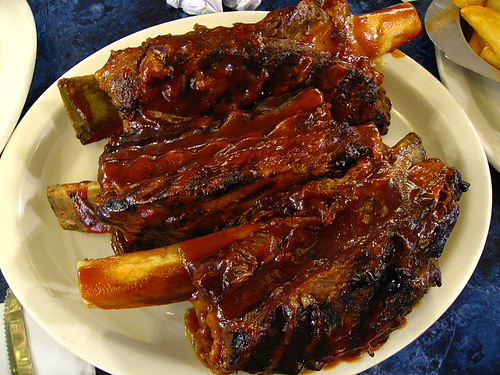 |
| Mmmmm... Ribs. |
“Mr. Lucas?” (squeak, squeak.)
“Mm-hm?” (I think he was actually
had a mouthful of ribs at the time.)
“Uh, Congratulations on getting the
Thalberg Award!” Of all the f***king things I could have said to
the guy, of all the thousands and thousands of things I fantasized
saying to George when I was a kid, it all fled from my consciousness,
and that was what I said. Yikes.
“Mmm.. thanks.”
“Alright, I'll leave you be.” Argh.
Monday, February 27, 2012
The Year Oscar Begged For Help
 |
| The Kodak Theatre, before. |
Indeed, it's too pat to suggest that the Oscar telecast was more narcissistic than usual. Narcissism is the lifeblood of the awards telecast: it's what kept the lights on in the "'Your Name Here' Theater" (Billy Crystal's reference to Chapter 11 Kodak), suspended the Cirque du Soliel acrobats up in the air, paid for the overstuffed goodie bags in the pre-awards luxury lounge. I misspoke here: goodie bags are over-- not very image-friendly in these class-divided, tough times. Now there are discreet "gift suites" set up in key hotels in Hollywood, full of amazing stuff nominees and celebrities can get their hands on-- no charge, free, gratis, thank you for being you. So if you're gonna be in Zanzibar the next few months, say hi to Adrien Brody, who was given a $35,000 resort vacation there at a gift suite. He was neither a presenter nor nominee. So when they say "it's an honor just to be nominated," this is what they're talking about.
It may have seemed to some like a boring, remarkably short Oscars (shortest in 30 years!) but you didn't have to look very hard to see a complete and articulate subliminal message, repeated over and over the entire evening. No courting kids, no young hosts (were James Franco and Anne Hathaway even there?), no Facebook or Twitter or mention of YouTube or anything like that: just a basic, existential subtext:
 | |
| Gee, what's been covered up? |
"Get off your butt and go see a movie!"
The big winners: The Artist and Hugo celebrated the nascent days of the film industry, the invention of film language and the advent of sound in the glamorous days of the silents. "See how amazing and historical movies are? Impressed? So get off your butt and go see a movie!"
Cirque du Soliel did an entire acrobatic dance dedicated to the experience of getting off one's butt and going to see a movie.
That weird montage of older movies near the beginning-- all of which are much, much better than anything nominated this year: "remember these? Now, get off your butt and go see a movie!"
Tom Sherak, head of the AMPAS, made a short and dull statement. Guess what it was?
Even Angelina Jolie's mile-long leg had a freighted meaning. She wasn't just showing off her gam: Jolie is Hollywood glamor personified, and that winking leg flashed a semaphore to a vast movie-going audience: "Want to see more? Then get off your butt and go see a movie!" (J-Lo's semi-exposed areola may have also had something to say to this area, but not quite as convincingly.)
The motion picture industry is in trouble. box office is down, attention-getting films are more expensive to produce, profit margins and therefore production slates are slimming. It may not be apparent when watching the Oscars, but Hollywood has a lot of experience in image management. There was a shocking column by a screenwriter in the New York Times last week which outlined how dire things are getting for those in the middle and lower rungs of Hollywood-- foreclosures, bankruptcies, careers evaporating as production gets cut back or exported.
Which leads back that unified, existential cry for help, which ran under the proceedings like the recurring audio feedback that plagued the whole show. And it's hard to ignore the fact that everyone was gathered in the Kodak Theatre-- the bankrupt former pillar of The Industry, victim to the digital technology which is gnawing at every level of Hollywood, from mighty L.A. basin studio to tiny Valley adult-film shingle.
Okay, that 's a bit apocalyptic-- It was still a very amusing, glamorous night. I got to watch it at an Oscar pool party thrown in a loft apartment in downtown San Francisco, with big wraparound views of the city and the bay. Amazing. There were about two dozen folks there, all charming and nice. I got to show off a little screenwriter wisdom, such as the difference in "&" and "and" in screenwriting credits. Somebody else won with something like 17 correct picks. I have never, ever won an Oscar pool.
Tuesday, January 24, 2012
2011 Oscar Noms: And Then There Were Nine

Walter Hill once explained in the DVD extras section of The Warriors (1979) that nine was key number for a "Collective Hero" movie, the right number of members for a small group of adventurers to embody a full range of personalities and traits. Perhaps the nine nominees are this collective persona, showing all facets of the human condition, set out against a wilderness of adversity and indifferent Academy voters. Or maybe I'm thinking about this a bit too much.
Of course if they had stuck with ten films, the Academy could have considered including Drive, Young Adult or Bridesmaids. Sheesh. Speaking of which, Kristin Wiig got a writing nod for Bridesmaids but not an acting nomination-- but Melissa McCarthy snagged a Supporting nod (this year's Marisa Tomei?). And Terrence Malick got a Best Director nod for The Tree of Life, but not for screenplay-- because there wasn't one.
Okay, here are the nominees, coupled with even more overheated insight.
The Artist - Technically a foreign film, nonetheless this black and white silent is 100% Hollywood to the core. I think this is a litmus test for Academy voting sensibilities: If The Artist takes the top prize, I think it indicates the industry folks in the voting body have given up caring about the outside world.
The Descendants - Didn't see it. Looked like an Oscar movie right out of the gate, akin to Up In The Air (2009), complete with George Clooney. Still: go get 'em Alexander Payne!
Extremely Loud & Incredibly Close - Really? I've read four major-paper reviews on it, and they each hated it. Is this the "Remember 9/11: it was really, really bad" nominee?
The Help - A studio mainstream summer-release film in the Best Picture category? What's this doing here? Actually, it is a fine film, a look at race and discrimination told from a simplified YA-style perspective.
Hugo - Like The Artist, This is another Hollywood self-referential nod, though it reaches back a little further than Golden Age Hollywood for it's source material.
Midnight in Paris - Hey, it's another film set in Paris featuring cameos by historical characters! Two in a year, what are the chances. Nice to see Woody Allen in the running again, how long has it been?
Moneyball - Just saw this one. Love to see it win, as it was a mature, complex film featuring recognizably grown-up characters.
The Tree of Life - My personal favorite film this year. It probably doesn't stand a chance of winning, as it didn't have a story per se. But it did have dinosaurs, Barton Springs Pool and Brad Pitt, and that's a powerful combination. The official line from AMPAS says the nominees for this film are "to be determined." Terrence Malick must be looking through piles of receipts to see who paid for everything.
War Horse - Quite a few reviewers intoned on the Old Hollywood Epic quality of War Horse, pointing out reverently that this movie was actually shot on film. I mentioned earlier that the last film camera was manufactured in 2009-- which makes the 'novelty' of a film actually shot on film yet another milestone in the triumph of digital filmmaking (and further evidence that Kodak's bankruptcy is sadly well-justified).
All in all, it's a typical year for Oscar-- a lot of artfully made, not particularly successful movies vying for prestige and an early 2012 re-release bump.
Monday, February 28, 2011
83rd Academy Awards: High Tech Traditionalism
The 83rd Academy Awards is in the books, an impressively long broadcast which tried hard to skew young and relevant-- only to end up as traditional as any Oscar ceremony I've seen in a long time.
Some random viewing notes:
• When the nominations were announced a few weeks ago, I called almost all of them. the only acting award I missed was Melissa Leo rather than Amy Adams for Supporting Actress, but I still get half-credit because both were for The Fighter. This isn't clairvoyance, it's just the application of brute sociology. For instance, the Best Picture win was easy to predict: The popularity and the award push for The Social Network peaked in fall, while The King's Speech was gaining momentum in January. It's a sad conceit, but it's been long observed that Academy voters have the memories of goldfish, and here's the proof.
The nature of the stories told in the above two films may have been a factor as well: A story of friendship bridging a social chasm versus a story about a bunch of privileged Ivy League types suing each other. This was excellently observed in a column I read in the San Jose Mercury about The Social Network, a sort of tech geek take on things. The takeaway quote: "The Social Network is a film about social networking made by people who hate social networking."
• Melissa Leo's rambling, sort of skeevy acceptance speech is what would happen if your favorite neighborhood bartender was awarded an Oscar. From this perspective, her F-bomb was actually obligatory. Are we sure she wasn't one of the Lowell, Mass. folks hired as local color for The Fighter?
• The co-hosts James Franco and Anne Hathaway were a pair of pretty clouds that drifted further and further apart as the evening progressed. It became apparent that Franco had mentally checked out of anything but the most mechanical aspects of hosting by mid-point (web speculation was that he was rockin' the ganga a little), which left poor Anne having to shuffle and dance and try to pick up the slack.
• I actually got a big kick out of the ending: the stage of the Kodak was stormed by the PS 22 chorus (from Staten Island) who sang "Over the Rainbow." They were joined at the very end by the Oscar winners, waving their gold statuettes. A nice little note to end on.
As fun as this was, it made me finally notice an ongoing problem with the way the Oscars are structured: Winners are shooed backstage, never to return to their seats (this year, they were kept backstage to provide additional web-only content, apparently). This means that as the telecast progresses, the orchestra seats are eventually filled with-- and there's no better way to put this-- losers (and seat fillers). This is probably the reason why the energy level peaks so early. Why not let the winners sit back down with their peers? They could pass their Oscars around, shout encouragement and imprecations from the audience, and generally keep things lively. I'm sure Melissa Leo would have livened things up.
• Ricky Gervais was nowhere to be found.
Some random viewing notes:
• When the nominations were announced a few weeks ago, I called almost all of them. the only acting award I missed was Melissa Leo rather than Amy Adams for Supporting Actress, but I still get half-credit because both were for The Fighter. This isn't clairvoyance, it's just the application of brute sociology. For instance, the Best Picture win was easy to predict: The popularity and the award push for The Social Network peaked in fall, while The King's Speech was gaining momentum in January. It's a sad conceit, but it's been long observed that Academy voters have the memories of goldfish, and here's the proof.
The nature of the stories told in the above two films may have been a factor as well: A story of friendship bridging a social chasm versus a story about a bunch of privileged Ivy League types suing each other. This was excellently observed in a column I read in the San Jose Mercury about The Social Network, a sort of tech geek take on things. The takeaway quote: "The Social Network is a film about social networking made by people who hate social networking."
• Melissa Leo's rambling, sort of skeevy acceptance speech is what would happen if your favorite neighborhood bartender was awarded an Oscar. From this perspective, her F-bomb was actually obligatory. Are we sure she wasn't one of the Lowell, Mass. folks hired as local color for The Fighter?
• The co-hosts James Franco and Anne Hathaway were a pair of pretty clouds that drifted further and further apart as the evening progressed. It became apparent that Franco had mentally checked out of anything but the most mechanical aspects of hosting by mid-point (web speculation was that he was rockin' the ganga a little), which left poor Anne having to shuffle and dance and try to pick up the slack.
• I actually got a big kick out of the ending: the stage of the Kodak was stormed by the PS 22 chorus (from Staten Island) who sang "Over the Rainbow." They were joined at the very end by the Oscar winners, waving their gold statuettes. A nice little note to end on.
As fun as this was, it made me finally notice an ongoing problem with the way the Oscars are structured: Winners are shooed backstage, never to return to their seats (this year, they were kept backstage to provide additional web-only content, apparently). This means that as the telecast progresses, the orchestra seats are eventually filled with-- and there's no better way to put this-- losers (and seat fillers). This is probably the reason why the energy level peaks so early. Why not let the winners sit back down with their peers? They could pass their Oscars around, shout encouragement and imprecations from the audience, and generally keep things lively. I'm sure Melissa Leo would have livened things up.
• Ricky Gervais was nowhere to be found.
Tuesday, January 25, 2011
Oscars: Tough Call this Year
This is one of those years, like last year, when the acting categories are easier to handicap than Best Picture-- and not just because there are only half as many noms per category. It looks like a bunch of shoo-ins: Colin Firth for The King's Speech, Natalie Portman for Black Swan, Christian Bale for The Fighter, and Amy Adams for The Fighter as well. Okay, maybe Hailee Stienfeld for True Grit, but I doubt it.
Nonetheless, here is the huge, unruly mob of Best Picture candidates. They have widely different budgets and each excels in very different ways, all of which makes comparison difficult. Seen six of them, which ain't bad: I'll see at least two more before Oscar night, I'm sure. In alphabetical order:
Black Swan - It's picked up a slightly unsavory reputation and had decent but not great box office, which gives it long odds. Darren Aronofsky has become the new Brian DePalma: An excellent director, but one that can't be trusted not to go completely over the top. (Haven't seen this yet.)
The Fighter - Saw it and loved it. Boxing epics, with their strong visuals, extremely obvious conflicts, and simple rags-to-riches storylines, are Academy voter catnip. It'll take acting and technical, but it doesn't quite have the scope and breadth of a Best Picture. I should say everyone but Mark Wahlberg has a shot at winning, as he was the quiet, underacting center of the film and therefore didn't get nominated. And I'm cheering hard for Amy Adams, who threw the best punch in the movie.
Inception - Love to see it win, because it's such a unique film, and it's a production that hews close to the ideal for a Hollywood big picture. But director Christopher Nolan wasn't nominated for some reason, so it's unlikely.
The Kids Are All Right - Didn't see it. No director nod, so no chance. I liked the 1979 Who rock-doc it was based on, though. Wait…
The King’s Speech - The front-runner, as things stand right now. It's got everything: Nice costumes, a unique historical perspective, and lots and lots of British actors.
127 Hours - Didn't see it. No director nod, so no chance. James Franco is second pick for Best Actor.
The Social Network - Just an amazing story, the most unique among the ten. It captures whole the feel of the now, a slice of the evolving present, with a clarity rarely seen in contemporary films. A morality play for a time with no morals. I'm handicapping this one as a very, very close second pick to The King's Speech.
Toy Story 3 - Awesome to see this one win, but it's animated so it probably won't. If you want to measure the quality of a film by it's power to convey strong emotional moments, this one beats anything I've seen this year. True, it didn't make people throw up and faint like 127 Hours did, but that's probably a good thing.
True Grit - This one has done great box office, and has that something extra that might mean a Best Picture win: It seems to have captured the public imagination in a way unique to the list of nominees. There's a fascinating article by Frank Rich in the New York times that draws a parallel between True Grit and The Social Network: both are about conflicts in moral vacuums, one in the Old West of the 1880s, the other in Cambridge, Massachusetts in 2003.
Winter’s Bone - Huh?
Tough to pick a front-runner, and mine is provisional: I reserve the right to change my mind. It's anyone's game!
Nonetheless, here is the huge, unruly mob of Best Picture candidates. They have widely different budgets and each excels in very different ways, all of which makes comparison difficult. Seen six of them, which ain't bad: I'll see at least two more before Oscar night, I'm sure. In alphabetical order:
Black Swan - It's picked up a slightly unsavory reputation and had decent but not great box office, which gives it long odds. Darren Aronofsky has become the new Brian DePalma: An excellent director, but one that can't be trusted not to go completely over the top. (Haven't seen this yet.)
The Fighter - Saw it and loved it. Boxing epics, with their strong visuals, extremely obvious conflicts, and simple rags-to-riches storylines, are Academy voter catnip. It'll take acting and technical, but it doesn't quite have the scope and breadth of a Best Picture. I should say everyone but Mark Wahlberg has a shot at winning, as he was the quiet, underacting center of the film and therefore didn't get nominated. And I'm cheering hard for Amy Adams, who threw the best punch in the movie.
Inception - Love to see it win, because it's such a unique film, and it's a production that hews close to the ideal for a Hollywood big picture. But director Christopher Nolan wasn't nominated for some reason, so it's unlikely.
The Kids Are All Right - Didn't see it. No director nod, so no chance. I liked the 1979 Who rock-doc it was based on, though. Wait…
The King’s Speech - The front-runner, as things stand right now. It's got everything: Nice costumes, a unique historical perspective, and lots and lots of British actors.
127 Hours - Didn't see it. No director nod, so no chance. James Franco is second pick for Best Actor.
The Social Network - Just an amazing story, the most unique among the ten. It captures whole the feel of the now, a slice of the evolving present, with a clarity rarely seen in contemporary films. A morality play for a time with no morals. I'm handicapping this one as a very, very close second pick to The King's Speech.
Toy Story 3 - Awesome to see this one win, but it's animated so it probably won't. If you want to measure the quality of a film by it's power to convey strong emotional moments, this one beats anything I've seen this year. True, it didn't make people throw up and faint like 127 Hours did, but that's probably a good thing.
True Grit - This one has done great box office, and has that something extra that might mean a Best Picture win: It seems to have captured the public imagination in a way unique to the list of nominees. There's a fascinating article by Frank Rich in the New York times that draws a parallel between True Grit and The Social Network: both are about conflicts in moral vacuums, one in the Old West of the 1880s, the other in Cambridge, Massachusetts in 2003.
Winter’s Bone - Huh?
Tough to pick a front-runner, and mine is provisional: I reserve the right to change my mind. It's anyone's game!
Oscar Nominees
The good people at Moviefone were kind enough to post a list of this mornings nominees for Academy Awards. See if you can spot what's missing!
Sunday, March 7, 2010
Oscars: Hooray for Conventional Wisdom
The fabulous 82nd annual Academy Awards handout is now in the history books. It was a triumph of Hollywood Conventional Wisdom, a perfect sort of ceremony that featured no real surprises. Okay, there were a few:
• Somebody made the strange decision this year was to start the Best Actor and Best Actress nominees with encomiums from peers and co-workers: we were treated to Tim Robbins talking about Morgan Freeman (funny), Colin Farrell toasting Jeremy Renner (embarrassing, but also funny), Stanley Tucci gassing on about Meryl Streep, etc. This process ate up over ten broadcast minutes, and it was deadly. Time stopped.
But there was a sound reason they decided to structure these categories that way: the undeniable force of Conventional Wisdom. Everyone in the Kodak Theater knew who the winners were. Jeff Bridges and Sandra Bullock were just plain due for Oscars, period. No Eddie Murphy in Dreamgirls snubs tonight! So the surprise in the end was how well the ceremony was engineered to make two solid locks seem downright magnanimous.
It wasn't exactly a fix, but Conventional Wisdom was too strong this year (as were the "for your consideration" campaigns) to allow any other outcome. When the Best Actor segment was over, I turned around to the people watching the broadcast with me and asked: "Think fast: what film did Jeff Bridges just win for?" "Uhhhh... Country Heart?" Giving everyone a moment to be personally celebrated, to have a moment of unshared spotlight, probably seemed like the least the Academy could do. Gotta keep Oprah happy...
• Conventional Wisdom made it's shadowy presence known again a few moments later, for the Best Director award. Okay, can you tell me what presenter Barbra Stresand would have done if a white male had won that Oscar? Tarantino as Taylor Swift and Babs as Kanye West, that's what.
And they played Katherine Bigelow off to "I Am Woman." What the hell? Jon Stewart calls the Oscars "The Gay Super Bowl:" Maybe there was a need to bury the needle on the kitsch-o-meter at least once during what was otherwise a rather restrained evening. I mean, the dancers were wearing-- quelle horreur-- street clothes!
• Speaking of what the hell, during the "rollcall of the dead" or whatever they call it, the Academy acknowledged Michael Jackson-- but not Farah Fawcett, who passed away on the same day. She was in nine theatrical releases: He was in two, and he was dead for one of them.
• Since Barbra was appeased by the selection of a female director, The air was let out of the Best Picture category as quickly as possible. Tom Hanks practically trotted out to the podium, tore open the envelope, barked out the winner (The nominees were not listed!) and quickly moonwalked back to allow Bigelow to retake the stage. (I really liked seeing Hurt Locker stars Jeremy Renner, Anthony Mackie and Brian Geraghty take the upper stage, howling, laughing and doing The Bump. Spontaneous and fun-- and, with all due respect, I doubt they'll ever be up there again.)
• A few surprises were to be had, my favorites being two blatant displays of bitchery. Roger Ross Williams, winner of Best Documentary Short Subject, came up on stage and started gushing in the emotionally overwhelmed way most lower-level Oscar winners gush. Then an apparition wearing a sparkly shower curtain-- Elinor Burkett, the category's other winner-- came in stage right, pushed him aside and said, "Ain't that just like a man?" She then started in with her grand, swinging-for-the-fences speech-- and the mike was abruptly cut off. 45 seconds, people! The long shot afterward showed the presenters trying to shoo her off the stage.
Sandy Powell won her third Oscar for Costume design. She slowly slinked to the stage, fairly broadcasting the fact she made her own gown. Her speech went something like this: "This my third Oscar, so it's not quite as surprising to get it. I would dedicate this to all the new talent and designers just getting into the business, but I'm keeping this."
• In some of the podium presentations, there was a strange, rather prominent noise going in the background, a roaring, clunky commotion. It was in the parts where the nominees were speaking into the podium mikes, which were pointed upwards and were likely catching machinery noise in the massive flyspace above the Kodak Theater stage. Or it was, for the first time ever heard by the public, the great gears of The Industry meshing. The great gears grind slowly, but they do grind everyone.
• My wife summed it up best: "Everyone got what they deserved: the nominees, the audience, everyone."
ADDENDA: Dana Stevens of Slate had an interesting interpretation of Sandy Powell's speech: she may have been signaling that the Academy can stop giving her awards, thank you. And from what I have read on the Washington Post, the Elinor Burkett stage shove was the end result of some amazing offstage action.
• Somebody made the strange decision this year was to start the Best Actor and Best Actress nominees with encomiums from peers and co-workers: we were treated to Tim Robbins talking about Morgan Freeman (funny), Colin Farrell toasting Jeremy Renner (embarrassing, but also funny), Stanley Tucci gassing on about Meryl Streep, etc. This process ate up over ten broadcast minutes, and it was deadly. Time stopped.
But there was a sound reason they decided to structure these categories that way: the undeniable force of Conventional Wisdom. Everyone in the Kodak Theater knew who the winners were. Jeff Bridges and Sandra Bullock were just plain due for Oscars, period. No Eddie Murphy in Dreamgirls snubs tonight! So the surprise in the end was how well the ceremony was engineered to make two solid locks seem downright magnanimous.
It wasn't exactly a fix, but Conventional Wisdom was too strong this year (as were the "for your consideration" campaigns) to allow any other outcome. When the Best Actor segment was over, I turned around to the people watching the broadcast with me and asked: "Think fast: what film did Jeff Bridges just win for?" "Uhhhh... Country Heart?" Giving everyone a moment to be personally celebrated, to have a moment of unshared spotlight, probably seemed like the least the Academy could do. Gotta keep Oprah happy...
• Conventional Wisdom made it's shadowy presence known again a few moments later, for the Best Director award. Okay, can you tell me what presenter Barbra Stresand would have done if a white male had won that Oscar? Tarantino as Taylor Swift and Babs as Kanye West, that's what.
And they played Katherine Bigelow off to "I Am Woman." What the hell? Jon Stewart calls the Oscars "The Gay Super Bowl:" Maybe there was a need to bury the needle on the kitsch-o-meter at least once during what was otherwise a rather restrained evening. I mean, the dancers were wearing-- quelle horreur-- street clothes!
• Speaking of what the hell, during the "rollcall of the dead" or whatever they call it, the Academy acknowledged Michael Jackson-- but not Farah Fawcett, who passed away on the same day. She was in nine theatrical releases: He was in two, and he was dead for one of them.
• Since Barbra was appeased by the selection of a female director, The air was let out of the Best Picture category as quickly as possible. Tom Hanks practically trotted out to the podium, tore open the envelope, barked out the winner (The nominees were not listed!) and quickly moonwalked back to allow Bigelow to retake the stage. (I really liked seeing Hurt Locker stars Jeremy Renner, Anthony Mackie and Brian Geraghty take the upper stage, howling, laughing and doing The Bump. Spontaneous and fun-- and, with all due respect, I doubt they'll ever be up there again.)
• A few surprises were to be had, my favorites being two blatant displays of bitchery. Roger Ross Williams, winner of Best Documentary Short Subject, came up on stage and started gushing in the emotionally overwhelmed way most lower-level Oscar winners gush. Then an apparition wearing a sparkly shower curtain-- Elinor Burkett, the category's other winner-- came in stage right, pushed him aside and said, "Ain't that just like a man?" She then started in with her grand, swinging-for-the-fences speech-- and the mike was abruptly cut off. 45 seconds, people! The long shot afterward showed the presenters trying to shoo her off the stage.
Sandy Powell won her third Oscar for Costume design. She slowly slinked to the stage, fairly broadcasting the fact she made her own gown. Her speech went something like this: "This my third Oscar, so it's not quite as surprising to get it. I would dedicate this to all the new talent and designers just getting into the business, but I'm keeping this."
• In some of the podium presentations, there was a strange, rather prominent noise going in the background, a roaring, clunky commotion. It was in the parts where the nominees were speaking into the podium mikes, which were pointed upwards and were likely catching machinery noise in the massive flyspace above the Kodak Theater stage. Or it was, for the first time ever heard by the public, the great gears of The Industry meshing. The great gears grind slowly, but they do grind everyone.
• My wife summed it up best: "Everyone got what they deserved: the nominees, the audience, everyone."
ADDENDA: Dana Stevens of Slate had an interesting interpretation of Sandy Powell's speech: she may have been signaling that the Academy can stop giving her awards, thank you. And from what I have read on the Washington Post, the Elinor Burkett stage shove was the end result of some amazing offstage action.
Thursday, March 4, 2010
New Category: Best Actor-Type-Person
Last month I was joshing about increasing the Academy Award's Best Picture nominations next year to 25, because it would be fun to have the Oscars grind out for five hours. But I just read a proposal which, if implemented, would lop off ten nominations in one fell swoop. But the reasons are far from fun-- and are as poorly thought out as my idea.
Kim Elsesser, titled a research scholar (i.e. grad student) in Women's Studies at UCLA, has proposed in the Op-Ed section of the New York Times that the acting categories go unisex. On one hand this is an intriguing idea, and would cut a big chunk off the broadcast: Supporting Actor, Director, Actor, Best Picture, boom, done, goodnight!
But Elsesser isn't interested in making a short night of it: her bent, as you can guess from her academic credentials, is that the whole notion of Actor and Actress Oscars is deeply sexist. What can I say-- aside from the fact she is wrong, and she uses some shaky logic to prop up her ideas. Out of the gate, she kicks her argument off with a vivid example:
Her topper occurs a few paragraphs later:
There are plenty of non-gender professions with singular award categories: director, cinematographer, art direction, etc. They are singular because they are judged by output: the director's finished film, the costume designer's visual style, etc. Acting is about producing a version of one's own self. To judge a performance, you have to consider gender first, because really that's the first thing you see (this ain't radio, after all).
Having worked with actors quite often, I can say there is a big difference between the performances of male and female actors. Sure, it all comes from conceptual frameworks that are universal (Stanislavski, Method acting, etc.), but most actors build their acting instrumentation starting from the most basic framework: their own gender. And because the differences between the genders can be profound, the elements that comprise a strong performance can be as equally disparate. it's not a "stereotype" that men and women are different: they really are. Just ask any man or woman: they'll tell you.
(I'll admit this isn't always true: I just re-watched Alien (d. Ridley Scott, 1979) last night. The actors could have chosen their roles randomly, and the film would have played out pretty much the same.)
Acting is very much like a sports category, in fact, but far more egalitarian in it's division. Like curling or billiards, all about skill and prowess, not brute strength. A good performance is a good performance, and judging a performance against others in their most obvious and primary peer group is purely logical, and makes evaluation easier, more meaningful, and nuanced. It also better reflects the actor's role as an artistic interpreter of the intrinsic reality of the human condition, which, for any good actor or Academy that hands out vaguely male statues, should be job one.
Kim Elsesser, titled a research scholar (i.e. grad student) in Women's Studies at UCLA, has proposed in the Op-Ed section of the New York Times that the acting categories go unisex. On one hand this is an intriguing idea, and would cut a big chunk off the broadcast: Supporting Actor, Director, Actor, Best Picture, boom, done, goodnight!
But Elsesser isn't interested in making a short night of it: her bent, as you can guess from her academic credentials, is that the whole notion of Actor and Actress Oscars is deeply sexist. What can I say-- aside from the fact she is wrong, and she uses some shaky logic to prop up her ideas. Out of the gate, she kicks her argument off with a vivid example:
Suppose... [the Academy] presented separate honors for best white actor and best non-white actor, and that Mr. Freeman was prohibited from competing against the likes of Mr. Clooney and Mr. Bridges. Surely, the academy would be derided as intolerant and out of touch; public outcry would swiftly ensure that Oscar nominations never again fell along racial lines.She goes on to say gendered awards are just as discriminatory. This argument is pure equivocation: Racism does not equal sexism, and gendered categories don't equal sexism either.
Her topper occurs a few paragraphs later:
But separate is not equal. While it is certainly acceptable for sports competitions like the Olympics to have separate events for male and female athletes, the biological differences do not affect acting performances. The divided Oscar categories merely insult women, because they suggest that women would not be victorious if the categories were combined. In addition, this segregation helps perpetuate the stereotype that the differences between men and women are so great that the two sexes cannot be evaluated as equals in their professions. [italics mine]This is a classic example of argumentum ad ignorantiam. It's an argument from personal belief, that belief being that western culture can and will instantly slip back to Jim Crow, pre-suffrage times if not for constant vigilance. So in Ms. Elsesser's mind, the Academy ballot-holding members are saying: "Oh sure, Sandra Bullock is great and all, but Matt Damon would have been so much better." Her argument also flattens the definition of acting from a whole-body, presence-based performance to a simple profession, no different than being a plumber or Speaker of the House. (oh, and BTW: does saying that the Actress categories are some kind of set-aside program for women seem a bit like self-loathing? Couldn't the opposite be true?)
There are plenty of non-gender professions with singular award categories: director, cinematographer, art direction, etc. They are singular because they are judged by output: the director's finished film, the costume designer's visual style, etc. Acting is about producing a version of one's own self. To judge a performance, you have to consider gender first, because really that's the first thing you see (this ain't radio, after all).
Having worked with actors quite often, I can say there is a big difference between the performances of male and female actors. Sure, it all comes from conceptual frameworks that are universal (Stanislavski, Method acting, etc.), but most actors build their acting instrumentation starting from the most basic framework: their own gender. And because the differences between the genders can be profound, the elements that comprise a strong performance can be as equally disparate. it's not a "stereotype" that men and women are different: they really are. Just ask any man or woman: they'll tell you.
(I'll admit this isn't always true: I just re-watched Alien (d. Ridley Scott, 1979) last night. The actors could have chosen their roles randomly, and the film would have played out pretty much the same.)
Acting is very much like a sports category, in fact, but far more egalitarian in it's division. Like curling or billiards, all about skill and prowess, not brute strength. A good performance is a good performance, and judging a performance against others in their most obvious and primary peer group is purely logical, and makes evaluation easier, more meaningful, and nuanced. It also better reflects the actor's role as an artistic interpreter of the intrinsic reality of the human condition, which, for any good actor or Academy that hands out vaguely male statues, should be job one.
Wednesday, February 10, 2010
Seriously, Man
Just seen: A Serious Man (on On-Demand), the Coen Brothers movie that is among the huge mound of films vying for Best Picture. This raises my tally of watched nominees to 8 out of 10. It is a black comedy, and as such it is quite funny and unusually spooky. But...
 Coen Brothers films remind me of points on a biorhythm curve*. Remember that 70s quackery? Emotional, physical and intellectual sinusoidal waves, all cresting and dipping to their own time. Triple highs are auspicious, but watch out for those "critical days," when all three bottom out.
When the Coens are hitting the triple high we get amazing stuff-- O Brother, Where Art Thou?, Raising Arizona, The Hudsucker Proxy, even The Big Lebowski. Even when we get a dip or two, it's still compelling: No Country for Old Men, Fargo and Blood Simple.
But man, watch out for that triple low point. A Serious Man reminded me of Barton Fink and a LOT of The Man Who Wasn't There: grim stories with hapless, hopeless protagonists. It's the story of Larry Gopnik, a perfectly nice man who get his ass kicked by every single other character-- wife, kids, brother, his Rabbi, total strangers, everybody-- from fade-up to the devastating black-out. Even the Columbia Record Club has it in for him. As they did with O Brother, the Coens took the core of the story from an ancient source-- in this case the Book of Job, set in suburban Minneapolis in 1967.
Lining it up with the current Oscar nominees, it sounds comparable to Precious, which I haven't seen. Of course, from what I read, The life of Precious is several orders of magnitude more horrible than the life of Larry Gopnik. So I think I'll cut bait and stop at eight nominees.
*Just for laughs, I just checked my Biorhythm chart here. Yikes. I am not leaving the house today.
 Coen Brothers films remind me of points on a biorhythm curve*. Remember that 70s quackery? Emotional, physical and intellectual sinusoidal waves, all cresting and dipping to their own time. Triple highs are auspicious, but watch out for those "critical days," when all three bottom out.
When the Coens are hitting the triple high we get amazing stuff-- O Brother, Where Art Thou?, Raising Arizona, The Hudsucker Proxy, even The Big Lebowski. Even when we get a dip or two, it's still compelling: No Country for Old Men, Fargo and Blood Simple.
But man, watch out for that triple low point. A Serious Man reminded me of Barton Fink and a LOT of The Man Who Wasn't There: grim stories with hapless, hopeless protagonists. It's the story of Larry Gopnik, a perfectly nice man who get his ass kicked by every single other character-- wife, kids, brother, his Rabbi, total strangers, everybody-- from fade-up to the devastating black-out. Even the Columbia Record Club has it in for him. As they did with O Brother, the Coens took the core of the story from an ancient source-- in this case the Book of Job, set in suburban Minneapolis in 1967.
Lining it up with the current Oscar nominees, it sounds comparable to Precious, which I haven't seen. Of course, from what I read, The life of Precious is several orders of magnitude more horrible than the life of Larry Gopnik. So I think I'll cut bait and stop at eight nominees.
*Just for laughs, I just checked my Biorhythm chart here. Yikes. I am not leaving the house today.
Monday, February 8, 2010
Just Seen: The Blind Side
Caught The Blind Side Saturday, which ups my tally of seen Best Picture nominated films to seven-- a personal record, if you think about it.
It was quite enjoyable, a solid offering in the Inspirational Sports genre. It reminded me a lot of Invincible and The Rookie: well-made, patently inoffensive family fare which show exceptionally talented, gifted athletes as ordinary, struggling folks like you and me. What's not to like?
Sandra Bullock will no doubt get the "she's due" Best Actress Oscar. Between this film and The Proposal, She probably made as much money for the studios this year than any number of foldable robots. She does a great job-- the most notable part of her performance is she sounds nothing like herself. She either payed very close attention to her vocal coach or just lapsed back to a native accent (she's from Georgia).
A few notes:
• This is the second 2009 blockbuster Sandra Bullock film that Julia Roberts was offered first-- and passed on. But Roberts did say yes to Valentine's Day, the Garry Marshall day-player-fest which opens next week. Perhaps it was the ensemble aspect: it was no doubt a fairly effortless commitment, a short gig on an LA shoot.
• The film's third act complication is strange (and believe me, if you are at all familiar with the Inspirational Sports genre I ain't giving anything away here). The Blind Side tells the story of Michael Oher, a young man of impoverished means who, with the help of the Tuohy family, gets the help he needs to not only graduate from high school, but also become an excellent football player. The complication comes in the form of an NCAA rep who asks Oher if he was adopted solely so he could play ball for Ole Miss, the Tuohy's alma mater. Because the film portrays him as having no skill at football before he met the Tuohy family or attended private school, his adoptive family is exonerated. But if the semi-reliable sources in the IMDb and Wikipedia are correct, in reality Oher was an "experienced" football player in public school before he met the Tuohys, and his transfer to private school was recommended by his public-school coach, not a family friend as depicted. This fact, and the fact Oher's private-school football coach gained a job at Ole Miss at roughly the same time Oher enrolled, tells me that the NCAA actually had a pretty good handle on the facts at the time.
This whitewashing (pardon the entendre) for narrative clarity is a consistent flaw of the Inspirational Sports genre: the true stories they tell have to be morally unambiguous, and facts are usually sacrificed to that end.
• The audience demographic was mostly older women. Like my experience attending the Metropolitan Opera HD simulcast, I was one of the youngest people in there, which never happens anymore.
• Seated just behind us was an External Monologuist. I outlined various types of of Movie Talkers on our previous blog, and she was classic example of someone who never had a thought she doesn't say out loud. Repeatedly. Normally, I would have shut her up, but my wife and I found her amusing. After all, there was nothing particularly challenging about the plot of The Blind Side, so she wasn't exactly ruining it for us. After a while we discerned a pattern to her yammering: Expressing Her Feelings (Saying "oh my God" about 10,000 times) and Being Utterly Confused ("Did he graduate?" "Where did he go?" "Who is that? His father?"). She also needed everything that showed up on screen in text explained to her by her (very patient) family members.
She was the ultimate claque: every major scene ending was accompanied with clear utterances like "What's going to happen now?" or "boy, she sure is mad!" Maybe she wasn't there at all, and what I was hearing was a surround-channel audio program: Audio Assistance For The Narratively Impaired.
It was quite enjoyable, a solid offering in the Inspirational Sports genre. It reminded me a lot of Invincible and The Rookie: well-made, patently inoffensive family fare which show exceptionally talented, gifted athletes as ordinary, struggling folks like you and me. What's not to like?
Sandra Bullock will no doubt get the "she's due" Best Actress Oscar. Between this film and The Proposal, She probably made as much money for the studios this year than any number of foldable robots. She does a great job-- the most notable part of her performance is she sounds nothing like herself. She either payed very close attention to her vocal coach or just lapsed back to a native accent (she's from Georgia).
A few notes:
• This is the second 2009 blockbuster Sandra Bullock film that Julia Roberts was offered first-- and passed on. But Roberts did say yes to Valentine's Day, the Garry Marshall day-player-fest which opens next week. Perhaps it was the ensemble aspect: it was no doubt a fairly effortless commitment, a short gig on an LA shoot.
• The film's third act complication is strange (and believe me, if you are at all familiar with the Inspirational Sports genre I ain't giving anything away here). The Blind Side tells the story of Michael Oher, a young man of impoverished means who, with the help of the Tuohy family, gets the help he needs to not only graduate from high school, but also become an excellent football player. The complication comes in the form of an NCAA rep who asks Oher if he was adopted solely so he could play ball for Ole Miss, the Tuohy's alma mater. Because the film portrays him as having no skill at football before he met the Tuohy family or attended private school, his adoptive family is exonerated. But if the semi-reliable sources in the IMDb and Wikipedia are correct, in reality Oher was an "experienced" football player in public school before he met the Tuohys, and his transfer to private school was recommended by his public-school coach, not a family friend as depicted. This fact, and the fact Oher's private-school football coach gained a job at Ole Miss at roughly the same time Oher enrolled, tells me that the NCAA actually had a pretty good handle on the facts at the time.
This whitewashing (pardon the entendre) for narrative clarity is a consistent flaw of the Inspirational Sports genre: the true stories they tell have to be morally unambiguous, and facts are usually sacrificed to that end.
• The audience demographic was mostly older women. Like my experience attending the Metropolitan Opera HD simulcast, I was one of the youngest people in there, which never happens anymore.
• Seated just behind us was an External Monologuist. I outlined various types of of Movie Talkers on our previous blog, and she was classic example of someone who never had a thought she doesn't say out loud. Repeatedly. Normally, I would have shut her up, but my wife and I found her amusing. After all, there was nothing particularly challenging about the plot of The Blind Side, so she wasn't exactly ruining it for us. After a while we discerned a pattern to her yammering: Expressing Her Feelings (Saying "oh my God" about 10,000 times) and Being Utterly Confused ("Did he graduate?" "Where did he go?" "Who is that? His father?"). She also needed everything that showed up on screen in text explained to her by her (very patient) family members.
She was the ultimate claque: every major scene ending was accompanied with clear utterances like "What's going to happen now?" or "boy, she sure is mad!" Maybe she wasn't there at all, and what I was hearing was a surround-channel audio program: Audio Assistance For The Narratively Impaired.
Wednesday, February 3, 2010
Man, That's a Lot of Nominations
For the first time since 1943, The Academy has seen fit to nominate 10 films for the Best Picture top prize. I think this is fun.
They should expand the Best Picture category to 25 nominations next year. Why not? They could briefly describe each nominated film at the beginning and end of each segment-- or they could throw out all the rules and go live for five solid hours. (And wouldn't it would be a hoot to see what all those amazing dresses and expensive tuxes will look like after being sat on for five hours?) And with a field of 25, the tipping point for a winning film goes to a hair over four percent of the votes, which would guarantee a certain amount of amusing chaos.
I am very curious as to how they are going to divvy up the screen in that moment before the envelope is torn open. Ten little boxes-- it's going to look like a security camera suite at a very expensive, very exclusive mall.
Anyway, here are the nominees, in alphabetical order. I actually saw quite a few of these: Last year, I was 0 for 5, pathetic. Because I have I'll just go ahead an annotate my take on each film's chance of actually winning:
Avatar - It's a "Hollywood Votes For Itself" sort of shoe-in. Best odds in the bunch. I am very happy to see Avatar didn't get a nom for screenplay-- it almost restores my faith.
The Blind Side - Didn't catch this one. John Lee Hancock didn't get a director nom, so I wouldn't bet on it.
District 9 - An excellent movie, and a gratifying choice. I think it has the best chance of the ones on this list-- one that did not get a director nom, that is. Which means, unfortunately, there's no way it'll win.
An Education - Didn't catch this one either. By the look of it, this film will clean up with the academy members with schoolgirl fetishes and those who are fans of "Mad Men." Director Lone Scherfig didn't get a nom, so it'll do nothing.
The Hurt Locker - An amazing movie. It's the front-runner for the "Hollywood Votes for Quality" academy crowd. It absolutely confirmed the fact that a very good film could be made about the Iraq war-- All they had to do was put away the crying towel and embrace an action-film ethos. Go get 'em, James Cameron's Ex! (And a big nod to Modesto's own Jeremy Renner, the nominated star of The Hurt Locker. I seriously thought this guy was doomed to play weasel-faced bastards, as he did in Dahmer and S.W.A.T.)
Inglourious Basterds - I saw it. It has a chance, because Quentin was nominated too. But why? For every good scene with Christoph Waltz, there is one of Brad Pitt masticating scenery. There were so many references to Pabst, Pola Negri and UFA I thought I was back in Film School and I was being graded on it. I read on several news sites that Tarantino was "due" for a major nod. If his recent output was, in terms of box-office and relevance, in any way indicative of this, I'd agree.
Precious - My Austin Film Festival Precious story: I was sitting down to a screening of Calvin Marshall and a woman-- by the look of her accessories, a very well-off woman-- sat down next to me. She had just seen Precious and gushed about how powerful and devastating it was. I had read the extensive article on it in the festival program, so I kind of knew what she was talking about. But there was something about a rich white woman telling me about her cinematic peek at soul-crushing black inner-city poverty that made me kind of ill. Precious has the best chance of any of the Indie underdogs to score an upset victory, mostly because I suspect half the Academy voters are like that woman in Austin.
A Serious Man - The Coens got their Oscar hardware two years ago, so never mind.
Up - Hey-- Isn't there another category for this film already? I quite enjoyed it, and it's so well-written and paced it deserves to duke it out in the Best Picture category.
Up in the Air - Saw it, liked it quite a bit. Strong second or third place, if the Academy had such things... Wait...
Hey, I just got a whole NEW idea! Instead of adding more nominations, how about additional Silver and Bronze Oscars in all categories? Anything to get to that magical 5-hour broadcast length...
They should expand the Best Picture category to 25 nominations next year. Why not? They could briefly describe each nominated film at the beginning and end of each segment-- or they could throw out all the rules and go live for five solid hours. (And wouldn't it would be a hoot to see what all those amazing dresses and expensive tuxes will look like after being sat on for five hours?) And with a field of 25, the tipping point for a winning film goes to a hair over four percent of the votes, which would guarantee a certain amount of amusing chaos.
I am very curious as to how they are going to divvy up the screen in that moment before the envelope is torn open. Ten little boxes-- it's going to look like a security camera suite at a very expensive, very exclusive mall.
Anyway, here are the nominees, in alphabetical order. I actually saw quite a few of these: Last year, I was 0 for 5, pathetic. Because I have I'll just go ahead an annotate my take on each film's chance of actually winning:
Avatar - It's a "Hollywood Votes For Itself" sort of shoe-in. Best odds in the bunch. I am very happy to see Avatar didn't get a nom for screenplay-- it almost restores my faith.
The Blind Side - Didn't catch this one. John Lee Hancock didn't get a director nom, so I wouldn't bet on it.
District 9 - An excellent movie, and a gratifying choice. I think it has the best chance of the ones on this list-- one that did not get a director nom, that is. Which means, unfortunately, there's no way it'll win.
An Education - Didn't catch this one either. By the look of it, this film will clean up with the academy members with schoolgirl fetishes and those who are fans of "Mad Men." Director Lone Scherfig didn't get a nom, so it'll do nothing.
The Hurt Locker - An amazing movie. It's the front-runner for the "Hollywood Votes for Quality" academy crowd. It absolutely confirmed the fact that a very good film could be made about the Iraq war-- All they had to do was put away the crying towel and embrace an action-film ethos. Go get 'em, James Cameron's Ex! (And a big nod to Modesto's own Jeremy Renner, the nominated star of The Hurt Locker. I seriously thought this guy was doomed to play weasel-faced bastards, as he did in Dahmer and S.W.A.T.)
Inglourious Basterds - I saw it. It has a chance, because Quentin was nominated too. But why? For every good scene with Christoph Waltz, there is one of Brad Pitt masticating scenery. There were so many references to Pabst, Pola Negri and UFA I thought I was back in Film School and I was being graded on it. I read on several news sites that Tarantino was "due" for a major nod. If his recent output was, in terms of box-office and relevance, in any way indicative of this, I'd agree.
Precious - My Austin Film Festival Precious story: I was sitting down to a screening of Calvin Marshall and a woman-- by the look of her accessories, a very well-off woman-- sat down next to me. She had just seen Precious and gushed about how powerful and devastating it was. I had read the extensive article on it in the festival program, so I kind of knew what she was talking about. But there was something about a rich white woman telling me about her cinematic peek at soul-crushing black inner-city poverty that made me kind of ill. Precious has the best chance of any of the Indie underdogs to score an upset victory, mostly because I suspect half the Academy voters are like that woman in Austin.
A Serious Man - The Coens got their Oscar hardware two years ago, so never mind.
Up - Hey-- Isn't there another category for this film already? I quite enjoyed it, and it's so well-written and paced it deserves to duke it out in the Best Picture category.
Up in the Air - Saw it, liked it quite a bit. Strong second or third place, if the Academy had such things... Wait...
Hey, I just got a whole NEW idea! Instead of adding more nominations, how about additional Silver and Bronze Oscars in all categories? Anything to get to that magical 5-hour broadcast length...
Subscribe to:
Posts (Atom)