Showing posts with label Anamorphic. Show all posts

Thursday, October 8, 2020

The Comey Rule: It Is What It Is

 “It's funny how the colors of the real world only seem really real when you viddy them on the screen.” —Alex Delarge, A Clockwork Orange (1971)

Got through the two-part, 3.5 hour Showtime miniseries The Comey Rule in one sitting, right after watching the Vice Presidential debates, in fact.

The production is top-notch, shot anamorphic in luscious cool tones by veteran DP Elliot Davis and directed by Billy Ray, who wrote the biopics Captain Phillips and Richard Jewell. Despite  its impressive length the miniseries never flags: it moves from one political dilemma to the next (Clinton’s emails, Russian interference and kompromat, etc.) with nervous energy throughout part 1 and into Part 2, where Trump finally shows up. He’s the ultimate non-moveable object, and every character in the film ends up crashing right into him.

Brandon Gleeson as Trump. He is often
shown in the Oval Office with the sun
shining so bright behind him it flares
across the screen. The symbolism at
work here is self-explanatory.


This is the first big-budget narrative biopic about the Trump administration. (there have been dozens of documentaries.) It features Jeff Daniels as James Comey, delivering one of his trademark “Tom Hanks Light” trustworthy and calm performances. The thing is packed with A-list stars like Holly Hunter and Jonathan Banks and Michael Kelly. (The most fun portrayals: William Sadler as Michael Flynn and Joe Lo Truglio as Jeff Sessions.)

Irish actor Brendon Gleeson plays President Donald Trump, and it is a revelation. He inhabits Trump: his Queens-hatched singsong voice, orange skin, sci-fi hairdo, the sack suits. Every third line is punctuated by the wet rasp of his nostrils taking in a breath. In the universe this film sets up in Part One— munificent, hard-working, sort of WASPy people dressed in plain suits, working hard but important jobs— Trump crashes into Part Two like a space alien. I hope he gets all the Emmys.

FBI brass, watching the 2016 election results.
Michael Kelly plays Andrew McCabe.
None of them at this point know
how doomed they are.

The screenplay was adapted from James Comey’s book “A Higher Loyalty,” and as such it tends to hagiography: Comey, in many places, comes off like a solid, patriotic G-man whose only loyalties were to justice and the FBI. But there is also a counter-theme to the portrayal the miniseries does not shy away from. James Comey is shown as a government official with a fatal flaw: he has no political instincts. No gut instincts at all, really. The whole Clinton email debacle— declaring an investigation less than fortnight before the election, and calling it off three days before— was shown as a result of his self-righteousness, his dogged adherence to procedure, without any thought to political fallout.  When someone as primal and cunning as Trump enters his life the miniseries shows in sickening detail he was utterly unprepared for it. He falls back on his honesty and competence, and in the end it makes no difference at all.

One of the wonderful elements of biopics like this is how they can show the color and detail behind events we have recently seen on television or the internet. Biopics somehow make what is real even more real, just like Alex Delarge told us. Great example: the public introduction of Comey into Trump’s administration, the scene he described in his book where when Trump entered, he subconsciously backed up to the opposite side of the room. Trump calls “his” FBI director over: Comey goes frozen-faced. He gives him the trademark tugging handshake and whispers “let’s get a few pictures together.” Meanwhile Comey’s wife and daughter are watching live at home— and the wife says, “that’s his ‘oh shit’ face."

James Comey (left) and Jim Clapper (right)
riding the elevator in Trump Tower.
Contemporary biopics are usually stories filled with dread. We KNOW what is going to happen to the hapless characters introduced in Act One, so all we can do sit helplessly as history and misfortune overtake them. The list is very long: Flight 93, The Perfect Storm, Too Big to Fail (the HBO biopic about the 2008 crash, this film’s closest cousin), and both of Billy Ray’s aforementioned writing credits.

The Comey Rule
is no exception. You get to relive the 2016 election and all the sickening depression that came with it. When Trump starts taking charge, all you can do is watch helplessly as career government employees try to comprehend someone like Trump, who has absolutely no care about the rules and laws and precedents everyone else relies on to keep government running smoothly. The most dread-fulled part of The Comey Rule is this spectacle of slow-motion disaster: The cool, competent bureaucrats and agency employees and lawyers who are are helpless in the face of Trump. They all know something bad is about to happen to the rule of law and the reputation of their agencies, and all they can do is look at each other and shrug.

“It is what it is” is a Trump quote about the Coronavirus, but it shows up in mob movies with regularity. It has a very specific meaning: it says a terrible thing has happened— but it HAD to happen, and there is nothing you or anybody on earth can do about it.

The 2020 election is upon us. Let us hope the outcome is a hopeful one, because The Comey Rule showed us how easy it is to watch everything go to shit and mumble “it is what it is.”

Friday, August 21, 2020

Public Domain Friday: Latitude Zero


Here, got a movie for you.

I was completely unaware of this movie until last night, when it turned up in my Amazon Prime recommendations. What is this? I said. Joseph Cotton and Ceasar Romero in submarines? Directed by the guy responsible for all those Godzilla movies in the sixties? I'M IN!

If you didn't grow up watching it on Creature Features, it's probably for two reasons. One is that it's predictably awful. Joseph Cotton seems to be kicking off his late-career headlong dive into humiliation here. It's a few years before Lady Frankenstein and The Abominable Dr Phibes, and how he consented to wearing this costumes (and I swear, it must be a little lipstick and rouge also) can only be explained by a need for money or some really strong kink we never found out about. Romero fares better, if only because he'd been doing Batman for a couple years and was comfortable with camp.

The other reason appears to be the usual legal battles. The movie is an international co-production between Tojo studios and Four Star Productions, an American television production company. But early in the production, after flying Americans to Japan for shooting, Four Star went bankrupt and left the movie to soldier on with half the budget intact. Then once the initial TV rights expired they were held up in a legal battle which kept it out of sight for decades. It's only now that ALL rights have expired that you can see this. 

Friday, August 9, 2019

Tarantino the Nostalgic Unreliable Narrator

I went into Once Upon a Time in Hollywood expecting not to like it that much: he burned me very badly with his cute switcheroo act with The Hateful Eight, a film he touted as an epic widescreen roadshow movie but turned out to be a blood-drenched, claustrophobic indie film that had no earthly reason to be in Ultra Panavision 70.

But after thinking about it for a while afterward, I have a grudging respect for this film. Once Upon a Time is built around an original story, unusual for him: its not a pastiche or an homage or a dully executed re-make of some cheap exploitation film. It’s really him, talking directly to us and not through some faux-junk, schlocky exploitation genre— and God damn it if that isn’t refreshing. Quentin succeeds at his primary goal here: creating an alternate universe version of Los Angeles in 1969. He did a splendid job of it. The dialog is crisp, mostly lacking the big gobs of “Tarantino-speak” that bogged down earlier efforts, and the acting snaps as well. It’s a longish film, and his obsession with the trappings of the past often overwhelms his story, but more worth your time than any of his films since Jackie Brown.

On to the notes!

Nostalgia: Once Upon a Time drowns in nostalgia, aching and wistful and angry at the passage of time that erased the treasures lovingly displayed onscreen. Quentin Tarantino is a filmmaker driven by desires— obscure action cinema, violence, glib dialogue, women’s bare feet. But this time his desire is the past. His past, a past he has said was the favorite time of his childhood.

Once Upon a Time is Quentin the video-store clerk and kid who grew up in LA in the 1960s and 1970s, finally brought to his fullest. It’s a wishlist of everything he ever wanted to do in a movie as a kid, pattered out in his characteristic staccato: he wants to be a TV western star (Quentin Tarantino was named after Burt Reynold’s character in “Gunsmoke”). He wants to beat up Bruce Lee. He wants to change Hollywood history (more later). He wants to set an LP needle down right on the gap before his favorite song (this happens several times) and hear the KHJ and KFWB jingles ring out over an AM car radio again. He wants to make a movie with Steve McQueen and Michelle Phillips and Sharon Tate. He wants all he knew and saw and loved as a child returned to him.*

But most of all, he wants to go home to the past. You can feel it: his longing reaches right out of the frame. It’s all there in broad strokes: late 60s Hollywood Boulevard lovingly recreated; classic, unchanged locales like Musso and Frank and El Coyote visited. There’s a montage near the end of the film that gave one of the biggest thrills of the movie: night falls and long-gone business facades light up. There’s an old Der Weinerschnitzel, a Mission-style Taco Bell, The Cinerama Dome restored to its Pacific Theaters glory.

Tarantino is one year younger than I am, and I spent some time in LA around this time as well— down in sleepy suburban Lynwood rather than Hollywood, but I know these sights, the look and feel of the era. I’ll admit one of the strongest reactions I had to Once Upon a Time in Hollywood was a strong desire to move into this film. I didn’t want to leave. I’m not sure if 1969 was a better world than 2017, but the version he showed us was simpler, shinier, and undeniably beautiful.

Two-person, one-character protagonist: washed-up star Rick Dalton (Leonardo DiCaprio) and his stunt-double/dogsbody Cliff Booth (Brad Pitt) are the inseparable pair at the center of the film. They make a very big deal out of the fact that Rick can’t function without Cliff, and vice versa. This makes it easy to pin this relationship as a Tarantino staple, tough guy male bonding. But it goes far deeper than that. Rick and Cliff are the same character. They cannot exist outside of the definition they have for each other. The two characters span one complete male personality. Rick is insecure, weak, vain and sensitive (he cries like three times in the film), but also talented and ambitious. Cliff is taciturn, strong, highly capable and practical, but also lacks ambition to the point he is content to live in a wreck of a trailer in North Hollywood. A lesser effort would have these traits embodied in one overly complex, somewhat unbelievable character: in Once Upon a Time this one character is smeared over two individuals, yin and yang, completing each other in all ways, functioning as one complete person. This sort of split character has been done in other films, but usually the other way: in biopics they make they take handfuls of real historical figures and smoosh them into one character.

History and the Unreliable Narrator (mild spoilers): Once Upon a time in Hollywood follows three intertwining storylines, much like Pulp Fiction but without time-shifting tricks: Rick and his buddy Cliff, trying to re-start a failed Hollywood career; Sharon Tate’s arrival in Hollywood, and— lurking like an evil portent— the Manson Family, biding their time in an abandoned movie ranch in Chatsworth, waiting for their call to the stage.

Anybody familiar with recent history knows what happened the night of August 8, 1969: Four members of the Manson Family entered the house on 10050 Cielo Drive in the LA hills and murdered everyone inside, including actor Sharon Tate. Not to give away anything specific, but this is not what happens at the end of Once Upon a Time. Something completely made-up happens.

Quentin Tarantino has done this sort of “alternative historical fiction” thing before: he killed the living hell out of Hitler in a French movie theater in Inglourious Basterds. And by all means he has every right to do so: he’s the storyteller here and he has a right to re-tell historical events any way he wants to. When you get right down to it, every filmmaker who ever shot a narrative film is a total and complete liar. You can plot a line straight through the relative level of reality in any filmmaker’s work, from hyper-real (Zero Dark Thirty, The Grapes of Wrath, HBO’s Chernobyl) to utter fantasy (Toy Story 4, Lord of the Rings, Top Gun) with lots of shading in-between. And the hyper-real ones are still mostly made-up hooey.

But the tall tale Tarantino is spinning at the conclusion of Once Upon a Time does something very strange. If the terrible thing that is supposed to happen on the night of August 8, 1969 doesn’t happen, what was the point of two-thirds of the film? In other words, if you showed this film to somebody with NO IDEA of the history Quentin Tarantino is re-writing, what would she make of it? She would sit through long sequences of Sharon Tate wandering around Los Angeles, shopping, seeing herself in a movie theater in Westwood. She would see long sequences of Manson Girls wandering around Los Angeles barefoot, hitchhiking and hanging around Spahn ranch. But they never really connect: all the long minutes of foreboding and build-up are dissipated in a standard Tarantino gory ending. Our historically ignorant movie viewer would leave the screening wondering why those other sequences even exist.

Does a filmmaker owe fidelity to historical facts? I don’t know. What I do know is this film will be seen by people 50, maybe 100 years from now. The Tate-LaBianca murders will no longer be a part of living history: to these future viewers, they’ll be as familiar with the actual events as we are of the details of the murder of Stanford White in 1906. Which is to say they may very well accept Once Upon a Time in Hollywood’s ending as actual history. This is how history gets distorted: it does not seem important now, but we owe some debt to the future to tell the truth.

*Quentin Tarantino put himself in this film twice, even though he had no cameo. In one segment Rick Dalton is resting between set-ups in a western backlot set next to a precocious child actor (Julia Butters). She is roughly the same age QT would have been in 1969, and you can hear him talking through her as she engages Rick in some positive affirmation. Later in the film one of the characters announces a move to “a condo in Toluca Lake,” likely the same one occupied by Jimmie and Bonnie 25 years later in Pulp Fiction (1994).

Thursday, March 21, 2019

Apollo 11: Best "Found-Footage" Doc EVER

First of all, I was there for the real thing: July 20th, 1969, when Neil and Buzz of Apollo 11 walked on the moon. A moment in history never to be forgotten or repeated, the day the cold, lifeless universe began to yield to humanity's will. I did not think in such grandiose terms at the time, of course, being seven years old-- but nothing could have pried me away from our Motorola console TV that day, not for all the candy in the world (and the candy was very good in 1969).

We had relatives over and everyone watched with wonder-- except my uncle Jim, who had a big lunch and was passed out in dad's Barcalounger, snoring through the whole thing. I was annoyed with him at the time, but now I realize he had a half-good reason to be zonked out: For such a momentous event in world history it was not a particularly interesting one to watch. Neil's step onto the lunar surface was carried live, but it was a super-contrasty monochrome image. The networks carrying the moon landing used a lot of cheesy animation, simulations and talking heads to pad out the low-res NASA video feed. The astronauts had to return to the earth, with it's plentiful film processing facilities, with magazines of exposed 16mm movie film and 70mm still images to give us the iconic imagery we associate with the era.
Live video of Armstrong on the moon looked like this.

The media status for early manned spaceflight hasn't changed that much: Grainy 16mm and low-res video (some in color), backed up by more 16mm TV coverage. When documentary filmmaker Todd Douglas Miller set out to make a 50th anniversary tribute of the Apollo 11 mission, he started out with the same resources everyone else had since the Nixon era: The familiar stills and grainy news footage, the same warbling audio.

Then two remarkable archives of previously unseen and rarely heard content were discovered.

The Mitchell AP65, very likely one of the cameras used
to document the Apollo missions.
The first discovery was the identification, deep in the vaults of the National Archives, of 165 reels of well-preserved Todd-AO 65mm film negative documenting the Apollo missions, from 8 to 14. These had been stored-- unseen-- since they were shot. Nobody even knew WHY this incredible trove of film existed: There was a tenuous connection to a failed co-production between NASA and MGM pictures, and this precious footage may have been outtakes from this effort. It is more likely that some unknown Public Affairs Officer at NASA wanted a definitive archive document for this extraordinary moment in human history, in the highest fidelity possible. In terms of capturing detailed, realistic imagery, 65mm was about as good as you could get in the late 1960s-- The resolution is the equivalent of 13K digital, a DCP format that does not currently exist because it would melt the image processors.

From the opening sequence: the Crawler delivering the
Saturn v rocket to the launch pad.
The second discovery was the original 30-track audio recordings of  the Apollo missions. At Mission Control in Houston all the various departments (CAPCOM, FIDO, Guidance, etc.) had their own audio circuit loops so the various members of each team could talk to each other. Other departments could punch into these loops as needed: a lot of the cool buttons on the Mission Control consoles are simply audio patch switches. These archive tape reels were digitized, corrected for various imperfections (the “wow and flutter” of the original audio made a lot of the voices on these tracks sound tremulous and nervous: now they just sound normal) and time-coded.

The Saturn V taking off, in 65mm Todd-AO.
These new resources went into Apollo 11— and the results are nothing short of magnificent. You have never seen Apollo-era NASA footage like this before: It's crystal-clear, with vibrant, unfaded color, looking like it was shot yesterday. The vividness is startling, out of context and impossible-feeling, as if someone found super8 home movies taken during the Battle of Gettysburg. The 65mm footage in concentrated in the beginning and end of the film, the launch and all the hubbub around it, and the carrier recovery and processing afterward. There was one Todd-AO camera set up less than a mile from the launch pad (on remote control, if they were smart) and the result is the most insanely detailed look at a Saturn V taking off ever seen. It puts the digital simulations of Apollo 13 (1995) and First Man (2018) to shame.

Johnny Carson, watching the launch from the VIP stands.
He is wearing a give-away paper baseball cap provided
courtesy of RCA. This was 1969: wearing hats went out with
john Kennedy, and only little boys went out in public
wearing baseball caps.
The 65mm camera operators covering the launch did something remarkable: they turned the cameras away from the NASA gear and into the crowds. Some of the best footage is of people milling around that hot morning in Florida, chatting, grabbing snacks, setting up cameras. Warm-weather casual fashion was on display everywhere: and what struck me is 100% of the adult men in attendance at Cape Kennedy or watching nearby wore shirts with buttons and collars. In 1969 T-shirts were underwear, or just for boys.

They let the 65mm camera into the Launch Control Center
at Kennedy, probably because all the windows would provide
enough light to get good shots. Mission Control in Houston
is windowless and all the footage is low-light 16mm.
The middle of the film relies mostly on older 16mm film archives, but the addition of the recovered 30-track audio elements adds something new: when we see Gene Krantz or Charlie Duke talking on those black headsets, the audio is in perfect sync. Before the new audio was available, filmmakers didn't even try to sync the audio.

Overall, it’s a tidy (93 minutes), Cinéma vérité style doc, long on reproducing the sights and sounds of the Apollo 11 mission with a minimum of explanation and no narration. If bringing the past back to life is the goal of any documentary, the startling new video and audio of Apollo 11 sets the highest standard I’ve ever seen.

Neil, Mike and Buzz, about to board the Airstream to the stars!
Any new documentary about American manned spaceflight is an exercise in somewhat wistful nostalgia: they document an era when we used to take on huge, improbable projects like this, apply the best minds on earth to the task, and make human history. There was a recent interview with a retired NASA official where he said that if the funding for space exploration had continued at the same pace as the Apollo program, humans would have landed on Mars by 1985. Alas.

Sunday, December 25, 2016

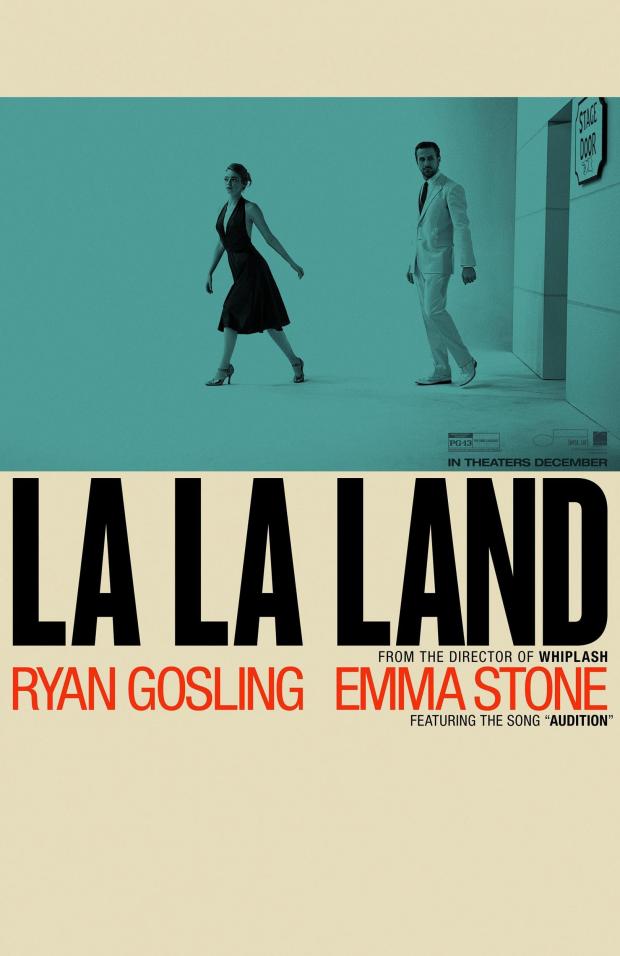
La La Land Successfully Updates A Genre

La La Land is a rare bird, a genre musical film— refreshing and uplifting, sincere and happy and melancholy, a much-needed anodyne for the darkness and cynicism of late cinema. It tells the story of the meeting of two young people, Sebastian (Ryan Gosling) the musician and Mia (Emma Stone) the struggling actress. Both are working marginal jobs, waiting for their moment to break into the careers they dream of. When they meet (after a few hilarious missteps) love begins to bloom— and in true musical manner, their emotions soar in the form of song and dance. This is what is wonderful about musicals: in their universe emotions cannot be contained by prosaic reality. They require the characters spontaneously burst into song. Narrative reality breaks loose and people levitate into a magical space where people dance in the middle of traffic jams and fly into the stars of a planetarium.

But it’s not all just a cinematic heaven of singing and lyrical passages of fancy: the eternal rival of romance and career soon takes over.  Mia and Seb inspire each other to take risks, work hard and strive to make their personal dreams come true. The cost of pushing career first soon becomes the central conflict of La La Land, which leads to one of the most soaring and beautiful and melancholy and moving conclusions I have seen in a modern film.

The third character own this film— the namesake— is it’s wonderful, make-believe Los Angeles: Angel’s Flight, Mulholland Drive, Griffith Park, palm trees and stately SoCal architecture under an endless blue sky or deep blue night. It’s a fun, vibrant place full of artist, actors, strivers and dreamers. It’s been too easy in films of late to see LA as some of late-capitalist hellscape (see Training Day): It’s refreshing to remind all of us that LA is a place where people still go to try to make their dreams come true.

Director Damien Chazelle’s last film was Whiplash, a sort of crazy stalker film set in the world of jazz music about an earnest drummer and his insane instructor (J. K. Simmons, who has a lovely cameo in this film).  Jazz plays heavily and strangely in La La Land as well: Sebastian is a young man obsessed with the world of jazz: he has posters of jazz greats in his apartments, Hoagy Carmichael’s piano stool and longs to open a real jazz club in Los Angeles. There are plenty of kids these days who passionately love alls sorts of dead or marginal forms of music: it never becomes clear of Seb is sincere or just really good at affecting his love of the genre.

"A Lovely Night" on location.
The most remarkable number— a real masterpiece of a shot— is “A Lovely Night,” which occurs near the beginning of the film. After a party in the Hollywood Hills where they accident meet up, Seb is helping Mia look for her car. They break into song and dance at a scenic overlook, the wash of lights in the LA basin below. The scene, which goes from real-world to singing to dance to tap-dance (!) is shot at the real location and very specific time: PAST “Magic Hour,” just after sunset, when the warm glow of the sunset underscores a deepening dark blue sky. The set lighting is low as to illuminate the actors and still leave the sunset and sky bright. This scene not only highlights the considerable singing acting talents of of Ryan Gosling and Emma Stone, it shows off cutting-edge film technology: fine-grained, fast film stock (La La Land was mostly shot on 35mm film), fast anamorphic lenses and the latest light, agile camera packages. Were this a Golden Age musical, this shot would have happened on a soundstage. But instead, it is one long, six-minute shot at a very narrow, specific time of day. This makes it breathtaking on several levels.

Another nice PAST-magic hour shot.
La La Land is in many ways an updated classic movie, a pastiche of the conventions, narratives and styles of Hollywood musicals. It is not a breakthrough in and of itself: this isn’t pure storytelling and cinematic innovation like Mad Max: Fury Road was. It takes the best elements of a great genre, updates the sensibilities to contemporary morés and makes it all fresh and unexpected again. There’s a little Vincente Minelli here, some Gene Kelley there, a little Jaques Demy, Even a bit of Ross Hunter/ Doris Day and Paul Thomas Anderson.

Another girl in magical old Los Angeles, dreaming
of acting fame. Naomi Watts in Mulholland Dr.
Given all these obvious movie-history references it was then very, very strange that while La La Land played, the place I kept going to for a visual and stylistic reference was… David Lynch. I COULD NOT STOP thinking: “This is a light-hearted musical version of Mulholland Dr. (2001).” It shares a lot of the same qualities as Lynch’s masterpiece: striking cinematography filled with shots of strong primary colors; an abiding love of Los Angeles locations, show business, actors and the mechanics of filmmaking; flights of surrealism; and intimate close-ups, bursting with emotion. These films are on entirely different missions— light, uplifting musical surrealism versus a surreal dive into the darkest parts of the id— but there is a common thread as well, in look and feel.

I may well be mistaken and La La Land may have been released in the
original CinemaScope aspect ratio of 2.55:1. But that's not how I saw it
in Redwood City: they couldn't even manage to mask the screen right.
And, sorry to say, I have to disagree with both the opening title card and Dana Stevens’ review and report that La La Land is NOT in CinemaScope. That specific film format was proprietary for to 20th Century-Fox and Bausch and Lomb, who standardized the elements of anamorphic cinematography. CinemaScope lenses were not much used past 1960: these early models had distortion problems that caused actors’ faces to widen unnaturally: “CinemaScope Mumps,” they called it. Panavision fixed this problem by re-arranging lens elements to minimize distortion. This film is actually in Panavision: they used Series C lenses to shoot it. But this is a quibble: the widescreen compositions are so lovely and the mise-en-scene is so well developed and rich, it’s worth another viewing just to look for visual clues and symmetries.

If you love Hollywood genres old and new, this is a must-see.

Friday, January 1, 2016

QT's Roadshow Gimmick: or, The Heuristic Eight

This still is the actual proportion of Ultra Panavision 70mm.
Went to a late screening of The Hateful Eight at the Century San Francisco Center, where a friend (Chris) has successfully seen the thing. Very nice place with leather seats where you can buy a beer. At 11:00 on the dot the projected cranked up and the overture screen appeared on that wide, wide screen.

The rest of this is going to a Hegelian dialectical analysis of The Hateful Eight in Roadshow format. It's important to quantify the entire experience this way because when you get right down to it, the synthesis of technology and subject here is super goddamned peculiar.

THESIS: The Ultra Panavision 70mm Roadshow Release.
The extra wide format Tarantino used here -- 65mm source with an extra anamorphic squeeze bringing the frame to a stunning 2.76:1 aspect ratio-- is quite rare and was used exclusively for prestige Hollywood productions. Ben Hur, The Greatest Story Ever Told, It's a Mad, Mad, Mad, Mad World and The Fall of the Roman Empire were previous films lensed in this format.

The technical presentation at the Century San Francisco Center was simply excellent. The image suffered a little bit from the screen masking, which was open at the bottom, showing a soft edge. I believe the auditorium was equipped for either 'scope (2.35:1) or spherical/HD (1.8:1) and simply could not mask the screen down to the right aspect ratio.

70mm film. This is a faded clip from
Hello Dolly! (1970) which was shot in 65mm.
For the sheer visual experience, it's worth the effort seeing the film this way (and you can until January 11th, when they will dismount all the 70mm projection gear). I have been fortunate to have seen several films in Ultra Panavision before (Ben Hur and It's a Mad x4 World, in the Cinerama Dome no less) and the sheer visual aspect of the film-- incredible 70mm detail, rich color and natural tone of photochemical film makes for a memorable experience. (it would have been even better to have seen a screening on a deeply curved Cinerama screen but those are no longer available in the Bay Area.)

No less pleasurable is the entire Roadshow experience: an overture, intermission and a quality program handed to every patron. More films should do this. When I saw 2001: A Space Odyssey in Cinerama Roadshow when I was a little kid there were programs, but you had to buy them.

ANTITHESIS: The Hateful Eight
The movie itself was vile. Set in the Old West, it's a tale about a collection of mostly unpleasant Western movie types holed up in a mountain trading post during a blizzard. Having a full complement of characters, Quentin advances his story by having his characters give little speeches and then kill each other. His idea of a "plot twist" is killing off a character and letting the story dynamics fall into a reductio ad absurdum pattern until the next killing. If anything (and H/T to Chris for pointing this out) it's a lot like John Carpenter's The Thing (1982) complete with Kurt Russell.

They're hateful and there are eight of them.
Walton Goggins (#6 here) turned in a great,
unusual stand-out performance.
There are no overarching themes aside from vengeance and pointless violence and super-casual 19th century racism. Like Django Unchained, one could look at this film as a addressing slavery and institutional racism, but it's clear that ol' QT is only vaguely aware of this: he merely loves having his characters say "nigger" over and over and over until the shock value hardens into dull acceptance.

Some critics have argued that Quentin Tarantino is expertly deconstructing archetypes of classic cinema in his movies. That may well be, but I do not think I have ever seen a Hollywood or spaghetti western quite as nihilistic and meaningless as The Hateful Eight. If anything it gave some glimpses into QT's thought processes-- and man, it's ugly in there. Maybe he's trying to meld the classic low-budget Western with the Austrian horror genre (i.e. Funny Games) in terms of sheer lack of human empathy, but I doubt it. It's all just those ugly thoughts. In fact he's so in love with his own tough-guy, everyone-is-a-killer narrative that he reads the left-hand narration out loud right after the intermission-- apparently because he believes we're a bunch of goldfish who forgot everything in the first half of the movie.

The Hateful Eight also claustrophobic. Most of the movie is set in one room. Wide film notwithstanding, this film has the lowest and simplest production values of any Quentin Tarantino film-- and this includes Reservoir Dogs, another one-set film but with a lot of interesting scenes set in other interesting places.

SYNTHESIS: Tarantino's Roadshow Gimmick
Roadshow implies prestige: Every other film released in Ultra Panavision 70mm had incredibly large budgets, stellar casts and sweeping vistas and locations. Even the ones shot in spherical 65mm, from Oklahoma! (1955) to Samsara (2011) have a certain cachet, a promise of an enhanced experience. Add to that the roadshow format, with an overture, intermission and a program-- all elements of legitimate theater transplanted into cinema to impart a sense of occasion and importance--  it adds up to the anticipation of a special, full-sensory, even transcendent cinematic experience.

We don't get any of that here.

The Hateful Eight is an anti-prestige movie. It's a grindhouse Western full of grungy, glib characters who spend the majority of the film in a rustic shack pointing revolvers at each other. There are some gorgeous sweeping vistas in the beginning of the film, when the first four of the eight meet up in a stagecoach, set in the snowy wilds of Wyoming. But aside from some clever use of cross-frame staging and mise-en-scene, the super-wide frame and rich film look is wasted. It's the least spectacular large-format movie I've ever seen.

The synthetic effect is, as I said, super goddamned peculiar. It's like putting on evening wear and paying a premium to watch a bunch of YouTube cat videos. I overheard a few conversations during the intermission: Most other audience members were trying to define what the big deal was about 70mm and why the screen was so squished. This represents a misuse of the format. Tarantino should have made Inglorious Basterds in Ultra Panavision 65: it had sweep, spectacle, a huge cast and amazing settings. Hell, he should have made Kill Bill into a single, 200-minute-long-with-intermission roadshow production. In terms of matching content to format The Hateful Eight deserved to be filmed in 16mm and blown up to plain HD.

If you want to see a bit of cinematic history, a real live roadshow 70mm release with the full bells and whistles, The Hateful Eight technically qualifies, I suppose. If you're all hype to see Jennifer Jason Leigh (who was great, BTW) get punched in the face, covered with her own and various people's blood, and called a bitch about a million times, see the Digital Cinema version: it's shorter and cheaper.

Tuesday, December 29, 2015

Quentin would have been PISSED

With nothing compelling on TV and a movie pass burning in my wallet, I decided to attend a roadshow screening of The Hateful Eight.

I've sort of fallen out with Tarantino lately, what with his ardent passion for turning junk movies from the past into faux-junk cinema and utter devotion to pointless nihilistic gore and over-the-top vengeance stories. It's all part of his huge movie-geek thing-- but something of substance DID come out of it. The man cares about old-school widescreen cinema: so do I. That's where our Venn diagrams intersect.

He went through an extraordinary amount of trouble to create a roadshow release of The Hateful Eight. The last film I remember seeing in a proper roadshow release was Apocalyse Now, a credits-free 70mm screening with a program provided. The Hateful Eight goes a few steps better, with a musical overture, intermission and a three-hour program length.

At least, that's what I understand is supposed to happen.

The fun part: going out with a big ol' 65mm
camera and shooting cool lens flares.
December 28th's  last screening was supposed to start at eleven at the Daly City 20. I got there early, paid the $3 up-charge and staked out a seat near the screen, pleased they had curtained it for crazy wide 2.76:1 Ultra Panavision. Two young women-- practically the only female-only party in a half-full show-- stopped on the way in and noted the smell. Sure enough-- this was the fourth screening of the day and Quentin's core audience demographic had filled the auditorium with a heavy, funky, manly fragrance.

11:00 became 11:10, then 11:20. No movie. The floor manager appeared, handed out rain checks and promised we'd be up and running in about ten minutes. At 11:40, he came back and cancelled the show. So, in the end I did NOT see The Hateful Eight-- but I got two movie passes and three roadshow programs out of the experience, so not a total loss.

The floor manager and I chatted just before he called the screening off. Apparently the theater got all the hardware for a 70mm screening just before it was supposed to start. The projector was refurbished, and at the end of the roadshow screening they will haul it away and 2K digital shows would take it's place. The problem was the projector was just plain broken: it simply would not pass the wide film, some sort of mechanical failure. This cancelled screening was not the first one they had to axe either. Roadshow screenings have gone dark all across the US and Canada in regular intervals.

Hey: Quentin Tarantino and The Weinstein Company are trying very hard to give the audience a taste of the widescreen glories of the past, and more power to them for it.  The thing is: they're giving audience a taste of not just that, but the entirety of photomechanical projection technology.

For each of The Hateful Eight roadshow venues they had to ship in a 70mm projector, set it up and align it, and station a projectionist exclusively to handle the thing. (I'm sure they had to bring in flatbed film platters in some places as well, but not Daly City: they still had one Christie system left). These projectors are likely vintage Century or Todd-AO machines they bought used and had mechanically refurbished. But without the infrastructure and expertise to maintain these machines, they break. They didn't break as much in the past because they were so common.

DP70 35/70mm projector.
Back in my movie theater management days a surprising number of theaters I managed had 70mm capability. In the 80s United Artists had the presence of mind to buy up and install a lot of DP-70 Todd-AO projectors made by Phillips/Norelco in the Netherlands in 1955 or so. The reasons for buying up these machines was twofold: they were very solidly made and reliable for regular 35mm screenings, and even the dopiest non-union assistant manager could switch them over to 70mm. Even with dopey non-union assistant managers running the shows, there were technicians available for overhaul and spare parts were in abundance in every projection booth (sometimes even spare projectors). This all made the average screening in the film era a reliable thing.

Nonetheless, there were a lot of moving parts and flying film and things went off the rails all the time. I am personally responsible for destroying a $3000 reel of 70mm: I started a screening of Bonfire of the Vanities in 70mm blow-up (why? WHY?) forgetting to engage the feed platter motor. Reel One wrapped around the hub and was torn to shreds. Fortunately we could switch to 35mm until a replacement reel arrived (and Larry Levin finished yelling at me).

Digital projection has as we all know, transformed the moviegoing experience. For the audience the changes have been subtle: the picture is more steady, screenings more reliable, and unfortunately trailers nearly endless. the films still "break," though, but they do it digitally: It was reported that an opening night screening of Star Wars: The Force Awakens glitched a few minutes in and skipped to the very end of the film. Digital Cinema's most profound change happened in the booth: no moving parts. Films are loaded via hard drive. The roar of the average film projector (which was terrifyingly loud when running 70mm) has been replaced by the hum of cooling fans.

Like I said, big praise for Tarantino for bringing back Ultra Panavision, but it's a kind of stunt, like wiring theater seats to shock people. My cancelled show was part of this whole retro-technical stunt rather than the continuum of modern Digital Cinema technology, and as such none of the backups were available. There was no 35mm print backup or a spare digital projector. He's giving people a taste of the old film days, but it's so late after the passing of this technology it's definitely a double-edged sword. Part of this is sheer hubris: it's easy and cool on the front end to go out and shoot a film with 65mm Panavision cameras and hand-restored 1.25X anamorphic lenses. On the back end it's not so easy: conforming 100 theaters to a nearly dead film format is a tall order indeed, a stunt not as easily pulled off.

So I'm gonna try again soon to see another roadshow screening, but this time I'm going to a theater that isn't in the sticks (Daly City: I'll bet they installed the less reliable refurbished projectors in the outliers). Sheer law of averages means next time the projector will light up.

Monday, September 14, 2015

Love-- Don't Fear-- The Walking Dead

 “Fear the Walking Dead,” the companion series of AMC’s “The Walking Dead,” premiered a few weeks ago to huge ratings. It is set in East Los Angeles during the very beginning of the same zombie apocalypse as the first series, but if the pace of the first three episodes is any indication a major part of this series is going to be eyewitness to the collapse of civilization. This was skipped in the original series (and the graphic novel): The protagonist wakes up in an abandoned hospital, the gap between normality and post civilization left to the imagination of the viewer.

FTWD has been subject to mixed reviews: some think it is an excellent thriller with some amazing potential, others think the premier episodes was slow and many of the core characters are unlikable. These are both fair observations. I think it is excellent television, and you should definitely check it out! Also, I believe there is a reason why this show was structured this way:

• The core of the cast are Travis (Cliff Curtis) and Maddie (Kim Dickens), both with children from previous marriages. two adults struggling to merge into a new family unit as the story begins. And as much as I like this show so far, I have to admit that all three of their kids are remarkably awful. Maddie’s son Nick (Frank Dillane, a dead ringer for a young Johnny Depp) is a hopeless junkie who sees his first zombie when he comes to in a squat in an abandoned church: so far he has been resolutely concentrating on scoring more opiates, little else. Maddie’s daughter Alicia (Alycia Debnam-Carey) is a high-schooler who was ready to bolt from family and safety to be with her infected, dying boyfriend. Travis’ son Chris (Lorenzo Henrie) is your basic never-respond-to-parents-calls, clueless kid. Much parental energy has been spent in these first three episodes just rounding the kids up in one place, leaving precious little time to cope with the collapse of technological civilization.

Travis, trying to call his dumb kid.
I think there is a reason we are saddled with so many addled kids in this series— and I know the primary reason is likely trying to capture a young viewer demographic. But “The Walking Dead” is the most popular series on television, and so far has disproven the need to cast with the 18-to-25 “ABC Family” audience in mind. This has more to do with showing true, ground-up character construction. These kids are truly clueless (except for flashes from the otherwise drug-addicted Nick, who is the very first character to identify the ”infected” not as sick people but animated dead). We will get to see them develop survival skills from essentially nothing as the show develops. Contemporary young adults are stereotyped as coddled, tech-addicted and incapable of self-support: it should be interesting to see how they harden into zombie killers.

• Added to this core family are Daniel Salazar (Ruben Blades), his wife and daughter. They are from El Salvador, and bring some very interesting developing-nation values into this story. From their first meeting Daniel strikes bargains with Travis and his family: Every favor is matched with obligation. He is not shy about blowing away a zombie with a shotgun. He also sees Travis’s aversion to guns as a sign of weakness— and says (in Spanish) “Good people will be the first to die.” El Salvador was (and well may still be) a messed-up country controlled by autocrats, with a weak government and no rule of law. He is the Greek Chorus of this series, knowing all the upcoming events are going to be bad and are getting worse.

• One of the reasons I think audience are more critical of “Fear the Walking Dead” has something to do with the diminishing returns of any spin-off. The first series introduced the zombie apocalypse, right around Halloween 2010 in fact: it was bleak, thrilling, terrifying and unlike any horror show seen before. Viewers of “Fear the Walking Dead” know this universe well: they are drumming their fingers impatiently, waiting for those hordes of shuffling undead to show up, the expected Grand Guignol of gore, the descent into amoral kill-or-be-killed survival.  But the emphasis on this series is quite different: as I’ve said before here, the collapse of civilization is just as terrifying as animated cannibal corpses. The lights go out; food runs out; basic services are gone. Eventually the emergency services (the California National Guard, apparently) will break down as well, as they are either eaten or abandon their posts and run for the desert. This is going to be playing out in detail, and will be the standout feature of "FTWD."

Look at those lovely anamorphic flares!
• As is the standard for this franchise, a sizable percentage of the cast playing Southern Californians are from the Commonwealth (England, New Zealand and Australia). I’m not gonna get all Donald Trump here, but this casting fetish still strikes me as odd.

• One of the most pleasing things about FTWD is how they’re shooting it. When AMC was financing their first dramatic series it was a big risk, and to keep costs down they shot “Breaking Bad” and “The Walking Dead” in Super16. When “Breaking Bad” started to take off they upgraded the budget and shot in 35mm, but “Walking Dead” stayed with 16mm: It looks gritty, grainy, a little washed out, which perfectly suits the bleak, zombie-infested wastelands of the South. But for "FTWD" they chose to shoot in 2K digital with Hawk Vintage ’74 anamorphic lenses. This gives the show a clean, expansive look, with the same flares, bokeh and shallow focus of a theatrical release in ‘scope. Visually it is as about as far as you can get from the original series. It's still in full-frame 16x9, but I'm hoping the BluRay release will be in 2.35:1.