Showing posts with label Los Angeles. Show all posts

Friday, July 3, 2020

Falling Down: D-Fens Quixote

An image from the incredible opening shot. The camera starts on
Michael Douglas' lips, flies out of his car, allaround it, and settles on
him again. This was before computer graphics made this easy.

A recent re-watching of the 1993 Joel Schumacher film Falling Down (it was a homework assignment) turned up a number of fascinating elements— some of them unadulterated 1990s values, some modern re-evaluations, and at least one new definition. Falling Down, it turns out,  is a lot of different things.

Synopsis. William Foster, recently fired from his aerospace job, walks away from his car in a Los Angeles traffic jam. He embarks on a city-spanning adventure: he is trying to get to Venice for his daughter’s birthday party, despite the fact his ex-wife has a restraining order against him. What follows is a series of obstacles to his goal, all challenges to his worldview, one that is fading away. While he is being pursued by Detective Prendergast (Robert Duvall) the protagonist’s quest becomes a path of increasing violence and destruction across the city.

Parable of White Victimization. Time has not been kind to many of this film’s themes. The most obvious one, the one pursued in the press at the time: D-Fens was a “latter-day prophet, denouncing the hypocrisy of our times.” White men were losing ground in an ever-more-diverse America. At the time, when Hollywood and popular culture was basically white men as well, this crisis was internalized.

The staff of Whammyburger, being told they make a lousy product
by a man waving a TEC-9 around. Dede Pfeiffer (center) is the
completely unflappable counter girl. She's a hoot.
D-Fens establishes his “everyman” credentials by constantly questioning things many people at the time questioned as well. Those questions start out picayune: Why does a can of Coke cost 85 cents? Why doesn’t Whammyburger serve breakfast past 11:30? Why can’t I just sit here and catch my breath?

Vignettes are sprinkled throughout the film that reinforce his “angry white man” perspective. Urban decay. Police harassment. A homeless white guy holding a begging sign, next to industrious Latino men selling goods on the street.

Beth (Barbara Hershey) realizing she may have had a hand
in the victimization of a 1990s American white male--
the least victimized sort of person there is.
Later, his questioning veers into more sweeping social criticism. While cutting across a golf course, D-Fens wonders why the vast green space isn’t open to the public. He later hides in the pool house of an immense mansion, and finds out (via a family of poor tenants) that it is owned by a plastic surgeon. At the time, these observations struck close to home: Was D-Fens a victim?

The film went a bit further than that to indemnify William Foster as a victim of his times. When the police interview his ex-wife Beth (Barbara Hershey) she admits her reasons for placing restraining order on him were spurious. He had a temper, but he didn’t drink and never struck her or her daughter, and the judge who set the order “wanted to make an example of him.” As the interview progresses she looks increasingly distressed and embarrassed.

Joel Shumacher and screenwriter Ebbe Roe Smith crafted Falling Down to channel “White Male Paranoia.” The reason the image of Michael Douglas — buzz cut, broken horn rims— made the cover of Newsweek is this film successfully captured a moment in history. After the fall of the Berlin Wall and the breakup of the Soviet Union, George Bush scaled back defense spending on a massive scale. Military installations were closed. Aerospace companies like Grumman and Lockheed closed down facilities all over the United States: Southern California was hit hard. William Foster’s job is obviously part of this loss, part of the USA’s military-industrial contraction as the cold-war era was coming to an end. To the people who ran the show back then— middle-class white men— they saw it as something that was happening to them, and they were the victims.

(As an aside, my mom worked for Lockheed for 30+ years, and I was an eyewitness to the post-cold-war wave of defense industry layoffs. It was as bad as it came off in the film, and it didn't just affect white men.)

D-Fens as Anti-Antihero. This is not just wordplay for a villain: it’s the best way to describe him. A character can be categorized by two criteria: deeds and thoughts.

A HERO is a character who does heroic deeds and embodies heroic qualities. Captain America, Indiana Jones, Obi-Wan Kenobi, Joan of Arc, Robin Hood: all embodiments of positive values and behaviors.

An ANTIHERO is a character who does heroic deeds but does not embody heroic qualities. Tom Jones, Tristam Shandy, Deadpool, “Mad” Max Rocketanski, Rick Blaine and the nameless protagonists of Sergio Leone’s and Akira Kurosawa’s films fit this description. They do not obey any rules of lawful conduct, are often transgressive or violent, but in the end their acts resolve into a greater good.


A VILLAIN is a character without redeeming qualities, who actively oppose the efforts of heroes and the greater good. Darth Vader, Sauron, Noah Cross, Norman Bates, The Wicked Witch: all are engaged in selfish ends that will cause great harm if they succeed.

But William “D-Fens” Foster is something else. He is a regular man, down on his luck and emotionally unstable, but not extraordinary in any way. Throughout the film he voices reasonable opinions, social commentary about the crumbling world around him. His goals are not intrinsically villainous: he merely wants to go home, and is forced by all manner of extraordinary obstacles to adapt ever more violent methods to achieve his goal.

D-Fens does not aspire to heroic status. He merely wants simple, basic needs filled: change for the phone, breakfast, a moment to rest in a vacant lot. These simple goals are always thwarted— so as the film progresses he cares less and less about behaving in a lawful manner. In his eyes, all he sees are forms of injustice, large and small: overpriced soda, gang territoriality, pointless road closures, obnoxious golfers. In his eyes it’s all injustice against him and the world he comes from.

But in the end, when Prendergast pulls a gun on him on Venice Pier, D-Fens looks at all he has wrought— family running, police clearing the area— and finally comes to the realization that according to the rules of the world he now lives in, he is the bad guy.

"I'm the bad guy?"
He is an ANTI-ANTIHERO: A character who understands morality and justice, but is incapable of any form of heroic action, and in the end acts against the greater good. The anti-antihero is distinct from the antihero by their mindset: they believe their goals are for good and believe are working toward the good, but are blind to the destructive nature of their actions and in the end do no good at all.

Michael Corleone was a decent example of an anti-antihero: he wanted to do good, become legitimate, but in the end (of Godfather 2, at least) was incapable of saving his family or himself.  Perhaps the all-time greatest anti-antihero ever created was Walter White. Every move he made was designed to get himself out of a bad situation (poverty, disease, anonymity, humiliation). By the end he ends up destroying everything he loves. Viewers of “Breaking Bad” rooted for him every week, because he was a likable, normal guy with relatable problems. Every week he slipped further and further away, to a place where there was nothing left but violence and revenge.

The Episodic Journey. Jim Bisso pegged Falling Down precisely: it’s Don Quixote, Western literature first modern novel, and it pulls two elements from Miguel de Cervantes’s 17th-century work. In form, both center on a wandering protagonist in a series of disconnected encounters. Don Quixote also shares an important trait with D-Fens: both are delusional. Quixote overdosed on tales of chivalry from the past and has come to believe they are quite real. D-Fens is also obsessed with a past where he was the hero of the American narrative.

The difference is in the final details: Don Quixote’s quest takes years and in the end he recovers from his delusions. D-Fens's wanderings take place over the span of one day, his violence and delusions only get worse, and in the end is killed via “suicide-by-cop.*”

1993 vs. 2020. D-Fens is not some sort of MAGA prototype: He was a product of mid-century values who is finally being forced to deal head-on with the reality of the post-Cold War world. He looks like the sort of gun-toting bigot we see on the news in 2020, but he isn't.


In one episode D-Fens stops to buy his daughter a gift— and watches black man picketing a bank across the street. His sign says “Not Economically Viable.” The man is shouting that he was denied a loan due to the color of his skin. He is then arrested and taken away. D-Fens sympathizes with him, even going as far as repeating the sign’s slogan.

Later D-Fens is sheltered from the police by Nick (Frederick Forrest), the deeply bigoted, racial-slur-slinging military surplus store owner. Nick admires D-Fens's violent spree and exclaims “I’m with you! we’re the same!” Nick shows D-Fens some Nazi artifacts and gives him a LAW rocket launcher (talk about Chekov’s gun!). But D-Fens is repelled by Nick’s white supremacy. D-Fens ends up stabbing Nick to death to prevent his likely rape— which informs the trope that virulent homophobes are latent homosexuals.

It may be a 1993 cultural assumption at play here, but William Foster is not a white supremacist, He is not comfortable in multicultural America, and is clearly nostalgic for the days of unquestioned white hegemony before the 1990s, but racism is never his core motive.

We can look at Falling Down in 2020 and see D-Fens as the unsprouted seed of the MAGA mindset. It would take 20 years of union-busting, opioid addiction, corporate offshoring, a drastic loss of economic status and constant watering by conservative news for this seed to bear the fruit we see sprouting everywhere today.

* Japanese literature and cinema feature a “Ronin Character.” This is an antihero protagonist who, when freed of the considerable restraints of society, openly criticizes and challenges the status quo. But the cost for such freedom is always the same: they die by the end. Falling Down fits into this concept well.

(h/t to John for the title.)

Sunday, November 18, 2018

It's Nice To See ANY Side of the Wind At This Point

You know, I watched a lot of Tonight Show with Johnny Carson in my youth. And it was great comfort food but if you asked me to tell you now about something I remember from all those years of TV, I couldn't. Almost.

I remember one anecdote from the late seventies. Rich Little was on the show, chatting with Johnny about his experience shooting Orson Welles' The Other Side Of The Wind. It was a party scene, and suddenly Orson, behind the camera, bellowed "look down! Between your legs! Midgets are running between your legs!" And later between takes, Little asks Orson "hey, what's with the midgets?" And Orson grunted, "We'll put the midgets in later, when we're in Mexico."

Since then, I've wanted to see that movie.

And by all accounts, Orson wanted me to see it too. Principal photography was done, piecemeal, from 1970 to 1976 whenever people were available and there was enough money; and post production went on for another 5 years until, tragically the footage was seized by the Ayatollah Khomeini during Iran's revolution. (a major portion of the film was owned by the Shah's brother-in-law). From then until his death, Welles devoted his time to getting the footage released and raising money to finish it, but it never happened and Wind became another unfinished Welles movie. There's a lot of 'em.

However, perhaps because it was his last and because the subject matter was clearly so much about Welles himself, people have been trying to until the Gordian knot that secured this thing ever since. And Netflix, a company with resources so great that they could achieve what Showtime failed to do in 2002, has finally done it. Those crazy bastards not only finished The Other Side of The Wind, they also slapped together a documentary about it called They'll Love Me When I'm Dead. It's a documentary about a movie which is, largely, a movie about itself.

Let's just call it TOTSOTW, shall we? TOTSOTW takes place during the last night of film director Jake Hanneford's (John Huston) life. Hanneford is a legend, a firebrand iconoclast genius with enormous appetites, gallons of toxic masculinity and little discipline. His friends (allies, I guess) are throwing a party for his birthday but also to screen his unfinished art film, "The Other Side of the Wind" in hopes of raising the money to finish it. At Hanneford's side is his pal and erstwhile biographer Brooks Otterlake, a character obviously based on Peter Bogdanovich who was originally to be played by Rich Little because Bogdanovich lapses into impressions frequently. However Little dropped out because he only had 3 weeks to shoot, and Welles replaced him with Bogdanovich, So Bogdanovich is playing the Bogdanovich character but Huston plays the Welles character.

Most of the guests are either film students, critics, old Hanneford compatriots, mannequins, or mischievous drunk midgets. I'll be honest, I thought Rich Little had made that part up.

I'm giving you the setup and not the plot here. Frederick Wisemen, the documentarist, was once approached by a film festival. There were writing up a program for the weekend and they wondered if he could summarize his entry into a paragraph for them. Wiseman scowled, "if I could do that I wouldn't need to make the documentary!"  TOTSOTW is pretty similar. It IS the summary. It's kind of those ten years boiled down into 2 hours and 2 minutes. I can tell you it's shot in 3 or four different styles, two aspect ratios, and seemingly whatever film stock Welles could get at a discount. It looks like Oliver Stone's work from a couple decades later. Part of the conceit is that some of the footage is from the film within a film, some is just the movie, and some is documentary footage from film students. Mostly it's a hall of mirrors so you won't notice that there is three years between the close up and the reverse angle.

As infuriating as TOTSOTW can be, I kinda love it. I want to watch it again a few times. Once Welles gave up on trying to sell tickets to the normies he did his best work (and worst simultaneously) and it's fascinating driving around the sharp curves in his brain.

Sunday, December 25, 2016

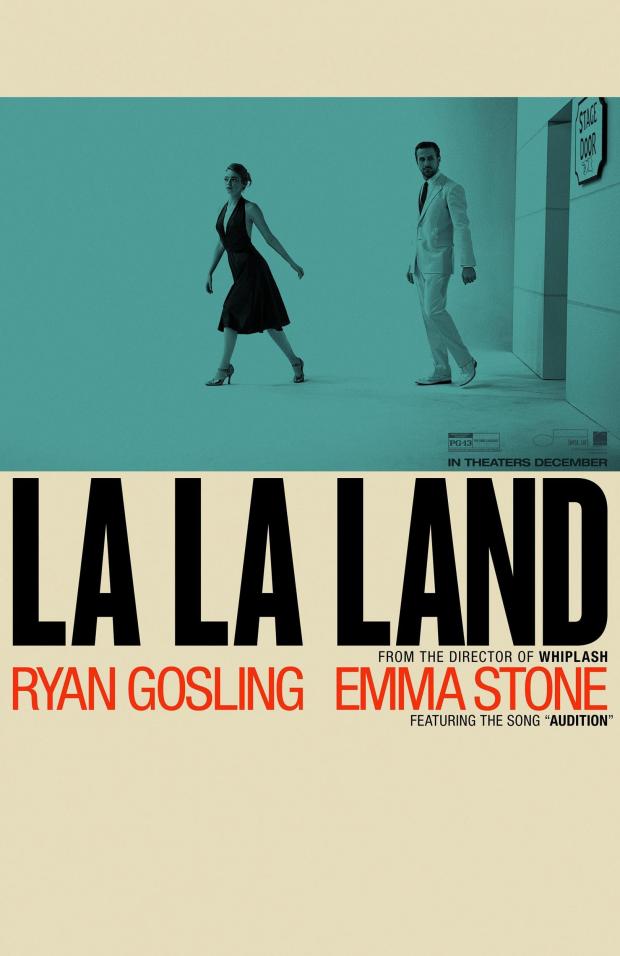
La La Land Successfully Updates A Genre

La La Land is a rare bird, a genre musical film— refreshing and uplifting, sincere and happy and melancholy, a much-needed anodyne for the darkness and cynicism of late cinema. It tells the story of the meeting of two young people, Sebastian (Ryan Gosling) the musician and Mia (Emma Stone) the struggling actress. Both are working marginal jobs, waiting for their moment to break into the careers they dream of. When they meet (after a few hilarious missteps) love begins to bloom— and in true musical manner, their emotions soar in the form of song and dance. This is what is wonderful about musicals: in their universe emotions cannot be contained by prosaic reality. They require the characters spontaneously burst into song. Narrative reality breaks loose and people levitate into a magical space where people dance in the middle of traffic jams and fly into the stars of a planetarium.

But it’s not all just a cinematic heaven of singing and lyrical passages of fancy: the eternal rival of romance and career soon takes over.  Mia and Seb inspire each other to take risks, work hard and strive to make their personal dreams come true. The cost of pushing career first soon becomes the central conflict of La La Land, which leads to one of the most soaring and beautiful and melancholy and moving conclusions I have seen in a modern film.

The third character own this film— the namesake— is it’s wonderful, make-believe Los Angeles: Angel’s Flight, Mulholland Drive, Griffith Park, palm trees and stately SoCal architecture under an endless blue sky or deep blue night. It’s a fun, vibrant place full of artist, actors, strivers and dreamers. It’s been too easy in films of late to see LA as some of late-capitalist hellscape (see Training Day): It’s refreshing to remind all of us that LA is a place where people still go to try to make their dreams come true.

Director Damien Chazelle’s last film was Whiplash, a sort of crazy stalker film set in the world of jazz music about an earnest drummer and his insane instructor (J. K. Simmons, who has a lovely cameo in this film).  Jazz plays heavily and strangely in La La Land as well: Sebastian is a young man obsessed with the world of jazz: he has posters of jazz greats in his apartments, Hoagy Carmichael’s piano stool and longs to open a real jazz club in Los Angeles. There are plenty of kids these days who passionately love alls sorts of dead or marginal forms of music: it never becomes clear of Seb is sincere or just really good at affecting his love of the genre.

"A Lovely Night" on location.
The most remarkable number— a real masterpiece of a shot— is “A Lovely Night,” which occurs near the beginning of the film. After a party in the Hollywood Hills where they accident meet up, Seb is helping Mia look for her car. They break into song and dance at a scenic overlook, the wash of lights in the LA basin below. The scene, which goes from real-world to singing to dance to tap-dance (!) is shot at the real location and very specific time: PAST “Magic Hour,” just after sunset, when the warm glow of the sunset underscores a deepening dark blue sky. The set lighting is low as to illuminate the actors and still leave the sunset and sky bright. This scene not only highlights the considerable singing acting talents of of Ryan Gosling and Emma Stone, it shows off cutting-edge film technology: fine-grained, fast film stock (La La Land was mostly shot on 35mm film), fast anamorphic lenses and the latest light, agile camera packages. Were this a Golden Age musical, this shot would have happened on a soundstage. But instead, it is one long, six-minute shot at a very narrow, specific time of day. This makes it breathtaking on several levels.

Another nice PAST-magic hour shot.
La La Land is in many ways an updated classic movie, a pastiche of the conventions, narratives and styles of Hollywood musicals. It is not a breakthrough in and of itself: this isn’t pure storytelling and cinematic innovation like Mad Max: Fury Road was. It takes the best elements of a great genre, updates the sensibilities to contemporary morés and makes it all fresh and unexpected again. There’s a little Vincente Minelli here, some Gene Kelley there, a little Jaques Demy, Even a bit of Ross Hunter/ Doris Day and Paul Thomas Anderson.

Another girl in magical old Los Angeles, dreaming
of acting fame. Naomi Watts in Mulholland Dr.
Given all these obvious movie-history references it was then very, very strange that while La La Land played, the place I kept going to for a visual and stylistic reference was… David Lynch. I COULD NOT STOP thinking: “This is a light-hearted musical version of Mulholland Dr. (2001).” It shares a lot of the same qualities as Lynch’s masterpiece: striking cinematography filled with shots of strong primary colors; an abiding love of Los Angeles locations, show business, actors and the mechanics of filmmaking; flights of surrealism; and intimate close-ups, bursting with emotion. These films are on entirely different missions— light, uplifting musical surrealism versus a surreal dive into the darkest parts of the id— but there is a common thread as well, in look and feel.

I may well be mistaken and La La Land may have been released in the
original CinemaScope aspect ratio of 2.55:1. But that's not how I saw it
in Redwood City: they couldn't even manage to mask the screen right.
And, sorry to say, I have to disagree with both the opening title card and Dana Stevens’ review and report that La La Land is NOT in CinemaScope. That specific film format was proprietary for to 20th Century-Fox and Bausch and Lomb, who standardized the elements of anamorphic cinematography. CinemaScope lenses were not much used past 1960: these early models had distortion problems that caused actors’ faces to widen unnaturally: “CinemaScope Mumps,” they called it. Panavision fixed this problem by re-arranging lens elements to minimize distortion. This film is actually in Panavision: they used Series C lenses to shoot it. But this is a quibble: the widescreen compositions are so lovely and the mise-en-scene is so well developed and rich, it’s worth another viewing just to look for visual clues and symmetries.

If you love Hollywood genres old and new, this is a must-see.

Monday, October 10, 2016

Donald Trump and Hollywood Omertà

Many people have seen, or at least read about, the now-infamous “hot mic” tape of a candid conversation between Donald Trump and Billy Bush in September 2005. News outlets and the internet are currently saturated with analysis of the content of this tape, in which Trump admits that his money and power permits him to commit sexual assault. The astounding crudity of the verbal exchange was seen as revealing the true nature of Donald Trump’s personality and attitude towards women, and the revelation of this tape may well prove to be the tipping point of the 2016 presidential election.

But this article isn’t about the content of the tape: it’s about why it took so long for it to be released. This is the part of this incredible story that seems to be under-discussed— and it relates directly to Hollywood, which is why it’s being discussed here.

The official story is the producer of “Access Hollywood,” Steve Silverstein, remembered this interview about two weeks before the release and dug the footage out of archives. This story is almost certainly false. The reason why it’s not believable is actually embedded in how the tape was recorded.

This political bombshell (more of a nuclear warhead) was taken from a segment of “Access Hollywood” which documented a cameo Donald Trump was making on the soap opera “Days of Our Lives.” It was shot on the backlot of NBC Studios in Burbank. A camera crew was following Trump and “Access” host Billy Bush: both men were fitted with lavalier microphones and transmitter packs which broadcast RF signal to receivers attached to the camera. During the publicly-released segment a cameraman had stepped outside the bus to set up a shot showing Bush and Trump arriving at the studio to be greeted by soap star Arianne Zucker. Thinking they were off-camera, the two men engaged in a crude, degrading conversation about women. Aside from the on-camera personalities there were seven people involved in this taping: two cameramen, the segment producer, a production assistant, Trump’s bodyguard and PR person, and the bus driver.

After this segment was shot, the footage was likely seen and handled by even more people: on-line and offline editors, more show producers, audio technicians and maybe even an archivist.

Charlie Chaplin, during one of his
many, many court appearances.
So about a dozen people— very likely more— heard and saw this footage in 2005. Yet NONE of these people recalled this conversation, one of the most devastating revelations of character any political aspirant has ever uttered? Particularly as this 2005 taping came on the heels of complaints by the cast and crew of Trump’s show “The Apprentice” about his crude on-set behavior? That is an impressive case of collective amnesia.

Hollywood’s code of silence strikes again.

The film industry has been creating and controlling secrets since the days of Charlie Chaplin (and Lita MacMurray) and Fatty Arbuckle (and Virginia Rappe). The studios all had (and still have) well-funded departments which handled public relations and “fixers,” producer-level executives who specialized in keeping indiscretions out of the press. (Hail Caesar was a thinly fictionalized account about a famous studio fixer.)

The culture of secrecy goes very deep in both the film and TV industries. Entertainment is an unusual industry in that the general public is constantly and intently curious about it. Supermarkets do not devote shelf space at the checkout counters with magazines dishing the dirt on astrophysicists and farmers, after all. Scripts and storylines have to be kept secret: details of film shoots are kept from public view as much as possible as well. The need for confidentiality rivals the Pentagon’s.

It’s all for the greater glory of the Industry, of course. That, and jobs. A scandal that would bring down a star would shut down production. A leaked script would kill off box-office potential. Finally, there’s the prestige factor: being on the set gives even the lowest PA or grip access to some of that rare stuff, Hollywood Glamor— stacks of non-disclosure agreements are willingly signed to gain access to that inner circle.

Why did this revelation take so long to emerge into the light of public scrutiny? The culture of Hollywood, a full century of studio secrets kept, reputations protected, indiscretions hidden. And they are so good at it: Did you know that Tom Cruise is only 5’7”? It took a LOT of will to overcome that much inertia and tradition.

Wednesday, September 30, 2015

The Wonders Of (YouTube) Space

Glamorous Italian Laura
Fantuzzi and I enjoying
free cappuccino in the free
photo booth 
I have been to paradise; it is known as YouTube Space LA in Playa Del Rey.

This weekend as the result of my involvement with a web series called The Noir Bizarre, I got to spend the day in one of the studios that YouTube provides for some of their members. Specifically, members who have over 10,000 followers. To encourage these people, Google provides them with a free studio, and free use of lights, cameras, and editing equipment. Also not insignificantly, cappuccino. You just walk out to the lobby and ask. You could get a latte instead but let's face it, if it's free you may as well get the cap.

It's not easy to find, hidden away like many good things. There is a whole community being built around there right now and somehow Google maps hasn't been completely informed about all the closed roads. Still, once you get there parking is free. This is my way to telling the rest of the cast why I was late. Sorry guys!

The studio we were in was little more than an air-conditioned box with a green screen, fortunate for us because we decided to set the scene on Mars. I won't dwell on the details of the shoot because it was plenty boring but know that if we were a maybe not all that prepared, the place accommodated us just fine. Had we storyboarded everything in advance, I'm sure it would be the same. It's kind of like everything on YouTube yourself... you think of something, look it up, and there it is, for free. Unless someone files a copywrite takedown notice, selfish bastards. Sorry, tangent.

The place was bustling with eager young indie filmmakers, having discussions in the lobby, liking each other on Facebook, drinking cappuccinos and taking selfies in front of any handy logo. There are plenty, believe me.

It would have been fun to stick around and edit there (on Apple's Final Cut pro, surprisingly) but the Noir Bizarre folk have their own stuff at home thanks. I got to see the bays though and it looks like you could complete a mighty fine feature film in that place.

Note, clear it with them first, just as a courtesy.

I'll happily go back when the chance arises though I don't know if I PERSONALLY have 10k followers on the horizon. Cross your fingers.


Monday, September 14, 2015

Love-- Don't Fear-- The Walking Dead

 “Fear the Walking Dead,” the companion series of AMC’s “The Walking Dead,” premiered a few weeks ago to huge ratings. It is set in East Los Angeles during the very beginning of the same zombie apocalypse as the first series, but if the pace of the first three episodes is any indication a major part of this series is going to be eyewitness to the collapse of civilization. This was skipped in the original series (and the graphic novel): The protagonist wakes up in an abandoned hospital, the gap between normality and post civilization left to the imagination of the viewer.

FTWD has been subject to mixed reviews: some think it is an excellent thriller with some amazing potential, others think the premier episodes was slow and many of the core characters are unlikable. These are both fair observations. I think it is excellent television, and you should definitely check it out! Also, I believe there is a reason why this show was structured this way:

• The core of the cast are Travis (Cliff Curtis) and Maddie (Kim Dickens), both with children from previous marriages. two adults struggling to merge into a new family unit as the story begins. And as much as I like this show so far, I have to admit that all three of their kids are remarkably awful. Maddie’s son Nick (Frank Dillane, a dead ringer for a young Johnny Depp) is a hopeless junkie who sees his first zombie when he comes to in a squat in an abandoned church: so far he has been resolutely concentrating on scoring more opiates, little else. Maddie’s daughter Alicia (Alycia Debnam-Carey) is a high-schooler who was ready to bolt from family and safety to be with her infected, dying boyfriend. Travis’ son Chris (Lorenzo Henrie) is your basic never-respond-to-parents-calls, clueless kid. Much parental energy has been spent in these first three episodes just rounding the kids up in one place, leaving precious little time to cope with the collapse of technological civilization.

Travis, trying to call his dumb kid.
I think there is a reason we are saddled with so many addled kids in this series— and I know the primary reason is likely trying to capture a young viewer demographic. But “The Walking Dead” is the most popular series on television, and so far has disproven the need to cast with the 18-to-25 “ABC Family” audience in mind. This has more to do with showing true, ground-up character construction. These kids are truly clueless (except for flashes from the otherwise drug-addicted Nick, who is the very first character to identify the ”infected” not as sick people but animated dead). We will get to see them develop survival skills from essentially nothing as the show develops. Contemporary young adults are stereotyped as coddled, tech-addicted and incapable of self-support: it should be interesting to see how they harden into zombie killers.

• Added to this core family are Daniel Salazar (Ruben Blades), his wife and daughter. They are from El Salvador, and bring some very interesting developing-nation values into this story. From their first meeting Daniel strikes bargains with Travis and his family: Every favor is matched with obligation. He is not shy about blowing away a zombie with a shotgun. He also sees Travis’s aversion to guns as a sign of weakness— and says (in Spanish) “Good people will be the first to die.” El Salvador was (and well may still be) a messed-up country controlled by autocrats, with a weak government and no rule of law. He is the Greek Chorus of this series, knowing all the upcoming events are going to be bad and are getting worse.

• One of the reasons I think audience are more critical of “Fear the Walking Dead” has something to do with the diminishing returns of any spin-off. The first series introduced the zombie apocalypse, right around Halloween 2010 in fact: it was bleak, thrilling, terrifying and unlike any horror show seen before. Viewers of “Fear the Walking Dead” know this universe well: they are drumming their fingers impatiently, waiting for those hordes of shuffling undead to show up, the expected Grand Guignol of gore, the descent into amoral kill-or-be-killed survival.  But the emphasis on this series is quite different: as I’ve said before here, the collapse of civilization is just as terrifying as animated cannibal corpses. The lights go out; food runs out; basic services are gone. Eventually the emergency services (the California National Guard, apparently) will break down as well, as they are either eaten or abandon their posts and run for the desert. This is going to be playing out in detail, and will be the standout feature of "FTWD."

Look at those lovely anamorphic flares!
• As is the standard for this franchise, a sizable percentage of the cast playing Southern Californians are from the Commonwealth (England, New Zealand and Australia). I’m not gonna get all Donald Trump here, but this casting fetish still strikes me as odd.

• One of the most pleasing things about FTWD is how they’re shooting it. When AMC was financing their first dramatic series it was a big risk, and to keep costs down they shot “Breaking Bad” and “The Walking Dead” in Super16. When “Breaking Bad” started to take off they upgraded the budget and shot in 35mm, but “Walking Dead” stayed with 16mm: It looks gritty, grainy, a little washed out, which perfectly suits the bleak, zombie-infested wastelands of the South. But for "FTWD" they chose to shoot in 2K digital with Hawk Vintage ’74 anamorphic lenses. This gives the show a clean, expansive look, with the same flares, bokeh and shallow focus of a theatrical release in ‘scope. Visually it is as about as far as you can get from the original series. It's still in full-frame 16x9, but I'm hoping the BluRay release will be in 2.35:1.

Tuesday, January 13, 2015

Inherent Vice: Pynchon 101

This poster, aside from tweaking Leonardo DaVinci, gives an idea
of the many wonderful cameos in Inherent Vice. Martin Short
(far right) is particularly funny and strange.
After dinner last Friday, the wife and I stopped by the Redwood City 20 to see what was playing. We spontaneously decided to see Inherent Vice. I love that sort of thing-- we went in unprepared for Paul Thomas Anderson's newest film-- and it ended up being a total delight.

It's the story of "Doc" Sportello (Joaquin Phoenix) a hippie P.I. who is hired to find a missing girl who also happens to be his ex. thus begins Doc's strange journey through 1970 Los Angeles-- both helped and hindered by Detective "Bigfoot" Bjornsen (Josh Brolin), a flat-topped, hippie-hating, brutal/delusional LA cop who also carries a SAG card (we see him as an extra in "Adam-12," in fact). On the long, winding path of investigation Doc encounters all sorts of odd and historically appropriate types: Nazi bikers, cultists, a Laurel Canyon mansion full of hippies, a hidden cabal of dentists and drugs. Lots and lots and lots of drugs. River Phoenix does an amazing job, in fact, of conveying an amazing range of stoned: mellow high, totally baked, buzzed, flying' and everything in-between.

"Doc" Sportello (River Phoenix), doing what he does
dozens of times in the film.
Compared to any other sort of film, I'd say it was not unlike The Big Lebowski- but it's a LOT more like Kiss Me Deadly, a film noir saturated in the light of Los Angeles and the darkness cast by the greedy and evil.

This is the first Thomas Pynchon book ever committed to film, and the script was apparently personally approved by Pynchon as well. Thomas Pynchon and Paul Thomas Anderson were made for each other-- their mutual approach to storytelling is spacey and convoluted yet brimming with insight. Inherent Vice perfectly embodies a lot of Pynchon's favorite motifs: Los Angeles, complex whodunits, subtle mysticism and conspiracies by shadowy, powerful organizations. The 2009 book was considered considered "Pynchon Lite," one of his most accessible novels. If this is so, than the movie version is an even better introduction to his distinctive literary style. Pynchon 101.

Thomas Pynchon, as seen on "The Simpsons." According
to Josh Brolin, the reclusive author has a cameo in
Inherent Vice. Forget it: we'll never figure it out.
Paul Thomas Anderson has developed an elliptical and indirect narrative style, especially in his later films: Inherent Vice could be described as being comprised of a series of close-ups and medium shots of Joaquin Phoenix interacting and reacting. He is an example of a filmmaker whose core relationship with cinematic storytelling has clearly evolved: his beginnings as a teller of Tarantino-like multiple-storyline widescreen films like Boogie Nights and Magnolia to a focus on nuance and dialog, as in The Master and Inherent Vice. This refocusing gives these later films a rambling feel as the plot slowly snakes from one scene to another. It take a little getting used to, but when it all clicks together it's exhilarating.

Inherent Vice is also very funny-- which is sort of unusual. P.T. Anderson doesn't really do funny: There was some situational comedy in Boogie Nights, and Punch Drunk Love was supposed to be funny (it wasn't), but this is the first time he stretches out for some Coen Brothers-style sardonic humor.

Check it out, you'll enjoy it. See it high, and you might enjoy it even more.

Friday, December 19, 2014

North Korea Now Runs Hollywood

The Sony Pictures hacking and shut-down of the release of The Interview is the first truly successful cyber-attack-- and one of the most remarkable events in media history.

This is not the first time this has happened: In 1976, an extremist group staged an attack in Washington, DC to prevent the release of Mohammad: Messenger of God. They believed (without having seen the film) that Anthony Quinn was playing The Prophet on-screen, a depiction forbidden by Islamic law. He wasn't, of course-- but the premiere got pulled and the movie never recovered.

As a cyber-attack, the timing and roll-out was breathtakingly effective. They got into Sony's system via stolen admin passwords, pulled out every juicy document and let Gawker and TMZ do the rest. Only after the damage was done did the hackers state their intentions: Cancel The Interview, or else. Distributors freaked out and cancelled bookings: Sony was so demoralized by then they just went ahead and pulled it. I would not be surprised that we find out later that there were direct extortion attempts between the hackers and Sony execs even before the leaks started.

All you see of Mohammad in this film
is the end of his camel-driving stick.
This is one long bad event for everyone it has touched: Bad for Sony Pictures and everyone mentioned in every catty email. Bad for Hollywood in general. Bad for free speech. Bad for the US government, which needs to create a proportional response to this attack. It's even bad for North Korea, who did the goddamned thing in the first place-- and will catch hell for it. Point-to-point:

• The behavior of Sony Pictures in this whole episode has been nothing short of completely typical Hollywood: Fearful, herd-following and craven. Obama himself said canceling the release of The Interview was a mistake. Craven-- but not out of character.

The Interview is now fully and officially buried: All press materials and trailers have been withdrawn from public access. The hackers got everything they asked for, and then some. People are calling Sony spineless for caving to an unseen, unknown hacker threat, but really I see no deviation from how Hollywood usually works. As an example, it came to light today that Paramount has ordered the next Star Trek movie reworked to be more like, you know, Guardians of the Galaxy. Yikes.

The socialist-realist style poster for The Interview.
hilarious.
In a perfect world, a world where the brave people stand courageously for their principles (like most of the characters in the comic book movies that are keeping the lights on in most Hollywood studios) Sony would have told the hackers to fuck off, and seen-- as most of us can conclude-- that the threats to moviegoers had no real credibility, and released the film. But even if these feckless execs grew spines, the movie was doomed: Sony does not control distribution. Theater chains have everything to lose and nothing to gain if something bad happens during a screening of The Interview. Imagine if it actually got released-- it would be a field day for every lone dumbshit out there to call in a bomb threat for the sheer fun of it.

• Seth Rogen and James Franco are going to lose most of their shot-calling power for this. They'll still be in movies, but I sincerely doubt if they will have any juice to get anything greenlighted for quite a long time, if ever. All this over a film that early reviews and pre-release reviews called a mediocre and unfunny comedy. It's a shame-- not because they're amazing, magical talents (they aren't) but because the movie that will stunt their careers was so inconsequential.

• This is all and entirely North Korea's doing (maybe with the help of some paid proxies in China, which has experience in such things). But: why do this? Why risk an international incident and retaliation over some dumb comedy with weak prospects? There are two possible reasons:

Scene from The Interview where Kim Jong-un
(Randall Park) gets immolated. quite the laugh riot, no?
1. Western media is easier to access in North Korea than ever. Which means that it is quite possible for the wretched masses toiling under the ruling regime to get a chance to see this film-- a comic take on the assassination of Kim Jong-un. If this regime is in a vulnerable state, even something as frivolous as The Interview could upset the fragile ruling junta.

2. Kim Jong-un, the leader of North Korea who is the target of assassination in this film, is a movie buff. In his youth he would sneak into Japan to go to Disneyland. He knows how powerful movies can be-- and he probably took this film as a sort of personal betrayal.

But why would a sovereign nation even bother to instigate a hack on a private company to specifically force a lame-looking comedy film to go dark?  Because Kim Jong-un isn't Hitler or Stalin or even Mao: He's Tony Soprano. As the late Christopher Hitchens observed, North Korea is run by a "militarized crime family that completely owns both the country and its people." Extortion isn't what nations tend to do-- but it is exactly what gangsters do.

Tuesday, June 11, 2013

Kubrick at LACMA

I managed to rush down to Los Angeles to visit the Stanley Kubrick exhibit at the L.A. County Museum of Art before it closed at the end of the month. It was a bit of a pain to get everything to work out on short notice, but the payoff far outweighed the cost.

The Kubrick exhibit takes up the first floor of the Art of The Americas hall, and is arranged like all good museum retrospectives: chronologically, starting with an overview, a short visit to his earlier works, and on chronologically through his highly singular ouvre to Warsaw Diaries, a project he was just in the early stages of researching when he died.

There are a few situational ironies about this exhibit. Stanley Kubrick only shot one film in California: The Killing (1956), his second feature-- and most of that was filmed in the Bay Area, around the former Bay Meadows racetrack in San Mateo. He scrupulously avoided spending time in Hollywood. Los Angeles put on quite a tribute for an outlander-- but then again, it's all one big business. The money that financed his films flowed for the most part out of studio gates. If he was not one of Hollywood's own, then he is widely considered one.

What I found especially pleasing is how hard the curators strove for authenticity in all the sections: there are very few reproductions, aside from amazingly detailed ones, like the model maze from The Shining or the hanging 10-foot model of Discovery One. But Jack Torrance's typewriter and axes, Private Joker's helmet, Barry Lyndon's costume: all the genuine deal. Someone had reproduced the sexy milk-dispensing mannikins from A Clockwork Orange, which struck me as an odd thing to do.

I was very gratified to see that the part of the exhibit concerning 2001: A Space Odyssey was by far the largest in space and number of artifacts. I had read in Piers Bizony's excellent, definitive book 2001: Filming The Future that Kubrick had deliberately destroyed the sets, props, spaceship models and costumes after wrapping 2001 to keep them from being used in cheesy sci-fi films afterward. (This happened to George Pal's Forbidden Planet (1956): those crazy grey jumpsuits showed up on TV shows well into the 1960s, as did Robbie the Robot). I was amazed even a little of it survived.

We visited LACMA on a Friday: there was a comfortable amount of other visitors there, no real crowding. Therefore, I was able to take as much time as I wanted in the Kubrick exhibit. I circled around and took it all in again.

It was an incredible culmuination for me. It was nothing short of awe-inspiring to be in the presence of the artifacts of Kubrick's works. It allowed me to slip through the gossamer veil of the cinema screen: while you're in there, among the hand-written script notes and props and lenses, you're on Kubrick's side of the camera. You stand with Kubrick, see what he saw and wrote and imagined. A powerful, unforgettable experience.

If you missed this retrospective, feel free to kick yourself.
Outside the exhibit space.


A dark room just inside the entrance. It shows side-by-side clips from his films,
one side overlaid with pithy quotes. This goes a long way to show the
breathtaking span of Kubrick's auteur vision.

This is on the wall just past the main entrance. It makes no sense here.
Makes all kinds of sense once you've gone through the exhibit.

Stuart Freeborn's articulated
Australopithicus makeup.
Part of the 2001 exhibit. The Discovery model is a reproduction: the
Space Station 5 chairs are authentic.


Fairchild-Curtis fisheye lens-- This is HAL's eye, the one they used
in close-ups and as a filming lens for HAL's POV.

They displayed the HAL Lens behind glass, but on both sides. All you have to do
is point your camera up to the back and you could shoot right through it.
This is a picture of me as HAL would have seen it, taken straight through
the Fairchild lens. Just amazing.

An actual production Discovery space helmet. This was Dave Bowman's: He wore it on the first EVA to replace the "faulty"
AE-35 unit, and unfortunately forgot it later on. I stared at this for at least ten minutes: I never, ever thought I'd
see something like this in person.


A detail from a surviving spacesuit costume, one of
the silver ones worn on the Moon. This is the
data pad, and there is supposed to be a number
of buttons on it. They must have fallen out.


There was other stuff there too: Here is Private Joker's helmet from
Full Metal Jacket. His gold wire-frame glasses were on display just
below as well.

All work and no going to LA to see a once-in-a-lifetime
museum retrospective make Jack a dull boy. The actual prop
Adler typewriter from The Shining.

Wednesday, May 29, 2013

HBO: Rich Weird Men Behaving Badly

Michael Douglas IS Liberace. It was the first time
Douglas ever portrayed a non-fictional character
in a movie-- and he nailed it.

I need to share an insight. Mind you, I'm not the first person to have this insight: it builds on an article by Brian Lowery in Variety.

There is something very unusual going in at HBO. The mysterious Powers That Be seem to have a fixation-- one that pokes right through the films and shows they approve, fund and broadcast like broken glass in a paper bag. I'm going to paint the idée fixe these executives seem to be obsessed with a sweeping, and ridiculously simple, comparison of two of their most recent cable films:

• Behind the Candelabra: A Steven Soderbergh HBO film about a wealthy, powerful white man (Liberace) who made life sheer hell for everyone around him.

• Phil Spector: A David Mamet HBO film about a wealthy, powerful white man (Phil Spector) who makes life sheer hell for everyone around him.

Lowry's article expands on this weird parallelism of these films-- wealthy decadent jaded men who channel their desires onto the lesser people in their orbit and force them, again through their power, to suffer for them as well. (BTW: Candelabra was an amazing movie; Phil Spector is talky and dull.) He concludes that HBO execs actually understand and sympathize with the moral universe these men inhabit. Phil Spector may or may not have shot Lana Clarkson; Liberace may or may not have screwed over Scott Thorson in the palimony settlement. It's not much of a stretch to believe cable execs live in the same world as the troubled men portrayed in these movies, a sympathy that may have tweaked the characterizations a bit.

Enoch "Nucky" Thompson
(Steve Buscemi). What he lacks in
brawn he makes up for in menace.

This is a decent read on these films-- but then there's THIS: What I believe is this theme's long, long tail:

• "Game of Thrones:" An HBO series about wealthy, powerful white men (Joffrey Baratheon, Jaime Lannister, Tywin Lannister, etc.) who make life sheer hell for everyone around them.

• "True Blood:" An HBO series about wealthy, powerful white men (Bill Compton, Eric Northman, various vampire royalty) who make life sheer hell for everyone around them.

• "Boardwalk Empire:" An HBO series about a wealthy, powerful white man (Nucky Thompson) who makes life sheer hell for everyone around him.

• "Deadwood:" An HBO series about a wealthy, powerful white man (Al Swearengen) who makes life sheer hell for everyone around him.

• "Curb Your Enthusiasm:" An HBO series about a wealthy, (sort of) powerful white man (Larry David) who makes life sheer hell for everyone around him.

• Game Change: An HBO film about a wealthy, powerful white man (John McCain) who makes life sheer hell for everyone around him--by selecting Sarah Palin as his running mate. I'm not being partisan here: Much of the film focuses on the very real suffering of the staffers charged with getting Palin ready to campaign.

• The Girl: An HBO movie about a wealthy, powerful white man (Alfred Hitchcock) who makes life sheer hell for Tippi Hedren.

All of these shows are the puzzling evidence that points to a simpler explanation of HBO's thing about powerful white guys screwing over their financial and social inferiors. I believe it all started here:

Tony Soprano (James Gandolfini) in his natural
environment: checkered tablecloth, Pellegrini water.
• "The Sopranos:" An HBO series about a wealthy, powerful white man (Anthony Soprano Jr.) who makes life sheer hell for everyone around him.

It is difficult even now to fully illustrate what a profound effect David Chase's epic mob series had on American broadcasting. It redefined HBO from a movie channel to a prestigious destination, appointment television in the days before DVRs and binge-watching. It launched the style of hyper-serial series storytelling that is now the norm on cable and broadcast. "The Sopranos" was also soaked in gore-- bloodletting became an expected dramatic feature, spreading from premium to basic cable and now even to broadcast ("Hannibal" is as bloody a show as I've ever seen, and it's on NBC). It was The Show That Changed Everything.

Most importantly: "The Sopranos" dispensed entirely with a central character viewers could comfortably identify with. Tony Soprano was a cold-blooded mob boss, a man who was defined by his shrink Dr. Melfi as a sociopath. He killed without remorse. He was also affable and he loved those in his circle-- but his actions invariable led to the suffering of those in that circle. It was an absolutely fascinating push-pull with the audience, something David Chase admitted he struggled with: He wanted the audience to love Tony, so he made him charming-- but he made sure this charm was countered by frequent glimpses into his repugnant, immoral soul. Tony Soprano was lovable, chummy, loyal, repellent, unknowable and sick. This push and pull made for irresistible television.
Found this online. Makes my case perfectly.

In short: which executive would NOT want to emulate such success? So as a result we still see David Chase's story and character dynamics all over the airwaves. Tony Soprano's basic character traits can be found in all of the above-outlined shows-- in Dexter Morgan and Walter White and Don Draper as well. Weathy, famous television executives may very well feel sympatico with the wealthy and famous, but their primary concern is attracting eyeballs-- and thus keeping the jobs that made them that way.

Of course HBO does offer a counterbalance to this hegemony of Caucasian Male One Percenters. Most of their miniseries-- from Band of Brothers to John Adams to Mildred Pierce-- do not share these values at all. No, there's not much of a counterbalance to all that privilege, and it may or may not be the right or even fair sort of answer to this trend. It can be embodied thus:

• "Girls:" An HBO series about penniless, struggling white women who make life sheer hell mostly for themselves.

Wednesday, January 9, 2013

33rd Razzie Awards Noms Announced

Taking their usual place of (dis)honor the day before the Academy Awards nomination announcement, the snarkmeisters behind the Golden Raspberry Awards announced the 2012 candidates this morning. Most of 'em are the usual suspects-- but I have to admit this year's five ignominious Worst Picture Noms movies are unusually novel.

Those Worst Movie nominees (and bear in mind, I have seen none of these films):

The Twilight Saga: Breaking Dawn, Part 2
- Alright, it made over $800 million dollars in total BO, but I'll agree that's no reason not to believe it's terrible. It also nailed ten other nominations. There is a reason the Razzie people go after a film like this, one that is crafted for the low expectations of a YA-oriented audience: it has to do with the fanboy nature of the Razzie nominating body. As I have noted before, these are the same folks that thought that The Last Airbender was a worse cinematic affront than Sex in the City 2.

Battleship - Well-deserved. It's one thing to take a line of toys and fashion a franchise of brick-stupid movies out of them. It's quite another thing for an injection-molded plastic board game to be the inspiration for an insanely overproduced effects epic. Okay, they're not different at all, really. Still: why?

Oogieloves in the Big Balloon Adventure - This prefabricated Teletubbies rip-off went down as one of the biggest bombs of 2012: made for $20 million, it took $445,000 opening weekend. It sounds absolutely ghastly, and it garnered some of the funniest reviews I've read in a while.

That's My Boy! - I've mentioned elsewhere that Adam Sandler is getting a bit too old and sour to do his mugging act in his movies anymore. I was proven right and wrong in 2012: he played Jack and Jill in Jack and Jill, so he could both shamelessly mug and be his own dour straight man. In That's My Boy! Sandler plays the estranged, degenerate jailbird dad of Andy Samberg. Adam trots out his gross-out Party Boy persona for this character-- but the problem here is the puckish charm that made this persona at least palatable in past movies is all but gone now. In cases like this, you're supposed to compensate for having a charmless protag with superb, witty writing (i.e. Bad Santa). Nope.

A Thousand Words - This long, long, long-delayed Eddie Murphy film garnered an amazing rating of ZERO percent on Rotten Tomatoes. It was the effective and anticlimactic end of the High-Concent Redemption Comedy sub-genre (Liar Liar, Groundhog Day, Click, etc.).

Back to the Razzie Awards Press release: I read the 2012 noms on the LATimes website, then tried to follow the link to their website. Razzies.com is a terrible, terrible place: crowded, ugly layout, counter-intuitive navigation, infested with ads and pop-ups. I would almost believe it was created to be awful on purpose.

Regardless of the remarkable fecklessness of their web presence, the Razzies serve an absolutely vital function: they're one of the few checks on unbridled ego and hype-induced delusion left in the motion picture industry. The AMPAS, the AFI and MPAA should underwrite the damn thing.

The Razzie Award ceremony is apparently a fun, low-budget affair-- one where actual, A-list nominees sometimes appear. Sandra Bullock showed up for the 2009 awards, accepting her Golden Raspberry for All About Steve. The hilarious part: apparently Sandra walked out toting the original Golden Raspberry Award prototype. The Razzie officials eventually had to ask for it back, in exchange for the standard $1.98 gold spray-painted plastic award.

Monday, October 8, 2012

The Ultimate Recursive Movie

The Cinerama film festival did not actually close October 4th with How the West Was Won: the festival folks had special unannounced treat for the widescreen cinema fans in attendance that night.

In The Picture (2012) is a brand-new 30-min film shot in actual 3-strip Cinerama, the first since 1962. David Strohmaier, a film editor with an abiding love of old film formats and one of the organizers of the Cinerama film festival, got hold of a Cinerama camera, had it rebuilt, got Fuji to donate some filmstock, and set out to to make a travelogue.

The results were delightful and quite spectacular. In the Picture closely follows the structure of Cinerama Holiday (1955), which was framed around two couples traveling around and seeing wonders in the US and Europe. But since In The Picture was made on the cheap, it used inexpensively accessed locations around Los Angeles-- Griffith Park Observatory, Angel's Flight, Mullholland Drive, etc.

Shooting In The Picture. Note the three film magazines.
This rig weighs over 200 pounds and required three
car batteries to drive all three mags.
The film features two stars from How The West Was Won: Stanley Livingston (Chip Douglas from "My Three Sons") and a cameo by Debbie Reynolds. It even emulated the stilted dialog style of Cinerama Holiday-- though that might have more to do with working with a vintage Cinerama camera. It was usually placed about two feet from the actors for medium shots and, not being blimped, made an unholy racket.

Recursion is when an element repeats into itself, a potentially endless loop.The recursive thing I was referring to was the ending of In The Picture, and it was uncanny-- and a little spooky, as it occurred on several levels, each more directly recursive than the next:

TOP LEVEL RECURSION - At the end of Cinerama Holiday the two couples go to the Warner Theater in New York, buy tickets to Cinerama Holiday, and see themselves on the big wide screen. In The Picture, faithful to the source, ends the same way, with the four actors buying tickets in the Arclight lobby, going to the Dome and seeing themselves. So far this is a familiar movie trick: I seem to remember Buster Keaton doing it. However:

DEEPER RECURSION - In The Picture was shot just a few months ago. It is very, very strange to see the exact same place Daniel and I were sitting in displayed up on the big screen, especially in outlandishly huge 3-strip Cinerama. The same ushers and ticket-takers we saw in the lobby were extras in this sequence, and the four actors sat down in the same section we were seated in. Not a little unsettling.

A still I took of In The Picture as it was being screened at
the Cinerama Dome. By coincidence, when the actors
see themselves on screen, this is the scene they see.

EVEN DEEPER RECURSION - During this screening, In The Picture's four principal actors were in attendance-- seated all around us, in fact. The movie had already invaded our intrinsic reality: with the actors there it was literally sharing our air. (This is my reaction, of course: I understand that if you live in LA this sort of thing happens all the time.)

DEEPEST RECURSION - The 30-minute short was followed by the screening of 15-minute video documentary called "The Last Days of Cinerama," which was about… The making of In The Picture. Daniel and I fully expected this doc be followed by a 7-minute short about the making of "The Last Days of Cinerama"-- but it was getting late, Dan had to work the next day, so we didn't stick around to find out.