Showing posts with label digital transmission. Show all posts

Tuesday, April 21, 2020

Nobody Knows Anything, For Real This Time

William Goldman’s famous Hollywood aphorism “Nobody Knows Anything” has never applied with as much profound depth it does now.

Hollywood as a collective definition is composed of several large interlocking systems, all designed to create, produce and distribute entertainment content. Most are being crushed by the coronavirus lockdown. Going through the process beginning to end:


• Pre-production is still going strong. TV writer’s rooms are staffed via video conference, and scripts are still being optioned. Projects are still being greenlit, and everyone is positioning for the days that will follow COVID-19.


• Productions are dark. Thousands of film and TV show production companies are shut down, crews on furlough, sound stages empty, equipment unrented. Film and TV Production are collective endeavors, ones that require a lot of close contact (for example: during shooting, an average cinema camera rig has three sets of hands on it) so it won’t be safe for a long time. News and some forms of reality TV have the edge here: “American Idol” is experimenting with a remote contestant format, which is better than nothing.


• Live theater is utterly dark. Hamilton is playing at precisely zero venues worldwide.


• Streaming services and cable are doing incredible business right now. Industry leaders are worried about the medium-term health of this sector: If the astounding level of unemployment continues, subscriptions to streaming services and full-service cable will start to dwindle as people find them increasingly unaffordable.

• The big hit to Hollywood: Film Exhibition. Movie theaters are closed, and the prospects of movie-going returning to prior levels any time soon is increasingly uncertain. In fact the very survival of movie theaters is in doubt: AMC may be looking at bankruptcy protection (something they do once a decade or so, but still).

Movie-going has been derided constantly in the age of streaming as a dinosaur, a relic of the pre-television industry. This is what most of this post is going to concentrate on, because I do not think people really grasp how absolutely vital the movie theater ecosystem is, and how losing them will profoundly affect almost every other aspect of the entertainment industry.

Studios operate on a “tentpole” model: big, well-publicized films released to thousands of theaters worldwide and provide revenue through box office sales for other productions. To turn a profit for these films, which are generally budgeted over $100 million, huge theater capacity is required, hundreds of thousands of butts in seats. Marvel, the newest large studio, operated on the tentpole model 100%. Others operate downmarket, packaging independent films made on modest budgets.

But all this machinery has stopped.

I’m offering two prognostications for the future of the motion picture exhibition industry, both on the extremes.


FULL RECOVERY SCENARIO


A seating diagram programmed to create a safe space around each sold seat.
A mix of singles, 2s, 3s and 4s shown. Nobody is placed in the middle of a row
so they do not have to pass close to anybody else. Capacity is reduced 75% to 80%.

When the states start slowly opening up theaters again, social distancing guidelines can be put into effect to assure patrons who are going to be VERY VERY NERVOUS about going into a darkened windowless room full of strangers.

The way I came up with (which no doubt the theater chains are implementing) is centered around the fact that most theaters are based on reserved-seat ticket sales. When a block of seats is purchased, the seats around them are condemned for the screening to maintain a 6-foot defensive space. If strict contact rules are allowed— two parties per row to eliminate close passing for the aisle, which is always ass-to-face— theaters can be filled about 25% of capacity. This does not allow for full sellouts, but it is at least equal to a modest weekday crowd.


During these first few weeks or months people will likely be treated to low-budget fare. Independent films, genre comedies, horror films: films with modest budget and the possibility of getting a return even in lower-capacity venues. Studios can and will reserve their large-budget tentpole films until they can get enough screening capacity to make releasing them a worthwhile risk. (a lot of big-budget films are frozen in post-production as well: visual effects houses are not operating, and a film the scope of something like Avengers: Endgame can’t be finished off on somebody’s iMac at home.)

Once the curve is safely flattened theaters can go back to full capacity, though it remains to be seen if people will feel confident enough to pack themselves into sellouts for quite a while. Some late-summer big-budget releases— the sequel to Wonder Woman being an example— are sticking to their release dates, betting the huge audiences are just waiting for the all-clear.


Bravely sticking to a mid-August
release date. Notice it's already
been moved down from June.
COLLAPSE SCENARIO

Major chains, empty but still paying huge rents for their their multiplexes, go out of business. Theaters that survive see persistent poor box-office as people, still spooked by COVID-19, stay away.


Without a way to recoup investment for big-budget films, the studios release them streaming at a loss. Streaming and on-demand represent a revenue source, but compared to theatrical release box office it’s tiny, ancillary, in the old days a way to slightly round up the numbers.

If the financial downturn continues and people cancel subscriptions, even this outlet will become even more problematic. Without a path to profit studios will eventually stop green-lighting big-budget films entirely. For movie geeks who hate comic-book movies this sounds heavenly, but remember that big films finance small films. The Lord of the Rings trilogy financed a decade’s worth of modest-budget New Line films.


Without theaters, the theatrical distribution system will collapse. This will create chaos: non-chain theaters that managed to stay open will have nothing to screen. Drive-in theaters, the only healthy subsection of the exhibition industry, will collapse as well when they run out of films to screen.


This bleak scenario ends on your TV: Streaming, on-demand and TV will be the only outlet for scripted entertainment. The big franchises will likely be broken up into series and miniseries. Cable and premium, already increasingly turning to series to attract viewers, will start to shrink: many of the add-on premium channels show endless theatrical films, and with that source of content gone add-ons like Starz Action and Showtime Comedy will start vanishing.


The other problem is the eternal conflict: Hollywood versus The Internet. If the theater industry collapses, the Internet wins— and never forget the old hacker battle cry: “The Internet wants to be free.” People naturally EXPECT films to be cheap or even free when they’re on TV. Additionally, any film put out on streaming is available for torrent download within hours. In my job as a post-production profession I’ve always advised indie filmmakers to only put your films on streaming platforms when all other revenue streams— festivals, optical media— have been exhausted. Once it’s online, you’re done making money off it.

 But with all the eggs in the TV screen basket we’re back to the ability of people to pay for these services. If hard times persist, many of them will end up cancelling, which will drive revenue even lower.

Well, those are the extremes. I think the reality will be somewhere in-between: some chains will close, some big-budget films will be canceled, and it’s going to be tough to make a living in Hollywood for a while.

But really: nobody knows anything.

Saturday, January 25, 2020

Harley Motherf***ing Quinn

[Warning: adult language and situations. No spoilers, though.]

Harley Quinn, voice supplied by "The Big Bang Theory's"
Kaley Cuoco. So less of the insane Brooklynite attitude from
previous iterations, more of a scary SoCal girl.
I don’t review TV shows that often, animation almost never, and I’m not a comic book fanboy. But I chanced upon a review on io9 that was so intriguing I had to check it out— and I was not disappointed.

“Harley Quinn” is a comedic adult animated web-based show now streaming on DC Universe, behind an $8-a-month paywall. It tells the story of Harley Quinn, the Joker’s lover and sidekick, as she dumps him and tries to invent herself as an independent person and supervillain in her own right. She does this with the help of her best friend / roommate Poison Ivy (Lake Bell, a wonderfully dry voice performance), and her crew of minor villains who I would know if I actually read comic books.

Harley and Poison Ivy, roommates. These two characters
may be the most 'shipped couple on the internet. So far
they are depicted a just close friends, but the season
is not over yet.
The dynamic between Harley Quinn and Joker has been well-documented, and they’re even going to make it big deal out of it in the Margot Robbie-starring live-action film coming out next month. Her character has been described as suffering from dependent personality disorder: in her former life she became so obsessed with Joker while treating him in Arkham Asylum she abandoned everything to become his often-abused sidekick. As a super villain origin stories go it may be the most mundane one ever: Harley was a victim of abusive, manipulating partner, a trauma untold thousands of people are suffering every day in the real world. It has given her character a special resonance with fans: even though Harley is a supervillain, her personal emotional issues have a human scale and her efforts to break free of her abusive partner make her even more relatable. The show does not shy away from this unhealthy dynamic, and in fact it casts most of her personal growth as an anodyne to Joker, her romantic obsession transformed into professional competition. Harley a fun character, given considerable depth: she is "a bad guy, but not a bad person," and her story arc probably has her headed to antihero status.

The creators of “Harley Quinn” made a strange but ultimately transformative decision: As it is not a broadcast show there are no real restrictions to language and content, so they decided to make a show for adults. It's a bit of a shock. To give a feel for the dialog:


Harley (to Joker, in a subconscious confrontation): “You think you created me, but no one did. My fucked-up parents didn’t create me. Neither did Jessica Sarner when she lied to the whole fucking camp and said I lost my virginity to a horse! A HORSE!” (applies baseball bat to Joker’s crotch: he doubles over) “Neither did those cops who questioned me for hours about what happened to Jessica Sarner! And YOU sure as hell didn’t fucking create me, Puddin’!”

And the sexual innuendo is of the single-entendre variety:


Bane (to Joker on phone): “Harley is at Penguin’s nephew’s Bar Mitzvah.”
Joker: “She crashed the stupid thing?”

Bane: “Yeah. Seems like she’s doing pretty well. Brought a tiger. Pretty cool!”
Joker: “What? Anyone can buy a tiger. You know she has HPV, right?”
Bane: “Most sexually active adults do.”
Joker: “Shut up!”


Dr. Psycho, after the second time he called someone a c**t.
Yeah, the filter is off and this makes it for fairly exhilarating viewing. There are some limits: no female nudity (yet*), but lots of pixelated male crotches. The show even has a line, and one character crosses it: Dr. Psycho, one of Wonder Woman’s nemeses, is blackballed out of the Legion of Doom for calling her, in the heat of battle, a c**t. (it’s the only profane utterance bleeped on the entire show.)

I know adult-oriented animated series are not exactly a new phenomenon: “South Park” is 20+ years old, seriously raunchy, and the movie was legendary in that regard. Every episode of the immensely popular Adult Swim series “Rick and Morty” is filled end-to-end with bleeps and blurred-out genitalia.

What makes “Harley Quinn” exceedingly unusual is the fact it is camped dead center in the DC Universe. It is not a sidecar, like the way Deadpool— the foul-mouthed, violent antihero from Marvel— is a sidecar, peripheral to the X-Men universe (several X-Men make an appearance in the sequel) and completely walled off from the big-money Avengers universe. Deadpool will never crack dick jokes with Captain America. (Professor X, maybe.)

In her show Harley regularly interacts with the big hitters, Batman and Superman and the like. The iconic superheroes they spend hundreds of millions of dollars to make movies about. And by “interact,” I mean when Harley meets The Batman in the first episode, she adamantly insists he is called that because he fucks bats.

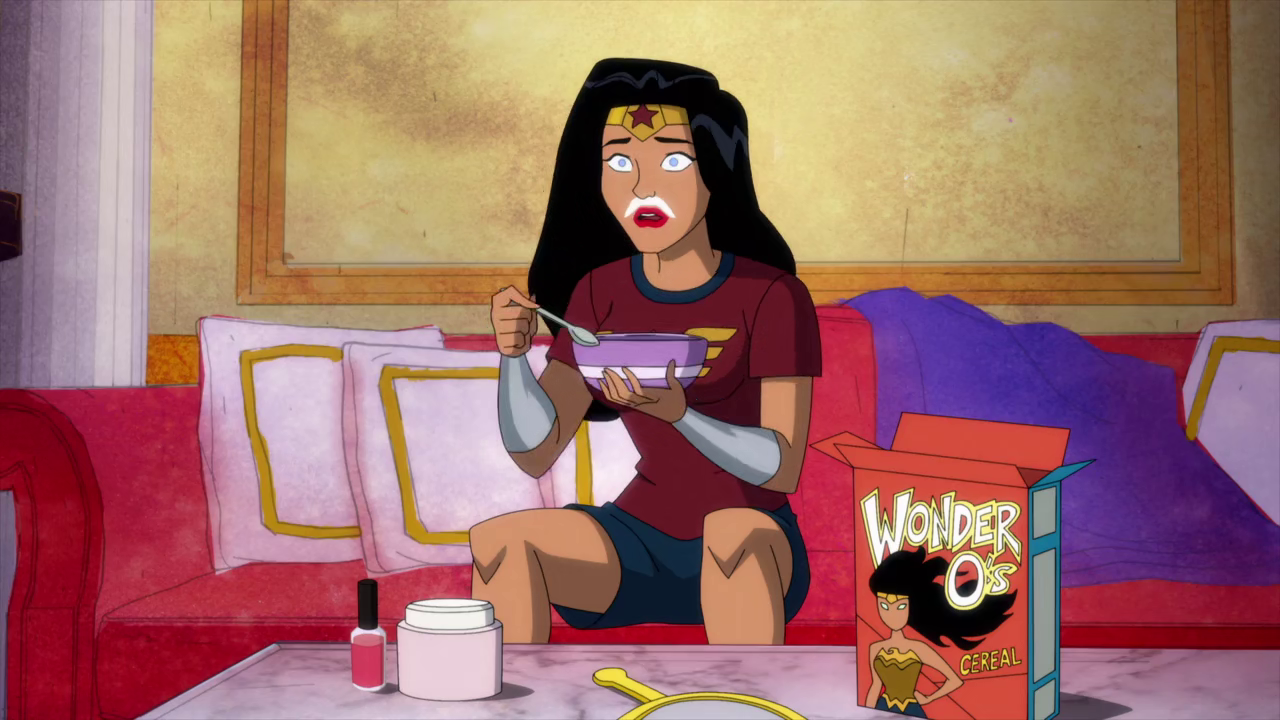
Wonder Woman, eating her own brand of breakfast cereal,
realizing all the ground rules have changed.
This juxtaposition turns an amusing series into a surreal one. What we have is a series which has IP-critical superhero guest cameos— and they basically stand in inhibited silence while a collection of supervillains dance around them, calling them out with ripe curses and sexual innuendo. The decision by DC and Warner Bros. to execute this vision is mystifying.

The other exhilaration that comes from ”Harley Quinn” is how this adult theme remakes every character anew. All the profanity and frank sex talk draws attention to the eroticism that rushes like a deep undercurrent under all superhero stories.The supervillans and superheroes depicted in the blockbuster movies are (mostly) extensions of their juvenile, sexless origins as juvenile, sexless comic-book characters, still hewing to a long-gone 70-year-old Comics Code. Not on “Harley Quinn:” on that show, everyone depicted are People Who Fuck.

People Who Fuck are all around us: it is the normal state of the human race. The great majority of DC and Marvel movies and TV shows still depict their intellectual property as non-existent from the waist down, like Muppets. This is my biggest peeve with the MCU: missing the normalizing dimension as People Who Fuck, for all the significant kisses and long, lingering gazes they’re all just cardboard simulations of real people.

This is the liberating synthesis of “Harley Quinn,” the result of the thesis of comic book characters mixed with the antithesis of real-world People who Fuck. Even though they are set in an unbelievable, unrealistic universe of magic and superpowers, the characters depicted within seem more real than any version of them that came before.

*One of the most confounding things about Adult or R-rated entertainment of late: no problem with profanity and verbally describing sexual situations-- but nudity is increasingly rare. I think, in the case of this show, the influence of the internet is the major deciding factor. If the showrunners ever decided to show Harley Quinn running around with her tits out, every fanboy image server on earth would promptly explode. So that will never happen.

Friday, December 19, 2014

North Korea Now Runs Hollywood

The Sony Pictures hacking and shut-down of the release of The Interview is the first truly successful cyber-attack-- and one of the most remarkable events in media history.

This is not the first time this has happened: In 1976, an extremist group staged an attack in Washington, DC to prevent the release of Mohammad: Messenger of God. They believed (without having seen the film) that Anthony Quinn was playing The Prophet on-screen, a depiction forbidden by Islamic law. He wasn't, of course-- but the premiere got pulled and the movie never recovered.

As a cyber-attack, the timing and roll-out was breathtakingly effective. They got into Sony's system via stolen admin passwords, pulled out every juicy document and let Gawker and TMZ do the rest. Only after the damage was done did the hackers state their intentions: Cancel The Interview, or else. Distributors freaked out and cancelled bookings: Sony was so demoralized by then they just went ahead and pulled it. I would not be surprised that we find out later that there were direct extortion attempts between the hackers and Sony execs even before the leaks started.

All you see of Mohammad in this film
is the end of his camel-driving stick.
This is one long bad event for everyone it has touched: Bad for Sony Pictures and everyone mentioned in every catty email. Bad for Hollywood in general. Bad for free speech. Bad for the US government, which needs to create a proportional response to this attack. It's even bad for North Korea, who did the goddamned thing in the first place-- and will catch hell for it. Point-to-point:

• The behavior of Sony Pictures in this whole episode has been nothing short of completely typical Hollywood: Fearful, herd-following and craven. Obama himself said canceling the release of The Interview was a mistake. Craven-- but not out of character.

The Interview is now fully and officially buried: All press materials and trailers have been withdrawn from public access. The hackers got everything they asked for, and then some. People are calling Sony spineless for caving to an unseen, unknown hacker threat, but really I see no deviation from how Hollywood usually works. As an example, it came to light today that Paramount has ordered the next Star Trek movie reworked to be more like, you know, Guardians of the Galaxy. Yikes.

The socialist-realist style poster for The Interview.
hilarious.
In a perfect world, a world where the brave people stand courageously for their principles (like most of the characters in the comic book movies that are keeping the lights on in most Hollywood studios) Sony would have told the hackers to fuck off, and seen-- as most of us can conclude-- that the threats to moviegoers had no real credibility, and released the film. But even if these feckless execs grew spines, the movie was doomed: Sony does not control distribution. Theater chains have everything to lose and nothing to gain if something bad happens during a screening of The Interview. Imagine if it actually got released-- it would be a field day for every lone dumbshit out there to call in a bomb threat for the sheer fun of it.

• Seth Rogen and James Franco are going to lose most of their shot-calling power for this. They'll still be in movies, but I sincerely doubt if they will have any juice to get anything greenlighted for quite a long time, if ever. All this over a film that early reviews and pre-release reviews called a mediocre and unfunny comedy. It's a shame-- not because they're amazing, magical talents (they aren't) but because the movie that will stunt their careers was so inconsequential.

• This is all and entirely North Korea's doing (maybe with the help of some paid proxies in China, which has experience in such things). But: why do this? Why risk an international incident and retaliation over some dumb comedy with weak prospects? There are two possible reasons:

Scene from The Interview where Kim Jong-un
(Randall Park) gets immolated. quite the laugh riot, no?
1. Western media is easier to access in North Korea than ever. Which means that it is quite possible for the wretched masses toiling under the ruling regime to get a chance to see this film-- a comic take on the assassination of Kim Jong-un. If this regime is in a vulnerable state, even something as frivolous as The Interview could upset the fragile ruling junta.

2. Kim Jong-un, the leader of North Korea who is the target of assassination in this film, is a movie buff. In his youth he would sneak into Japan to go to Disneyland. He knows how powerful movies can be-- and he probably took this film as a sort of personal betrayal.

But why would a sovereign nation even bother to instigate a hack on a private company to specifically force a lame-looking comedy film to go dark?  Because Kim Jong-un isn't Hitler or Stalin or even Mao: He's Tony Soprano. As the late Christopher Hitchens observed, North Korea is run by a "militarized crime family that completely owns both the country and its people." Extortion isn't what nations tend to do-- but it is exactly what gangsters do.

Friday, August 10, 2012

Walden: now on X-Box and PS3

A TPN:BOW Repost, showing that I was getting my curmudgeon on 4 whole years ago! --s
The mass of men lead lives of quiet desperation.

–Henry David Thoreau, from his book Walden, 1854
Quite honestly, I believed the line “quiet desperation” came from this source below. I still think most average English-speaking people of a certain age do as well:

Every year is getting shorter, never seem to find the time

Plans that either come to naught or half a page of scribbled lines

Hanging on in quiet desperation in the English way

The time is gone, the song is over

Thought I’d something more to say

–Roger Waters, from “Time,” by Pink Floyd, 1973
Either way, the aphorism doesn’t apply anymore. Here’s why:

[Quite a while ago, apparently], as my bandmates and I tried like hell to load out of a rehearsal space to make room for the next booked band, the conversation took a philosophical turn. Not the best way to turn a conversation when you’re in a hurry, but that’s the way things go.

We were all being somewhat affected by the changes and vicissitudes of the middle years. We were tallying up various minor maladies we were suffering, recounting the ill fortunes that have befallen the friends and family of all the members of late.

Glen, the quiet, reserved rhythm guitarist, asked, perhaps not all that rhetorically, if this is what the future held for all of us—a series of increasingly unhappy tidings, the eventual closing of life’s doors of opportunity until only one remains.

David, the talented lead singer, brought up the “Quiet Desperation” quote. We all agreed.

Then I thought about it for a bit. We had all just finished damaging our hearing for three solid hours with rock.

What do people in America do to inject some distraction and excitement into their empty lives? They do something cacophanous. This is becoming the Age of Noisy.

• Movies are LOUDER than ever. Almost all multiplexes are equipped with three-thousand-watt, DTS-SDDS-Dolby Digital compatible auditoriums. The average IMAX theater is equipped with 10,000 watts of audio power.

• TV is LOUDER than ever. The HDTV broadcast standard includes 5.1 surround sound.

• Video Games are LOUDER than ever. The gentle “beep-boop” of Colecovision has long yielded to game fare like HALO in its fully 5.1 surround sound capable, subwoofer-shredding glory.

• The Internet is LOUDER than ever. Try to enjoy surfing the web sans computer speakers sometime. [actually, the advent of phone apps may have quieted things down in this area a little-- but not much.]

• The friggin’ WORLD is louder than ever. In my neighborhood, there is a 1:1 correlation between people who rent their dwellings and people who own LOUD gas-powered things. (Noticed I said “people who rent:” People in my area who OWN their dwellings are either too busy working to pay mortgages or too old to be into new-fangled whiz-bangs.) Big shiny motorcycles, just like "American Chopper:" They run them up and down the streets most weekends, not really having anywhere useful to go. They also own those little gas-powered razor scooters, hot-rodded cars, gas-powered RC cars, etc. etc. The outstanding neighborhood annoyance is a guy with a LOUD Harley-compatible bike equipped with a fairing—into which he installed a stereo. So the entire block gets to hear him rev his bike, turn up his now drowned-out stereo, rev his bike again, re-adjust his stereo, and so on and so on. It’s the most foolish thing on two wheels I’ve ever seen, and I’ve been to the circus.

How are we, the citizens of consumer-culture Western society, personally reacting when faced with a quiet moment? Do we take stock, accept the silence as an introspective moment of Eternity visited to our hectic existences? Or do we drown that mother out?

Admittedly, some people do accept and even seek out quiet and solitude, and use this stillness to enrich their soul and accept their place in the Universe. But not enough, not nearly enough– and our own technology has made it far too easy to turn to entertainment to fill the void. Could Walden have been written if Thoreau had DirectTV?
The mass of men lead lives of noisy desperation.

–Skot C.

Friday, April 27, 2012

The Flyover Countries

It's been an interesting 20 hours. Let me preface this by saying that when I go to a forgeign country, which I never do but when I do, I have to spend at least a few hours channel surfing. Televsion in other countries is delightful - exotic and at the same time familiar. Especially the commercials. One of the highlights of my trip to London a couple of years ago was stumbling on a low-tech quiz show called Countdown that made me love the empire all the more. It was parodied later in an episode of The IT Crowd which culminated in a deadly game of street Countdown.

So yesterday when I ran across an item in Gizmodo about a website which streams live television from sources all over the world, I was sucked in. Below, a few mini-anecdotes from my adventures. Understand that it's 8 hours later in Europe, and I started watching around 5:00pm, so it was 2:00am and beyond on the French and British stations. As I write this it's prime time in Europe and I should be watching now instead of writing this, but I'm that dedicated to blogging.

My most important discovery - Direct8 in France, on weeknights, doesn't run infomercials. Oh no. What it runs is this:


A pretty girl, stretched out on a chaise lounge, reading Baudelaire out loud. There can be no thing Frenchier than this.

Informercials were found on ITV 1-4. Basically there were two - for a miracle steam mop and a miracle folding inflatable bed. Want! Also spotted on another French network, a foundation garment, modeled by girls who had absolutely no need for foundation garments. Surprised?

Hart to Hart in French is far better than How I Met Your Mother in Russian.

Why, oh why, can't someone figure out a way to import Later with Jools Holland? It's probably the best music show ever conceived. They tried a version in the 90s with David Sanborn, but it wasn't as manic or insane and you never watched it. No one did.

A lot of channels simply wouldn't load. I was disappointed twice in my effort to watch Countdown. Also the east coast feeds of American channels though I have to admit that I wasn't trying very hard on those.

There is this Just for Men commercial (it's a hair dye product) in which a handsome older guy dyes his hair just enough to be a LITTLE grey. It turned up on one of the British channels, only the guy had a British accent; it seemed more natural. I now think that's the original version and OUR version is dubbed.

Lou Reed still rocks, but he looks like Mildred Natwick.

One of the French channels, at least overnight, simply plays the BBC2 feed in English. Must be for insomniac expats.

I wish I had taken better notes about which channel played that awful video about going to Rio, apparently all night long, over and over again. It's the music-video-about-going-to-Rio channel. Italian maybe?

Tragic Update, 4/30: "This site has been disabled due to DMCA complaints". And so, therefore, have we all.

Wednesday, February 15, 2012

Talking Back to The Screen: the Movie

People can sometimes foster an intense bond with their favorite films, which is what fandom is all about. The question is: What can be done about this intense bond, aside from seeing the film over and over and buying all the action figures and video releases?

The traditional answer was to join a fan club and seek out people who share your interests. Studios love fan clubs-- it's the right kind of adoration, and best of all it supports the ancillary marketing industry.

Still, if you wanted to go further, and you were handy with a camera, you could make a little tribute film (God knows I've made my share). Some of my favorite stories in this area are those of fandom gone seriously overboard: in particular, that kid who built the Enterprise bridge set in his mother's basement-- becoming the perfect 10.0 on the “Trek-O-Meter.”

Perhaps the ultimate fan tribute of all time was pulled off by three kids from Mississippi who took seven years to create their own shot-for-shot adaptation of Raiders of the Lost Ark. Apparently, Steven Spielberg was impressed. Why not? These teeners did it the old-fashioned way: using the movie as a script and painstakingly recreating all the scenes by hand. Gotta admire their gumption-- and since what they made will never cut into the Indiana Jones revenue stream, why not embrace it?

The trend in fandom (or at least film geekdom) we're seeing now is repurposed Hollywood films. It's much, much easier to rip a DVD, re-edit scenes from it, and post the results on YouTube than it is to make Captain Kirk's chair out of plywood or fashion a huge rolling booby-trap boulder out of papier-mache.

 In the early days of this tendency, the results were clever and justifiably famous: The recut of The Shining as “Shine,” a trailer for a romantic comedy, showing not only the deftness of the creator's editing skills but the hollowness of RomCom cliches.
Later that same year (2006) somebody re-edited Mary Poppins as a horror film-- not as clever as the “Shine” trailer, but still effective.
Woefully, it has become too far easy to cut up feature films. It's the “mumble core” effect: more and cheaper ways to make films has not resulted in a flowering of new auteurs, but rather a wave of mediocrity and unreleasable movies. If you want an idea of the current state of things, go to YouTube and type “Hitler on” in the search box. (Of course, in a perfect reversal of this trend, some wiseacre took this overused scene from Downfall (Der Untergang, 2004) and, in Raiders Adaptation fashion, reshot it word-for-word.

What are these innumerable Hitler rants with funny subtitles? Not much more than Talking Over the Movie. It's more or less the same as what those “movie talkers” do, keeping up an imaginary two-way dialog with the big screen. Or what you do, in the privacy of your own home, adding witty commentary to “American Idol.” it is the quickest, least clever, and most immediate reaction one can have to a film or TV show.

But just when I was completely exasperated with the entire deal, my sister turned me onto a new example of a repurposed movie, and a clever and hilarious one at that: “Guy On a Buffalo.” Like “Shine," this is an example of how someone with a good sense of humor and talent-- in this case, Austin-based musical talent-- can take a nearly forgotten drive-in B picture from 1978 and make it into something amazing-- Talking Over the Movie done well.
And how does Hollywood feel about all this? They hate it, of course. It's not as bad as bit-torrenting whole movies or TV series, but it is a basic intellectual property violation. Still, nobody has ever been prosecuted for re-purposing films on YouTube-- so long as there is no profit in it.

In fact, they may be getting into the act themselves, throwing in the towel and joining in. One of the pre-release trailers for Man On a Ledge (2012) features one of it's stars, Elizabeth Banks, talking over a trailer for the film. It seems a bit like DVD commentary, but it's so funny-- and so totally at odds with the action-drama genre of the film she's talking over-- that it's quite clear the studio has given up trying to be serious. If someone is gonna talk over our film, the producers must have reasoned, let it at least be someone with talent, and on our payroll.

Thursday, October 13, 2011

The End of Film

Sometime in 2009, the last professional 35mm motion picture camera was assembled.

The three major camera companies-- Panavision, Aaton and ARRI-- have since been devoted to designing and improving their digital cameras. The 35mm cameras that made them famous are still out there, and they still service them, but to quote Deborah Kaufman on Creative Cow, "someone, somewhere in the world, is now holding the last film camera ever to roll off the line."

Meanwhile, the number of movie theaters screens set up for digital projection surpassed fifty percent of all screens, and they're installing over seven hundred new projectors every month. This is a net gain, I think: the days of scratched prints and out-of-frame shows may be history. But with the exception of IMAX (a 65mm process that grows in popularity every year) film print delivery will eventually become rare, then a sort of historical curiosity. I can see a time not far off when you will have to visit a subsidized rep and revival theatre (a museum screening room, LA's Cinematheque, or the Packard-supported Guild in Palo Alto, for example) to see what a projected 35mm print looks like.

It should surprise nobody that film has been virtually dead in television production for years, but what's weird is how the tipping point came: during the near-shutdown of Hollywood due to the SAG labor dust-up in 2008. TV's move to AFTRA contract players, who had a deal with TV producers so long as the film were made digitally, made film use in TV production vanish overnight.

As far as movies go, we're living in strange times. Sure, the major films shot digitally look a lot like their 35mm predecessors. But the shallow focus and squeezed bokeh of Panavision, the red circles of film halation on point-source lights, the organic grain density of the photochemical process: these are 20th century artifacts, remnants of the analog world.

We're well into the 21st century now, and the precise, pure color of digital cinema is steadily becoming the norm. For filmmakers, this may well be a good thing: 35mm film stock is, and always has been, phenomenally expensive stuff. For the cost of 20 reels of color negative and processing for same, you can go out and buy a RED ONE 4K Digital Cinema camera and capture an unlimited amount of footage at the same resolution.

For film enthusiasts, this progress is sort of a mixed bag. In the days of film, the cost of stock set the lower bar for film production. Film production needed high-level financing, and financing requires return on investment, which requires things like actors, competent lighting, coherent scripts and decent post-production standards. A few years ago the opening up of film markets to zero-budget films spawned the "mumble-core" movement and The Room (D. Tommy Wiseau, 2003). There are thousands of kids out there, energized with all sorts of personal cinematic epiphanies, running their hands over their DSLRs, ready to roll-- and the image resolution at their command rivals any professional camera. Watch out.

On the other hand, It's important to remember that Hollywood is a system: It's stock in trade is slickly made, big-budget creations populated with familiar faces, available to be seen in a darkened auditorium or on a major network near you. This system was created because of the needs of film: To tell a story using the low-sensitivity nitrate stocks of the time, you needed a studio to shine a lot of lights on actors, sets on stages where scenes could be repeated reliably, and access to development labs for workprints. The film studios remain, though the film itself is gone.

Then again: if we can have cars without gas engines and computers without keyboards, we can have film studios without film.

Thursday, September 15, 2011

Hollywood's Immune System

In order to see Contagion comfortably, I chose a late, late showtime: 10:55, the last showtime at the Tanforan 20. From what I'd read about the effectiveness of Steven Soderbergh's new thriller, I wanted at least a few rows of seats between me and the next moviegoer. There were only 8 or so in the auditorium, and nobody was coughing. (but there was, as there always seems to be in late-night movie screenings these days, a couple dragging their toddler-aged kid along.)

Contagion is a very good, very scary film. Soderbergh calls it a horror film, evading the "thriller" tag, and he has a good point. Good horror plays on primal fears-- remember that grotty dude hacking away without covering his mouth at Starbucks last week? Sure you do. That, coupled with the always-unsettling glimpse of the thin veneer of society peeling away at the epidemic's later stages, creates feelings of rising unease as the film progresses. And as it uses Soderburgh's signature multiple-storyline style, you're never quite sure which of the Oscar-caliber ensemble is going to bite the dust next.

Later in the film there are plenty of scenes of National Guard troops in digital camouflage and Hum-Vees keeping roadblocks. This aspect calls back to the discussion about Torchwood: Miracle Day, which covers remarkably similar ground concerning profound social disruption. But here's the thing: the high-concept sci-fi idea of everyone on earth inexplicably granted life everlasting is sort of fun to think about, but the hard-science idea of an unstoppable virus wiping out millions is not only depressing and scary to ponder, less than 100 years ago something very similar actually happened.

Aside from the micron-sized and therefore un-telegenic virus, there's a human villain in this piece: Alan Krumweide (Jude Law), a crummy, weedy fellow who sows fear and misinformation and false hope in alternative medicine cures through his blog. In a film that focuses on the selfless efforts of government scientist to save lives (a la Outbreak and The Andromeda Strain) he represents the conspiracy nuts, the anti-vaccine moms-- the whole, weird anti-science know-nothing movement that seems to depressingly be steadily gaining traction in larger society.

But I think there's something more subtle going on here. This is at least the second major feature film which paints a harsh picture of the internet in general and social networking specifically. Recall the tone of The Social Network, a film that exposes Facebook's roots as a crude sexist college diversion and it's founders as litigious snobs or prickly sociopaths. And in Contagion, it's made clear that everything would be going so much better for humanity in general if it were not for some nutty blogger from San Francisco (surprise: Hollywood yet again portrays the Bay Area as a scenic loony bin).

And why shouldn't establishment Hollywood view the Internet in the worst possible light? As far as the studios are concerned, it's a disease.

I think such negative depictions of internet culture in major movies are a sign of Hollywood's immune system going into overdrive. Even now, there is little the internet and social networking can do to help studios sell tickets: viral hits like Paranormal Activity and The Blair Witch Project are so rare they've become cautionary tales (as in: never mention either of them when you're pitching a script). In realpolitik, internet film marketing is just another money-suck for which studios are obliged to staff buildings full of web designers and marketers to create feckless web presences for their movies.

The internet has come to represent nothing less than a full attack on Hollywood, a galloping infection that attacks both control of product and the bottom line. The studio buys a script, and they have to make sure it doesn't get uploaded somewhere. Greenlight, and there are even more potential leaks. Outright piracy begins generally at the first pre-screenings right through general release, eating away box-office as effectively as a blood-borne parasite eats red blood cells. As whole films fall into bit-torrent oblivion, snippets of their films get cut out and put on YouTube or Daily Motion and there's little to be done about that either. Finally, even the home video market and it's tidy widget-style sales model is being sapped by streaming services, offering the same film for a fraction of the cost of a DVD or BluRay version.
As falling revenues draws the industry into existential crisis, we're seeing it's immune system deploy T-cells and leukocytes, out to destroy the malignancy. Expect to see more.

Once upon a time, internet culture as depicted by Hollywood was a rich source of pseudo-high-tech, blatantly unbelievable tropes: "I'll have to hack their IP with a custom-written worm to access their triple-encrypted password. And… there it is!" Remember Hackers (1995) with Angeline Jolie as "Acid Burn" and Jonny Lee Miller as "Crash Override?" Hoo-boy. But that was then: the era of that sort of fun-loving naivete is over.

Friday, February 11, 2011

When Movie Screens Ran Red (With Ink)

And just to bookend Daniel's post about the most profitable films of all time, CNBC posted a slideshow of the 15 biggest box-office bombs of all time. Being CNBC, these are the ones that represented the highest loss per investment, as opposed to artistic failures or low-budget bombs-- which is good, because that would be one long, long slideshow.

Three of these films were so financially disastrous they brought down the studios that made them. Square Pictures, associated with the video game company of the same name, was brought low by Final Fantasy (2001) and a fundamental misunderstanding of the uncanny valley. The venerable Carolco shingle (who brought us the Terminator movies) was undone by Cutthroat Island (1995), Renny Harland's pirate-themed love letter to his then-wife Geena Davis. And United Artists Pictures, which was founded by Charlie Chaplin and co. in the early silent era, was destroyed by the failure of the infamous Heaven's Gate (1980).

For reasons that are either obvious or fortuitous, I've only seen two of these films, Soldier and Speed Racer. I'm quite surprised Soldier cost so much money, as it appeared to have been shot entirely in a junkyard. On the other hand, every single CGI-related penny they spent on Speed Racer us up there on the screen, in eye-smarting color and action sequences so incoherently blurry and fast it overwhelmed my cable connection-- the physics-defying car races fractured on my HD flatscreen into data-failure macroblocks.

Crazy, risky business, movies. Thank god.

Monday, February 7, 2011

Orientation

So here are the highlights of MY Sunday.

1. Farmer's Market in Long Beach - bought a couple of Bacon Avocados and a bison steak.

2. Helped my girlfriend escape from the onorous yoke of Comcast by fixin' up her roof antenna.

3. Not watching the Superbowl, except to test reception.

LH (said girlfriend) has been on Comcast since she moved in to her place last year, and she got one of those bundles where they provide cable and internet service for a low introductory rate. And since she doesn't watch a lot of TV she got the absolute minium of cable possible - local channels, public access, weather, the Learning Channel and Classic Arts Showcase. And even though she has a 32 inch 1080i TV, her cable box was only providing standard def. She'd come over to my place and see glorious Hi-Def images pulled out of the ether for nothin' and she decided it worth the cost of 3 months of service to buy a good roof antenna and get it installed. However, the guy who put it up there just basically stuck it in a hole and left.

The thing is, lugging the thing up a ladder and putting it a hole nowadays is the hardest part. My job was easy as hell, even easier because I have what those guys in the sixties didn't; an iphone. (I also needed a monkey wrench and screwdriver, but that's details). But the most important thing you need when you're setting up an antenna is which way to point it, and putting this into your browser is almost the whole battle. You tell it where you are, it tells you where the signals are. As it happens, in Los Angeles County almost all the TV worth seeing comes from Mount Wilson, so you don't have to choose which stations you'd rather see. The whole package is right there.

From my apartment, Mount Wilson is 76-78 degrees off magnetic north. If I were setting up the antenna there, I'd take the iPhone up to the roof, use the compass, and point the antenna that way. And I'm thinking of trying to get permission to do that, because now my girlfriend gets better reception than I do. In fact, terrestrial HD is a better quality than cable or satellite HD because those guys take the terrestrial signal and recompress it before they send it to you. If you have multiple inputs on your HDTV (you do, trust me) consider hooking up an antenna for the local channels.

Tonight I think I'll enjoy House in pristeen HD while eating my bison steak. By the way, who won?

Wednesday, December 8, 2010

Or, You Could Get 2000 People To Pay You $10 Apiece

How much do you dislike crowds? Do you really hate driving 5 miles to the mall to see a first run movie? Good news!

A proposed service aims to bring movies to homes the same day they hit theaters, a milestone that Hollywood has long anticipated with a mixture of fear and fascination.

But there's a catch: At the prices currently being discussed by Prima Cinema Inc., the start-up that is touting the service, those movies will reach only world's the best-appointed living rooms.

Prima plans to charge customers a one-time fee of about $20,000 for a digital-delivery system and an additional $500 per film. The Los Angeles-based company has around $5 million in backing from the venture arm of Best Buy Co. and General Electric Co.'s Universal Pictures, and hopes to start delivering movies to customers as soon as a year from now.
Ironically the only people who could afford this service would be studio executives, who can write it off as a business expense. Hard as it is to believe, people believe this is a workable business model.

The steep price has been met with mixed reactions in Hollywood. Some executives question whether it will be possible to build a market beyond a few thousand users. (Prima says it plans to install its systems in 250,000 homes within five years.) Others say the high price would create an exclusive, super-premium niche market without cutting into existing sources of revenue.

"While this is a niche market, there is a chance for significant upside," says Adam Fogelson, chairman of Universal Pictures, which holds a minority stake in Prima. "And precisely because it is a niche market, that upside should come without harming any of our existing partners or revenue streams."

...The president of the National Association of Theatre Owners John Fithian, who was briefed on Prima, says the exhibitors reaction to Prima's model would "be decided on an individual company basis." Still, he says, most exhibitors aren't in favor of systems that impinge on movie-going.

The Prima model "makes very little sense as it risks millions to make pennies" by exposing movies to the possibility of piracy early on, Mr. Fithian says. "There is no such thing as a secure distribution to the home," he adds, noting, "This proposal will give pirates a pristine digital copy early, resulting in millions of lost revenue to piracy, while at the same time selling a very limited number of units. Only billionaires can afford $500 per movie."

..."It's clear that there is a big white space between the theatrical and DVD releases of movies that content companies can fill without cannibalizing folks on either side of the spectrum," Sony Corp. of America Chief Financial Officer Robert Wiesenthal said at a media-business conference in New York Tuesday. "There's a real consumer desire for an early, premium offering in the home."
A big white space! I see an increase in home-invasion incidents from people who can't get into a sold-out theatre but CAN break a few windows. And on their way out, they'll steal bread to feed their starving children.

Thursday, July 15, 2010

Free Summer Movie Of The Week

I'm going to make this a regular feature if I can remember to. Today's free download: Zontar - Thing From Venus.

Starring John Agar, Zontar is a remake of an only slightly better movie called It Conquered the World. It's the product of Larry Buchanan's Azalea Films, an ultra-low-budget offshoot of AIP which apparently existed to remake black and white properties in color, because color TV was booming then. Other Azalea Films are Mars Needs Women, The Eye Creatures, and Creature of Destructions.

It's free because it was more money and trouble to renew the copywrite than maintain it. I won't tell you how (I can't) but you are welcome to download this movie, burn it on to a DVD and watch it. I think you can even try to sell it to someone else and the MPAA is okay with that.

As you might expect, it's hilarious.

Tuesday, July 6, 2010

Quote of the Day

"The internet's like MTV. At one time MTV was hip and suddenly it became outdated. Anyway, all these computers and digital gadgets are no good.

"They just fill your head with numbers and that can't be good for you."
-Prince (h/t Gizmodo)

Friday, June 11, 2010

TV Tech in Fast Refresh Mode

Daniel is apparently dead to us. He is flat on his back, watching vivid imagery on his new 240 Hz flatscreen. He says he screwed his back up: I guess we 'll take it it on faith, for he is a most reliable narrator.

The point of this article is an expansion of an earlier comment concerning the inevitable march of entertainment technology. the new high-refresh-rate HDTVs are gaining popularity, but I don't think the general public (or people who think about these things) has really grasped just how important a milestone they represent. In our gadget-centric world, a 120 or 240 Hz TV seems like just another incremental brand improvement, like the a G4 iPhone or a faster Xbox. but I think it's going to prove to be one of the more significant innovations in recent entertainment tech.

Since the invention of moving picture images 114 years ago, the technology of presenting entertainment has been in a state of constant innovation to a single purpose: to create a medium that is as fully immersive as, and indistinguishable from, reality. The first was 35mm film, which for it's first 40-odd years was restrained by photochemical technology (silver halogen emulsion creating black-and-white images) mechanical tolerances (18 frames per second was as fast as hand-cranked cameras could go) and optical limitations (spherical lenses, which needed a frame as close to round as possible to create a sharp image). These limitations did not stop inventors from adding sync sound as quickly as the technology would allow. The frame rate went up to 24, which, again, was a fast as late-20s cameras could run film without flying apart.

Color, which was in experimental mode for decades, was implemented well before it was affordable or practical, recording on 3-strip cameras with beam splitters. Eastman negative film, the first truly practical color film stock, wasn't made available until 1950, which is an indication of just how difficult it was to perfect.

Television came along, with it's crummy low-res image. But what it offered was something movies could not: immediacy. No tickets, no leaving the house: the entertainment came to you. After TV, it all became a race: Color TV, 3D, Stereo audio, CinemaScope, IMAX, Surround Sound, HD. These innovations were all an effort to create a medium that removed the impediment of it's own technological limitations from the viewing experience.

And now we're seeing the two mediums, Film and TV, merge: a 1080 image has nearly all the visual information of a 35mm film frame. Digital Cinema 2K and HD in 1080 24p are almost the same resolution: I can shoot it with my Canon T2i!

But new high-refresh-rate HD monitors address this ongoing rush to reality-perfect imagery in a new way: by increasing the frame rate to a point where persistence of vision becomes purely internal. Video, with it's 60hz interlaced image, has always been more "vivid" than 24 frames-per-second film: now the image processors in high-frequency TVs can take any source at any frame rate, interpolate new in-between frames, and ratchet up the display rate to a point where pretty much anything looks startlingly real.

Remember that "Hertz" is a measure of frequency per second. These new TVs (like Daniel's) display a mind-blowing 240 frames per second. This is ten times faster than motion picture film. Even a state-of-the-art Panavision 35mm camera would explode if it were run this fast, and top recording speed of a Red One Digital camera is 120 fps. This is so fast the screen surface itself vanishes, and the perception of the image on it becomes amazingly vivid. The "frame rate" of human visual perception-- the speed at which imagery is processed in the retina and visual cortex-- is met, and maybe even exceeded, with a fast-rate HDTV. In other words, if you sit close enough to the screen, you're there.

3D is the final hurdle. And I think, current movie-going trends notwithstanding, as long as 3D require the viewer wear big dumb-looking glasses it'll be as much a novelty as it was in the Creature of the Black Lagoon era. And novelties are, by definition, not practical.

Wednesday, February 24, 2010

The Return Of The Fox

After almost a year of silence, FoxTV has returned to the broadcast airwaves in my neighborhood. You may recall it (and MyTV, LA channel 13) vanished the day of the digital switchover last year. I was reduced to watching House via bittorrent. To add insult to injury, I recently got a cease and decist letter from Universal Television demaning I delete all my episodes of the free show. Come to think of that, that's a blog post right there. Memo to self.

Anyway, this weekend I was swinging around the dial and there was FoxTV! Sure it was an anamorphically squeezed SD signal encoded as channel 13.3 instead of 11.1 - who knows how long this will last before they stop fooling around and shut it off? - but it's nice to see the Simpsons again.

By the way, why is Til Death still on? Does anyone really watch that show, or is some kind of money-laundering scheme like According to Jim?

Monday, November 9, 2009

Not The Beatles, But An Incredible Psycho-Acoustic Simulation


The quaint anachronistic battle to make Beatles songs available online legally (as opposed to the way I got them - all of them) has been dealt another blow in the last few days, as Bluebeat.com has been stopped from distributing songs for a quarter apiece.

Bluebeat's owner, Hank Risan, has claimed he does not need to license the music as the service is selling re-recorded versions of the songs using a technology called "psycho-acoustic simulation".

He argues it enables him to sell music that sounds identical to recordings, making it exempt under a section of the Copyright Act which applies to recordings that "imitate or simulate those in the copyrighted sound recording".
As utterly convincing as this technical argument is, it hasn't been enough to stop the injunction. The Beatles are offline again until November 20th, when lawyers from both sides will attempt to bamboozle a judge into seeing their point of view. Meanwhile, the Fab Four are losing money by not participating in the paid download arena. Not that they (the corporate entity which represents the Beatles, obviously) need the money.

Tuesday, September 22, 2009

Forced Into a Life Of Crime

As of last night, the rubber hit the road, DTV-wise. Readers may recall that I live alone and watch little television, therefore I refuse to pay for cable. I see it as the equivalent of buying 8 movies tickets a month and only going out to see one matinee.

However, there is one show I am still hooked on and that's Fox's House. Maybe it's the thrill of seeing Sherlock Holmes Americanized and turned back into a doctor, just like the guy he was based on; maybe it's the wish fulfillment. I want to be an insufferable jerk who everybody tolerates because he's always right. I'm halfway there now, except for the people tolerating me part.

Problem is the switch in early summer to digital transmission knocked a couple of channels off my lineup. I can watch Telemundo and Korean sitcoms in crystal clarity, but I ain't got no FoxTV. So broadcast House is out.

This leaves with two options, and I'm taking the illegal one. I can watch House on Hulu but the quality is poor and no matter when I choose to view it, I'm at the mercy of Hulu's servers and tricky bandwidth. I also can't watch the show live, but then it's not really live when it airs either. Hulu in my place is at least viewable on the real television instead of a computer monitor, but let's be realistic and admit that the only difference is the TV is bigger.

Other option? The industry-despised Bittorrent. In this system, you wait an hour after the show airs, fire up the client (mine is Vuze) and it starts grabbing pieces of House from a swarm of other users. The more popular it is, the quicker it comes. This is why I woke up this morning with a complete 720p copy of the two-hour season premiere, yet I've been waiting for two weeks to get THE BEST OF THE FREE DESIGN, an album by a group who made the Partridge Family sound like the Fuggs.

My point here is that the industry is making it difficult for me to get their a-list property legally, while their sad, unsalable back-catalog items are what I'll probably end up paying for. What kind of business model is that? Let's fix that, mmm? I want to come in from the cold.

Monday, August 31, 2009

Disaster Threatens My Entertainment Options

Attention terrorists: did you know that most broadcasting towers in the Los Angeles area are located high atop Mt. Wilson? Which is, at the moment, on fire?


The "Station fire" had already consumed 42,500 acres of the Angeles National Forest, destroyed at least 18 homes and led to the death of two firefighters. Attention then turned to Mt. Wilson, where a historic observatory stands -- as well as the transmitting towers for the majority of Los Angeles' TV stations.

A Los Angeles County Fire Department spokesperson told KCAL-TV that fire retardant had been spread around the transmission equipment and that brush had been cleared around the area -- but he expected fire to nonetheless hit the site in the near future.

"There's nothing we can do to stop that fire from going up Mt. Wilson," he told the station.

Every major L.A. TV station transmits from Mt. Wilson.

Stations advised viewers that they may lose their over-the-air signal, and noted that most cable and satellite customers would still continue to receive the stations (which are fed directly to those services rather than over the air).
So again, the guy without the cable is gettin' screwed. *Sigh* Time to fire up Hulu!

By the way note to my Mom, who always assumes when she reads about stuff like this that I might be on fire - it's thirty miles away, mom.