Showing posts with label nostalgia. Show all posts

Friday, July 3, 2020

Falling Down: D-Fens Quixote

An image from the incredible opening shot. The camera starts on
Michael Douglas' lips, flies out of his car, allaround it, and settles on
him again. This was before computer graphics made this easy.

A recent re-watching of the 1993 Joel Schumacher film Falling Down (it was a homework assignment) turned up a number of fascinating elements— some of them unadulterated 1990s values, some modern re-evaluations, and at least one new definition. Falling Down, it turns out,  is a lot of different things.

Synopsis. William Foster, recently fired from his aerospace job, walks away from his car in a Los Angeles traffic jam. He embarks on a city-spanning adventure: he is trying to get to Venice for his daughter’s birthday party, despite the fact his ex-wife has a restraining order against him. What follows is a series of obstacles to his goal, all challenges to his worldview, one that is fading away. While he is being pursued by Detective Prendergast (Robert Duvall) the protagonist’s quest becomes a path of increasing violence and destruction across the city.

Parable of White Victimization. Time has not been kind to many of this film’s themes. The most obvious one, the one pursued in the press at the time: D-Fens was a “latter-day prophet, denouncing the hypocrisy of our times.” White men were losing ground in an ever-more-diverse America. At the time, when Hollywood and popular culture was basically white men as well, this crisis was internalized.

The staff of Whammyburger, being told they make a lousy product
by a man waving a TEC-9 around. Dede Pfeiffer (center) is the
completely unflappable counter girl. She's a hoot.
D-Fens establishes his “everyman” credentials by constantly questioning things many people at the time questioned as well. Those questions start out picayune: Why does a can of Coke cost 85 cents? Why doesn’t Whammyburger serve breakfast past 11:30? Why can’t I just sit here and catch my breath?

Vignettes are sprinkled throughout the film that reinforce his “angry white man” perspective. Urban decay. Police harassment. A homeless white guy holding a begging sign, next to industrious Latino men selling goods on the street.

Beth (Barbara Hershey) realizing she may have had a hand
in the victimization of a 1990s American white male--
the least victimized sort of person there is.
Later, his questioning veers into more sweeping social criticism. While cutting across a golf course, D-Fens wonders why the vast green space isn’t open to the public. He later hides in the pool house of an immense mansion, and finds out (via a family of poor tenants) that it is owned by a plastic surgeon. At the time, these observations struck close to home: Was D-Fens a victim?

The film went a bit further than that to indemnify William Foster as a victim of his times. When the police interview his ex-wife Beth (Barbara Hershey) she admits her reasons for placing restraining order on him were spurious. He had a temper, but he didn’t drink and never struck her or her daughter, and the judge who set the order “wanted to make an example of him.” As the interview progresses she looks increasingly distressed and embarrassed.

Joel Shumacher and screenwriter Ebbe Roe Smith crafted Falling Down to channel “White Male Paranoia.” The reason the image of Michael Douglas — buzz cut, broken horn rims— made the cover of Newsweek is this film successfully captured a moment in history. After the fall of the Berlin Wall and the breakup of the Soviet Union, George Bush scaled back defense spending on a massive scale. Military installations were closed. Aerospace companies like Grumman and Lockheed closed down facilities all over the United States: Southern California was hit hard. William Foster’s job is obviously part of this loss, part of the USA’s military-industrial contraction as the cold-war era was coming to an end. To the people who ran the show back then— middle-class white men— they saw it as something that was happening to them, and they were the victims.

(As an aside, my mom worked for Lockheed for 30+ years, and I was an eyewitness to the post-cold-war wave of defense industry layoffs. It was as bad as it came off in the film, and it didn't just affect white men.)

D-Fens as Anti-Antihero. This is not just wordplay for a villain: it’s the best way to describe him. A character can be categorized by two criteria: deeds and thoughts.

A HERO is a character who does heroic deeds and embodies heroic qualities. Captain America, Indiana Jones, Obi-Wan Kenobi, Joan of Arc, Robin Hood: all embodiments of positive values and behaviors.

An ANTIHERO is a character who does heroic deeds but does not embody heroic qualities. Tom Jones, Tristam Shandy, Deadpool, “Mad” Max Rocketanski, Rick Blaine and the nameless protagonists of Sergio Leone’s and Akira Kurosawa’s films fit this description. They do not obey any rules of lawful conduct, are often transgressive or violent, but in the end their acts resolve into a greater good.


A VILLAIN is a character without redeeming qualities, who actively oppose the efforts of heroes and the greater good. Darth Vader, Sauron, Noah Cross, Norman Bates, The Wicked Witch: all are engaged in selfish ends that will cause great harm if they succeed.

But William “D-Fens” Foster is something else. He is a regular man, down on his luck and emotionally unstable, but not extraordinary in any way. Throughout the film he voices reasonable opinions, social commentary about the crumbling world around him. His goals are not intrinsically villainous: he merely wants to go home, and is forced by all manner of extraordinary obstacles to adapt ever more violent methods to achieve his goal.

D-Fens does not aspire to heroic status. He merely wants simple, basic needs filled: change for the phone, breakfast, a moment to rest in a vacant lot. These simple goals are always thwarted— so as the film progresses he cares less and less about behaving in a lawful manner. In his eyes, all he sees are forms of injustice, large and small: overpriced soda, gang territoriality, pointless road closures, obnoxious golfers. In his eyes it’s all injustice against him and the world he comes from.

But in the end, when Prendergast pulls a gun on him on Venice Pier, D-Fens looks at all he has wrought— family running, police clearing the area— and finally comes to the realization that according to the rules of the world he now lives in, he is the bad guy.

"I'm the bad guy?"
He is an ANTI-ANTIHERO: A character who understands morality and justice, but is incapable of any form of heroic action, and in the end acts against the greater good. The anti-antihero is distinct from the antihero by their mindset: they believe their goals are for good and believe are working toward the good, but are blind to the destructive nature of their actions and in the end do no good at all.

Michael Corleone was a decent example of an anti-antihero: he wanted to do good, become legitimate, but in the end (of Godfather 2, at least) was incapable of saving his family or himself.  Perhaps the all-time greatest anti-antihero ever created was Walter White. Every move he made was designed to get himself out of a bad situation (poverty, disease, anonymity, humiliation). By the end he ends up destroying everything he loves. Viewers of “Breaking Bad” rooted for him every week, because he was a likable, normal guy with relatable problems. Every week he slipped further and further away, to a place where there was nothing left but violence and revenge.

The Episodic Journey. Jim Bisso pegged Falling Down precisely: it’s Don Quixote, Western literature first modern novel, and it pulls two elements from Miguel de Cervantes’s 17th-century work. In form, both center on a wandering protagonist in a series of disconnected encounters. Don Quixote also shares an important trait with D-Fens: both are delusional. Quixote overdosed on tales of chivalry from the past and has come to believe they are quite real. D-Fens is also obsessed with a past where he was the hero of the American narrative.

The difference is in the final details: Don Quixote’s quest takes years and in the end he recovers from his delusions. D-Fens's wanderings take place over the span of one day, his violence and delusions only get worse, and in the end is killed via “suicide-by-cop.*”

1993 vs. 2020. D-Fens is not some sort of MAGA prototype: He was a product of mid-century values who is finally being forced to deal head-on with the reality of the post-Cold War world. He looks like the sort of gun-toting bigot we see on the news in 2020, but he isn't.


In one episode D-Fens stops to buy his daughter a gift— and watches black man picketing a bank across the street. His sign says “Not Economically Viable.” The man is shouting that he was denied a loan due to the color of his skin. He is then arrested and taken away. D-Fens sympathizes with him, even going as far as repeating the sign’s slogan.

Later D-Fens is sheltered from the police by Nick (Frederick Forrest), the deeply bigoted, racial-slur-slinging military surplus store owner. Nick admires D-Fens's violent spree and exclaims “I’m with you! we’re the same!” Nick shows D-Fens some Nazi artifacts and gives him a LAW rocket launcher (talk about Chekov’s gun!). But D-Fens is repelled by Nick’s white supremacy. D-Fens ends up stabbing Nick to death to prevent his likely rape— which informs the trope that virulent homophobes are latent homosexuals.

It may be a 1993 cultural assumption at play here, but William Foster is not a white supremacist, He is not comfortable in multicultural America, and is clearly nostalgic for the days of unquestioned white hegemony before the 1990s, but racism is never his core motive.

We can look at Falling Down in 2020 and see D-Fens as the unsprouted seed of the MAGA mindset. It would take 20 years of union-busting, opioid addiction, corporate offshoring, a drastic loss of economic status and constant watering by conservative news for this seed to bear the fruit we see sprouting everywhere today.

* Japanese literature and cinema feature a “Ronin Character.” This is an antihero protagonist who, when freed of the considerable restraints of society, openly criticizes and challenges the status quo. But the cost for such freedom is always the same: they die by the end. Falling Down fits into this concept well.

(h/t to John for the title.)

Tuesday, October 8, 2019

JOKER: Nihilism With a Purpose

How fascinating was Todd Phillips' Joker? I didn’t even realize until it was over that the movie was in 1.85:1, traditional spherical widescreen. We’re in an era where almost every theatrical film, tiny indie or major studio release, is in 2.39 ‘scope. It was presented in the period-correct aspect ratio, and the period-correct film washed over me so thoroughly I didn’t even see the frame— and I ALWAYS see the frame.

Controversy swirls around Joker like the cloud of delusions that define Arthur Fleck (Joaquin Phoenix), the movie’s antihero. we’ll get to that later, but first an appreciation of the film’s star. Phoenix was given a lot to work with here and he delivers. In truth, he over-delivers: his character is mentally ill and unknowable and his performance never deviates from this condition. This lends his story and the larger story of Joker a disjointed, alienated feel.

Arthur is a clown-for-hire who aspires to be a stand-up comedian, except his illness leaves him basically without a sense of humor. Inappropriate laughter is his illness’s major symptom: we see him in a comedy club, trying very hard to understand how comedy works, writing notes and laughing at the set-ups, not the punchlines. And his laugh is not a chilling villain’s cackle: it’s a strangled, involuntary reflex he cannot control.

Joker is set in a realistic version of a fictional past: Gotham, the East Coast city from the Batman franchise, in the late 1970s or early 1980s. It has the look and feel of the gritty “New Hollywood” films shot in New York or Philadelphia at the time: trash in the streets, tagged up subway cars, theaters downtown devoted to pornography, and there is not a computer or cellphone in sight. You will think Todd Phillips is emulating Martin Scorsese’s Taxi Driver (1976) to an extreme degree, and you‘d be right. But I’ll argue it’s worth it: the art direction, locations, sets and costumes are worth the price of admission by themselves. The attention to detail is remarkable and thorough. Joker only betrays its 21st-Century origins in the beauty of the images (Shot on an Arri Alexa 65) and the smoothness of camera movement (they have all sorts of magical tech gizmos to facilitate that). Back in the bad old days filmmakers like Scorsese and Melvin Van Peebles and Joseph Sargent and Gordon Parks had to make do with Arriflex IIc cameras loaded with grainy, pushed 35mm film, wooden sticks and Lowell incandescent lights.

Gordon parks, making do with an Arri IIc.
In my opinion Joker could have dispensed entirely with the entire DC Batman mythology. The film did not need it, and it added nothing to the core of what is essentially a psychological thriller. In fact, the baggage of the Joker mythology creates an ethical issue: we know that Joker will become a master criminal and an unrepentant, cold-blooded murderer: this aspect is part and parcel of Joker’s DC persona. But remove Arthur Fleck’s known fate to be a villain, and it becomes the story of one man’s mental disintegration during an era where isolation and alienation were practically the norm.

Martin Scorsese, behind a soundproofed Mitchell NCR.
It’s not a perfect film and it is not that easy to watch: Arthur Fleck is set up as a victim for most of it, and we see him on the ground getting his ass kicked twice. The first half of the film is set-up, and we see things in Arthur’s life, which started out bad, just get worse. The very conditions of urban life in the late 1970s are the antagonist here: Budget cut-backs eliminate Arthur’s weekly visits to a social worker and access to medication to keep his illness in check. He lives in a hideous apartment with his declining mother (Frances Conroy) in a neighborhood overflowing with trash. Adding humiliation to alienation, Arthur’s attempt at stand-up comedy is mocked by a late-night talk-show host (Robert De Niro, playing Jerry Lewis from The King of Comedy). His character is clearly being pushed towards a break with normality, and when it comes the only thing surprising about it is how gory it is.

Joaquin Phoenix, before an Arri Alexa 65.
It also makes Arthur Fleck’s eventual transformation into the Joker problematic. The film explains him away: he is the product of bad genes, a terrible childhood, an even more terrible environment, and horribly complete social isolation. This was the thrust of most of his comic-book origin stories as well: in the famous graphic novel “The Killing Joke,” The Joker is the result of one normal man after one very bad day.

At the point in the story where Arthur Fleck eventually snaps, everything in the film has been placed to make his move to villainy sympathetic. This makes Joker an exercise in pure cinematic nihilism: it’s a director deciding make a murderous villain his movie’s hero. And this is where the film goes from compelling but flawed to brilliant, because Joaquin Phoenix’s performance is the counterbalance to Todd Phillips’ nihilism. He portrays Arthur Fleck as disjointed and mercurial: his moods change from scene to scene, from somewhat sympathetic to completely alien. He leaves the audience with nothing to grab on to, which is the point. As much as the film tries to set up the origins of Joker as pitiable, Joaquin Phoenix pushes back, making sure you don’t feel shit for the guy. It is rare these days to see the an actor-versus-director dynamic play out onscreen, but that’s what we get here.

The “tell” of Joker— the element Todd Phillips and co-writer Steve Silver steered away from DC canon to stake out new narrative territory– is the portrayal of Bruce Wayne’s father, industrialist Thomas Wayne (an almost unrecognizable Brett Cullen). In the comics he is the just, benign father-figure of young Bruce, whose strong ethical sense set Bruce on the path to be a superhero. But in Joker he is a grasping, bloated capitalist who literally sneers at the poor: “Those of us who have accomplished something with our lives will always look down on those who have not as clowns.” Thomas Wayne's statement sparks deep resentment among Gotham’s beaten-down residents, and starts a clown-themed anti-establishment movement— not too far off from the Guy Fawkes thing from V for Vendetta— to topple the rich of the city.

And that is what makes Joker timely. Set in the 1970s, it nonetheless completely understands the cruelty of inequality in our time, and the fact that a society without empathy breeds monsters.

Friday, August 9, 2019

Tarantino the Nostalgic Unreliable Narrator

I went into Once Upon a Time in Hollywood expecting not to like it that much: he burned me very badly with his cute switcheroo act with The Hateful Eight, a film he touted as an epic widescreen roadshow movie but turned out to be a blood-drenched, claustrophobic indie film that had no earthly reason to be in Ultra Panavision 70.

But after thinking about it for a while afterward, I have a grudging respect for this film. Once Upon a Time is built around an original story, unusual for him: its not a pastiche or an homage or a dully executed re-make of some cheap exploitation film. It’s really him, talking directly to us and not through some faux-junk, schlocky exploitation genre— and God damn it if that isn’t refreshing. Quentin succeeds at his primary goal here: creating an alternate universe version of Los Angeles in 1969. He did a splendid job of it. The dialog is crisp, mostly lacking the big gobs of “Tarantino-speak” that bogged down earlier efforts, and the acting snaps as well. It’s a longish film, and his obsession with the trappings of the past often overwhelms his story, but more worth your time than any of his films since Jackie Brown.

On to the notes!

Nostalgia: Once Upon a Time drowns in nostalgia, aching and wistful and angry at the passage of time that erased the treasures lovingly displayed onscreen. Quentin Tarantino is a filmmaker driven by desires— obscure action cinema, violence, glib dialogue, women’s bare feet. But this time his desire is the past. His past, a past he has said was the favorite time of his childhood.

Once Upon a Time is Quentin the video-store clerk and kid who grew up in LA in the 1960s and 1970s, finally brought to his fullest. It’s a wishlist of everything he ever wanted to do in a movie as a kid, pattered out in his characteristic staccato: he wants to be a TV western star (Quentin Tarantino was named after Burt Reynold’s character in “Gunsmoke”). He wants to beat up Bruce Lee. He wants to change Hollywood history (more later). He wants to set an LP needle down right on the gap before his favorite song (this happens several times) and hear the KHJ and KFWB jingles ring out over an AM car radio again. He wants to make a movie with Steve McQueen and Michelle Phillips and Sharon Tate. He wants all he knew and saw and loved as a child returned to him.*

But most of all, he wants to go home to the past. You can feel it: his longing reaches right out of the frame. It’s all there in broad strokes: late 60s Hollywood Boulevard lovingly recreated; classic, unchanged locales like Musso and Frank and El Coyote visited. There’s a montage near the end of the film that gave one of the biggest thrills of the movie: night falls and long-gone business facades light up. There’s an old Der Weinerschnitzel, a Mission-style Taco Bell, The Cinerama Dome restored to its Pacific Theaters glory.

Tarantino is one year younger than I am, and I spent some time in LA around this time as well— down in sleepy suburban Lynwood rather than Hollywood, but I know these sights, the look and feel of the era. I’ll admit one of the strongest reactions I had to Once Upon a Time in Hollywood was a strong desire to move into this film. I didn’t want to leave. I’m not sure if 1969 was a better world than 2017, but the version he showed us was simpler, shinier, and undeniably beautiful.

Two-person, one-character protagonist: washed-up star Rick Dalton (Leonardo DiCaprio) and his stunt-double/dogsbody Cliff Booth (Brad Pitt) are the inseparable pair at the center of the film. They make a very big deal out of the fact that Rick can’t function without Cliff, and vice versa. This makes it easy to pin this relationship as a Tarantino staple, tough guy male bonding. But it goes far deeper than that. Rick and Cliff are the same character. They cannot exist outside of the definition they have for each other. The two characters span one complete male personality. Rick is insecure, weak, vain and sensitive (he cries like three times in the film), but also talented and ambitious. Cliff is taciturn, strong, highly capable and practical, but also lacks ambition to the point he is content to live in a wreck of a trailer in North Hollywood. A lesser effort would have these traits embodied in one overly complex, somewhat unbelievable character: in Once Upon a Time this one character is smeared over two individuals, yin and yang, completing each other in all ways, functioning as one complete person. This sort of split character has been done in other films, but usually the other way: in biopics they make they take handfuls of real historical figures and smoosh them into one character.

History and the Unreliable Narrator (mild spoilers): Once Upon a time in Hollywood follows three intertwining storylines, much like Pulp Fiction but without time-shifting tricks: Rick and his buddy Cliff, trying to re-start a failed Hollywood career; Sharon Tate’s arrival in Hollywood, and— lurking like an evil portent— the Manson Family, biding their time in an abandoned movie ranch in Chatsworth, waiting for their call to the stage.

Anybody familiar with recent history knows what happened the night of August 8, 1969: Four members of the Manson Family entered the house on 10050 Cielo Drive in the LA hills and murdered everyone inside, including actor Sharon Tate. Not to give away anything specific, but this is not what happens at the end of Once Upon a Time. Something completely made-up happens.

Quentin Tarantino has done this sort of “alternative historical fiction” thing before: he killed the living hell out of Hitler in a French movie theater in Inglourious Basterds. And by all means he has every right to do so: he’s the storyteller here and he has a right to re-tell historical events any way he wants to. When you get right down to it, every filmmaker who ever shot a narrative film is a total and complete liar. You can plot a line straight through the relative level of reality in any filmmaker’s work, from hyper-real (Zero Dark Thirty, The Grapes of Wrath, HBO’s Chernobyl) to utter fantasy (Toy Story 4, Lord of the Rings, Top Gun) with lots of shading in-between. And the hyper-real ones are still mostly made-up hooey.

But the tall tale Tarantino is spinning at the conclusion of Once Upon a Time does something very strange. If the terrible thing that is supposed to happen on the night of August 8, 1969 doesn’t happen, what was the point of two-thirds of the film? In other words, if you showed this film to somebody with NO IDEA of the history Quentin Tarantino is re-writing, what would she make of it? She would sit through long sequences of Sharon Tate wandering around Los Angeles, shopping, seeing herself in a movie theater in Westwood. She would see long sequences of Manson Girls wandering around Los Angeles barefoot, hitchhiking and hanging around Spahn ranch. But they never really connect: all the long minutes of foreboding and build-up are dissipated in a standard Tarantino gory ending. Our historically ignorant movie viewer would leave the screening wondering why those other sequences even exist.

Does a filmmaker owe fidelity to historical facts? I don’t know. What I do know is this film will be seen by people 50, maybe 100 years from now. The Tate-LaBianca murders will no longer be a part of living history: to these future viewers, they’ll be as familiar with the actual events as we are of the details of the murder of Stanford White in 1906. Which is to say they may very well accept Once Upon a Time in Hollywood’s ending as actual history. This is how history gets distorted: it does not seem important now, but we owe some debt to the future to tell the truth.

*Quentin Tarantino put himself in this film twice, even though he had no cameo. In one segment Rick Dalton is resting between set-ups in a western backlot set next to a precocious child actor (Julia Butters). She is roughly the same age QT would have been in 1969, and you can hear him talking through her as she engages Rick in some positive affirmation. Later in the film one of the characters announces a move to “a condo in Toluca Lake,” likely the same one occupied by Jimmie and Bonnie 25 years later in Pulp Fiction (1994).

Saturday, March 23, 2019

That's "Us," all right: The Hometown Perspective

Jordan Peele's Us is in some ways an expanded version of his earlier film Get Out: it deals in the same paranoid themes of identity and replacement as his first film. The new one transcends the limitations of the first, and it’s concentration on racial messages, to explore some strange new ideas. A lot of them.

The Wilsons, a family of four headed by Gabe (Winston Duke) and Adelaide (Lupita Nyong’o) set out for a vacation in the Santa Cruz area. Adelaide was there when she was a child, back in 1986: something traumatic happened to her back then that fills her with quiet unease. Then, one night in their comfortable lake house, a family of four shows up at their driveway— nearly identical copies of them, clad in red jumpsuits, holding golden scissors. They proceed to brutalize the Wilsons, fully intent on eventually killing them, likely to replace them. Not sure how that would work: these doubles are all mute-- except for Red, Adelaide’s doppelgänger, who talks in a raspy, wounded voice, who explains that they are mirror images of the Wilsons, waiting underground their entire lives for their chance to come up into our world. Things quickly become violent, and that violence soon spreads to their neighbors' lake house, and continues to build.

Hi. We're not the neighbors. We're you.
Jordan Peele explores some expansive ideas in this film: it has a symbolic language that plays out stronger than the horror elements. Class (there is a very literal underclass in this universe), identity and the conditional nature of morality are strong themes. These explorations give the film a more speculative, “Twilight Zone” feel than establishing a horror film tone. Nonetheless, there are homages to the “Strangers” and “Purge” franchise, and a good-sized dose of Nihilist Austrian Horror as well. Most of all, it’s a variation of “Invasion of the Body Snatchers,” the ultimate body-horror franchise.

This is a scene from a sequence at the beginning of Us, which
takes place in a "dark ride" at the Boardwalk. It's a labyrinth
made to look like a forest, lit in dark pale blue light, with
recorded narration saying odd things over ambient forest
sounds. It did not remind me of a haunted house ride:
it looked like an exhibit at the Museum of Jurassic
Technology in Venice.
For all the gore and suspense, its also clear that this is Peele’s sophomore effort: he throws in so many ideas and symbols that these explorations tend to overwhelm the horror elements, making it an engaging film, but less of an emotional experience as the tidy, horrific Get Out. The photography is outstanding, telling half the story through repeated images and motions, reflections and wide-open ‘scope compositions. The performances are very good as well, with Lupita Nyong’o in particular turning in performance you would swear was done by two entirely different people.

That’s all well and good, but what about the local angle?

Jordan Peele and the Giant Dipper.
Our hometown of Santa Cruz (Daniel the Box Office Report guy and I both hail from there) has been in some popular films— but it rarely gets a star turn under it’s own name. It does in Us--and a very satisfying star turn at that. In the 1980s at least, the super-duper-left-leaning city council found objections to the themes of most films that wanted to shoot there, and insisted the city’s name be stricken from the scripts. Which is why The Lost Boys is set in “Santa Paula” and Sudden Impact is set in “Santa Carla:” Creator and Killer Klowns from Outer Space aren’t really set anywhere.

The Santa Cruz Beach Boardwalk is a central setting in Us (as it is in most films set in the area) and I’ll admit this new film gets something right about the place earlier films missed: it’s kinda creepy. This amusement park been around for over a century, and the places where Us was filmed are on the east end of the boardwalk, which hasn’t changed much in 40 years. The opening flashback is set in 1986: having actually been there multiple times in 1986, I can say the film gets it right, and the place is unchanged. (The only difference is there used to be very good video arcade on that end, which is not evident in the flashbacks.) The Seaside Company keeps throwing paint on the place every season, but anyone who has grown up there knows the Boardwalk is an ancient place, full of history. To walk there on a summer evening is to feel the closeness of a long past: the smell of creosote, gear oil, suntan lotion and cotton candy: the crashing surf and the screams from the roller coaster riders. As kids we all shared Boardwalk myths, whispered to each other, invariably horrific: the girl who fell from the Sky Glider. The sailor who was decapitated at the top of the Giant Dipper. Us captures this mood: timeless dread barely covered up under new paint.

This is something you can see
any day of the week in Santa Cruz.
One of the first shocks in Us is in the 1986 flashback, when young Adelaide wanders away from her parents at the Boardwalk. She walks by a scary-looking homeless person holding a sign with a bible verse on it (Jeremiah 11:11, one terrifying verse!). People in the audience had a visceral reaction to this guy. Having grown up in Santa Cruz, however, all I could do was shrug: In my old hometown, he’s way too common to be scary.


All good horror stories start at home, right?

Thursday, March 21, 2019

Apollo 11: Best "Found-Footage" Doc EVER

First of all, I was there for the real thing: July 20th, 1969, when Neil and Buzz of Apollo 11 walked on the moon. A moment in history never to be forgotten or repeated, the day the cold, lifeless universe began to yield to humanity's will. I did not think in such grandiose terms at the time, of course, being seven years old-- but nothing could have pried me away from our Motorola console TV that day, not for all the candy in the world (and the candy was very good in 1969).

We had relatives over and everyone watched with wonder-- except my uncle Jim, who had a big lunch and was passed out in dad's Barcalounger, snoring through the whole thing. I was annoyed with him at the time, but now I realize he had a half-good reason to be zonked out: For such a momentous event in world history it was not a particularly interesting one to watch. Neil's step onto the lunar surface was carried live, but it was a super-contrasty monochrome image. The networks carrying the moon landing used a lot of cheesy animation, simulations and talking heads to pad out the low-res NASA video feed. The astronauts had to return to the earth, with it's plentiful film processing facilities, with magazines of exposed 16mm movie film and 70mm still images to give us the iconic imagery we associate with the era.
Live video of Armstrong on the moon looked like this.

The media status for early manned spaceflight hasn't changed that much: Grainy 16mm and low-res video (some in color), backed up by more 16mm TV coverage. When documentary filmmaker Todd Douglas Miller set out to make a 50th anniversary tribute of the Apollo 11 mission, he started out with the same resources everyone else had since the Nixon era: The familiar stills and grainy news footage, the same warbling audio.

Then two remarkable archives of previously unseen and rarely heard content were discovered.

The Mitchell AP65, very likely one of the cameras used
to document the Apollo missions.
The first discovery was the identification, deep in the vaults of the National Archives, of 165 reels of well-preserved Todd-AO 65mm film negative documenting the Apollo missions, from 8 to 14. These had been stored-- unseen-- since they were shot. Nobody even knew WHY this incredible trove of film existed: There was a tenuous connection to a failed co-production between NASA and MGM pictures, and this precious footage may have been outtakes from this effort. It is more likely that some unknown Public Affairs Officer at NASA wanted a definitive archive document for this extraordinary moment in human history, in the highest fidelity possible. In terms of capturing detailed, realistic imagery, 65mm was about as good as you could get in the late 1960s-- The resolution is the equivalent of 13K digital, a DCP format that does not currently exist because it would melt the image processors.

From the opening sequence: the Crawler delivering the
Saturn v rocket to the launch pad.
The second discovery was the original 30-track audio recordings of  the Apollo missions. At Mission Control in Houston all the various departments (CAPCOM, FIDO, Guidance, etc.) had their own audio circuit loops so the various members of each team could talk to each other. Other departments could punch into these loops as needed: a lot of the cool buttons on the Mission Control consoles are simply audio patch switches. These archive tape reels were digitized, corrected for various imperfections (the “wow and flutter” of the original audio made a lot of the voices on these tracks sound tremulous and nervous: now they just sound normal) and time-coded.

The Saturn V taking off, in 65mm Todd-AO.
These new resources went into Apollo 11— and the results are nothing short of magnificent. You have never seen Apollo-era NASA footage like this before: It's crystal-clear, with vibrant, unfaded color, looking like it was shot yesterday. The vividness is startling, out of context and impossible-feeling, as if someone found super8 home movies taken during the Battle of Gettysburg. The 65mm footage in concentrated in the beginning and end of the film, the launch and all the hubbub around it, and the carrier recovery and processing afterward. There was one Todd-AO camera set up less than a mile from the launch pad (on remote control, if they were smart) and the result is the most insanely detailed look at a Saturn V taking off ever seen. It puts the digital simulations of Apollo 13 (1995) and First Man (2018) to shame.

Johnny Carson, watching the launch from the VIP stands.
He is wearing a give-away paper baseball cap provided
courtesy of RCA. This was 1969: wearing hats went out with
john Kennedy, and only little boys went out in public
wearing baseball caps.
The 65mm camera operators covering the launch did something remarkable: they turned the cameras away from the NASA gear and into the crowds. Some of the best footage is of people milling around that hot morning in Florida, chatting, grabbing snacks, setting up cameras. Warm-weather casual fashion was on display everywhere: and what struck me is 100% of the adult men in attendance at Cape Kennedy or watching nearby wore shirts with buttons and collars. In 1969 T-shirts were underwear, or just for boys.

They let the 65mm camera into the Launch Control Center
at Kennedy, probably because all the windows would provide
enough light to get good shots. Mission Control in Houston
is windowless and all the footage is low-light 16mm.
The middle of the film relies mostly on older 16mm film archives, but the addition of the recovered 30-track audio elements adds something new: when we see Gene Krantz or Charlie Duke talking on those black headsets, the audio is in perfect sync. Before the new audio was available, filmmakers didn't even try to sync the audio.

Overall, it’s a tidy (93 minutes), CinĂ©ma vĂ©ritĂ© style doc, long on reproducing the sights and sounds of the Apollo 11 mission with a minimum of explanation and no narration. If bringing the past back to life is the goal of any documentary, the startling new video and audio of Apollo 11 sets the highest standard I’ve ever seen.

Neil, Mike and Buzz, about to board the Airstream to the stars!
Any new documentary about American manned spaceflight is an exercise in somewhat wistful nostalgia: they document an era when we used to take on huge, improbable projects like this, apply the best minds on earth to the task, and make human history. There was a recent interview with a retired NASA official where he said that if the funding for space exploration had continued at the same pace as the Apollo program, humans would have landed on Mars by 1985. Alas.

Sunday, November 18, 2018

It's Nice To See ANY Side of the Wind At This Point

You know, I watched a lot of Tonight Show with Johnny Carson in my youth. And it was great comfort food but if you asked me to tell you now about something I remember from all those years of TV, I couldn't. Almost.

I remember one anecdote from the late seventies. Rich Little was on the show, chatting with Johnny about his experience shooting Orson Welles' The Other Side Of The Wind. It was a party scene, and suddenly Orson, behind the camera, bellowed "look down! Between your legs! Midgets are running between your legs!" And later between takes, Little asks Orson "hey, what's with the midgets?" And Orson grunted, "We'll put the midgets in later, when we're in Mexico."

Since then, I've wanted to see that movie.

And by all accounts, Orson wanted me to see it too. Principal photography was done, piecemeal, from 1970 to 1976 whenever people were available and there was enough money; and post production went on for another 5 years until, tragically the footage was seized by the Ayatollah Khomeini during Iran's revolution. (a major portion of the film was owned by the Shah's brother-in-law). From then until his death, Welles devoted his time to getting the footage released and raising money to finish it, but it never happened and Wind became another unfinished Welles movie. There's a lot of 'em.

However, perhaps because it was his last and because the subject matter was clearly so much about Welles himself, people have been trying to until the Gordian knot that secured this thing ever since. And Netflix, a company with resources so great that they could achieve what Showtime failed to do in 2002, has finally done it. Those crazy bastards not only finished The Other Side of The Wind, they also slapped together a documentary about it called They'll Love Me When I'm Dead. It's a documentary about a movie which is, largely, a movie about itself.

Let's just call it TOTSOTW, shall we? TOTSOTW takes place during the last night of film director Jake Hanneford's (John Huston) life. Hanneford is a legend, a firebrand iconoclast genius with enormous appetites, gallons of toxic masculinity and little discipline. His friends (allies, I guess) are throwing a party for his birthday but also to screen his unfinished art film, "The Other Side of the Wind" in hopes of raising the money to finish it. At Hanneford's side is his pal and erstwhile biographer Brooks Otterlake, a character obviously based on Peter Bogdanovich who was originally to be played by Rich Little because Bogdanovich lapses into impressions frequently. However Little dropped out because he only had 3 weeks to shoot, and Welles replaced him with Bogdanovich, So Bogdanovich is playing the Bogdanovich character but Huston plays the Welles character.

Most of the guests are either film students, critics, old Hanneford compatriots, mannequins, or mischievous drunk midgets. I'll be honest, I thought Rich Little had made that part up.

I'm giving you the setup and not the plot here. Frederick Wisemen, the documentarist, was once approached by a film festival. There were writing up a program for the weekend and they wondered if he could summarize his entry into a paragraph for them. Wiseman scowled, "if I could do that I wouldn't need to make the documentary!"  TOTSOTW is pretty similar. It IS the summary. It's kind of those ten years boiled down into 2 hours and 2 minutes. I can tell you it's shot in 3 or four different styles, two aspect ratios, and seemingly whatever film stock Welles could get at a discount. It looks like Oliver Stone's work from a couple decades later. Part of the conceit is that some of the footage is from the film within a film, some is just the movie, and some is documentary footage from film students. Mostly it's a hall of mirrors so you won't notice that there is three years between the close up and the reverse angle.

As infuriating as TOTSOTW can be, I kinda love it. I want to watch it again a few times. Once Welles gave up on trying to sell tickets to the normies he did his best work (and worst simultaneously) and it's fascinating driving around the sharp curves in his brain.

Saturday, May 27, 2017

Star Wars 40: The Franchise Re-Awakens

I recently posted a link or two on social media to a post I wrote five years ago about the 35th anniversary of the release of the first Star Wars movie. An interesting read, a take in a very specific moment. One that requires an update!

This was the last effort of
George Lucas's Lucasfilm.
Five years ago Lucasfilm was still in the hands of creator George Lucas— and it was looking sad. In some sort of last-ditch effort to keep the whole franchise relevant he re-released Star Wars Episode I: The Phantom Menace in 3D, and it was met by remarkable indifference. Part of it may well be the fact he was trying to push the least popular movie of the series, and the audience was having none of it. part of it was how uninspired an idea it was in the first place: by putting 3D lipstick on the Phantom Menace pig he was signaling that he no longer had any new ideas for his creation.

That 35th post reflected this sense of despair, of the ending of things. It was the slowly dawning realization that we were going to move past Star Wars being a current, active franchise and more an artifact of past film glory. Back to the Future? Great Franchise. So was The Thin Man. Throw Star Wars on that old pile.

But less than five months after I wrote that post, the unthinkable happened: The franchise fired George Lucas. He was the immovable object: as I said in a post on the subject,

It's obvious that the rock in the road in terms of the last three Star Wars films has been George Lucas himself— his feeble kiddie-pandering, his dull political pontificating, and his peculiar and depressing take on morality. His decisions were impediments that prevented the second three films from reaching the heights of the first three.

Kathleen Kennedy shows us where her heart is.
Lucasfilm was sold to Disney without George being any part of it, veteran Lucas and Spielberg producer Kathleen Kennedy took over production for Lucasfilm Ltd., and she immediately started making brilliant decisions. She hired Michael Arndt and Lawrence Kasdan to write the next episode of the main franchise, and attached JJ Abrams to direct it. Soon after Kennedy let ILM head John Knoll develop a standalone story and brought in Tony Gilroy to write it.

This Vanity Fair excerpt tell you everything you need to
know about why Kathleen Kennedy is running
Lucasfilm now. (h/t Tadd Schellenbach)
The aspect that Kennedy brought into the franchise was more than the removal of the dead hand of Lucas’s faded imagination: she showed amazing respect for the both franchise and the audience. She realized something Lucas forgot: Star Wars was partly owned by its fans, and that base stretched back 35 years. Any new effort required fealty to that canon.

The results exceeded all expectation: Star Wars Episode VII: The Force Awakens (2015, right on schedule) was a exciting new installment which introduced new characters while keeping the main protagonists of the franchise— Han, Leia and Luke— front and center as well. Sure, the story was variation of Episodes IV and VI (Death Star, Starkiller Base, same diff) but it was tightly written, full of humor and surprisingly positive dialogue (after a while, you really start noticing how much all the protagonists complement the efforts of the other protagonists: it's kinda weird). The production was both spectacular and felt materially substantial, utilizing as many practical sets and effects as possible. Episode VII was critically acclaimed, very successful and sent out a tremendous message: Star Wars is back, and we went out of our way to respect the franchise and you, our fans.

With the triumph of Episode VII still hanging in the air like a rainbow Rogue One: A Star Wars Story was released one year later. This was a remarkable film in that it featured no Jedis, no lightsabers and (almost) none of the Skywalker clan. It was a completely standalone story, a bold experiment to test the ability of the Star Wars universe to support completely original characters and story forms. Rogue One also celebrated the ordinary people in the Star Wars universe, those struggling under the yoke of the First Galactic Empire-- it shredded David Brin's objection of the franchise, which he saw as anti-democratic and focused on elites. It was nearly as successful as Episode VII, and many critics (me among them) proclaimed it one of the finest entries in the canon.

Teaser one-sheet: a bit of Episodes
IV, V and VI all mooshed together.
Here are how things stand mid-2017: Lucasfilm under Kathleen Kennedy has successfully revived a dying franchise. Disney/ Lucasfilm is 2-0 so far, with two more in production: Star Wars Episode VIII: The Last Jedi opening in December and an as-yet unnamed Han Solo standalone film, due out next year. Of these two, I think we can count on one more solid win with Episode VIII. The “Young Han Solo” movie? Not so sure. It has a solid director team (Phil Lord and Christopher Miller) and Lawrence Kasdan wrote the script-- but there’s such a whiff of “Disney’s Star Wars Babies” to it that it has the possibility— a slight one, but it’s there— of this anthology entry landing with a thud.

I’d say the pessimism I have had over a beloved movie franchise five years ago is pretty much gone, and I’m one happy Star Wars fan. But when you live in golden times (I’m talking about the franchise, not the larger world, which sucks right now) you are constantly searching the horizon for storm clouds. This re-awakening can only last as long as it is led by executives who both love it and know how to make it profitable, and in Hollywood this is always a balancing act.

The other concern is more philosophical: Sure, a huge number of people love the franchise, and some have for 40 years: but being given more quality installments is like going to a huge chain restaurant that always serves everyone their favorite food. You never get tired of it, but after a while you wonder: Are better and newer restaurants being crowded out? How long can they keep serving this great stuff before everyone gets sick of it, even though the quality has never flagged? And how long can this fabulous chain go on before new management decides to cash in-- and steak and Stag’s Leap Malbec 2011 becomes saltines and tap water?

Sunday, December 25, 2016

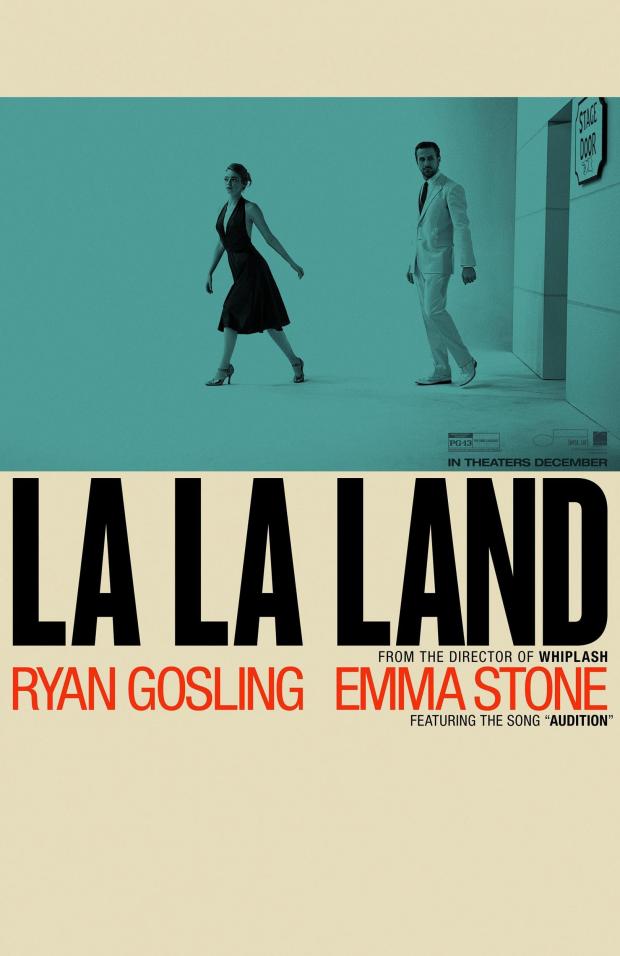
La La Land Successfully Updates A Genre

La La Land is a rare bird, a genre musical film— refreshing and uplifting, sincere and happy and melancholy, a much-needed anodyne for the darkness and cynicism of late cinema. It tells the story of the meeting of two young people, Sebastian (Ryan Gosling) the musician and Mia (Emma Stone) the struggling actress. Both are working marginal jobs, waiting for their moment to break into the careers they dream of. When they meet (after a few hilarious missteps) love begins to bloom— and in true musical manner, their emotions soar in the form of song and dance. This is what is wonderful about musicals: in their universe emotions cannot be contained by prosaic reality. They require the characters spontaneously burst into song. Narrative reality breaks loose and people levitate into a magical space where people dance in the middle of traffic jams and fly into the stars of a planetarium.

But it’s not all just a cinematic heaven of singing and lyrical passages of fancy: the eternal rival of romance and career soon takes over.  Mia and Seb inspire each other to take risks, work hard and strive to make their personal dreams come true. The cost of pushing career first soon becomes the central conflict of La La Land, which leads to one of the most soaring and beautiful and melancholy and moving conclusions I have seen in a modern film.

The third character own this film— the namesake— is it’s wonderful, make-believe Los Angeles: Angel’s Flight, Mulholland Drive, Griffith Park, palm trees and stately SoCal architecture under an endless blue sky or deep blue night. It’s a fun, vibrant place full of artist, actors, strivers and dreamers. It’s been too easy in films of late to see LA as some of late-capitalist hellscape (see Training Day): It’s refreshing to remind all of us that LA is a place where people still go to try to make their dreams come true.

Director Damien Chazelle’s last film was Whiplash, a sort of crazy stalker film set in the world of jazz music about an earnest drummer and his insane instructor (J. K. Simmons, who has a lovely cameo in this film).  Jazz plays heavily and strangely in La La Land as well: Sebastian is a young man obsessed with the world of jazz: he has posters of jazz greats in his apartments, Hoagy Carmichael’s piano stool and longs to open a real jazz club in Los Angeles. There are plenty of kids these days who passionately love alls sorts of dead or marginal forms of music: it never becomes clear of Seb is sincere or just really good at affecting his love of the genre.

"A Lovely Night" on location.
The most remarkable number— a real masterpiece of a shot— is “A Lovely Night,” which occurs near the beginning of the film. After a party in the Hollywood Hills where they accident meet up, Seb is helping Mia look for her car. They break into song and dance at a scenic overlook, the wash of lights in the LA basin below. The scene, which goes from real-world to singing to dance to tap-dance (!) is shot at the real location and very specific time: PAST “Magic Hour,” just after sunset, when the warm glow of the sunset underscores a deepening dark blue sky. The set lighting is low as to illuminate the actors and still leave the sunset and sky bright. This scene not only highlights the considerable singing acting talents of of Ryan Gosling and Emma Stone, it shows off cutting-edge film technology: fine-grained, fast film stock (La La Land was mostly shot on 35mm film), fast anamorphic lenses and the latest light, agile camera packages. Were this a Golden Age musical, this shot would have happened on a soundstage. But instead, it is one long, six-minute shot at a very narrow, specific time of day. This makes it breathtaking on several levels.

Another nice PAST-magic hour shot.
La La Land is in many ways an updated classic movie, a pastiche of the conventions, narratives and styles of Hollywood musicals. It is not a breakthrough in and of itself: this isn’t pure storytelling and cinematic innovation like Mad Max: Fury Road was. It takes the best elements of a great genre, updates the sensibilities to contemporary morĂ©s and makes it all fresh and unexpected again. There’s a little Vincente Minelli here, some Gene Kelley there, a little Jaques Demy, Even a bit of Ross Hunter/ Doris Day and Paul Thomas Anderson.

Another girl in magical old Los Angeles, dreaming
of acting fame. Naomi Watts in Mulholland Dr.
Given all these obvious movie-history references it was then very, very strange that while La La Land played, the place I kept going to for a visual and stylistic reference was… David Lynch. I COULD NOT STOP thinking: “This is a light-hearted musical version of Mulholland Dr. (2001).” It shares a lot of the same qualities as Lynch’s masterpiece: striking cinematography filled with shots of strong primary colors; an abiding love of Los Angeles locations, show business, actors and the mechanics of filmmaking; flights of surrealism; and intimate close-ups, bursting with emotion. These films are on entirely different missions— light, uplifting musical surrealism versus a surreal dive into the darkest parts of the id— but there is a common thread as well, in look and feel.

I may well be mistaken and La La Land may have been released in the
original CinemaScope aspect ratio of 2.55:1. But that's not how I saw it
in Redwood City: they couldn't even manage to mask the screen right.
And, sorry to say, I have to disagree with both the opening title card and Dana Stevens’ review and report that La La Land is NOT in CinemaScope. That specific film format was proprietary for to 20th Century-Fox and Bausch and Lomb, who standardized the elements of anamorphic cinematography. CinemaScope lenses were not much used past 1960: these early models had distortion problems that caused actors’ faces to widen unnaturally: “CinemaScope Mumps,” they called it. Panavision fixed this problem by re-arranging lens elements to minimize distortion. This film is actually in Panavision: they used Series C lenses to shoot it. But this is a quibble: the widescreen compositions are so lovely and the mise-en-scene is so well developed and rich, it’s worth another viewing just to look for visual clues and symmetries.

If you love Hollywood genres old and new, this is a must-see.

Saturday, December 17, 2016

Rogue One: A Star Wars Story: Regular People Can Be Heroes Too

Rogue One: a Star Wars Story has been called the first “standalone story” set in the galaxy far, far away. This is only partially true: it tells the story of the theft of the Death Star Plans, essentially paragraph two of the opening title crawl from Star Wars Episode IV: A New Hope (1977) turned into a movie. Two other classic films got this “retroactive prequel” treatment: The Thing (1982) had a 2011 follow-up which told the story of the Norwegian Antarctic research station which discovered the alien spaceship and initially thawed out the shape-changing alien. Oz The Great and Powerful (2013) chronicled the events which brought a carnival magician to Oz and set him up as the ruler of the Emerald City.

This new film, directed by Visual Effects artist turned director Gareth Edwards, is a very satisfying action film and one of the finest additions to the Star Wars universe yet. Co-scripted by Tony Gilroy (writer of most of the Jason Bourne films) Rogue One is a gritty, serious, surprisingly dark caper film. It tells the story of group of ragged fugitives and hardened resistance fighters gathered by a desperate Rebel Alliance and given the task of somehow disrupting or stopping deployment of the Death Star, the Empire’s terrible new weapon. Along the course of this film we see this task change and evolve due to changing contingencies, and in the end this modest little spy story becomes a tremendous and consequential battle against the Empire as bold as any in the preceding films.

The Death Star never looked so evocative.
It is without a doubt the most beautiful-looking Star Wars movie yet made. The monumental visuals that we saw glimpses of in The Force Awakens— Rey climbing out of an immense wrecked Star Destroyer, Starkiller Base— are perfectly integrated into Rogue One. A Star Destroyer floats serenely yet menacingly over a walled city. The Death Star, creating an eclipse as it crosses in front of a sun. A pitched battle incongruously playing out on a warm tropical beach.

There is also a lot of fun stuff in Rogue One. It is set in the early days of the Empire and the film is rich with callbacks and easter eggs. Look hard enough and you will see crowd scenes filled with characters and creatures from other Star Wars movies. Senator Bail Organa (Jimmy Smits) has a part to play, as does Grand Moff Tarkin (Peter Cushing) a surprisingly major character considering the actor has been dead for 22 years.

K-2SO, voice and motion capture by Alan Tudyk. This droid
is the 21st century update to C-3PO. Instead of a fussy,
mannered, somewhat feckless British butler, we have
a very capable robot with a habit of gracelessly
saying everything it thinks. K-2SO provides the
funniest and suprisingly touching dialog in Rogue One.
My favorite moment from the film— the scene which shows how unique this franchise installment truly is— happens early on in Rogue One. Jyn Erso (Felicity Jones), our main protagonist, has seen her mother killed and father apprehended by authorities literally dropping out of the sky, in the form of Imperial stormtroopers lead by Senator Orson Krennic (Ben Mendelsohn). Having witnessed this, and being a life-long fugitive from the Empire, Jyn has led a criminal’s life. The scene I love takes place on Wobani, at an Imperial labor camp. Jyn is sitting in a transport, being taken to or from some job site, covered with dirt and in worn-out clothes, ankles shackled to the floor. We then see other prisoners, looking dirty and defeated, sitting around her. We then see an Imperial Stormtrooper guard sitting on a bench near the hatch— his white armor smeared with grime and dust, body language broadcasting as much depression and defeat as everyone else in the transport. This is the moment where I realized this was truly a street-level story. We are not going to see the machinations of royals and elites: we’re going to see how regular people live in this universe-- those working for the Empire, those fighting it, and those who are simply caught in it’s grip— and how some of them will themselves out of this obscurity and rise to heroism and greatness.

Jyn Erso (Felicity Jones): Fugitive becomes hero.
Science Fiction author David Brin has long criticized the Star Wars saga as an exercise in anti-democratic cinema: they concern themselves with the internal conflicts of a single dynastic family. Every other Star Wars franchise entry has centered on the Skywalker clan, a bloodline created by The Force itself which has had a strong hand shaping the history of an entire galaxy and all the creatures in it. Even last year’s The Force Awakens is primary about a new protagonist joining the search for Luke Skywalker with the help of Luke’s brother-in-law Han Solo. Much of the fan speculation about Rey is how she is related to the Skywalkers: is she a daughter? a cousin? Obi-Wan Kenobi’s granddaughter? Or— my favorite crazy theory— is she a clone of Luke Skywalker, taken from his hand lost in Bespin, probably found still clutching the same lightsaber that Rey takes up?

In any case, the main franchise storyline is about a family of highly superior, Force-empowered individuals, fighting for governmental power over an entire universe of essentially powerless citizens. Rogue One isn’t about these people at all. It’s about the people they oppress: the Rebel troops Princess Leia sent to their deaths, Luke Skywalker’s wingmen blown out of the sky, the innocents on the planets Darth Vader and his grandson Kylo Ren had a hand in destroying. Because it’s a story about ordinary people fighting for freedom from the oppression of the Empire, it is both a noble and inspiring hero’s saga, and a tale of the frailty and ambiguity of ordinary lives.

Monday, October 10, 2016

Donald Trump and Hollywood OmertĂ 

Many people have seen, or at least read about, the now-infamous “hot mic” tape of a candid conversation between Donald Trump and Billy Bush in September 2005. News outlets and the internet are currently saturated with analysis of the content of this tape, in which Trump admits that his money and power permits him to commit sexual assault. The astounding crudity of the verbal exchange was seen as revealing the true nature of Donald Trump’s personality and attitude towards women, and the revelation of this tape may well prove to be the tipping point of the 2016 presidential election.

But this article isn’t about the content of the tape: it’s about why it took so long for it to be released. This is the part of this incredible story that seems to be under-discussed— and it relates directly to Hollywood, which is why it’s being discussed here.

The official story is the producer of “Access Hollywood,” Steve Silverstein, remembered this interview about two weeks before the release and dug the footage out of archives. This story is almost certainly false. The reason why it’s not believable is actually embedded in how the tape was recorded.

This political bombshell (more of a nuclear warhead) was taken from a segment of “Access Hollywood” which documented a cameo Donald Trump was making on the soap opera “Days of Our Lives.” It was shot on the backlot of NBC Studios in Burbank. A camera crew was following Trump and “Access” host Billy Bush: both men were fitted with lavalier microphones and transmitter packs which broadcast RF signal to receivers attached to the camera. During the publicly-released segment a cameraman had stepped outside the bus to set up a shot showing Bush and Trump arriving at the studio to be greeted by soap star Arianne Zucker. Thinking they were off-camera, the two men engaged in a crude, degrading conversation about women. Aside from the on-camera personalities there were seven people involved in this taping: two cameramen, the segment producer, a production assistant, Trump’s bodyguard and PR person, and the bus driver.

After this segment was shot, the footage was likely seen and handled by even more people: on-line and offline editors, more show producers, audio technicians and maybe even an archivist.

Charlie Chaplin, during one of his
many, many court appearances.
So about a dozen people— very likely more— heard and saw this footage in 2005. Yet NONE of these people recalled this conversation, one of the most devastating revelations of character any political aspirant has ever uttered? Particularly as this 2005 taping came on the heels of complaints by the cast and crew of Trump’s show “The Apprentice” about his crude on-set behavior? That is an impressive case of collective amnesia.

Hollywood’s code of silence strikes again.

The film industry has been creating and controlling secrets since the days of Charlie Chaplin (and Lita MacMurray) and Fatty Arbuckle (and Virginia Rappe). The studios all had (and still have) well-funded departments which handled public relations and “fixers,” producer-level executives who specialized in keeping indiscretions out of the press. (Hail Caesar was a thinly fictionalized account about a famous studio fixer.)

The culture of secrecy goes very deep in both the film and TV industries. Entertainment is an unusual industry in that the general public is constantly and intently curious about it. Supermarkets do not devote shelf space at the checkout counters with magazines dishing the dirt on astrophysicists and farmers, after all. Scripts and storylines have to be kept secret: details of film shoots are kept from public view as much as possible as well. The need for confidentiality rivals the Pentagon’s.

It’s all for the greater glory of the Industry, of course. That, and jobs. A scandal that would bring down a star would shut down production. A leaked script would kill off box-office potential. Finally, there’s the prestige factor: being on the set gives even the lowest PA or grip access to some of that rare stuff, Hollywood Glamor— stacks of non-disclosure agreements are willingly signed to gain access to that inner circle.

Why did this revelation take so long to emerge into the light of public scrutiny? The culture of Hollywood, a full century of studio secrets kept, reputations protected, indiscretions hidden. And they are so good at it: Did you know that Tom Cruise is only 5’7”? It took a LOT of will to overcome that much inertia and tradition.