Showing posts with label 3D. Show all posts

Friday, August 30, 2019

Brush With Greatness: A Short Memoir

This true story happened in the early-to-mid-nineties, and that's important to know because the context explains a lot. Something else that you should know is I've loved bad movies almost all my life. One more thing to know is this was so important to my development that I'm astonished I haven't told this story already, but I just did a search through the archives and somehow, only now can it be told.

So, back in the nineties I used to keep a journal. It was mostly an emotional steam valve, not for anyone's consumption. But now and then I'd read a passage and think, this is good stuff! I can't publish it, of course, because it's very personal and it would ruin my life and the lives of those around me. But the idea nagged at me nonetheless. And there was a point where I realized that MS Word could export HTML without much trouble, and Apple provided we with a a little web publishing space for free. So I started publishing PARTS of my journal. I wasn't advertising it or anything. It was the web equivalent of an old couch on the sidewalk. If you happen to be in the neighborhood and you need a couch, take it away.

So, given that any post about people I knew was off-limits, I mostly published complaining about things. Maybe that would mean bad traffic or airline food to a normal man. I mostly weighed in on TV and movies.

Okay, so going all the way back to my first movie theater job, I had been stunned by TREASURE OF THE FOUR CROWNS, an early 3D effort by Cannon Pictures. It was awful. It starred Tony Anthony (an Italian with a much longer real name) but I noticed that it also starred, and was written by, a man named Gene Quintano. And throughout the ensuing decade, that name stuck with me and I watched for it, and every time he came up he was associated with a movie that I thought was terrible. (Most of them were also from Cannon Pictures, and almost everything they ever did was terrible.) But by the time I started this online journal, so-called because no one had coined "blog" yet, I was a kind of expert. A Quintanologist.

Gene's Acting Debut, COMIN' AT YA
And one day I did a whole entry about how much I hated all those movies. Having gotten it out of my system, I moved on to saying nice things about Twin Peaks or something.

Then, a week later, the weird part.

I got this unsolicited email from Gene Quintano.

My first thought was OMG GENE QUINTANO IS WRITING TO ME HE'S FAMOUS HE'S A WORKING SCREENWRITER THIS IS GREAT THIS IS GREAT and that faded as I read the email and realized that he was furious with me and I had made his kid cry because the kid didn't understand why anybody would hate his daddy.

And I wrote back, respectfully and explained that I was devastated that I had caused that trouble and had no idea that he would ever see it (also that he would care about my opinion but I kept that part to myself) and I'd do anything I could to make it right. He replied! If I could write an email to his kid and explain that I didn't hate Gene, that might help. So I did. I composed a short note in which I said that Gene Quintano himself was surely a wonderful guy and I just didn't care for the movies he was associated with.

That smoothed it over, kinda. Quintano wrote back a week later and pointed out that he was only the screenwriter and he didn't make the final decisions and his drafts were much better than the movies wound up being. I suggested he direct more. He did eventually helm 4 films, Including Honeymoon Academy and National Lampoon's Loaded Weapon. You be the judge.

What's the takeaway from this? It seems like a really early example of the internet's power to magnify a grievance. I think Mr Q and I were both sucker-punched by this, which is why it became such a thing. I was a nobody pretending to be a real film critic and not realizing that I had the reach of one, as long as you were an artist Googling yourself. Eventually all "real" film critics lost their clout to this phenomenon.

Anyway, maybe I'll issue another apology to Gene Quintano every 20 years or so until one of us is dead. If it's any consolation he's made a LOT more money in this business than I have, and rightly so.

Oh, and don't get me started on Lorenzo Semple Jr.

Saturday, May 27, 2017

Star Wars 40: The Franchise Re-Awakens

I recently posted a link or two on social media to a post I wrote five years ago about the 35th anniversary of the release of the first Star Wars movie. An interesting read, a take in a very specific moment. One that requires an update!

This was the last effort of
George Lucas's Lucasfilm.
Five years ago Lucasfilm was still in the hands of creator George Lucas— and it was looking sad. In some sort of last-ditch effort to keep the whole franchise relevant he re-released Star Wars Episode I: The Phantom Menace in 3D, and it was met by remarkable indifference. Part of it may well be the fact he was trying to push the least popular movie of the series, and the audience was having none of it. part of it was how uninspired an idea it was in the first place: by putting 3D lipstick on the Phantom Menace pig he was signaling that he no longer had any new ideas for his creation.

That 35th post reflected this sense of despair, of the ending of things. It was the slowly dawning realization that we were going to move past Star Wars being a current, active franchise and more an artifact of past film glory. Back to the Future? Great Franchise. So was The Thin Man. Throw Star Wars on that old pile.

But less than five months after I wrote that post, the unthinkable happened: The franchise fired George Lucas. He was the immovable object: as I said in a post on the subject,

It's obvious that the rock in the road in terms of the last three Star Wars films has been George Lucas himself— his feeble kiddie-pandering, his dull political pontificating, and his peculiar and depressing take on morality. His decisions were impediments that prevented the second three films from reaching the heights of the first three.

Kathleen Kennedy shows us where her heart is.
Lucasfilm was sold to Disney without George being any part of it, veteran Lucas and Spielberg producer Kathleen Kennedy took over production for Lucasfilm Ltd., and she immediately started making brilliant decisions. She hired Michael Arndt and Lawrence Kasdan to write the next episode of the main franchise, and attached JJ Abrams to direct it. Soon after Kennedy let ILM head John Knoll develop a standalone story and brought in Tony Gilroy to write it.

This Vanity Fair excerpt tell you everything you need to
know about why Kathleen Kennedy is running
Lucasfilm now. (h/t Tadd Schellenbach)
The aspect that Kennedy brought into the franchise was more than the removal of the dead hand of Lucas’s faded imagination: she showed amazing respect for the both franchise and the audience. She realized something Lucas forgot: Star Wars was partly owned by its fans, and that base stretched back 35 years. Any new effort required fealty to that canon.

The results exceeded all expectation: Star Wars Episode VII: The Force Awakens (2015, right on schedule) was a exciting new installment which introduced new characters while keeping the main protagonists of the franchise— Han, Leia and Luke— front and center as well. Sure, the story was variation of Episodes IV and VI (Death Star, Starkiller Base, same diff) but it was tightly written, full of humor and surprisingly positive dialogue (after a while, you really start noticing how much all the protagonists complement the efforts of the other protagonists: it's kinda weird). The production was both spectacular and felt materially substantial, utilizing as many practical sets and effects as possible. Episode VII was critically acclaimed, very successful and sent out a tremendous message: Star Wars is back, and we went out of our way to respect the franchise and you, our fans.

With the triumph of Episode VII still hanging in the air like a rainbow Rogue One: A Star Wars Story was released one year later. This was a remarkable film in that it featured no Jedis, no lightsabers and (almost) none of the Skywalker clan. It was a completely standalone story, a bold experiment to test the ability of the Star Wars universe to support completely original characters and story forms. Rogue One also celebrated the ordinary people in the Star Wars universe, those struggling under the yoke of the First Galactic Empire-- it shredded David Brin's objection of the franchise, which he saw as anti-democratic and focused on elites. It was nearly as successful as Episode VII, and many critics (me among them) proclaimed it one of the finest entries in the canon.

Teaser one-sheet: a bit of Episodes
IV, V and VI all mooshed together.
Here are how things stand mid-2017: Lucasfilm under Kathleen Kennedy has successfully revived a dying franchise. Disney/ Lucasfilm is 2-0 so far, with two more in production: Star Wars Episode VIII: The Last Jedi opening in December and an as-yet unnamed Han Solo standalone film, due out next year. Of these two, I think we can count on one more solid win with Episode VIII. The “Young Han Solo” movie? Not so sure. It has a solid director team (Phil Lord and Christopher Miller) and Lawrence Kasdan wrote the script-- but there’s such a whiff of “Disney’s Star Wars Babies” to it that it has the possibility— a slight one, but it’s there— of this anthology entry landing with a thud.

I’d say the pessimism I have had over a beloved movie franchise five years ago is pretty much gone, and I’m one happy Star Wars fan. But when you live in golden times (I’m talking about the franchise, not the larger world, which sucks right now) you are constantly searching the horizon for storm clouds. This re-awakening can only last as long as it is led by executives who both love it and know how to make it profitable, and in Hollywood this is always a balancing act.

The other concern is more philosophical: Sure, a huge number of people love the franchise, and some have for 40 years: but being given more quality installments is like going to a huge chain restaurant that always serves everyone their favorite food. You never get tired of it, but after a while you wonder: Are better and newer restaurants being crowded out? How long can they keep serving this great stuff before everyone gets sick of it, even though the quality has never flagged? And how long can this fabulous chain go on before new management decides to cash in-- and steak and Stag’s Leap Malbec 2011 becomes saltines and tap water?

Tuesday, October 6, 2015

My New Favorite Martian

Ridley Scott’s The Martian is a nice reversal of the bloat that is becoming epidemic in most big-budget films— especially in Ridley Scott movies. Prometheus was a hyperactive terrier of a movie, bouncing all over the place, rabidly exploring scifi/horror ideas and abandoning them with equal speed. Exodus was The Bible by way of Lord of the Rings— a dark, heavy, over-art-directed movie that had big CG monsters in it. The Martian is simple and exhilarating— it sticks with a handful of characters and confines itself within the realm of believable science and physics. This last part makes this film sublime: for sci-fi geeks, seeing a film that does NOT invoke some magical frammis to get out of the 3rd act is… well, magical in itself.

Not much to say about the plot you haven’t heard: an expedition to Mars gets hit by a storm which forces them to depart to orbit— leaving one of the crew behind, presumed dead. He isn’t, and now Mark Watney (Matt Damon) has to figure out how to survive alone until he is rescued. How he does it is never less than fascinating.

What makes the film work— aside from the clean direction and terrific casting— is the dialog. The screenplay is by Drew Goddard, a veteran of “Buffy the Vampire Slayer,” “Angel” and “Lost.” Those shows, especially “Buffy,” were known for their witty, fast-paced dialog. The dialog in The Martian isn’t fast-paced (you really need at least two people for proper dialog to happen) but Matt Damon’s naturally self-deprecating manner makes the witty asides Watney tells himself work very well. Humor relieves tension, and pacing out moments of wry exasperation and existential terror in turn makes the experience feel richer and more realistic.

A few notes:

A relatively bulky form factor with
mechanical limitations and limited dynamic range.
• The Martian Curse is being met head-on with this film— and so far The Martian seems to be beating it! It took $55 million domestic ($100 million worldwide) opening weekend against a $108 million budget. Just a note about budget here: for a film that displays all the sweep and grandeur of a big sci-fi movie, $108 mil is PEANUTS. Just comparing it to recent victims of the Martian Curse: Mars Needs Moms (2011) cost $150 million to make, and John Carter [of Mars] (2013) cost a mind-bending $264 million or more. And do you know why Ridley Scott’s Mars movie was so (relatively) cheap? It was mostly made in Hungary! The Martian exteriors were shot in Jordan— which, while grand and otherworldly, also looked just a bit familiar. Squint really hard you can see Peter O'Toole’s trailer from Lawrence of Arabia half-buried in a sand dune.

That's right-- everything from Rush's self-titled 1974
 premiere album to 2012's Clockwork Angels, all
on this tiny deal. (Nose not shown.)
• The diagetic soundtrack of The Martian features no song newer than 1979. Apparently the only music left behind on Mars belonged to Mission Commander Lewis (Jessica Chastain), a 1970’s Disco enthusiast. Though this makes for many amusing scenes of Watney being musically tormented (“No, I will not turn the beat around!”) frankly I found this rather unbelievable and a bit of a pander. Guardians of the Galaxy (2014) did the same thing (albeit with a more ecumenical selection of 70s pop) and it’s fair to say that if “Awesome Mix Vol. 1” was not part of that movie it would have been far less fun. They are trying for the same light, easy-to-relate-to musical touch with The Martian— but it doesn’t compute for several reasons: 1. The film set in the mid-2030’s: Disco will be 60 years old by then. Disco is music Lewis’ great-grandparents were into. 2. Digital audio files should NOT be this scarce-- even if they were accidentally left behind on Mars. My friend John received for his birthday the complete collected works of Rush. It was on a USB flash drive that was so small he could literally stuff it up his nose.

Although I did not include it in the article on
The Martian Curse. Robinson Crusoe on Mars did
poorly at the box-office as well. I also forgot
to mention the feature version of My Favorite
Martian
(1999), which also bombed (and
featured Jeff Daniels, who is also in
The Martian!).
• The Martian is a Robinson Crusoe story, set on Mars— not the 1964 movie, the 1719 novel by Daniel Dafoe. It explores the application of what is called “Robinson Crusoe Economics,” where the protagonist is in a unique economy where he is the only producer and consumer. To survive he needs to maximize both his personal profits and expand his productivity with very limited resources. Dafoe’s novel was written at the dawn of the Age of Enlightenment, when scientific and rational political thought became paramount. Crusoe was the embodiment of Enlightenment thought: To survive (profit), inventories are made, output calculated and problems are solved, mathematically and dispassionately. As this film is an absolute love letter to Science, nothing could be more appropriate.

• Donald Glover has a small role as Rich Purnell, a JPL astrodynamic physicist who figures in a key plot point. He plays it like a slovenly genius savant: minimal eye contact, poor social skills, the whole deal. Still, as he was both Troy Barnes in “Community” and comic rap artist Childish Gambino, when he showed up on-screen I expected comedy that never actually materialized. Strange.

• Seen in 3D at a late show. I was the only one laughing at the punchy dialog. The 3D is very good, feels natural and the image is unusually bright. See it that way.

Monday, December 17, 2012

The Hobbit: The Law of Diminishing Dwarves


My wife has really, really been looking forward to seeing The Hobbit for weeks, ever since she re-read the novel. And I was very curious about seeing what the new HFR 3D (48 frames per second) process looks like. So tonight we went to go check it out at the Cinemark San Mateo-- where we found out after buying tickets that they don't have HFR. Refund in pocket, we drove to Redwood City, where they did.

Basically, The Hobbit: An Unexpected Journey delivers it's promise: It's a dose of Middle Earth, just as detailed, grand and handsome-looking as any part of the LOTR trilogy. In fact, a lot of the characters from the trilogy show up-- Galathriel, Saruman The White, Frodo Baggins-- even though they aren't in the original book.

There are two basic area to look at with The Hobbit, which despite some harsh reviews had a champion opening weekend ($89 Million)-- the production and the new HFR 3D process:

The Production: I remember when New Line announced they were going to make the Hobbit into a prequel: It was quite exciting news, and a lot of fans were enthused about it. When they announced, not long after the initial news, that it was going to be a two-part epic, people generally shrugged. But when, during pre-production, they said The Hobbit was going to be a trilogy, there was some alarm. The covers of the book it's based on are closer together than any of the other Middle Earth books: that's a small amount of jam to spread on a lot of bread.

Let's look at the arithmetic of screenplay adaptation at work here. The Lord of the Rings trilogy of books totals 1,550 pages. The total running time of all three movies is 558 minutes. The general tally of a standard formatted screenplay is roughly a page a minute, so we can assume the three scripts together total less than 600 pages. This leaves the screenwriters with the standard job of reducing, cutting out characters and plotlines. But The Hobbit is 310 pages long. If they divide it evenly, that's about 103 pages of novel to turn into each movie-- which roughly lines up with where The Unexpected Journey, which is 169 minutes long, ended. There is over an hour of screen time to pad, and it shows.

Peter Jackson has added elements from Tolkien's unpublished memoirs, such as The Quest for Erebor, but you can feel the stretch as the film unwinds. Bilbo Baggins does not leave his hobbit-hole until nearly an hour of screen time has passed. Radagast the Brown Wizard shows up for an extended and fairly pointless sequence. Those LOTR characters ain't just cameos: they have a extended conclave mid-movie as well.

The most interesting, and glaring, change is the addition of an orc villain. Azog, a very minor character in the book, was the Orc king who killed Thror, the father of Thorin Oakenshield, the leader of the dwarf company headed to Erebor. In the movie he's now the nemesis of Thorin. He's also a very tall orc with blue skin, and bears an uncanny-- and even suspicious-- resemblance to one of the huge aliens from James Cameron's Avatar.

Thorin Oakenshield. Dwarf or Klingon? You decide.
There is also another issue, something inherent in the original story, which leaves The Hobbit at a disadvantage compared to the precedent films: the lack of charismatic eye-candy. The LOTR trilogy had, up-front and rock-star handsome, Humans and Elves: Aragorn, Legolas, Eomer, Boromir and even his brother Faramir. I remember the spontaneous applause that broke out during the closing credits at the opening-weekend screening of The Return of the King: throaty, manly yells for Frodo and Sam, schoolgirl screams for Aragorn and Legolas. With The Hobbit the heartthrob is (apparently) Thorin, a hair-covered dwarf set against a mob of a dozen-odd undifferentiated, hair-covered Dwarves. He just doesn't have that ineffable "it."

High Frame Rate 3D: I've read a few reviews for The Hobbit and they all make comment on this new process, where the film was shot at double the frame rate, 48 frames per second, and projected at the same speed. I also remember reading about the hooting and brickbats at the last ComicCon when they screened a sequence for fans in HFR 3D. The general consensus is this: it makes the film look like it was shot on video. It gives the film a cheap-looking patina, like "The Teletubbies" or a soap opera.

You know what? It's not that bad. Sure, there are some scenes that look sort of cheesy, especially handheld ones: they look like they were shot on the set with a video camera. And some of the props and costumes aren't quite as convincing as they might look in 24 frame. But generally it looks very good, and the high frame rate is only mildly distracting. The cinematography is lush and the effects blend seamlessly: this is what you notice first.

Still, I'd venture a suggestion: If anyone was going to make a 48 frame per second feature in the future, I'd use it on a real-life feature, like a comedy or a rom-com, something that does not have a lot of effects or makeup or weird costumes. The impact of a film like The Godfather or Dodgeball or Mulholland Drive would have been greatly enhanced with such an startlingly vivid format.

On the other hand, the high frame rate effect is offset, unfortunately, by the 3D. There was nothing wrong with it as executed in the production: it just suffers from having to put those glasses on and the dark, color-muted, washed-out look all 3-D films have.

Still, it's worth seeing. Remember the awful disappointment you felt when you saw Star Wars Episode I: The Phantom Menace? The Hobbit is nowhere near that bad-- It's just a big-screen example of the Law of Diminishing Returns.

Saturday, May 26, 2012

Star Wars 35: A Cautionary Tale

GL among his pre-digital models. I got a chance to run
my hands over a lot of these things at a Lucasfilm
exhibit at the Marin County Fair. After I left, I saw
the sign saying "Do Not Touch." Oh well.
So it's the 35th anniversary of the opening of Star Wars. That's a lot of Wookies under the bridge.

It's hard to express how exciting and unique a film it was when it came out, how much a part of my life it became-- and, as the years passed, how the franchise (and my admiration for it) stumbled and fell, becoming something emblematic of a primal fear, one that all of us share.

Sure I remember when Star Wars opened up. I was totally primed for it, for three reasons: 1) a totally inaccurate but exciting article about the upcoming "The Star Wars" in Cinefantastique magazine; 2) that amazing, amazing trailer-- They showed it on "Creature Features" in spring '77 and it got such a strong response Bob Wilkins had to show it several more times; 3) I was fourteen.

The Saturday after Star Wars opened (roadshow movies opened on Wednesdays) me and my Soquel High Sci-Fi Club buddies rocketed over the hill to San Jose and took in an afternoon screening at the Century 21 Theatre. Back then, big tentpole movies were platform-released: They would open up in a few dozen major markets in 70mm, then break wide a few weeks later. We waited in the long, long line, took our seats under the apex of the dome, watched the giant gold curtain roll out unveiling the deeply curved screen and the 20th Century Fox fanfare (no trailers whatsoever!)

It totally blew us away. It's difficult to think of a film since that so exceeded my expectations for transcendence. I was the right kind of kid at the right age in the right place in history, and the cultural phenomenon that was Star Wars entered me like an X-Ray. I lived Star Wars. I memorized Star Wars (It's all still in there). I wanted to meet George Lucas*: he was my personal God, and promised to be a font of endless creativity and magic.

I managed to see the it at least two dozen more times that long summer. When Empire came out three years later, we made it to opening day at the Century 21. Same with Jedi-- though, due to a ticketing mixup we saw that one in Pleasant Hill, but it was still in 70mm.

Fast-forward to 1999: Jeffrey Sargent and I are seeing Star Wars Episode I: The Phantom Menace at the AMC in San Francisco at the very first midnight screening. It had been sold out for weeks: Jeff did some major wheeling and dealing to secure us tickets. But the world had changed, cinema had changed and we had changed in the 16 years since Jedi's stirring ending (to the Ewok's "Yub-Yub Song," which George Lucas has since expunged from his improved version). I'm not sure Jeff coined it, but the next day he emailed our basic summary: "George Lucas Pissed In My Eyes."

From that moment on, the Star Wars universe appeared to a rapidly shrinking one, a galaxy under accelerating compromise. It may have started with the regrettable "Star Wars Holiday Special" from 1978, but that was sheer contractual obligation. No, it was the little changes and the little peeks into the Lucasfilm decision process that showed the Ozymandian artifice of the whole thing: the Special Editions, which both blunted the canon and disrespected the core audience. The little, sometimes condescending choices he made in the last three films, Jar Jar Binks and Annie Skywalker, the stilted dialog and the joyless, confusing plots. The final Star Wars film, Revenge of the Sith, was so devoid of surprise it was like watching a movie run backwards, characters and elements being assembled for their bow in a film then 28 years old. By that point, everything that had made me a rabid Star Wars fan back in 1977 had been systematically wrung out of me by George Lucas himself.

But it wasn't all him: I also managed to grow up (a bit) since 1977. I went to college, saw The Hidden Fortress, read Joseph Campbell and E. E. “Doc” Smith's Lensman novels. Seeing where Star Wars came from-- and how closely it was derived-- was inevitable, but instructive. One of the biggest jolts to my Star Wars fandom was reading sci-fi author David Brin's famous and devastating takedown of the ethics of Star Wars. One tiny bit:
George Lucas's version of romanticism is obsessed with nostalgia, feudalism, pyramid-shaped social orders, elitism, a hatred of science and the concept that only genetically advanced demigods matter. He openly avows to never having researched what real heroes do. He also expressed open contempt for this democratic civilization, telling the New York Times that he prefers a 'benign dictatorship.'
And now it's 2012: George Lucas recently re-released Episode I in painstakingly rendered 3D-- and the box-office response was startlingly indifferent. When I read the reviews for it I came to a realization: Star Wars was not the best thing George Lucas ever dreamed up: it was the ONLY thing he ever dreamed up.

God, I wanted to be just like George Lucas when I was a kid. Now he means something else to me. He's a cautionary tale: the embodiment of the frightening notion that we're only entitled to one really good, creative idea per lifetime.

---
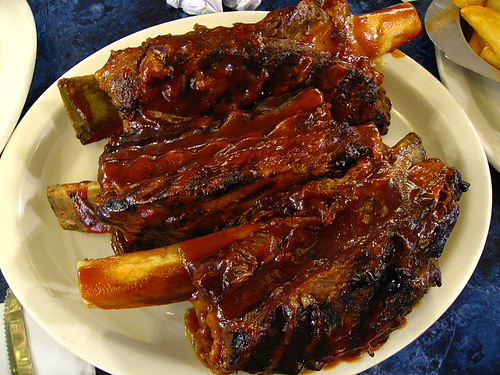
Mmmmm... Ribs.
*In 1992, I got my wish: I met George Lucas. My wife and I were sitting down to dinner at Tony Roma's in Corte Madera (long gone) and he sat down next to us. Alone. It was just a week after the Academy Awards, and he had received the Irving G. Thalberg Award. Yet there he was, all by himself, George Lucas and a good-sized pile of beef ribs. I mentally collected myself enough to squeak out something to say to him (and I DO mean squeak: in my head, I sounded like my 14-year-old self in full conniption mode):

“Mr. Lucas?” (squeak, squeak.)

“Mm-hm?” (I think he was actually had a mouthful of ribs at the time.)

“Uh, Congratulations on getting the Thalberg Award!” Of all the f***king things I could have said to the guy, of all the thousands and thousands of things I fantasized saying to George when I was a kid, it all fled from my consciousness, and that was what I said. Yikes.

“Mmm.. thanks.”

“Alright, I'll leave you be.” Argh.

Tuesday, December 21, 2010

A Little 3D on the Cheap

If you can cross your eyes and you don't like to go out in weather like this, you might enjoy this: Gizmodo sponsored a 3D photography contest. Some are fantastic, some just give you a headache, but hey, no glasses! No CGI animals! No movement.

What do you want for nothin'? Milk and cookies?

Thursday, October 21, 2010

In Case You Haven't Blown Enough On 3D TV Yet

While movie goers seem to be divided on whether 3D really enhances a film or not, it’s a hands down “no” for prescription glasses wearers. For those of us with less than perfect vision, wearing 3D glasses over prescription glasses can be a nauseating experience that leaves painful marks behind the ears. Samsung has recognized the fact that the majority of people require corrective lenses, and a great many choose to wear glasses, and therefore have an impeded 3D viewing experience. Their answer is prescription 3D glasses which are custom-made by an optometrist and take about a week to make.
So the medium requires a different encoded type of 3D for your player and proprietary glasses for each system (your Samsung glasses won't work with your Sony TV, for example) and now the glasses themselves will cost 3 times as much and can't be used on more than one head.

Why oh why won't people buy more 3DTVs?

h/t Gizmodo

Thursday, September 30, 2010

Dr. Vader's 3-D House of Jedis

What did it take to get me back to Hang a Lantern On It, after several months of distractions, work and screenplay revisions kept me away ?

The fact that George Lucas is re-releasing the six Star Wars movies in 3D. First up: Episode I: The Phantom Menace, then one a year.

I have railed on (and on and on) about how George Lucas has been milking the nugget of an original idea-- a half-borrowed, structurally derivative but nonetheless original idea-- for well over thirty years now. Fine, that's his business, though it pains me to think how many new ideas and filmmakers and he could have nurtured over this quarter-century-plus. Think about Lord of the Rings: that coulda been a Lucasfilm joint, and looked just as good as Peter Jackson's work, and he had the technology to do them a decade earlier!

There is something pathetic about Lucas wanting to jump onto the 3D bandwagon. For one thing, this bandwagon's wheels are coming off, as the boxoffice on 3D movies gets smaller and smaller. Check out this article in Slate for the blow-by-blow.

Lucas has found many ways to sell the same stuff to audiences over and over again, and I'll admit the re-releases of Episodes IV, V and VI were pretty cool, if a bit of a mixed bag (removing the "yub-yub song" from the end of Jedi, good; Having Greedo shoot first, unforgivable). But laying down $15, putting those stupid glasses on, and watching Jar Jar Binks shuck and jive in 3D? I think he finally crossed the line with me.