Tuesday, June 13, 2017


Tuesday, June 6, 2017
Saturday, June 3, 2017
Wonder Woman: Fury Road
 |
| Diana, Princess of Themyscera, getting ready to stab some guy. |
What if we had a superhero who has none of these issues? What if she was here because she chose to be here and is here to do good— not to psychologically play out some personal loss, but because it was simply the right thing to do?
Now we have the antithesis to the Dark Knight and the Man of Steel. Finally, after a nine-year development cycle and a dizzying number of deals, we have Wonder Woman, directed by Patty (2003's Monster) Jenkins. The title character is played by Israeli actor Gal Gadot, absolutely majestic in the role of Diana, Princess of Themyscera. (nobody in the film calls her “Wonder Woman.”) Jenkins has rendered a marvelous superhero tale, a breezy, often thoughtful film that is centered on a fascinating hero both capable and naïve, loving and fierce, a warrior for peace. It is not a perfect film— but as an entry into the superhero genre it is way above average. Go see!
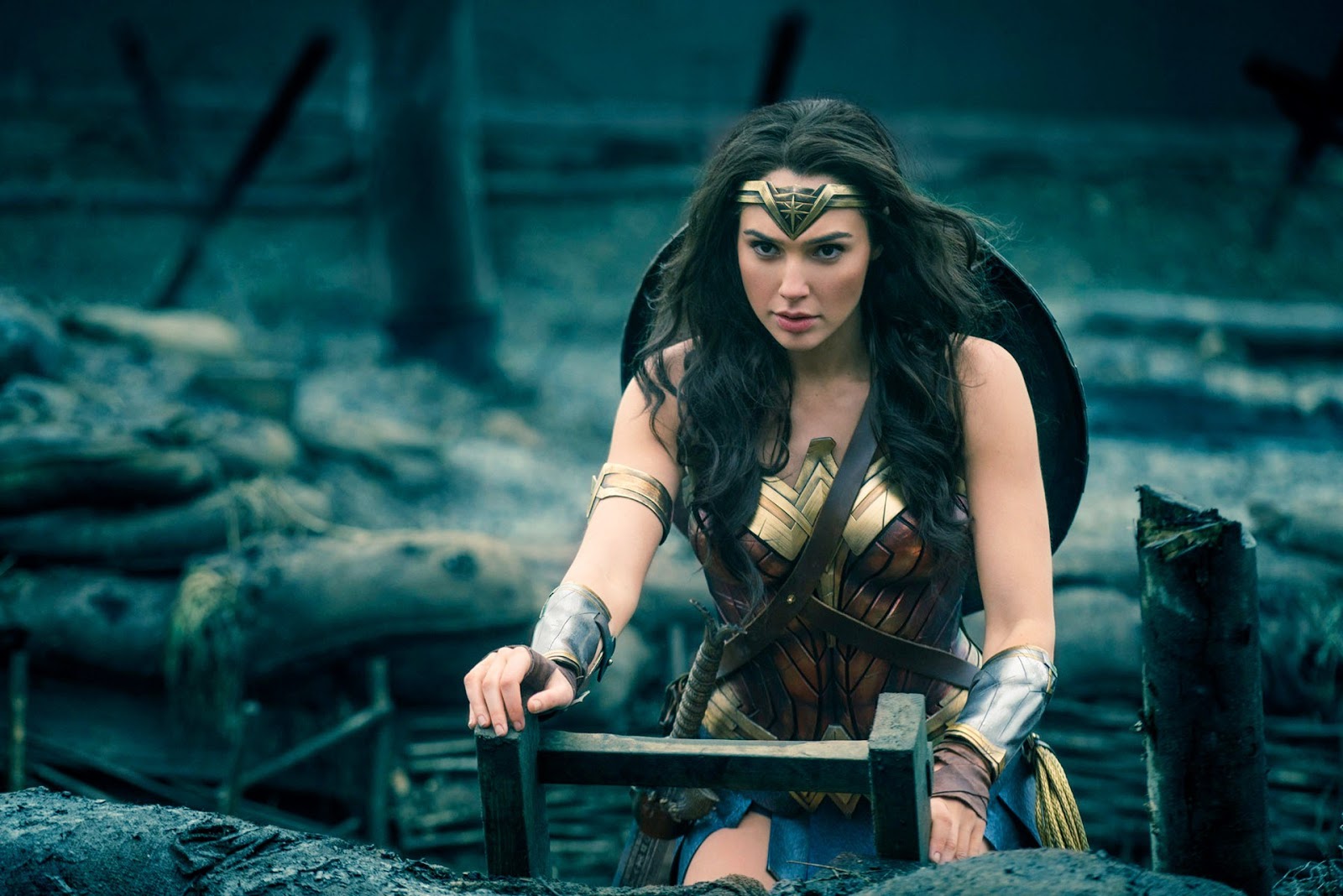 |
| Diana going "over the top" into No Man's Land. This sequence is incredibly great, indescribably thrilling and unexpected, worth the price of admission, even. |
A few notes:
• The film’s setting— Europe in 1918, the final months of The Great War— was a marvelous decision on several levels. There is a genuine surprise in the opening act— set on a timeless island magically protected from the outside world— when the lovely azure sky is literally pierced by a German Fokker monoplane. The film then fixes on World War I, the description of that war’s terrible scale and carnage motivates Diana to leave her idyllic home and end the conflict. The setting of the war— the muddy trenches, the damaged Belgian villages, smoky, bustling London— are rendered with incredible detail.
The decision set the film in 1918 follows a smart precedent: Captain America: the First Avenger (2011). That film was set mostly in the Second World War, which—while accurate to comic-book origin— was an unusual choice, not entirely necessary. Same goes with Wonder Woman, the WWI setting of which was an even more of a whole-cloth invention, as the comic book was first published in 1941. Both of these movies could have started in media res, set in our contemporary time, like the majority of comic-book movies are (Spider-Man started in 1962: in the movies he never saved John Kennedy, not even once) but instead chose to introduce our heroes in historical contexts.
Why? Because it effectively de-contextualizes the conflicts that informed their origins. We get to see heroes fight the Hun and Nazis, and the wrecked and ambiguous current state of geo-politics has nothing to do with it. There are no satellite phones or pocket nukes or stealth anything. The battles were more intimate and close those days, and they required guts and battlefield valor, not pinpoint drone missile targeting. It makes our heroes seem all that more pure.
 |
| Furiousa takes charge, defending the war rig from the forces of the malignant patriarch Immortan Joe. Max Rocketanski (Tom Hardy) helps as best he can. |
It also advances a worldview unheard of in major action films: that maybe patriarchy is a system that causes most of the destruction in the world. Maybe having men run things is a recipe for violence and war and climate destruction. It may even be bad for men in a patriarchy, who tend to define themselves in ways that limit the human potential of everyone in it, including themselves. Violence may be the ultimate catharsis, the red blood that powers action films, but the time may have come when the pleasure of violent catharsis can be questioned and challenged.
Wonder Woman advances this strong feminist theme. Diana comes from an island with no men, and when she leaves it she sees the world in all it’s sexist extremes. Naturally, she is outraged by this, and takes it upon herself to set things right. All her male cohorts can do is follow along as best they can. Steve Trevor, who in any other movie would be the stoic, capable lead character, is quickly reduced to a “feminist ally:” Her agenda becomes his agenda and all he can do is educate Diana on the complexities of modern warfare and social morés. Diana’s motivation is moral outrage against the Great War that men have started and wage without mercy against each other-- and the innocents caught in it’s grasp. The nature of evil itself is held up to question in Wonder Woman— is it an innate thing, part of human nature, or is violence a tragic flaw of the male psyche, or is it caused by something else entirely?
It’s not a perfect feminist manifesto: Wonder Woman definitely tries to have it both ways in places. These are plenty of scenes where Diana is ogled, and her presence as the most beautiful and capable person in the room eases over from admiration to voyeurism. This manifesto suffers especially with the big battle finale (no spoilers) which is more in common with the other titanic, lengthy CGI battles at the end of other DC and Marvel movies than this particular tale. It’s a well-crafted spectacle, a clash of immensely powerful super-powered beings, but after the real-world ethical dilemmas exposed and discussed the film before the finale hits I felt a little disappointed. Punches are being pulled a little, I think. If the film had ended a little earlier, with Diana realizing that war (especially THAT war) was nothing more than a form of nationalistic madness brought on by the belligerence and pride of the interconnected patriarchal royal houses of Europe, I think she would have discovered a deeper truth, and the audience would have left the auditorium wiser and maybe a little outraged, but outraged in a good way.
*Program note: there is NO easter egg tag at the end of Wonder Woman. Feel free to leave when the credits scroll starts.
Tuesday, May 30, 2017
Saturday, May 27, 2017
Star Wars 40: The Franchise Re-Awakens
I recently posted a link or two on social media to a post I wrote five years ago about the 35th anniversary of the release of the first Star Wars movie. An interesting read, a take in a very specific moment. One that requires an update!
Five years ago Lucasfilm was still in the hands of creator George Lucas— and it was looking sad. In some sort of last-ditch effort to keep the whole franchise relevant he re-released Star Wars Episode I: The Phantom Menace in 3D, and it was met by remarkable indifference. Part of it may well be the fact he was trying to push the least popular movie of the series, and the audience was having none of it. part of it was how uninspired an idea it was in the first place: by putting 3D lipstick on the Phantom Menace pig he was signaling that he no longer had any new ideas for his creation.
That 35th post reflected this sense of despair, of the ending of things. It was the slowly dawning realization that we were going to move past Star Wars being a current, active franchise and more an artifact of past film glory. Back to the Future? Great Franchise. So was The Thin Man. Throw Star Wars on that old pile.
But less than five months after I wrote that post, the unthinkable happened: The franchise fired George Lucas. He was the immovable object: as I said in a post on the subject,
Lucasfilm was sold to Disney without George being any part of it, veteran Lucas and Spielberg producer Kathleen Kennedy took over production for Lucasfilm Ltd., and she immediately started making brilliant decisions. She hired Michael Arndt and Lawrence Kasdan to write the next episode of the main franchise, and attached JJ Abrams to direct it. Soon after Kennedy let ILM head John Knoll develop a standalone story and brought in Tony Gilroy to write it.
The aspect that Kennedy brought into the franchise was more than the removal of the dead hand of Lucas’s faded imagination: she showed amazing respect for the both franchise and the audience. She realized something Lucas forgot: Star Wars was partly owned by its fans, and that base stretched back 35 years. Any new effort required fealty to that canon.
The results exceeded all expectation: Star Wars Episode VII: The Force Awakens (2015, right on schedule) was a exciting new installment which introduced new characters while keeping the main protagonists of the franchise— Han, Leia and Luke— front and center as well. Sure, the story was variation of Episodes IV and VI (Death Star, Starkiller Base, same diff) but it was tightly written, full of humor and surprisingly positive dialogue (after a while, you really start noticing how much all the protagonists complement the efforts of the other protagonists: it's kinda weird). The production was both spectacular and felt materially substantial, utilizing as many practical sets and effects as possible. Episode VII was critically acclaimed, very successful and sent out a tremendous message: Star Wars is back, and we went out of our way to respect the franchise and you, our fans.
With the triumph of Episode VII still hanging in the air like a rainbow Rogue One: A Star Wars Story was released one year later. This was a remarkable film in that it featured no Jedis, no lightsabers and (almost) none of the Skywalker clan. It was a completely standalone story, a bold experiment to test the ability of the Star Wars universe to support completely original characters and story forms. Rogue One also celebrated the ordinary people in the Star Wars universe, those struggling under the yoke of the First Galactic Empire-- it shredded David Brin's objection of the franchise, which he saw as anti-democratic and focused on elites. It was nearly as successful as Episode VII, and many critics (me among them) proclaimed it one of the finest entries in the canon.
Here are how things stand mid-2017: Lucasfilm under Kathleen Kennedy has successfully revived a dying franchise. Disney/ Lucasfilm is 2-0 so far, with two more in production: Star Wars Episode VIII: The Last Jedi opening in December and an as-yet unnamed Han Solo standalone film, due out next year. Of these two, I think we can count on one more solid win with Episode VIII. The “Young Han Solo” movie? Not so sure. It has a solid director team (Phil Lord and Christopher Miller) and Lawrence Kasdan wrote the script-- but there’s such a whiff of “Disney’s Star Wars Babies” to it that it has the possibility— a slight one, but it’s there— of this anthology entry landing with a thud.
I’d say the pessimism I have had over a beloved movie franchise five years ago is pretty much gone, and I’m one happy Star Wars fan. But when you live in golden times (I’m talking about the franchise, not the larger world, which sucks right now) you are constantly searching the horizon for storm clouds. This re-awakening can only last as long as it is led by executives who both love it and know how to make it profitable, and in Hollywood this is always a balancing act.
The other concern is more philosophical: Sure, a huge number of people love the franchise, and some have for 40 years: but being given more quality installments is like going to a huge chain restaurant that always serves everyone their favorite food. You never get tired of it, but after a while you wonder: Are better and newer restaurants being crowded out? How long can they keep serving this great stuff before everyone gets sick of it, even though the quality has never flagged? And how long can this fabulous chain go on before new management decides to cash in-- and steak and Stag’s Leap Malbec 2011 becomes saltines and tap water?
 |
| This was the last effort of George Lucas's Lucasfilm. |
That 35th post reflected this sense of despair, of the ending of things. It was the slowly dawning realization that we were going to move past Star Wars being a current, active franchise and more an artifact of past film glory. Back to the Future? Great Franchise. So was The Thin Man. Throw Star Wars on that old pile.
But less than five months after I wrote that post, the unthinkable happened: The franchise fired George Lucas. He was the immovable object: as I said in a post on the subject,
It's obvious that the rock in the road in terms of the last three Star Wars films has been George Lucas himself— his feeble kiddie-pandering, his dull political pontificating, and his peculiar and depressing take on morality. His decisions were impediments that prevented the second three films from reaching the heights of the first three.
 |
| Kathleen Kennedy shows us where her heart is. |
 |
| This Vanity Fair excerpt tell you everything you need to know about why Kathleen Kennedy is running Lucasfilm now. (h/t Tadd Schellenbach) |
The results exceeded all expectation: Star Wars Episode VII: The Force Awakens (2015, right on schedule) was a exciting new installment which introduced new characters while keeping the main protagonists of the franchise— Han, Leia and Luke— front and center as well. Sure, the story was variation of Episodes IV and VI (Death Star, Starkiller Base, same diff) but it was tightly written, full of humor and surprisingly positive dialogue (after a while, you really start noticing how much all the protagonists complement the efforts of the other protagonists: it's kinda weird). The production was both spectacular and felt materially substantial, utilizing as many practical sets and effects as possible. Episode VII was critically acclaimed, very successful and sent out a tremendous message: Star Wars is back, and we went out of our way to respect the franchise and you, our fans.
With the triumph of Episode VII still hanging in the air like a rainbow Rogue One: A Star Wars Story was released one year later. This was a remarkable film in that it featured no Jedis, no lightsabers and (almost) none of the Skywalker clan. It was a completely standalone story, a bold experiment to test the ability of the Star Wars universe to support completely original characters and story forms. Rogue One also celebrated the ordinary people in the Star Wars universe, those struggling under the yoke of the First Galactic Empire-- it shredded David Brin's objection of the franchise, which he saw as anti-democratic and focused on elites. It was nearly as successful as Episode VII, and many critics (me among them) proclaimed it one of the finest entries in the canon.
 |
| Teaser one-sheet: a bit of Episodes IV, V and VI all mooshed together. |
I’d say the pessimism I have had over a beloved movie franchise five years ago is pretty much gone, and I’m one happy Star Wars fan. But when you live in golden times (I’m talking about the franchise, not the larger world, which sucks right now) you are constantly searching the horizon for storm clouds. This re-awakening can only last as long as it is led by executives who both love it and know how to make it profitable, and in Hollywood this is always a balancing act.
The other concern is more philosophical: Sure, a huge number of people love the franchise, and some have for 40 years: but being given more quality installments is like going to a huge chain restaurant that always serves everyone their favorite food. You never get tired of it, but after a while you wonder: Are better and newer restaurants being crowded out? How long can they keep serving this great stuff before everyone gets sick of it, even though the quality has never flagged? And how long can this fabulous chain go on before new management decides to cash in-- and steak and Stag’s Leap Malbec 2011 becomes saltines and tap water?
Wednesday, May 24, 2017
Alien: Covenant as a Weyland-Yutani Investment Prospectus
 |
| The corporate logo as it appears in the era of Alien: Covenant, showing the influence of Ancient Egyptian mythology. |
 |
| The corporate logo as it as it appears later in the Alien fictional universe, around the time of Aliens. |
So I need advise all that Weyland-Yutani may not be a good long-term investment.
On to Alien: Covenant, the second Ridley Scott prequel. this latest prequel franchise installment-- occurring after the events of Prometheus but before Alien-- involves the crew of the colony ship Covenant being awoken by an interstellar storm and, during repairs, they catch a faint signal from a nearby planet. Bound by Weyland-Yutani’s rules about such things, they change course and investigate the signal. Yes, this exact same thing happened in Alien, but this world is much prettier, with big redwood trees and shimmering lakes. However, again like the first film that big horse-shoe Alien vessel is there, and the well-armed but non-space-suited crew of the Covenant are in for an unpleasant surprise…
 |
| Danny McBride's character is called "Tennessee." Gee, I wonder why. |
The thing Ridley Scott is interested in— aside from fascination over David and Walter— is explaining the origin of the Alien life-form. It is indeed compelling, the effort that goes into outlining and detailing this drawn-out exegesis. it's like watching a steel rail being heated and bent into a circle: a lot of effort, serves no real purpose, but it is still interesting to watch the process.
 |
| Covenant puts out a strong Aliens vibe in places. |
Nonetheless get a more-or less whole Alien creation story out of Alien: Covenant, which is much more than the plot gives us in terms of interest. Like the movie Alien, we start with a good dozen or so humans who manage to blunder or become enticed to planet where they meet their untimely ends in various violent ways. After a while the film devolves into a pastiche of haunted house/ teen slasher film tropes. The Alien is Mike Meyers, the crew are dumb teenagers who are killed off randomly, and we even have a nice Crystal Lake that they get murdered on. Actually, it’s the saving grace of Alien: Covenant and the original Alien that the grisly body count does not respect gender: men and women are killed off randomly. The ending is depressingly predictable, with a dull twist that will fool nobody: unlike Prometheus, which was weird enough to be mysterious, Covenant is too conventional to be all that surprising.
Like I said, it might be time to liquidate those Weyland-Yutani stocks. Yoyodyne Propulsion Systems, however, is still a blue-chip stock— or it would be if they ever went public.
Monday, May 22, 2017
Subscribe to:
Posts (Atom)