Monday, June 17, 2013

This Is The End: Bropocalypse!

Another addition to the "At World's End" sub-genre, this time it's not an asteroid or anything even vaguely scientific: It's the biblical Apocalypse, right out of the evangelical Protestant interpretation of the Book of Revelation.

It's a brilliant idea, because it personalizes the end of the world for the main characters, a collection of the hottest comedy stars in Hollywood ostensibly playing versions of themselves. The Rapture hits without warning less than 15 minutes into the movie. Seth Rogen and Jay Baruchel, taking a break from a party in James Franco's house, witness blue beams of heavenly light appear and pull the righteous straight into heaven. They rush back to Franco's house, dodging flames and fissures in the earth-- to find nobody at the party has noticed anything amiss. This wonderfully confirms what we all suspect is going to happen to movie stars on Judgement Day.
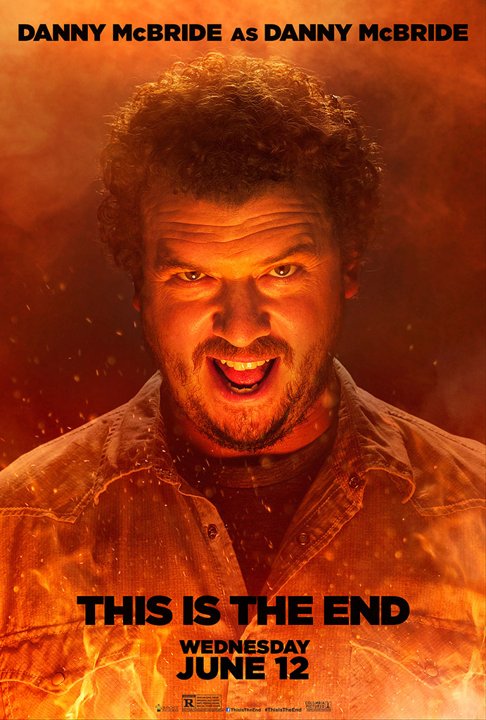
I don't know if Danny McBride is a
borderline sociopath in real life. I
doubt it. But it's his persona, and he
definitely runs with it in this film.

And sure enough, the Tribulation begins: fierily sinkholes open up and swallow celebrities. Eventually, just a few survivors-- Franco, Rogen, Baruchel, Craig Robinson, Jonah Hill and an uninvited Danny McBride-- are holed up in Franco's Beverly Hills mansion, waiting for rescue and slowly coming to face their final destiny.

(How the apocalyptic theme ties into the exhaustion of the bro comedy as a genre is an association best left to future film theorists.)

It's a very funny film, one that obviously skewers everything about these self-based characters and every movie they've ever made (while holed up in the mansion, they make an impromptu sequel to Pineapple Express shot with the video camera from 127 Hours). Interesting character dynamics play out. There are even some spectacular special effects. Go see!

A few notes:

• What makes it good is it's a Judd Apatow universe, or at least one envisioned by his protégés. Apatow himself was not involved--which is just as well, as he's retreated into his own navel (This is 40) and that's not the funniest orifice. Still, it hews to the sub-genere's major themes: bro bonding, recreational drug-taking, movie geekery, and a casual approach to extraordinary, one-percent-level wealth. It also features the crude and unmistakable signature of an Apatow-inspired production: exposed penises.

The flip side of this genre hallmark is also on, um, display: a somewhat fearful and marginal take on women. In fact, the biggest female role belongs to Emma (Harry Potter) Watson-- the main characters have a difficult time not referring to her as "Hermione." She, on the other hand, knows what sort of universe she has wound up in and ends up holding all the other characters off with an axe.

• Seth Rogen and co. know very well what sells tickets and the star power in this film is formidable: Rogen, Jay Baruchel, Jonah Hill and on down the line of Judd Apatow alumni right down to the amusing, bit-player appearance of Paul Rudd, who does nothing more than look terrified and carry an oversized champagne bottle with a bow on it.

• The budget of this film was surprisingly small ($25 million), considering the star power. This is an aspect I especially liked about This Is The End: Seth Rogen and Evan Goldberg (the producer/directors) must have talked everyone in it into working for scale or close to it. most of the money was lavished on production values-- apocalyptic exteriors, impressively destroyed sets, excellent visual effects-- so you see the whole budget on the screen. It also made all it's money back on opening weekend.

• I can also see how audiences could be led to believe that there is some truth to the characters that transcends the screenplay, Eisenstinian typeage at work. There is an undeniable kernel of truth to it, in that Seth Rogen, Jay Baruchel and their ilk tend to play versions of themselves in everything they do anyway. But there is no reason to believe that anything even close to celebrity true life is exposed in This Is The End. We don't know these people, and they would never allow anything close to that reality to be conveyed anyway.

• The real "tell" that This Is The End, "actors-playing-themselves" notwithstanding, is a work of full-on make-believe is buried at the end of the credits: This film was shot entirely in Louisiana, a state that subsidizes film production. It's just another runaway production. It's not James Franco's mansion. it's not even greater Los Angeles that's being impressively destroyed onscreen.

Tuesday, June 11, 2013

Kubrick at LACMA

I managed to rush down to Los Angeles to visit the Stanley Kubrick exhibit at the L.A. County Museum of Art before it closed at the end of the month. It was a bit of a pain to get everything to work out on short notice, but the payoff far outweighed the cost.

The Kubrick exhibit takes up the first floor of the Art of The Americas hall, and is arranged like all good museum retrospectives: chronologically, starting with an overview, a short visit to his earlier works, and on chronologically through his highly singular ouvre to Warsaw Diaries, a project he was just in the early stages of researching when he died.

There are a few situational ironies about this exhibit. Stanley Kubrick only shot one film in California: The Killing (1956), his second feature-- and most of that was filmed in the Bay Area, around the former Bay Meadows racetrack in San Mateo. He scrupulously avoided spending time in Hollywood. Los Angeles put on quite a tribute for an outlander-- but then again, it's all one big business. The money that financed his films flowed for the most part out of studio gates. If he was not one of Hollywood's own, then he is widely considered one.

What I found especially pleasing is how hard the curators strove for authenticity in all the sections: there are very few reproductions, aside from amazingly detailed ones, like the model maze from The Shining or the hanging 10-foot model of Discovery One. But Jack Torrance's typewriter and axes, Private Joker's helmet, Barry Lyndon's costume: all the genuine deal. Someone had reproduced the sexy milk-dispensing mannikins from A Clockwork Orange, which struck me as an odd thing to do.

I was very gratified to see that the part of the exhibit concerning 2001: A Space Odyssey was by far the largest in space and number of artifacts. I had read in Piers Bizony's excellent, definitive book 2001: Filming The Future that Kubrick had deliberately destroyed the sets, props, spaceship models and costumes after wrapping 2001 to keep them from being used in cheesy sci-fi films afterward. (This happened to George Pal's Forbidden Planet (1956): those crazy grey jumpsuits showed up on TV shows well into the 1960s, as did Robbie the Robot). I was amazed even a little of it survived.

We visited LACMA on a Friday: there was a comfortable amount of other visitors there, no real crowding. Therefore, I was able to take as much time as I wanted in the Kubrick exhibit. I circled around and took it all in again.

It was an incredible culmuination for me. It was nothing short of awe-inspiring to be in the presence of the artifacts of Kubrick's works. It allowed me to slip through the gossamer veil of the cinema screen: while you're in there, among the hand-written script notes and props and lenses, you're on Kubrick's side of the camera. You stand with Kubrick, see what he saw and wrote and imagined. A powerful, unforgettable experience.

If you missed this retrospective, feel free to kick yourself.
Outside the exhibit space.


A dark room just inside the entrance. It shows side-by-side clips from his films,
one side overlaid with pithy quotes. This goes a long way to show the
breathtaking span of Kubrick's auteur vision.

This is on the wall just past the main entrance. It makes no sense here.
Makes all kinds of sense once you've gone through the exhibit.

Stuart Freeborn's articulated
Australopithicus makeup.
Part of the 2001 exhibit. The Discovery model is a reproduction: the
Space Station 5 chairs are authentic.


Fairchild-Curtis fisheye lens-- This is HAL's eye, the one they used
in close-ups and as a filming lens for HAL's POV.

They displayed the HAL Lens behind glass, but on both sides. All you have to do
is point your camera up to the back and you could shoot right through it.
This is a picture of me as HAL would have seen it, taken straight through
the Fairchild lens. Just amazing.

An actual production Discovery space helmet. This was Dave Bowman's: He wore it on the first EVA to replace the "faulty"
AE-35 unit, and unfortunately forgot it later on. I stared at this for at least ten minutes: I never, ever thought I'd
see something like this in person.


A detail from a surviving spacesuit costume, one of
the silver ones worn on the Moon. This is the
data pad, and there is supposed to be a number
of buttons on it. They must have fallen out.


There was other stuff there too: Here is Private Joker's helmet from
Full Metal Jacket. His gold wire-frame glasses were on display just
below as well.

All work and no going to LA to see a once-in-a-lifetime
museum retrospective make Jack a dull boy. The actual prop
Adler typewriter from The Shining.

Weekend Box Office.


Thanks to Boxofficemojo.com for the unreadable chart behind me

(Note: as I post this the video is upside down; I am assured this will be corrected. If you're seeing it rightside up and would prefer it upside down, drop us a line! We're flexible here.)

Tuesday, June 4, 2013

Weekend Box Office


Thanks to Box Office Mojo for the numbers and for visual flair.

Wednesday, May 29, 2013

Weekend Box Office


Thanks to Box Office Mojo for the numbers!

HBO: Rich Weird Men Behaving Badly

Michael Douglas IS Liberace. It was the first time
Douglas ever portrayed a non-fictional character
in a movie-- and he nailed it.

I need to share an insight. Mind you, I'm not the first person to have this insight: it builds on an article by Brian Lowery in Variety.

There is something very unusual going in at HBO. The mysterious Powers That Be seem to have a fixation-- one that pokes right through the films and shows they approve, fund and broadcast like broken glass in a paper bag. I'm going to paint the idée fixe these executives seem to be obsessed with a sweeping, and ridiculously simple, comparison of two of their most recent cable films:

• Behind the Candelabra: A Steven Soderbergh HBO film about a wealthy, powerful white man (Liberace) who made life sheer hell for everyone around him.

• Phil Spector: A David Mamet HBO film about a wealthy, powerful white man (Phil Spector) who makes life sheer hell for everyone around him.

Lowry's article expands on this weird parallelism of these films-- wealthy decadent jaded men who channel their desires onto the lesser people in their orbit and force them, again through their power, to suffer for them as well. (BTW: Candelabra was an amazing movie; Phil Spector is talky and dull.) He concludes that HBO execs actually understand and sympathize with the moral universe these men inhabit. Phil Spector may or may not have shot Lana Clarkson; Liberace may or may not have screwed over Scott Thorson in the palimony settlement. It's not much of a stretch to believe cable execs live in the same world as the troubled men portrayed in these movies, a sympathy that may have tweaked the characterizations a bit.

Enoch "Nucky" Thompson
(Steve Buscemi). What he lacks in
brawn he makes up for in menace.

This is a decent read on these films-- but then there's THIS: What I believe is this theme's long, long tail:

• "Game of Thrones:" An HBO series about wealthy, powerful white men (Joffrey Baratheon, Jaime Lannister, Tywin Lannister, etc.) who make life sheer hell for everyone around them.

• "True Blood:" An HBO series about wealthy, powerful white men (Bill Compton, Eric Northman, various vampire royalty) who make life sheer hell for everyone around them.

• "Boardwalk Empire:" An HBO series about a wealthy, powerful white man (Nucky Thompson) who makes life sheer hell for everyone around him.

• "Deadwood:" An HBO series about a wealthy, powerful white man (Al Swearengen) who makes life sheer hell for everyone around him.

• "Curb Your Enthusiasm:" An HBO series about a wealthy, (sort of) powerful white man (Larry David) who makes life sheer hell for everyone around him.

• Game Change: An HBO film about a wealthy, powerful white man (John McCain) who makes life sheer hell for everyone around him--by selecting Sarah Palin as his running mate. I'm not being partisan here: Much of the film focuses on the very real suffering of the staffers charged with getting Palin ready to campaign.

• The Girl: An HBO movie about a wealthy, powerful white man (Alfred Hitchcock) who makes life sheer hell for Tippi Hedren.

All of these shows are the puzzling evidence that points to a simpler explanation of HBO's thing about powerful white guys screwing over their financial and social inferiors. I believe it all started here:

Tony Soprano (James Gandolfini) in his natural
environment: checkered tablecloth, Pellegrini water.
• "The Sopranos:" An HBO series about a wealthy, powerful white man (Anthony Soprano Jr.) who makes life sheer hell for everyone around him.

It is difficult even now to fully illustrate what a profound effect David Chase's epic mob series had on American broadcasting. It redefined HBO from a movie channel to a prestigious destination, appointment television in the days before DVRs and binge-watching. It launched the style of hyper-serial series storytelling that is now the norm on cable and broadcast. "The Sopranos" was also soaked in gore-- bloodletting became an expected dramatic feature, spreading from premium to basic cable and now even to broadcast ("Hannibal" is as bloody a show as I've ever seen, and it's on NBC). It was The Show That Changed Everything.

Most importantly: "The Sopranos" dispensed entirely with a central character viewers could comfortably identify with. Tony Soprano was a cold-blooded mob boss, a man who was defined by his shrink Dr. Melfi as a sociopath. He killed without remorse. He was also affable and he loved those in his circle-- but his actions invariable led to the suffering of those in that circle. It was an absolutely fascinating push-pull with the audience, something David Chase admitted he struggled with: He wanted the audience to love Tony, so he made him charming-- but he made sure this charm was countered by frequent glimpses into his repugnant, immoral soul. Tony Soprano was lovable, chummy, loyal, repellent, unknowable and sick. This push and pull made for irresistible television.
Found this online. Makes my case perfectly.

In short: which executive would NOT want to emulate such success? So as a result we still see David Chase's story and character dynamics all over the airwaves. Tony Soprano's basic character traits can be found in all of the above-outlined shows-- in Dexter Morgan and Walter White and Don Draper as well. Weathy, famous television executives may very well feel sympatico with the wealthy and famous, but their primary concern is attracting eyeballs-- and thus keeping the jobs that made them that way.

Of course HBO does offer a counterbalance to this hegemony of Caucasian Male One Percenters. Most of their miniseries-- from Band of Brothers to John Adams to Mildred Pierce-- do not share these values at all. No, there's not much of a counterbalance to all that privilege, and it may or may not be the right or even fair sort of answer to this trend. It can be embodied thus:

• "Girls:" An HBO series about penniless, struggling white women who make life sheer hell mostly for themselves.

Tuesday, May 21, 2013

Weekend Box Office


Thanks for Box Office Mojo both for the numbers, and the rundown about why Star Trek maybe isn't a huge success after all.