Monday, January 19, 2015
Weekend Box Office Report
Thanks to Box Office Mojo for the numbers, and the El Gringo Laundromat parking lot for local color


Tuesday, January 13, 2015
Inherent Vice: Pynchon 101
 |
| This poster, aside from tweaking Leonardo DaVinci, gives an idea of the many wonderful cameos in Inherent Vice. Martin Short (far right) is particularly funny and strange. |
It's the story of "Doc" Sportello (Joaquin Phoenix) a hippie P.I. who is hired to find a missing girl who also happens to be his ex. thus begins Doc's strange journey through 1970 Los Angeles-- both helped and hindered by Detective "Bigfoot" Bjornsen (Josh Brolin), a flat-topped, hippie-hating, brutal/delusional LA cop who also carries a SAG card (we see him as an extra in "Adam-12," in fact). On the long, winding path of investigation Doc encounters all sorts of odd and historically appropriate types: Nazi bikers, cultists, a Laurel Canyon mansion full of hippies, a hidden cabal of dentists and drugs. Lots and lots and lots of drugs. River Phoenix does an amazing job, in fact, of conveying an amazing range of stoned: mellow high, totally baked, buzzed, flying' and everything in-between.
 |
| "Doc" Sportello (River Phoenix), doing what he does dozens of times in the film. |
This is the first Thomas Pynchon book ever committed to film, and the script was apparently personally approved by Pynchon as well. Thomas Pynchon and Paul Thomas Anderson were made for each other-- their mutual approach to storytelling is spacey and convoluted yet brimming with insight. Inherent Vice perfectly embodies a lot of Pynchon's favorite motifs: Los Angeles, complex whodunits, subtle mysticism and conspiracies by shadowy, powerful organizations. The 2009 book was considered considered "Pynchon Lite," one of his most accessible novels. If this is so, than the movie version is an even better introduction to his distinctive literary style. Pynchon 101.
 |
| Thomas Pynchon, as seen on "The Simpsons." According to Josh Brolin, the reclusive author has a cameo in Inherent Vice. Forget it: we'll never figure it out. |
Inherent Vice is also very funny-- which is sort of unusual. P.T. Anderson doesn't really do funny: There was some situational comedy in Boogie Nights, and Punch Drunk Love was supposed to be funny (it wasn't), but this is the first time he stretches out for some Coen Brothers-style sardonic humor.
Check it out, you'll enjoy it. See it high, and you might enjoy it even more.
Monday, January 12, 2015
Weekend Box Office
Thanks to Box Office Mojo for the figures, thanks to up and coming intern Nassou Camera for... uh, camera work.
Wednesday, January 7, 2015
UNIDENTIFIED FOXY OBJECT
My descent into the desert of 70's televised sci-fi continues. When last I wrote, I had just discovered Canadian apprenticepiece THE STARLOST, isolated onto its own Roku channel to keep it from infecting other shows. I have made it through the whole 16 episodes, a journey as aimless as the voyage of the misbegotten Ark itself. Counted two attempts at spinoff series among them, by the way, both featuring interesting protagonists! A strategy they should have gone for up front, if you ask me.
But a few years before that, the folks pulling the strings behind THUNDERBIRDS and SUPERCAR took the plunge into "live action" with a show called UFO. It's streaming on Hulu and I advise a look. Seriously, look. Just turn down the sound, because it ruins everything.

Straker coordinates the efforts of a base on the Moon, a battle submarine with a detachable flying nose, and a tank and... honestly, who cares? It's just like Thunderbirds only when you aren't looking at great model vehicles you're looking a puppets, only in this case they happen to be actors.
The show took a lot of flack at the time for the expressionless acting style, but I think I'll be generous and just say that they were encouraged to underplay a little.
Anyway, it hardly matters what the people are doing here, because it's uncompelling nonsense. The reason to watch the show is it's a visual assault. The art direction, considering the whole thing only took place ten years later, assumed an awful lot. It assumed computers wouldn't change so very much but military spacewear would.


Anyway, you get the idea - the future was going to be improbably sexy. Oh and the aliens look like us, only greyed.
I only have seen the pilot so far but it looks like fun, if exhausting, viewing. Maybe it gets better, but that's not what I've heard. You read stories about this show but I don't think it played in my area, probably because it was hard to convince American TV buyers to field the angry letters about men's nipples.
Eventually Gerry and Sylvia Anderson, producers, calmed down a little and brought us Space: 1999, which assumed we'd have a little functioning city on the Moon by the end of the century. Wrong again you guys! I don't even have a Supercar yet! The Andersons have a lot to answer for.
Monday, January 5, 2015
Wednesday, December 31, 2014
Hobbit 3: Peter Jackson's Freestyle Round
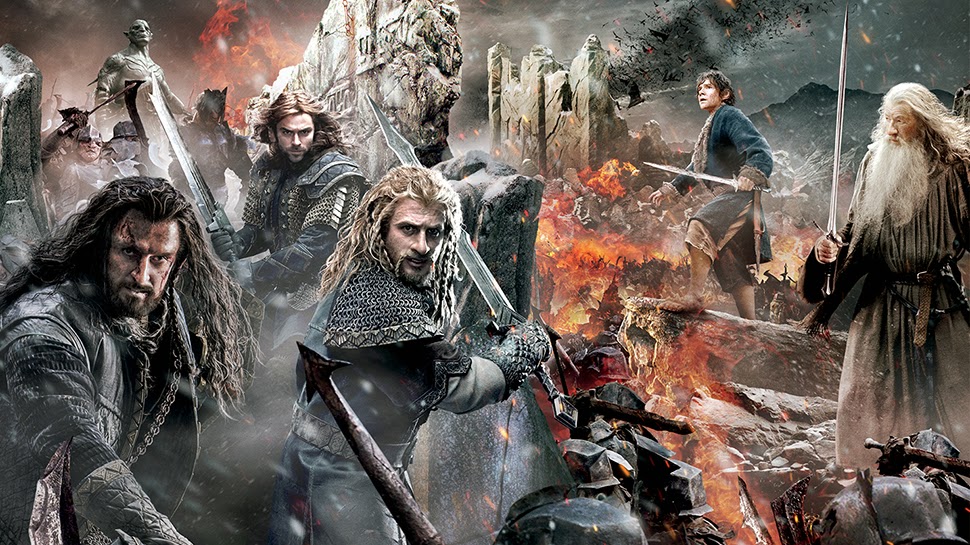 |
| Just a sample of the non-stop, overlapping action that is most of Battle of the Five Armies. |
Peter Jackson is much like a big kid with a huge Middle-Earth action play set. having dispensed for the most part with the events of the original novel in the first two movies, he gets to stretch out on the final battle scenes with greatly extended action sequences. His sense of cinematic place and direction is a good as ever, though, and the thousands of little CG soldiers on the screen never lose a sense of coherent action. And the ending is quite satisfying and presented without having to resort to the 6 endings of the last Lord of the Rings movie-- just one tidy ending, thank you.
Then again, the action on-screen versus the content of the original novel created a strange narrative situation where Bilbo Baggins (Martin Freeman) the titular hero of the film, disappears from the narrative for long stretches of time. I'm reminded of the third Matrix movie, where Neo disappears for most of a movie in which he is the putative savior.
Point-to-point:
• I only counted four armies. My issue probably lies with Tolkien, not Jackson.
 |
| Tauriel, cute as an elf. |
We also get something sorely needed in big action franchises like this: a love story. Sure, Tauriel the silvan elf may have been invented to prevent it from being the sausage fest of the original book, but it's welcome. She falls for Kili the dwarf, fully two heads shorter than her, but their love-at-first-sight relationship carries resonance-- and this is a welcome break from the general tones of madness, hate and manly stoicism embodied by everybody else in the film.
A lot of this has to do with Evangeline Lily. She was the best thing about "Lost:" a soulful, loving yet complex and hermetic character in a cast of caricatures and cyphers. Lilly is a remarkably expressive actor and the only shame is she hasn't been in more movies. Tauriel gets to show love and loss and longing in a keener and more immediate way than anyone else in the entire trilogy. It's either a complement to Peter Jackson's skills as storyteller-- or an anodyne, in that he cannot conceive of anyone capable of having softer emotional connections than a-- shudder-- female character.
• You can tell the various races of creatures in this film-- in all the Rings and Hobbit films-- by how they appear after a little wear and tear. Hobbits (Bilbo at least) and Wizards get completely filthy: in fact, the wizard Radegast the Brown has shown up in all three Hobbit movies with a wad of dried bird shit stuck to his head. Humans and Dwarves are sort of grungy all the time, never too clean or too dirty. Elves-- the overachievers of Middle Earth-- never have a hair out of place or a smudge on their clothes. Orcs are similarly neat, all things considered: the lead Orcs wear little bits of armor and show a lot of skin, and would not look out of place in a Pride parade.
• The HFR process: Much improved of the first Hobbit movie. It might be the outdoorsy settings overall, but the scenes seem brighter and more colorful than the dark, washed-out first installment. The 3D was remarkably restrained and natural-looking: There were only a few gimmicky shots of falling stones and billowing flame and whatnot. Whatever Peter Jackson's tech folks needed to do to get the look of 48-frame-per-second to not look like video gloss, they did it.
Peter Jackson, Tolkien: It's been a hell of a ride. The first film series raised the bar for fantasy films forever. The last three, while somewhat under-stuffed and not quite as novel as the first three, are still deserving of all the success they have reaped. If this is Jackson's victory round, he can and should be allowed to freestyle a bit.
Tuesday, December 30, 2014
Weekend Box Office Report
The color drained out, to express the bleakness of the winter season. Thanks and Kudos to BoxofficeMojo.com!
Subscribe to:
Posts (Atom)